


Key takeaways
- A study published in Nature on October 14, 2026 found that microplastics are not chemically inert: in water, their surfaces spontaneously generate highly reactive molecules called radicals.
- The most water-repelling plastics — polyethylene and polypropylene — were the most reactive, and breaking into smaller pieces multiplies the reactive surface.
- This is a laboratory mechanism, not proof of harm in the body: whether the same chemistry happens in human blood is still unknown, and blood lipids may dampen the reaction.
- Separately, plastic particles have been found in human blood, lungs, and artery plaque; a 2024 New England Journal of Medicine study linked plastics in carotid plaque to about 4.5 times the cardiovascular risk — an association, not proof of cause.
- The new chemistry gives researchers their first plausible mechanism connecting the particles now found everywhere to the cellular damage linked to them — and a target for designing safer plastics.
Microplastics are everywhere: in ocean water, in drinking water, in laundry lint — and inside the human body. This week, a study in the journal Nature gave the field something it has been missing: a chemical mechanism. Researchers at Columbia University and UC Berkeley report that microplastics sitting in water are not the inert fragments everyone assumed — their surfaces can spontaneously generate highly reactive molecules, the kind of chemistry that can damage cells.
The finding does not prove that microplastics are making people sick. What it does is replace a mystery with a mechanism — and, for the first time, give scientists a concrete chemical target in the effort to understand, and eventually reduce, any harm these particles cause.
Microplastics are not as inert as we thought
For decades, the working assumption was simple: commodity plastics sit in water and stay chemically quiet. They break down slowly under sunlight or chemicals, but the polymer surface itself was considered passive. That is a large part of why plastics were trusted for food packaging, water bottles, and children’s toys.
The new study, led by Wei Min, a professor of chemistry and biomedical engineering at Columbia, with Teresa Head-Gordon of UC Berkeley, puts a crack in that assumption. In one elegant experiment, the team stirred polystyrene powder into water next to a drop of methyl orange, a light-yellow laboratory dye. Over ten days, the solution bled nearly colorless — losing almost 90 percent of the dye’s original hue. Run the same test in methanol, ethanol, or other solvents, and nothing comparable happened. Water was the missing ingredient.
The proposed chemistry works like this: at the boundary where a water-repelling plastic meets water, hydroxide ions crowded into the water layers nearest the surface can lose an electron, becoming hydroxide radicals — reactive oxygen species, the textbook examples of molecules that can damage tissue. Head-Gordon’s group supplied the theoretical backbone for this picture.
Two details make the finding more consequential. First, fragmentation amplifies it: as a large piece of plastic shatters into micro- and nanoparticles, its surface area balloons relative to its volume, exposing vastly more reactive surface. Second, not all plastics are equal — the most hydrophobic (water-repelling) plastics tested, such as polyethylene and polypropylene, showed the strongest radical-generating activity, while more water-friendly plastics like PET were quieter. There is a trade-off lurking here: the least reactive plastics may also be the ones that break down slowest in the environment.

In water, microplastic surfaces can spontaneously generate reactive radicals – the chemistry a new Nature study identified as a possible route to cellular damage. Image generated by AI.
What the health evidence actually shows
The mechanism is new; the worry is not. Microplastic fragments have been detected across ecosystems and inside human tissues, including blood — which is mostly water, the very setting of the new chemistry. The human evidence so far is observational, but it has been accumulating:
In March 2024, a team led by Raffaele Marfella of the University of Campania in Naples reported in the New England Journal of Medicine that micro- and nanoplastics were detectable in the surgically removed carotid-artery plaque of about 60 percent of 304 patients. Over an average of 34 months of follow-up, patients with plastics in their plaque faced about 4.5 times the risk of heart attack, stroke, or death from any cause. The authors stressed that the study does not prove causality — but it was the first direct evidence that plastic particles themselves, not just chemical additives, are associated with human cardiovascular harm.
This month added two more data points. On October 12, University of Hawaiʻi researchers reported that 89 U.S. coastal counties with higher marine microplastic pollution tended to have higher rates of several cancers — digestive, thyroid, prostate, lung, and oral and throat cancers — across 54 million people between 2013 and 2021. It is an ecological study, and the lead author called the findings “preliminary evidence” requiring further investigation. And in a mouse study published in Science Advances earlier this year, Texas A&M researchers found that polyethylene particles in drinking water produced early markers of fatty liver disease over eight weeks — worse when combined with a Western-style diet — and mapped the damage to specific liver pathways.
None of these studies proves that microplastics cause disease in people. Taken together, though, they sketch a pattern: particles get in, inflammation and cellular stress follow, and outcomes look worse where exposure is higher.
Reasons to stay calm
The honest caveats matter as much as the findings. The Nature experiments happened in laboratory glassware, not in a living body — whether the same radical chemistry occurs in human blood is simply not known yet. The researchers identified the radicals but did not test what they do to living tissue, so any health impact remains, for now, speculative.
There is also a built-in dampener. Matthew Campen, a toxicologist who was not involved in the study, noted to New Scientist that in the body, microplastics would quickly be coated by surfactant lipids — “microplastics hit your lung and they are surrounded by surfactants immediately” — and in the lab, adding a surfactant dialed radical generation down. His advice to the public: “take a deep breath.”
Dose matters too. The radical chemistry is most concerning where particle concentrations are highest — discharges from plastic manufacturers, laundromats, and other industrial sources — rather than necessarily at the trace levels in a glass of tap water. And the everyday routes by which particles form are mundane: sunlight beating down on bottled water in storage, microwave heating, fibers shed in the wash.
Why it matters
Until this week, the debate about microplastics had a missing middle: particles were found in tissues, and worse outcomes were observed where particles were found, but the bridge between a polymer surface and cellular injury was largely speculative. The new study proposes that bridge, at least in a test tube — a conceptual shift from microplastics as mere physical irritants, or passive taxis for attached pollutants, to chemically active participants in their environment.
That shift also points at solutions. If the most water-repelling plastics drive the reactivity, then redesigning the surface chemistry of commodity plastics could reduce the toxic outcomes at the source — “rather than attempting to scrub particles from water supplies after the fact,” as the researchers put it. It reframes plastic formulation as a question of interfacial chemistry, not just bulk material properties.
There is a long way from a dye bleaching in a vial to a public-health verdict. But for a field that has been long on alarming detections and short on mechanisms, a mechanism is exactly what was needed. The next experiments — testing whether the chemistry happens in blood, at real-world doses, in living tissue — are already the obvious ones to run.
Related reading: Saving the Seas: What Works (and Why it Matters) — what actually reduces ocean pollution, from protected areas to plastic cleanups.
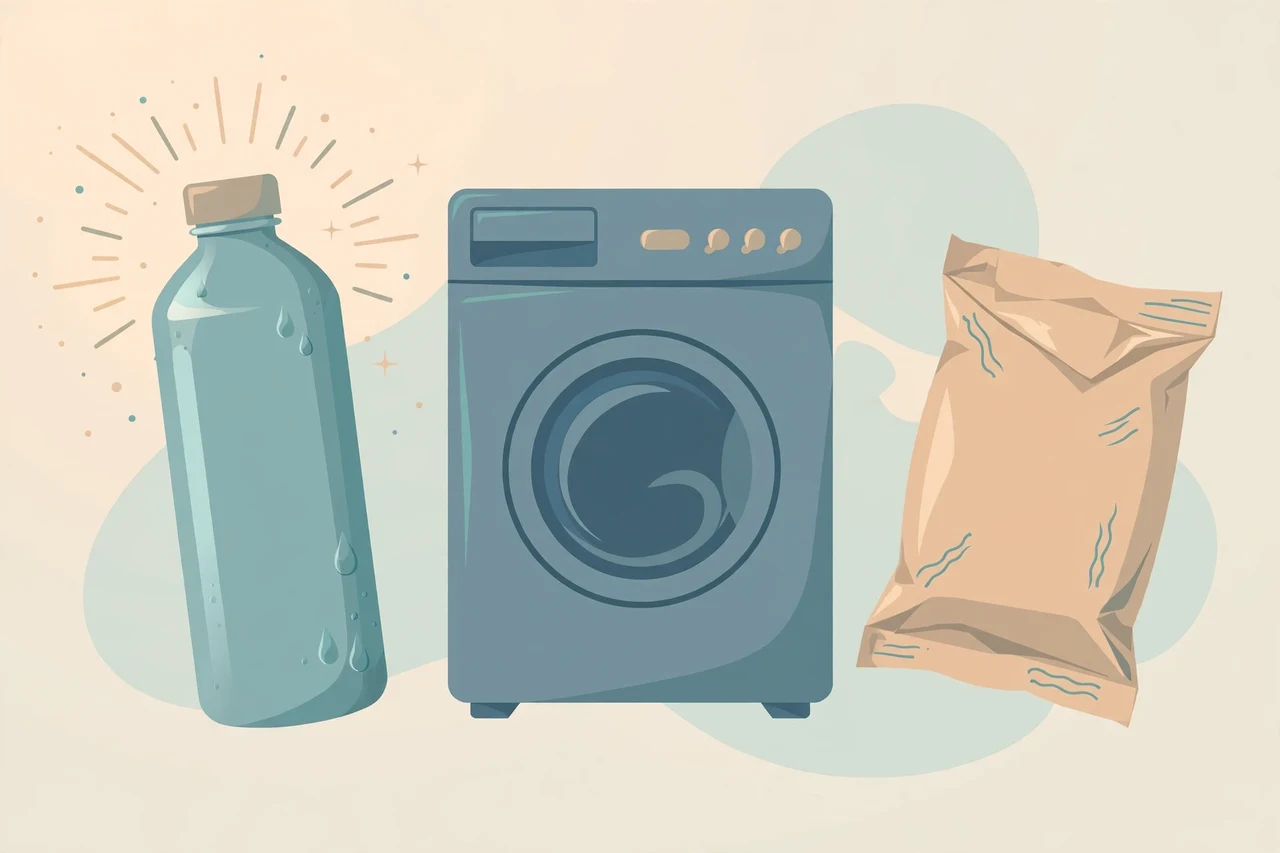
Everyday sources of microplastics: sunlit bottled water, laundry, and food packaging. Image generated by AI.
Frequently asked questions
Are microplastics in my blood?
They have been detected in human blood and in various tissues, including lungs and arterial plaque. What those detections mean for health is still being worked out — presence alone is not proof of harm.
Should I stop drinking bottled water?
No single avoidance step has been proven to protect health. What is known is that heat and sunlight increase particle shedding — storing bottles cool and out of the sun is reasonable, though the health benefit is indirect rather than demonstrated.
Can microplastics be removed from the body?
There is no proven method. Research is still establishing how particles move through and out of tissues. For now, the scientific focus is shifting toward making plastics themselves less reactive, rather than extracting particles after exposure.
Does this study prove plastic causes disease?
No. It demonstrates a plausible chemical mechanism in the lab. The human studies to date show associations — particles present where outcomes are worse — which is suggestive but not causal proof. The mechanism makes the associations harder to dismiss and easier to test.
Sources
- Qian N, Zhao R, Chan KY, et al., “Intrinsic physicochemical activity at microplastic–water interfaces”, Nature 658:650–657 (2026). Full text (DOI: 10.1038/s41586-026-11141-y)
- Columbia Climate School, “Microplastics Are Chemically Active, and Could Cause Biological Harm” (October 14, 2026). Press release
- New Scientist, “Microplastics may produce harmful molecules if they enter our blood” (October 14, 2026) — includes the surfactant caveat. Article
- University of Hawaiʻi, “UH research links marine microplastics to cancer rates” (October 12, 2026). UH News
- Marfella R, et al., “Microplastics and Nanoplastics in Atheromas and Cardiovascular Events”, New England Journal of Medicine (March 7, 2024). DOI: 10.1056/NEJMoa2309822
- Jung W, et al., “Spatial transcriptome mapping identifies Ppara-Anxa2 cross-talk in microplastic-induced hepatotoxicity”, Science Advances 12(25) (June 2026). DOI: 10.1126/sciadv.aec8681
- Phys.org, “Microplastics are chemically active and could cause biological harm” (October 14, 2026). Article








0 Comments