

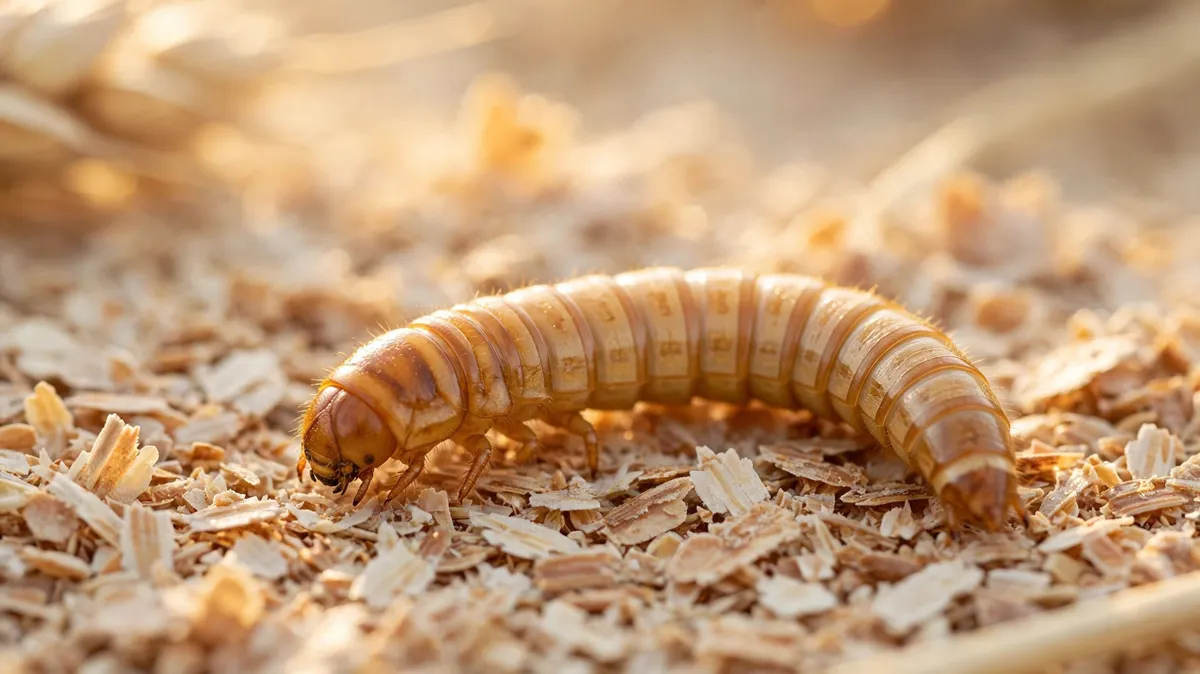
Originally published by Cinzia Chiandetti, Andrea Dissegna and Massimo Turatto in Frontiers for Young Minds on October 19, 2026, under a Creative Commons Attribution licence. Adapted here under that licence: rewritten for a general audience, with new structure, new explanations and a new ending. Frontiers for Young Minds and the authors do not endorse TeaLamp. Prepared by the TeaLamp Editorial Team with the help of AI.
Can mealworms change their minds? A small experiment with the larvae of a common beetle suggests the answer may be yes, in a limited but real sense. The larvae learned where to find food, then changed course when that food stopped being worth eating. That is not the same as human thinking, but it is more flexible than a simple reflex, and it raises fresh questions about the minds of very small animals.
Key takeaways on mealworms change their minds
- Mealworm larvae learned to find apple in one branch of a Y-shaped maze, then avoided that branch after the apple was made bitter elsewhere.
- A control group that tasted bitterness on a different food kept visiting the apple branch, showing the change was specific, not general confusion.
- The test was adapted from a classic rat experiment on goal-directed behaviour, where an animal changes its actions when a reward loses its value.
- The findings do not show that mealworms feel emotions or think like people, but they add to evidence that small invertebrates can act flexibly.
- Because mealworms are farmed as a sustainable protein, the results also feed into questions about how insects raised for food should be treated.
What it means to act on purpose
Psychologists draw a line between habits and goal-directed behaviour. A habit runs on autopilot: the same trigger produces the same response, whether or not the outcome is still wanted. Goal-directed behaviour is different. It depends on two pieces of knowledge: that an action leads to a result, and that the result is still worth having. When the result stops being attractive, the behaviour changes.
The Frontiers for Young Minds article explains this with two friends and a strawberry sweet. One friend keeps eating the sweet even after it turns bitter. The other stops, because he has learned that the sweet is no longer worth eating. Only the second friend is acting in a goal-directed way. The question the researchers asked was whether a mealworm larva, an animal with a tiny brain and no backbone, could pass a version of the same test.
Meet the mealworm
Mealworms are the larvae of the darkling beetle Tenebrio molitor. They are easy to raise in containers of grain, such as wheat bran, with pieces of fruit or vegetable for water. They are familiar as pet food and fish food, and they are increasingly discussed as food for people, because they are rich in protein and cheap to farm. They are also used in biological and medical research.
Earlier work had already hinted that these insects are not simple automata. Male mealworm beetles have been shown to adjust their behaviour according to how many rivals are nearby, a kind of quantity judgement. Larvae, meanwhile, can learn and remember, and what they learn early in life can still shape their behaviour after they become adult beetles. The new study, first published in Scientific Reports in 2024, asked whether larvae could also change a learned choice when the reward behind it changed.
The maze test, in three phases
The researchers adapted the outcome-devaluation test, a classic experiment first used with rats. In the rat version, the animal learns to press a lever for tasty food, then tastes the same food made sickening while the lever is out of reach. When the lever returns, rats that remember both lessons avoid pressing it. The mealworm version used a Y-shaped maze instead of a lever.
In the training phase, each larva was placed in the maze five times and learned that apple waited in one branch, the target branch. In the devaluation phase, outside the maze, half the larvae tasted apple made bitter with lemon juice, while the other half tasted a different food made bitter. The point of the second group was control: both groups had a nasty taste experience, but only one group had it with the food they had been seeking.
In the test phase, the larvae returned to the maze five times, this time with no food in either branch. Removing the food mattered, because it meant the larvae were choosing from memory alone, not following a smell. The researchers recorded which branch each larva visited.

A Y-shaped maze like the one used in the mealworm experiment. Image generated by AI.
What the larvae did
The experimental group, the larvae that had tasted bitter apple, avoided the target branch. The control group, which had tasted bitterness only on a different food, kept visiting the apple branch, as before. By the end of the test phase, visits to the target branch faded in both groups, which is expected when no food ever appears. The key difference was at the start: only the larvae whose own reward had turned bitter changed their minds right away.
That pattern is what goal-directed behaviour looks like in miniature. The larvae behaved as if they knew two things at once: that the branch used to lead to apple, and that apple was no longer pleasant. Put together, those two pieces of knowledge pointed to a new decision, and the larvae acted on it.
Why it matters beyond the maze
Animals constantly face trade-offs. A bird must decide whether to feed in an open field, where food is plentiful but danger is near, or to stay safe and hungry. Flexible decision-making helps an animal weigh one need against another instead of following a fixed script. Finding that capacity in a beetle larva suggests that this kind of flexibility is more widespread in the animal kingdom than once assumed.
The result also lands in a practical debate. Mealworms are promoted as a sustainable protein that could help feed a growing world, and they are farmed in large numbers. If larvae show signs of complex mental life, questions follow about how they are raised, handled and killed, and about what rules, if any, should cover insects in research and farming. In Europe, the article notes, specific laws on animal experiments currently protect vertebrates and cephalopods, such as octopuses and squids, but not insects.
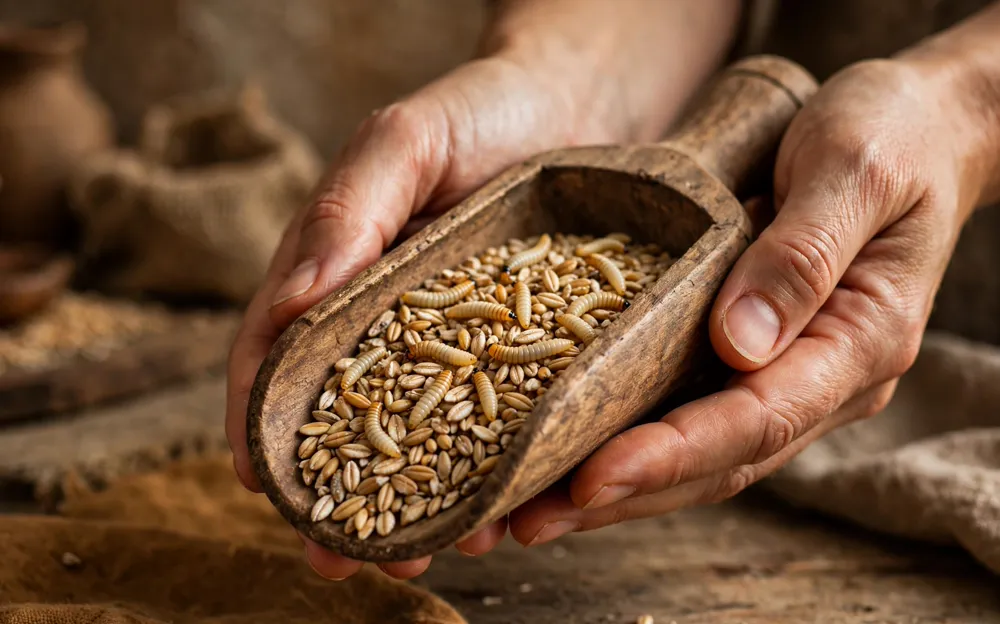
Mealworms in grain, the larvae farmed as a sustainable protein source. Image generated by AI.
What this does not prove
The authors are careful about the limits of their work, and readers should be too. Showing goal-directed behaviour is not the same as showing that mealworms experience feelings, suffer in a human sense, or think about the future. The study tested one kind of choice, about food, in one species, in a laboratory maze. It does not say that mealworms deserve the same treatment as other animals, only that small invertebrates can display more flexible behaviour than their reputation suggests.
It also leaves open questions the authors name themselves. Can mealworms make similar choices about things other than food? How long does the memory of a changed reward last? Do other insects show the same ability, and can larvae choose between competing needs, such as food and safety? Each answer, as the article puts it, is likely to raise more questions, which is how science usually works.
Related reading
For another story about a small animal with an unexpected biology, read Food and Stress: How Eating Well Can Lower Stress Levels, which looks at how food and the body interact in a very different way.
Frequently asked questions
Do mealworms think like humans?
No. The study shows one flexible behaviour, changing a learned food choice when the food turns bitter. That is a long way from human reasoning, language or self-awareness, and the authors do not claim otherwise.
Are mealworms safe to eat?
Mealworms are farmed as food in some countries and are rich in protein, but food rules vary by place, and anyone with a shellfish or dust-mite allergy should check local guidance, since related allergies can cross over. This article is about the behaviour study, not dietary advice.
Will insects get legal protection now?
Not on the basis of one study. The authors say their findings may inform future discussions about research and farming practices, but they do not call for mealworms to receive special treatment over other insects.
Sources
- Can An Insect Larva Change Its Mind? Frontiers for Young Minds, by Cinzia Chiandetti, Andrea Dissegna and Massimo Turatto, published October 19, 2026.
- Goal-directed behavior in Tenebrio molitor larvae, Dissegna, Turatto and Chiandetti, Scientific Reports, 2024.
- Using Frontiers for Young Minds Articles in Your Classroom, Frontiers, confirming all Frontiers for Young Minds articles use a Creative Commons CC-BY licence.








0 Comments