

Originally published by Susann Rossbach, Felix Ivo Rossbach, Cecilia Martin and Carlos M. Duarte in Frontiers for Young Minds on June 26, 2026, under a Creative Commons licence (CC BY) (“Copyright © 2026 Rossbach, Rossbach, Martin and Duarte. This is an open-access article distributed under the terms of the Creative Commons Attribution License (CC BY)”). Republished here under that licence. Frontiers and the authors are not contributors to TeaLamp and do not endorse it or its use of their work. The article is about saving the seas and what has worked so far. The authors state that the images in the article were created with generative AI (ChatGPT). Changes: formatting; conflict-of-interest and AI-tool statements and download links omitted (see the original); the authors’ AI-created figures reused with captions saying so; a short “Key takeaways” section added by TeaLamp. Prepared for TeaLamp by the TeaLamp Editorial Team with the help of AI.
The ocean is full of life, but it is also in trouble. From plastic pollution to disappearing coral reefs, many things have harmed the ocean and its inhabitants over the last centuries. But is there still hope? Yes! Around the world—from local towns and villages to scientists and politicians—people are working hard to help the ocean heal. We looked at more than 200 happy-ending stories from all around the globe, where things got better for many different species. For example, in some areas, there are now more animals and plants living in the ocean than there were in years past, or species that had completely disappeared from a region “returned home” as the waters became cleaner. These success stories show that there is hope for the ocean to bounce back—with a little help from all of us.
A Big Ocean Faces Big Problems
Earth’s oceans are enormous! They cover most of the planet (71%) and are home to all sorts of amazing creatures, such as whales, sharks, sea turtles, coral reefs, seagrass meadows, and many more. Oceans also help people by providing food to eat, and they keep Earth’s temperature just right. They even hide amazing discoveries, like new medicines and creatures that scientists are still learning about. In fact, scientists estimate that only 20% of the oceans have been explored so far. Many people around the world also earn their livings from the ocean and its resources.
But in many places, the ocean is hurting. Some animals have almost disappeared because too many of them were caught over the years; coral reefs are suffering from high water temperatures; and there is so much pollution and plastic floating around that some fish think it is food. You might have seen pictures or videos about this, and it can feel sad and maybe even a bit scary. So, is there anything we can do to make things better?
The good news is yes, we can, and there are already many great ideas out there! Scientists, governments, and local communities have created laws, set up rules for fishing, and made special ocean zones where nature is kept safe from the influence of humans. These areas are called marine protected areas (MPAs). On paper, MPAs sound like strong plans. But sadly, many of them do not work as well as they should [1]. Often, it is because not everyone follows the plan. Imagine a football team: the coach has made a great strategy, and the players are all really talented. But if one player is always late, another refuses to pass the ball, and a third does not like the coach and ignores the game plan, then the team is likely to lose. Even with great players and a good coach, the team will not win unless they work together. That is a bit like ocean protection. Even the best ideas will not work unless the people involved support each other, play by the rules, and care about the result.
So instead of just looking at what went wrong, we asked: “What about the times when people DID work together, and the ocean got better?” We believe that understanding what helps the ocean heal in one place, or with one species, can help us find meaningful ways to heal the ocean in other places, too.
Looking for Good News
To find out what works, we literally looked every where. Our team collected 217 real-life marine conservation successful stories from around the world over the last 50 years—each one showing how things got better over time. We looked at places like the freezing cold waters of the Arctic and Antarctic, the tropical seas in Asia or the Caribbean, and even the deep sea. Some stories were about single groups of animals, like whales, turtles, and fish (Figure 1). Others were about entire ecosystems and underwater habitats, like coral reefs, kelp forests, mangroves, or seagrass meadows. We also looked into the different types of pressures these animals and habitats must live under, like too much fishing, pollution, warming waters, or damage from boats and anchors.
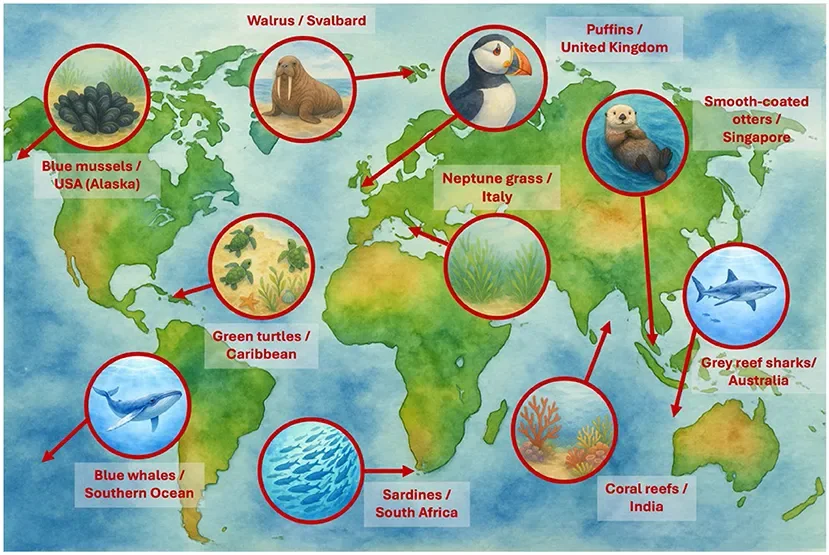
Figure 1 – A map of hope: examples of places around the world where the ocean got better. Image generated by AI.
We also looked at the actors in these stories and asked: “What kind of help was given? Were scientists involved? What about fishers, local communities, or government leaders? Were kids helping, too?” We wanted to know WHO made a difference. And in each story, we also looked at the bigger picture: What kind of place was it—rich or poor? Did many people live close by, or was the area remote? Were these areas and species already protected by law and, if they were, who made sure the laws were followed—the government or local communities? Was the solution expensive or simple? All these questions helped us learn which ideas might work in many places, not just one.
The Ocean is Strong (But Needs Our Help)
We discovered that the ocean got better in lots of places, and we found successful stories from every corner of the world. Some were from areas close to busy cities, others in regions with very few people living close by. In some places, big changes came from new laws. In others, small actions by just a few people made a big difference. We also saw that protecting or improving one element sometimes helped many others within the same ecosystem, like when planting eelgrass helped fish and crabs and even improved the water quality!
In almost every story (four out of five cases), people made these changes happen. And it was not just scientists or governments leading the way. Change also came from local communities choosing to fish less or differently, people helping clean beaches, farmers reducing discharge of harmful substances in rivers that flow to the sea, divers planting corals or seagrass, and international groups banning harmful chemicals. So, the message is clear: when lots of different people work together, real change can happen.
Here are two of our favorite examples from different parts of the world.
Success Story 1: Planting Eelgrass in Virginia, USA
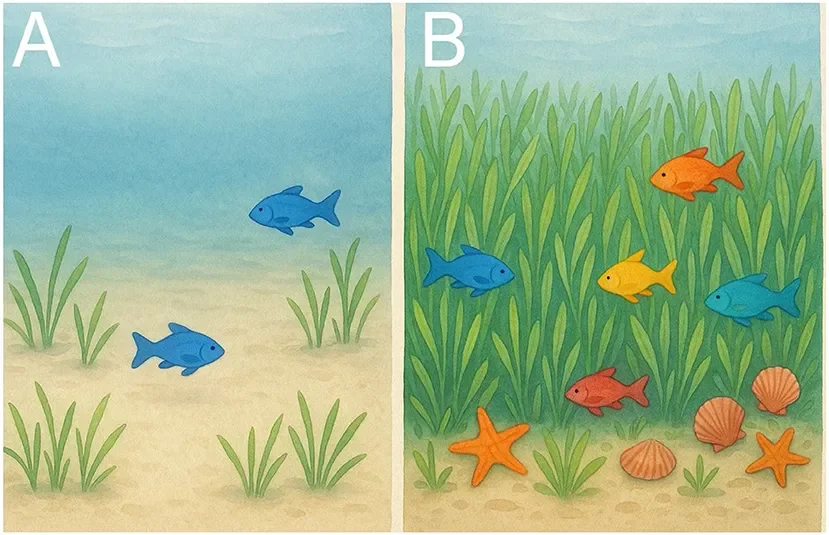
Figure 2 – When the eelgrass comes back, so does ocean life. Image generated by AI.
Eelgrass is a special kind of underwater plant that grows in shallow parts of the ocean. It provides a home for fish, helps clean the water, and captures carbon dioxide. But in Virginia (USA) eelgrass beds had almost disappeared. Fortunately, over many years, scientists, students, and volunteers teamed up to bring them back. They collected tiny eelgrass seeds and carefully planted them underwater—all by hand! After a few years, the eelgrass started growing again on its own, and now there are over 3,600 hectares (imagine more than 5.000 football fields!) of healthy eelgrass meadows and even animals like starfish and shellfish are returning (Figure 2) [2]. All of this improved the water quality over time, so now many other species benefit from this positive change, too!
Success Story 2: The Ban That Cleaned the Sea
Ships used to be painted with a chemical called tributyltin (TBT) to keep barnacles and other animals from sticking to their hulls. But TBT also poisoned ocean life, harming fish, snails, and other species. For example, TBT caused some sea snails to grow in strange ways that made it hard or even impossible for them to survive or have babies. When scientists discovered how dangerous TBT was (even in tiny amounts), countries around the world came together and banned its use. The result? In many places, sea life recovered quickly! Snail shells got stronger again and fish returned to coastal waters. One simple law made a big difference [3]!
What These Stories Tell Us
These are real stories, and they all have something in common. First, they show that the ocean is strong. When given the chance, nature often knows how to heal itself. Second, they show that people can be part of the solution, not just part of the problem! Whether it is a fisher agreeing to fish more carefully, a scientist studying how to save corals, or a group of ocean lovers planting seagrass, change happens when people care and work together (Figure 3). Third, these stories show that we already have many of the tools we need. The challenge is using them more often, and in more places.
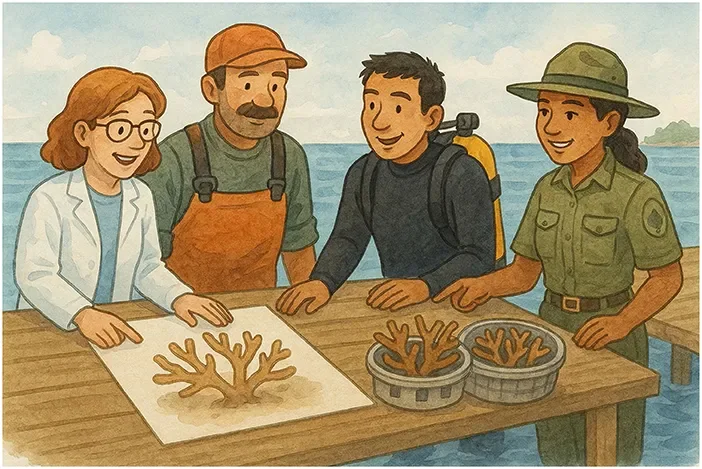
Figure 3 – Working together to restore coral reefs. Image generated by AI.
What You Can Do
You might be thinking, “But I am just a kid, can I really help the ocean”? The answer is a big, splashy YES! Even small actions can make a big difference, especially when lots of people do them together. You do not need to be a scientist or a grown-up with special tools. In fact, many success stories from around the world began with ordinary people who care about the ocean and decide to do something!
Here are some ways you can help the ocean, even if you do not live near one:
- Pick up trash. Litter can be transported to the ocean from hundreds if not thousands of miles away, through rivers or winds. Picking up litter everywhere—whether it is near a beach, a river, your neighborhood park, or even on top of a mountain—does help the ocean!
- Support ocean-friendly choices. Ask questions like: “Where did this fish on the menu come from?” or “Was it caught in a way that does not hurt the ocean?” Making smart choices at the store or at a restaurant helps protect marine life.
- Use less plastic. Try to use reusable bottles and bags. Every time you skip a plastic bag or say no to extra packaging, you are helping keep plastic out of the sea.
- Talk about it. Tell your friends, family, and teachers what you have learned. The more people know about ocean problems (and ocean hope!), the more helpers the ocean will have.
- Write or draw. You can write a letter, draw a picture, or even make a poster about ocean health. Share it with your school or community—you might inspire others!
You can also share these ideas with your friends and family so they too can join you in these positive actions. Our research shows that people are most effective when they do this together. Remember—the ocean does not need one perfect person. It needs millions of people doing their best, including kids like you. And maybe one day, you will be part of a success story we write about, too.
Glossary
Marine Protected Areas: Special parts of the ocean where activities like fishing or building are not allowed, to let nature rest and recover.
Species: A group of living things that are so similar to each other that they can have babies together, and those babies can grow and have babies, too.
Conservation: Helping nature stay healthy. Ocean conservation involves taking care of marine animals, plants, and places like coral reefs or seagrass meadows, or protecting areas from human damage.
Ecosystem: A place where living things, like animals and plants, and non-living things, like water and soil, all work together and depend on each other—like a forest, a pond, or a coral reef.
Tributyltin: A toxic chemical that was once used in paint on ships to keep sea creatures like barnacles and algae from sticking to the ship bottom.
References
[1] Edgar, G. J., Stuart-Smith, R. D., Willis, T. J., Kininmonth, S., Baker, S. C., Banks, S., et al. 2014. Global conservation outcomes depend on marine protected areas with five key features. Nature 506:216–20. doi: 10.1038/nature13022 [2] Orth, R. J., Lefcheck, J. S., McGlathery, K. S., Aoki, L., Luckenbach, M. W., Moore, K. A., et al. 2020. Restoration of seagrass habitat leads to rapid recovery of coastal ecosystem services. Sci. Adv. 6:eabc6434. doi: 10.1126/sciadv.abc6434 [3] Wilson, J. G., Minchin, D., McHugh, B., McGovern, E., Tanner, C. J., and Giltrap, M. 2015. Declines in TBT contamination in Irish coastal waters 1987-2011, using the dogwhelk (Nucella lapillus) as a biological indicator. Mar. Pollut. Bull. 100:289–96. doi: 10.1016/j.marpolbul.2015.08.038Key takeaways on saving the seas
- The team gathered 217 real-life marine conservation success stories from around the world over the last 50 years.
- In almost every story (four out of five cases), people made the change happen, including local communities and fishers as well as scientists and governments.
- Examples include replanting eelgrass in Virginia, USA, and the ban on a toxic ship-hull paint called tributyltin (TBT).
- Young readers can help by picking up trash, using less plastic, choosing ocean-friendly food and talking about what they learn.










0 Comments