

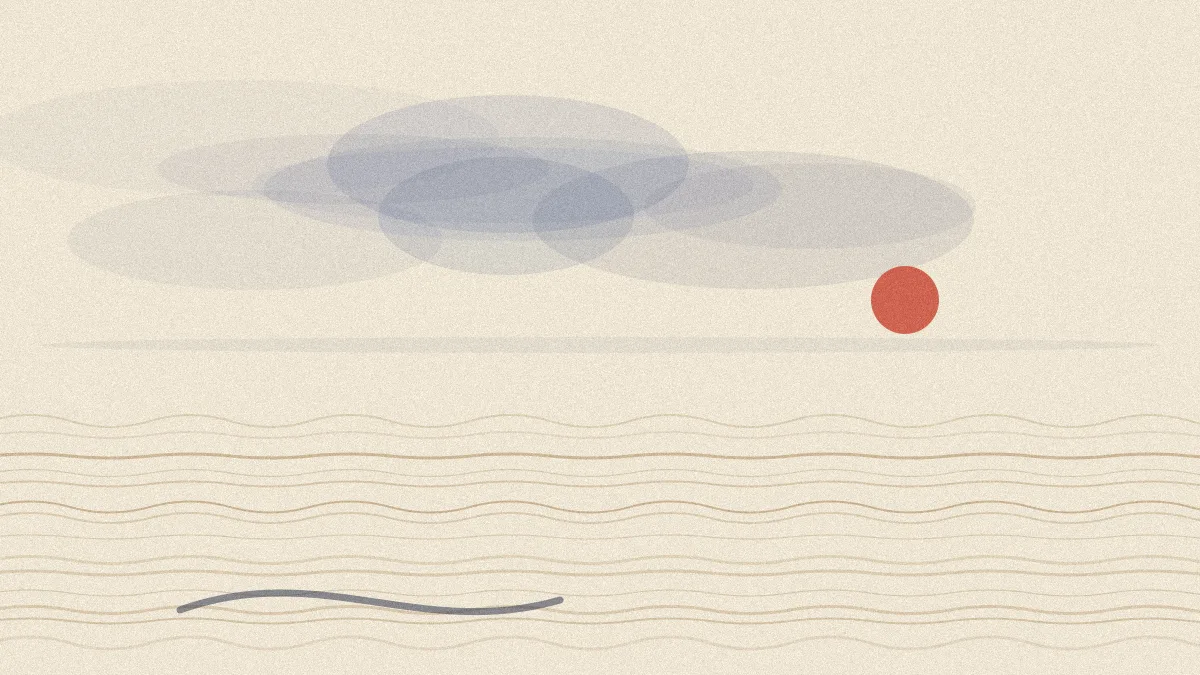
Originally published by Omid Memarian in Global Voices on September 19, 2026, under a Creative Commons Attribution 3.0 licence (see the Global Voices attribution policy). Adapted here under that licence: the interview was condensed, the answers summarised with short direct quotations, headings were rewritten and TeaLamp key takeaways, context and FAQ were added. The artist’s photographs from the original post were not reused. Global Voices and the interviewees do not endorse TeaLamp. Prepared by the TeaLamp Editorial Team with the help of AI.
Every Jaume Amigó painting begins with something seen outdoors — a rice paddy, a cloud, the marks a tide leaves on Moroccan sand — and ends, often months later, as a few essential forms on paper or canvas. In a conversation with Global Voices contributor Omid Memarian, the Catalan artist explains why he thinks quiet, contemplative work can be a way of taking a stand.
Key takeaways from the Jaume Amigó painting interview
- Amigó paints from memory: what survives the passage of time is what reaches the canvas.
- Deciding what to leave out is, he says, mostly intuition — and the hardest decision is knowing when a work is finished.
- Three decades of travel in Japan, plus long stays in Morocco, taught him “to say more with less.”
- Matsuo Bashō’s travel diary The Narrow Road to the Interior shaped his use of emptiness and restrained colour.
- In a world flooded with brutal images, he sees silence, beauty and contemplation as their own form of resistance.
Who is Jaume Amigó?
Amigó was born in Barcelona in 1963 and trained in engraving and printmaking at the city’s Llotja School of Art and Design. Painting is his core practice, but he also works in sculpture, ceramics, installation and stage design. He lives and works in l’Alzina de Ribelles, in Catalonia’s La Noguera region, and has shown his work in Spain, Japan, Morocco, the Netherlands and Switzerland. His 2025 project Entre núvols (Between Clouds), shown at the Port of Tarragona, was described as a “visible haiku.”
From seeing to painting: memory as a filter
Asked what happens between seeing something and painting it, Amigó describes a process of loss. He rarely paints on the spot. Instead, he works from recollection, and only the forms that resist forgetting end up on the canvas. Choosing what disappears and what stays is “an exercise in intuition,” and the act of painting becomes a kind of improvisation between memory and the brush.
That is also why he calls his studio “mobile.” He has worked in many rooms over the years, but for him the studio is less a building than a space that travels with him — wherever he happens to be.
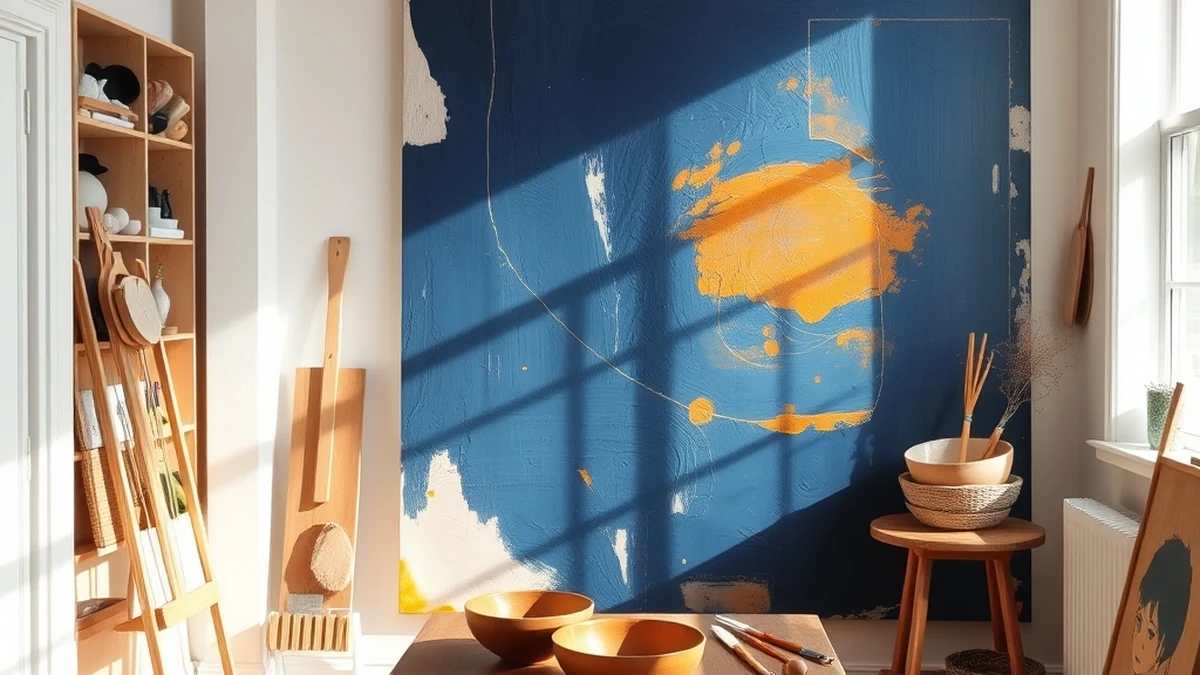
Image generated by AI
Handmade pigments and unfinished canvases
Printmaking left a lasting mark on how Amigó treats materials. Since he was young he has ground his own pigments, which he sees as a way of staying in touch with the earth. He also works with handmade paper, ceramics, iron and kaolin, choosing the material that best suits each idea.
He follows no fixed method. Many pieces are abandoned at the back of the studio for months or years; when he finds them again, some need only a small touch to be finished, while others are painted over in white so he can start again. “Usually, the work itself tells you it shouldn’t be touched anymore,” he says.
Japan, Morocco and the habit of collecting forms
Amigó calls himself “a collector of forms.” Japan, which he has visited for more than 30 years, and Morocco feed him shapes, materials and even smells that slowly enter his imagery — rarely as recognisable scenes, more as textures and gestures. He keeps notebooks on every trip, convinced that ideas which never take physical form simply expire.
For him, the most productive moment of a journey is coming home. Back in the studio he can “empty out” what he has gathered — and he finds that familiar surroundings look different after time away.
Bashō, emptiness and impermanence
Reading Matsuo Bashō’s 17th-century travel diary, written in spare prose and haiku, changed how Amigó thinks about painting. He took from it lessons in how to use empty space, how to reduce colour and how to express a lot through very little. In his view, form and emptiness carry equal weight in a picture, and the tension between what is shown and what is left out is where the work comes alive. He is also drawn to impermanence: something destined to disappear gains value precisely because it will not last.
Image generated by AI
Why quiet painting can be a form of resistance
Memarian’s final question addresses the moment we live in: constant images of war, displacement and suffering. Amigó admits that painters “cannot escape the state the world is currently in.” Working alone lets him step away from the noise, but not ignore it; the distance helps him see more clearly and decide where he stands. Painting, he concludes, can take a position without depicting reality directly — by creating “a place of silence, contemplation, and beauty” that, by contrast, resists.
Why it matters
Debates about art and politics often assume that only direct, documentary work counts as engaged. Amigó offers a different model, rooted in East Asian ideas of emptiness and in slow looking. Whether or not you agree, his answers are a useful guide to reading abstract painting: look for what has been left out, and ask why.
Related reading
For another artist interview adapted from Global Voices, read Melis Buyruk Porcelain: Myth, Fragility and Power. The full original conversation, with photographs of Amigó’s paintings, is available on Global Voices.
Frequently asked questions
Where is Jaume Amigó from?
He was born in Barcelona in 1963 and works in l’Alzina de Ribelles, in Catalonia’s La Noguera region.
What is Entre núvols?
Entre núvols (Between Clouds) is a 2025 project by Amigó shown at the Moll de Costa in the Port of Tarragona, described as a “visible haiku.”
Which book influenced his work?
Matsuo Bashō’s The Narrow Road to the Interior, a 17th-century Japanese travel diary in prose and haiku, inspired an extensive cycle of his paintings.





0 Comments