


An original TeaLamp explainer based on the sources listed below. Prepared by the TeaLamp Editorial Team with the help of AI.
Jack-o’-lantern history begins far from the pumpkin patch. Long before anyone carved a grinning face into a big orange pumpkin, the name belonged to mysterious lights over boggy ground, then to a sly character in Irish folklore, and then to lanterns cut from turnips. Here is how that small, glowing face travelled across an ocean and became the best-known symbol of Halloween.
Key takeaways on jack-o’-lantern history
- “Jack-o’-lantern” first described will-o’-the-wisps, the faint flickering lights seen over marshes at night.
- An Irish folk tale about “Stingy Jack,” a trickster doomed to wander with a glowing coal, gave the name a story.
- In Ireland, Scotland and England, people carved turnips, rutabagas and other root vegetables into lanterns.
- Immigrants to North America adapted the custom to the pumpkin, a native American plant that was bigger and easier to carve.
Lights over the marsh
The earliest meaning of the word had nothing to do with vegetables. In English, “jack-o’-lantern” was one of several folk names for the will-o’-the-wisp, known to scholars by the Latin ignis fatuus, or “foolish fire.” These are pale lights that sometimes seem to hover over bogs and wetlands after dark. Travellers in old stories follow them and get lost.
The name itself is simple enough. “Jack” was an everyday word for any ordinary man, so “Jack of the lantern” meant something like “the man with the lantern.” Many parts of Europe had their own versions of these wandering lights and their own tales to explain them.

Folk names such as jack-o’-lantern first described faint lights over marshes. Image generated by AI.
The tale of Stingy Jack
In Ireland, one of those explanations became a much-loved story. Folklorist Jack Santino retold it at the Library of Congress in 1982, in a lecture the Library’s American Folklife Center later shared on its Folklife Today blog and podcast. In the version most people know, Jack is a mean, clever man, often a blacksmith, who tricks the Devil more than once. Each time he wins a promise that the Devil will never claim his soul.
When Jack finally dies, he is too wicked to be let into Heaven, and the Devil, keeping his word, will not let him into Hell either. Instead, the Devil tosses him a single burning coal from the fire to light his way. Jack places it inside a hollowed-out turnip and sets off to wander the dark forever. He becomes “Jack of the Lantern,” and his glowing turnip explains the lights out on the bog.
The story has many local versions. According to the Irish Times, an 1836 article in the Dublin Penny Journal already set out the legend in detail, told by a chatty uncle on a dark night journey.
Turnips before pumpkins
To modern eyes, a carved turnip looks small and slightly eerie. But in Britain and Ireland it was the natural choice. In his 1982 talk, Santino pointed out that people there carved turnips, rutabagas and other large roots, and that the custom continues today. Records mention turnips, beets and even potatoes being carved at Halloween in nineteenth-century Ireland.
Carving a turnip is slow work. The flesh is dense, so it has to be scooped out bit by bit with a knife or spoon. A small candle or ember inside makes the thin walls glow, and a face cut into the side turns it into a lantern with personality. In parts of Somerset, in England, children still parade with carved “punkies” on Punkie Night in late October.
Why a face?
No single written rule explains the faces. Folklorists suggest a mix of reasons: fun, mischief, and an old idea that a fierce face in the window might keep wandering spirits, perhaps even Jack himself, away from the door. Halloween falls on October 31, at the turning point between autumn and winter, a time long linked with spirits in Irish and Scottish tradition.
A new world, a new lantern
Pumpkins were not available in Europe for most of that history. They are native to the Americas, where Indigenous peoples grew them long before European settlers arrived. As Santino put it in his lecture, pumpkins were introduced to the colonists by Native Americans.
In the nineteenth century, huge numbers of Irish and Scottish emigrants came to North America and brought their Halloween customs with them. Pumpkins were plentiful in autumn, larger than turnips and much softer to carve. The old tradition moved into a new vegetable, and the pumpkin lantern was born.
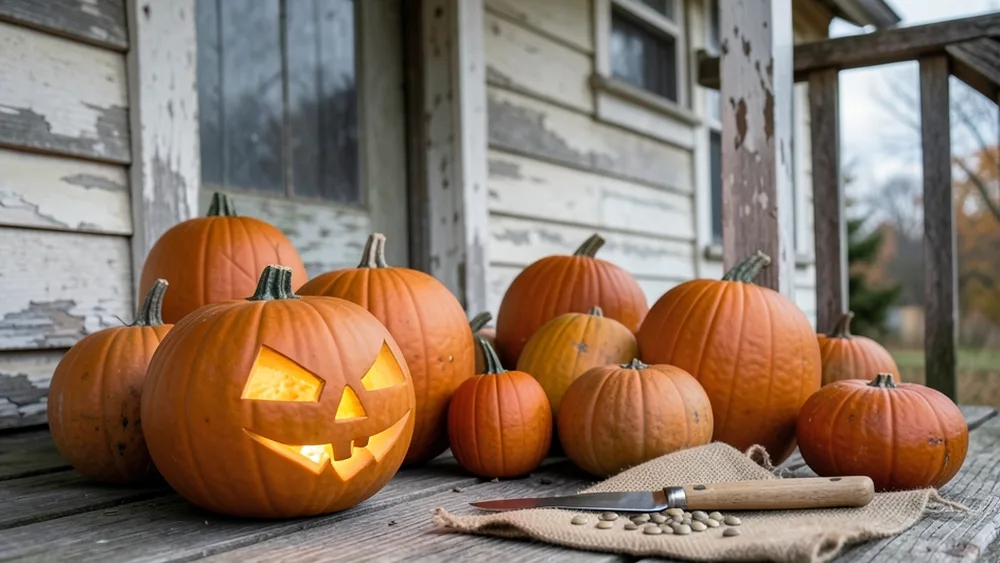
In North America, the pumpkin became the lantern of choice. Image generated by AI.
Early traces in print and art
The words appear in American writing early on, though not always about pumpkins. In Nathaniel Hawthorne’s 1835 tale “The Great Carbuncle,” one character teases another that a glowing gem hidden under his cloak would “gleam through the holes and make thee look like a jack-o’-lantern!” (Nathaniel Hawthorne, Twice-Told Tales). It is unclear whether he means a carved lantern or a marsh light.
By the second half of the century the picture is clearer. The Library of Congress holds an 1872 artwork by B. F. Reinhart showing a boy and girl carving a pumpkin into a jack-o’-lantern. And the Irish Times notes an 1886 Canadian newspaper report describing children making glowing pumpkin “heads” lit by tallow candles on Halloween night.
From folk custom to front porch
From there, the pumpkin lantern grew into a household ritual across North America and, more recently, in many other countries too. Families now carve faces, cats, castles and all sorts of designs, and battery tea lights often replace candles. Yet the story still hides inside every one: a lonely wanderer, a borrowed coal and a humble root vegetable.
Some people in Ireland and Scotland have revived the older turnip lanterns, with their crinkled skins and ghostly glow. The National Museum of Ireland – Country Life, in County Mayo, displays a painted plaster cast of a “ghost turnip” from Fintown, County Donegal. A schoolteacher sent the original to the museum in 1943, saying it was the kind always made in that area around 1900. It is a reminder that the jack-o’-lantern began not as a decoration but as a piece of folklore you could hold in your hand.
Why it matters
Jack-o’-lantern history is a neat lesson in how traditions travel. A word for marsh lights picked up a folk tale, the folk tale found a vegetable, and the vegetable changed when people crossed an ocean. Every glowing pumpkin on a doorstep this week carries a little of that long journey with it, from Irish bogs to modern front porches.
Related reading: the Vegetable Lamb of Tartary, a plant that was said to grow sheep.
Sources
- Spooky Stories for Halloween 2022 on the Folklife Today Podcast, Library of Congress (includes Jack Santino’s jack-o’-lantern story)
- A Halloween lecture by Jack Santino, Folklife Today, Library of Congress
- The story of Jack-o’-lantern, The Irish Times
- Ghost turnip (F1943.350), National Museum of Ireland
- Twice-Told Tales by Nathaniel Hawthorne, Project Gutenberg (public domain)
- The Mysterious History of the Jack-o’-Lantern, Denver Botanic Gardens









0 Comments