

A TeaLamp book summary of Anne of Green Gables by Lucy Maud Montgomery, first published in 1908. In the public domain. Prepared by the TeaLamp Editorial Team with the help of AI.
This Anne of Green Gables summary is for anyone who has always meant to meet literature’s most talkative orphan and never quite got around to it. Lucy Maud Montgomery’s 1908 novel tells how an eleven-year-old girl, sent by mistake to a farm that wanted a boy, wins over two stern siblings, a whole village, and more than a century of readers. It is a story about imagination, belonging and second chances, set among the red roads, orchards and sea light of Prince Edward Island.
Key takeaways on Anne of Green Gables
- Matthew and Marilla Cuthbert, middle-aged siblings on a Prince Edward Island farm, ask an orphanage for a boy to help with farm work and receive Anne Shirley instead.
- Anne, imaginative, talkative and desperate to belong, talks her way into staying at Green Gables.
- At school she finds her bosom friend Diana Barry, a fierce rival in Gilbert Blythe, and a string of scrapes that Avonlea never forgets.
- Anne grows from a lonely child who renames everything she sees into a capable young woman who chooses home over ambition.
- First published in 1908, the novel has sold more than fifty million copies and remains in print around the world.
The girl who arrived by mistake
The story opens with a mix-up. Matthew Cuthbert drives to Bright River station expecting the orphan boy he and his sister Marilla requested from Nova Scotia. Instead he finds a small girl with red braids, grey eyes and a tongue that never stops. Anne Shirley has spent her short life passed between households after her parents’ deaths, and she has learned to survive on talk and imagination. On the long drive back to Green Gables, she renames everything she passes: the avenue of apple trees becomes the White Way of Delight, and a pond becomes the Lake of Shining Waters.
Marilla is not pleased. A girl cannot do the farm work a boy could, and Anne’s chatter fills the quiet house to bursting. She means to send Anne back at once. But Matthew, shy and kind, has already fallen under the child’s spell, and Marilla, who prides herself on being practical, discovers that she cannot quite bring herself to return a child to an orphanage. Anne stays, on probation, and the Cuthberts’ orderly life is never orderly again.
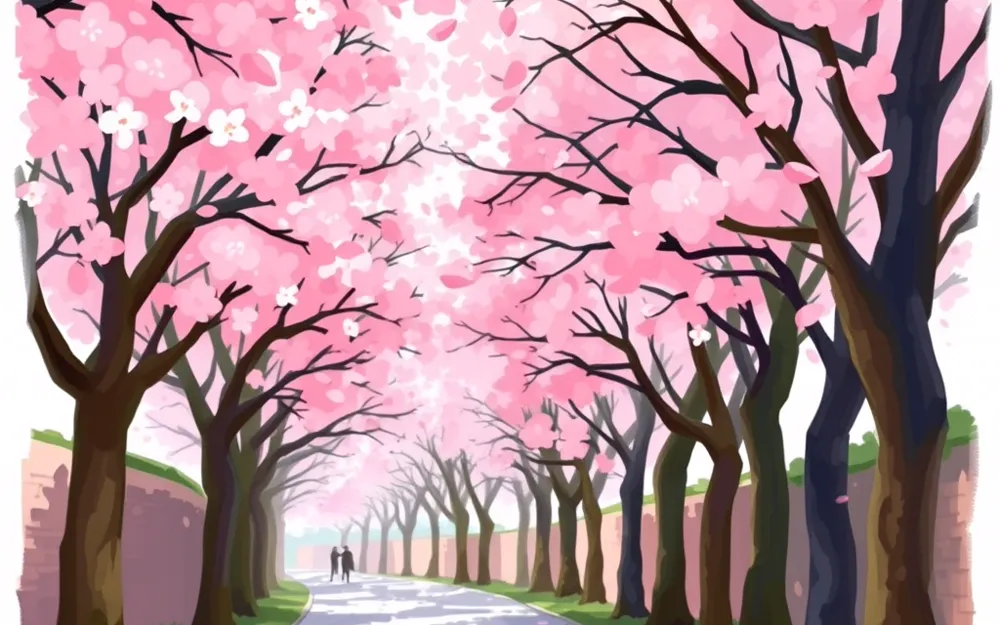
An avenue of apple trees in blossom, like the lane Anne names the White Way of Delight. Image generated by AI.
A home that learns to laugh
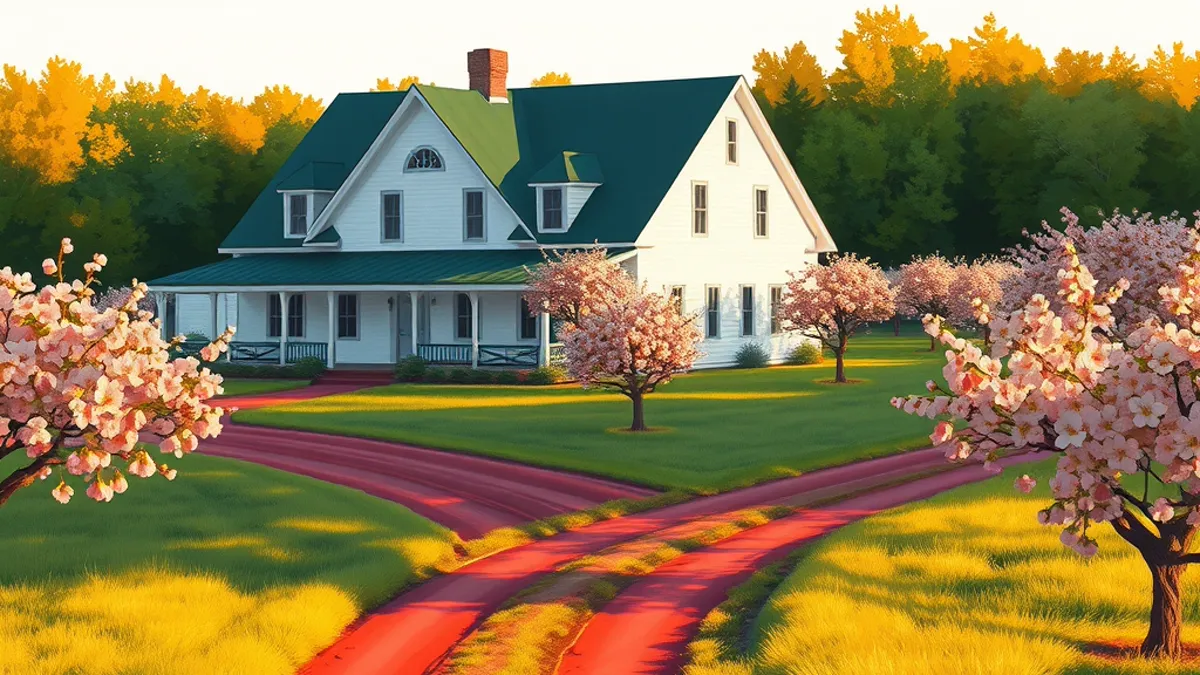
Green Gables is a white farmhouse with green gables, orchards and a lane of apple blossom, and Anne loves it at once. She also tests it daily. She dyes her hated red hair with a peddler’s bottle and turns it green. She bakes a cake with liniment instead of vanilla for the minister’s wife. She serves Diana raspberry cordial that turns out to be currant wine, and Diana’s mother bans the friendship for a time. Each disaster is followed by a grand apology, delivered with total sincerity, and each one softens Marilla a little more.
Montgomery never lets Anne’s imagination become mere decoration. It is how a child with no family of her own makes the world bearable. When Anne names a geranium, a brook or a lane, she is claiming a home. And slowly, the Cuthberts claim her back. Matthew buys her a dress with puffed sleeves, the fashion she longs for, because he cannot bear to see her in plain clothes. Marilla, who scolds Anne for vanity, sews the dress’s rivals herself. The household that began as a business arrangement becomes a family.
School, friendship and rivalry
At the Avonlea school, Anne finds Diana Barry, the dark-haired girl next door, and the two swear eternal friendship. They are kindred spirits, in Anne’s phrase, and Diana’s steady loyalty anchors Anne through every scrape. Anne also finds Gilbert Blythe, a clever boy who teases her about her red hair on her first day and earns a slate broken over his head for his trouble. The two become academic rivals, competing for the top of the class and, later, for the Avery scholarship to college.
Anne’s school years are a comedy of good intentions. She recites, she writes stories for the school club, she wins prizes, and she keeps getting into trouble by acting before she thinks. Through it all, Montgomery keeps the tone warm rather than cruel: the village gossips, especially the sharp-tongued Mrs. Rachel Lynde, are figures of fun, but they are never villains. Avonlea is a community that watches Anne closely and, in the end, roots for her.
Growing up, and choosing to stay
The novel’s final chapters turn serious without losing their warmth. Anne wins the Avery scholarship and dreams of college, but then Matthew dies suddenly, and Marilla’s eyesight begins to fail. Anne faces a choice that defines the whole book: she can take her scholarship and leave, or she can stay at Green Gables, teach at the Avonlea school and look after Marilla. She chooses to stay.
Gilbert, now a young man, quietly gives up the Avonlea school position so that Anne can have it, and the old rivalry settles into something gentler. The book closes not with a grand triumph but with a quiet promise. Anne, looking out over the home she has made, says to Marilla, “Isn’t it nice to think that tomorrow is a new day with no mistakes in it yet?” It is a line that sums up the novel: the past cannot be undone, but tomorrow is always open.

A slate, chalk, apples and wildflowers on a wooden school desk. Image generated by AI.
Why it matters
Anne of Green Gables endures because it takes a child’s inner life seriously. Anne is not a perfect heroine. She is vain about her hair, dramatic about her sorrows and careless with other people’s feelings. But she is also brave, funny and loyal, and she refuses to let a hard start decide her life. Readers who felt like outsiders have recognised themselves in her for more than a hundred years, and the novel’s Prince Edward Island setting, drawn from Montgomery’s own island childhood, gives that recognition a landscape to live in.
The book also quietly argues something radical for 1908: that a girl’s education and ambition matter, and that choosing home and family can be as brave as leaving them. Anne gives up college, but she does not give up learning. She becomes a teacher, a reader and the centre of a community, and the novel treats that as a triumph, not a sacrifice.
That is also why the book rewards rereading. A child reader laughs at the green hair and the liniment cake. An adult reader notices the quieter story underneath: two ageing siblings who learn to love a child they never planned for, a village that slowly makes room for a girl who talks too much, and a young woman who discovers that home is not only a place she was given, but a place she chose.
Related reading
For another beloved classic retold with warmth, see our review of The Wind in the Willows.
Frequently asked questions
Is Anne of Green Gables based on a true story?
No, though Montgomery drew on her own childhood on Prince Edward Island and on the island’s people and places. Anne herself is fictional, as are Matthew, Marilla and Avonlea, though the island’s landscapes are real.
What age is Anne of Green Gables suitable for?
It was written for readers of all ages and is often read from around age nine or ten up. Younger readers enjoy the scrapes and the humour, while older readers catch the novel’s themes of loss, ambition and belonging.
Are there sequels to Anne of Green Gables?
Yes. Montgomery wrote seven further Anne books, beginning with Anne of Avonlea, following Anne through college, teaching and marriage. This summary covers only the first book.








0 Comments