


Key takeaways
- Billions of neurons in your brain talk to each other using chemical messages, and each message is released in less than a thousandth of a second.
- The messages travel in tiny bubble-like packages called vesicles, which burst open through a protein “zipper” built from SNARE and SM proteins.
- A rush of calcium is the trigger: a protein called synaptotagmin senses it and snaps the zipper shut, firing the message across the synapse.
- Sixteen versions of synaptotagmin work at different speeds, letting every synapse tune its own signal — the adjustable “nano-computer” behind learning and memory.
Right now, as you read this sentence, billions of neurons in your brain are talking to each other. Figuring out how neurons communicate — how a signal leaps from one cell to the next in under a millisecond — took scientists the better part of a century, elegant experiments in the 1950s, and more than one Nobel Prize. The answer turned out to be a molecular machine of astonishing precision: chemical messages packed into tiny bubbles, released by a protein zipper, fired by a calcium-sensing trigger.
In a recent article for Frontiers for Young Minds, Nobel laureate Thomas C. Südhof — who shared the 2013 Nobel Prize in Physiology or Medicine for untangling this very machinery — tells the story of how neurons pull off this trick, and why the brain chose to talk in chemistry instead of electricity.
How neurons communicate across the synapse
Neurons do not touch each other. Between a sending neuron and its neighbor lies a minuscule gap called the synapse, and the conversation crosses it in chemical form. The sending neuron packages its message into chemicals called neurotransmitters, loads them into tiny bubble-like sacs called vesicles, and — when the moment comes — bursts the vesicles open, spilling the chemicals into the gap. The receiving neuron catches them with specialized receptors and responds.
That neurons talk in chemicals was not always obvious. In the 1950s and 1960s, Bernard Katz ran a series of brilliant experiments showing that communication across the synapse is chemical rather than electrical — work that earned him the 1970 Nobel Prize in Physiology or Medicine. But his answer raised a deeper question: why would the brain bother with chemicals at all?
Why the brain chose chemicals over electricity
After all, direct electrical connections between neurons exist. Called gap junctions, they dominate in simple animals like worms and connect some cells in the human brain too. A gap junction is beautifully simple — but it has only two states, like an on-off switch: electricity passes, or it does not.
A chemical synapse is a far richer device. The sending neuron can release many vesicles at once for a strong signal, or few for a weak one. The receiving neuron can dial its own sensitivity up or down. Signal strength can shift with timing, with recent activity, and with chemical influences arriving from elsewhere in the body. Every synapse, in other words, works like a tiny “nano-computer” that processes information rather than merely relaying it.
This flexibility is the whole point. An on-off network can only shout or stay silent; a network of adjustable chemical synapses can whisper, emphasize, habituate, and learn. That adjustability — each connection fine-tuning itself — is a large part of what gives the brain its power.
The zipper that fires the message
The release itself is a feat of molecular engineering. Each vesicle must merge with the sending neuron’s outer membrane — a process called fusion — to spill its neurotransmitters into the synapse. Fusion is handled by proteins called SNAREs, which sit on the vesicle, working with partner proteins called SM proteins on the cell membrane. Think of the SNARE complex as a zipper: it closes from the end farthest from the membrane toward the membrane itself, and in the resting state it sits half-zipped, holding the vesicle docked and ready but not yet fused.
What completes the zip? Calcium. Most people know calcium as the mineral in bones and teeth, but inside cells it doubles as an urgent signal. When an electrical impulse arrives, calcium floods into the neuron — and a protein called synaptotagmin, sitting on the vesicle, senses it. Finding this sensor was Südhof’s great hunt: his team systematically identified every protein in synaptic vesicles, and synaptotagmin stood out because of arm-like regions, called C2 domains, that looked built to grab calcium. It took about fifteen years of experiments to prove the hypothesis — synaptotagmin is the calcium sensor that kickstarts neurotransmitter release.
It does not work alone. A second protein, complexin, holds the half-zipped SNAREs in a cocked, ready position. When calcium binds synaptotagmin, the two proteins cooperate to finish zipping the SNARE complex, the membranes fuse, and the message fires — the entire sequence in less than a millisecond.
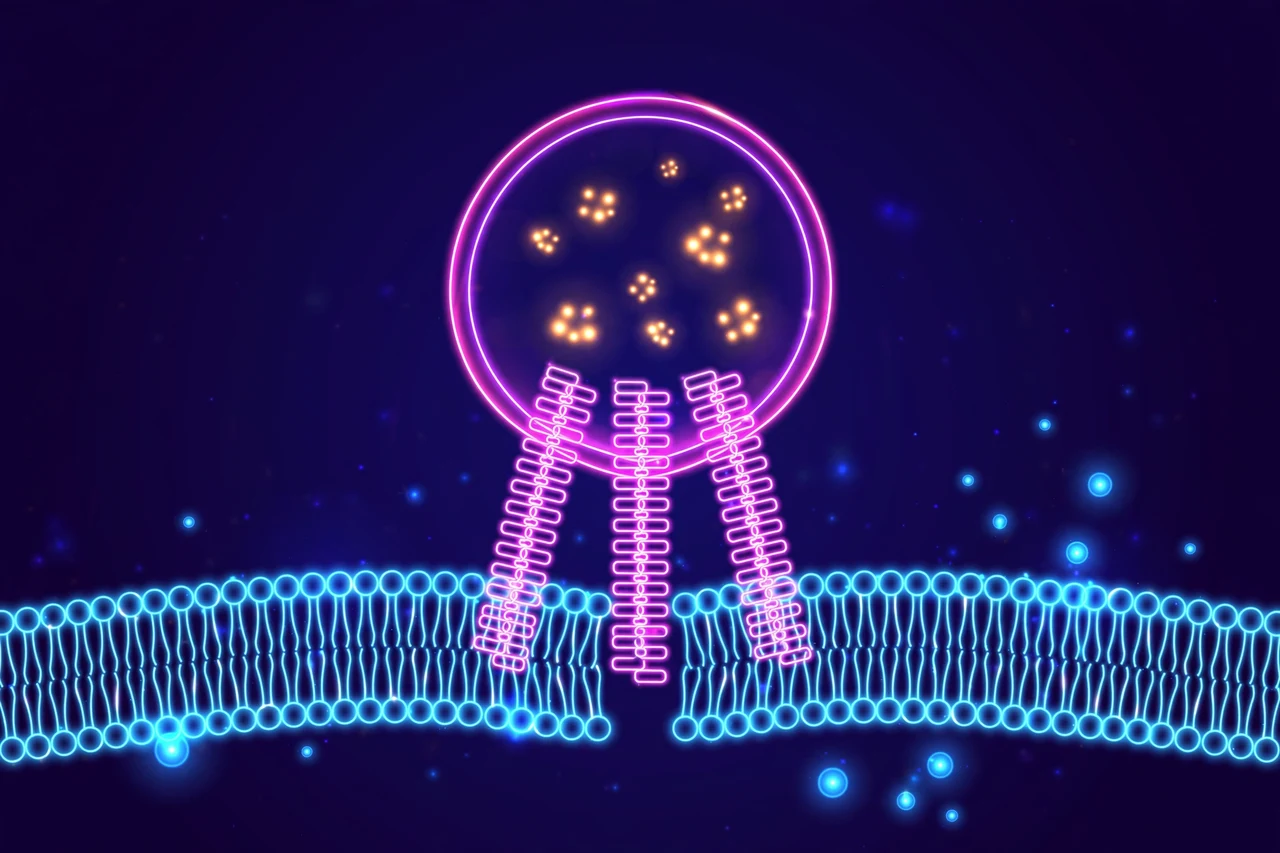
Neurotransmitter release works like a zipper: SNARE and SM proteins pull the vesicle and cell membrane together, and a calcium-triggered sensor snaps them shut. Image generated by AI.
A family of sensors, each with its own speed
Synaptotagmin turned out to be a family, not a single protein: sixteen versions exist, eight of which bind calcium, and four of them handle neurotransmitter release in the brain. Each runs at its own speed, and each is posted where its speed is needed.
Synaptotagmin-2 is the fastest of the four, which is why it sits at the junctions between nerves and muscles, where a signal must become a contraction almost instantly. Synaptotagmin-1 is a close second. Synaptotagmin-9 works at a moderate pace, and synaptotagmin-7 is the slowest — it kicks in during long, repeated bursts of release, the kind a synapse sees during continuous movement like walking or playing an instrument.
The same calcium-triggered machinery shows up outside the brain, too: cells that release hormones such as insulin and adrenaline use synaptotagmins for their own vesicle fusion. The zipper-and-sensor design is a general solution, deployed wherever biology needs fast, controlled release.
When the machinery breaks
This machinery is so fundamental that when it malfunctions, the consequences are severe. Scientists have found families with mutations in synaptotagmins that cause serious brain diseases in childhood. In other disorders, the immune system mistakenly attacks synaptotagmin, interfering with nerve-to-muscle signaling and causing muscle weakness.
Other attackers target the zipper itself. The toxins behind botulism and tetanus both assault SNARE proteins, blocking communication between neurons — which is why they cause paralysis. Such breakdowns are rare, and for a dark reason: the fusion machinery is so essential that a badly broken version is often not compatible with life at all.
Why it matters
Here is the payoff of all that adjustability. Because each synapse can tune its own strength, synapses change with use — growing stronger, weaker, or rewiring their responses. This changeability, called plasticity, is one of the foundations of learning and memory. The molecular machinery of vesicles, zippers, and calcium sensors is what makes plasticity physically possible.
It also explains something remarkable about the brain. Computers work with simple on-off signals, yet your brain — built from “nano-computers” that constantly retune themselves — can learn from a handful of experiences, adapt to surprises, and blend memory, emotion, and knowledge into understanding. The price of that flexibility is that our memories are not perfect recordings; they shift and reshape. But that same shiftiness is what lets us keep learning, for a lifetime.
Related reading: Optogenetics, Explained: Controlling Brain Cells with Light — how scientists use light to switch neurons on and off, built on the same synaptic machinery.

The brain uses four versions of the synaptotagmin sensor, each tuned to a different speed – the fastest sits where nerves meet muscle. Image generated by AI.
Frequently asked questions
What exactly is a synapse?
The tiny gap between two neurons where chemical communication happens. The sending neuron releases neurotransmitters into it; the receiving neuron picks them up with receptors. Your brain contains billions of synapses, and each one is an adjustable connection.
What are neurotransmitters?
Chemical messengers that carry signals across the synapse — the “words” of the neuronal conversation. Different neurotransmitters have different effects: some excite the receiving neuron, others calm it down.
Why do neurons not simply use electricity?
Some do — gap junctions pass electricity directly between cells. But electrical connections are on-off switches, while chemical synapses can be finely tuned in strength and timing. That tunability is what makes learning and memory possible.
What happens when synaptic transmission goes wrong?
Because the machinery is so essential, serious defects are often devastating: synaptotagmin mutations can cause childhood brain disease, and the bacterial toxins behind botulism and tetanus cause paralysis by attacking SNARE proteins and silencing the conversation between neurons.
Sources
- Südhof TC, “Fast and Fabulous: The Lightning-Speed Language of Neurons”, Frontiers for Young Minds 14:1739253 (2026). Full text (CC BY)
- The Nobel Prize in Physiology or Medicine 2013 — awarded to James E. Rothman, Randy W. Schekman and Thomas C. Südhof “for their discoveries of machinery regulating vesicle traffic”. Nobel Prize press release
- U.S. Centers for Disease Control and Prevention — botulism is caused by a toxin that attacks the body’s nerves, causing muscle paralysis. About botulism (CDC)










0 Comments