


Originally published by Omid Memarian in Global Voices on September 19, 2026, under a Creative Commons Attribution 3.0 licence. Adapted here under that licence: rewritten for a general audience, with new structure, new explanations and a new ending. The original photographs are not reused. Global Voices and the author do not endorse TeaLamp. Prepared by the TeaLamp Editorial Team with the help of AI.
Jaume Amigó paints slowly, in a world that looks fast. The Catalan artist works from a studio in the countryside of Catalonia, turning what he has seen on his travels into abstract paintings where colour, gesture and empty space carry equal weight. His work asks the viewer to slow down, look longer, and notice what has been left out as much as what is there.
Key takeaways on Jaume Amigó
- Amigó, born in Barcelona in 1963, trained in engraving and printmaking before making painting the centre of his work.
- He calls himself a collector of forms, gathering shapes, materials, textures and even smells from Japan and Morocco and letting them settle into his painting back home.
- His studio is not one fixed room: he describes it as mobile and permeable, a space that moves with him wherever he happens to be.
- For Amigó, emptiness in a painting matters as much as form, an idea he connects with the Japanese poet Matsuo Bashō and the value of saying more with less.
- He sees painting as a way of taking a position: creating a quiet space of beauty and contemplation that stands, by contrast, against a flood of instant images.
A painter shaped by printmaking
Amigó was born in Barcelona in 1963 and studied engraving and printmaking at the Llotja School of Art and Design. Painting remains central to his practice, but he has also worked in sculpture, ceramics, engraving, installation and scenography for the stage. That range shows in his paintings, where the mark of the hand and the character of the material matter as much as the image itself.
He is based in l’Alzina de Ribelles, in Catalonia’s La Noguera region, and has exhibited widely in Spain and abroad, including in Japan, Morocco, the Netherlands and Switzerland. His large works on paper and fabric, some several metres across, hold their colour in broad, calm fields, broken by lines and marks that feel like traces left behind by something that has passed.
The studio that moves with him
Asked what happens between seeing something and painting it, Amigó answers with memory. He normally paints what he has seen outside the studio, drawing on recollection. What survives the passage of time, he says, is what finally becomes fixed on canvas or paper. Many forms disappear along the way, and choosing what should disappear and what should remain is, for him, largely an exercise in intuition.
His studio, in his telling, is not a single room with four walls. Over the years he has worked in many studios, carrying experiences gathered during his travels and his life from one to the next. At bottom, he says, the studio is wherever he happens to be at any given moment. Ideas, he adds, need material form: if they do not find their way onto canvas or paper, they expire and disappear. That is why he always keeps notebooks for drawings and sketches, a record of what appears during the process.
Back in his own studio, the work continues in a slower rhythm. Some pieces are left abandoned at the back of the room for months or even years. When he comes across them again, they often surprise him, needing very little to reach completion. Others he paints straight over in white and starts again. Knowing when a work is finished, he says, is one of the hardest decisions in painting, and usually the work itself tells you it should not be touched any more.
Paint made from the earth
Material is not a detail in Amigó’s work; it is part of the meaning. Since he was very young, he has used pigments to make his own paints, a way of staying in direct contact with the earth and nature and bringing matter from the world around him into the work. His materials include handmade papers and kaolin, a soft white clay, gathered from the lands he inhabits and walks.
He also likes to step outside his comfort zone. Painting is his home ground, but he has found, over the years, the materials he considers most suitable for each idea, whether on canvas, on paper or in sculpture. Ceramics, iron and paper all enter his practice when an idea calls for them. The result is work that feels made rather than merely pictured: surfaces you can sense with your eyes, even in a photograph.
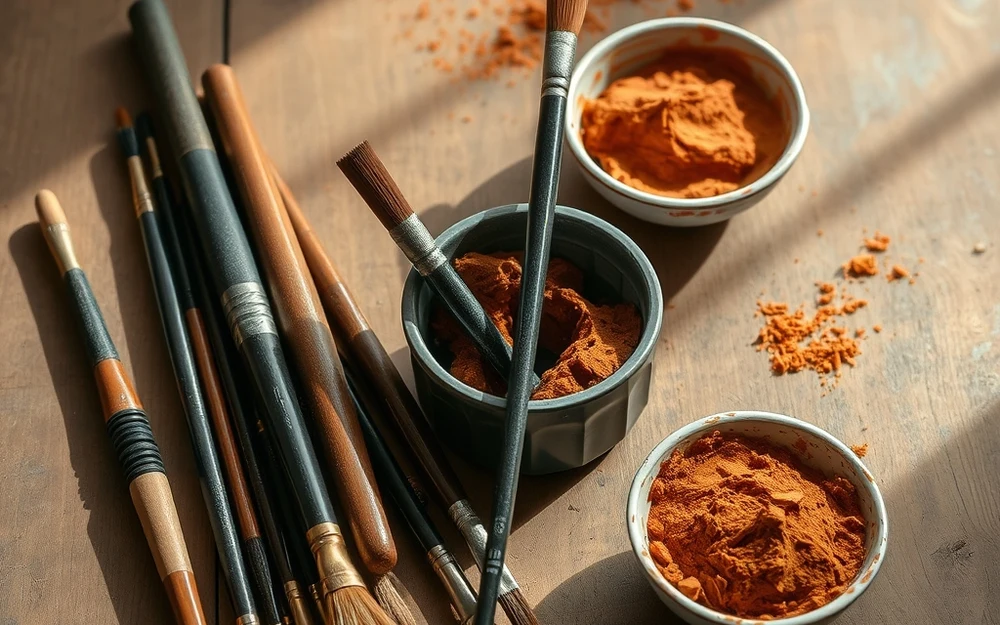
Paintbrushes and bowls of natural pigment, the raw materials of Amigó’s paint. Image generated by AI.
What Japan and Morocco gave him
Travel is central to Amigó’s visual language. Japan has been part of his life for more than thirty years, and Morocco has also become an important place for his practice. But neither country appears in his work as a postcard view. Instead, they enter through materials, textures, gestures and ways of observing nature.
He describes himself as a collector of forms, forms that, over time, he incorporates and transforms in his painting. Japan and Morocco have brought him new material: forms previously unknown to him, new materials, even smells that sparked his interest and somehow became part of his imagery. He has worked many times in both countries, and each trip has been enriching. But he says the most interesting part of travelling is coming home and returning to the studio, where he can empty out the sediment accumulated during the trip and put in order what he has seen, felt and gathered.
After being away, he adds, he starts looking at his surroundings differently. What he already knows can take on new forms and meanings. Travel, in this account, does not replace home. It teaches him to see home again.
Learning to say more with less
One influence Amigó names directly is the Japanese poet Matsuo Bashō, whose book The Narrow Road to the Interior recounts a journey through Japan in spare prose and haiku, turning encounters with landscape, nature and passing time into moments of contemplation. Amigó’s exhibition Entre núvols has been described as a visible haiku, a poetry of essentials.
Reading Bashō, Amigó says, quickly fascinated him: expressing a concept with extraordinary brevity and, at the same time, sublimity. Almost without realising it, Bashō became part of how he thinks about painting: how to use emptiness, how to reduce and pare down the use of colour, how to say more with less. Japan, he says, taught him that lesson over decades of visits, through its landscapes, its ceramics and its paintings, but above all through living alongside its people and the friends he made there.
In a painting, he believes, form and emptiness carry equal weight. It is a difficult balance to put into practice, but very rewarding when it is achieved. He is especially interested in the tension between what is present and what we choose to leave out, and in impermanence: the idea of something destined to disappear, which for that very reason takes on special value.
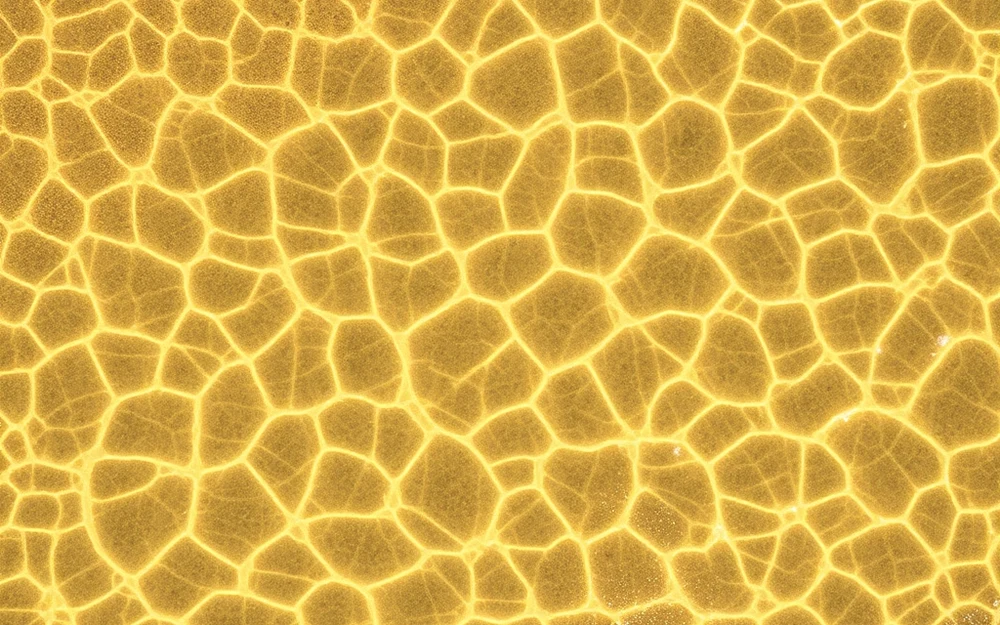
Sunlight on shallow water at low tide, the kind of natural trace Amigó turns into painting. Image generated by AI.
Why it matters
Amigó’s work offers a counterweight to the way most images reach us now: instantly, in large numbers, and often showing distress. He does not pretend painters can escape the state of the world. Instead, he tries to build another reality in the studio, a space where beauty, silence and the cycles of nature help him find his place in a world saturated with banal, meaningless images. Painting alone lets him step away for a moment, but that distance, he insists, does not mean ignoring what is happening. It lets him become more aware of it and find a way to position himself in relation to it.
That is why he calls painting a way of taking a position, not through a direct representation of reality, but through the creation of another possible space. A place of silence, contemplation and beauty can, precisely by contrast, become a form of resistance. For a viewer, the invitation is simpler: stand still for a while, and let a painting that says little say it completely.
Related reading
For another story about looking closely at a painting, read Girl with a Pearl Earring: What Science Found Under the Paint, which follows researchers examining Vermeer’s famous portrait layer by layer.
Frequently asked questions
Who is Jaume Amigó?
Jaume Amigó is a Catalan artist born in Barcelona in 1963. He trained in engraving and printmaking and now works mainly in painting, alongside sculpture, ceramics and installation, from a studio in Catalonia’s La Noguera region.
What does his work look like?
His paintings are abstract, built from broad fields of colour, gestural marks and generous empty space. They draw on landscapes, tides, clouds and other natural traces, reduced to their essentials rather than painted as realistic scenes.
Why does he talk about emptiness?
For Amigó, what is left out of a painting matters as much as what is put in. He connects this with the Japanese idea of saying more with less, learned from decades of travel in Japan and from reading the poet Matsuo Bashō.
Sources
- ‘A place of silence, contemplation, and beauty can also become a form of resistance,’ in conversation with Catalan artist Jaume Amigó, Global Voices, by Omid Memarian, published September 19, 2026.
- Global Voices FAQ, confirming Global Voices content is licensed as Creative Commons Attribution.
- Jaume Amigó: Islands, Galerie Roger Katwijk, corroborating the mobile studio, work in Ifitry in Morocco, Osaka and Tokyo in Japan, and Amsterdam, and the use of handmade papers and kaolin.








0 Comments