

Originally published by Subhashish Panigrahi in Global Voices on April 17, 2026, under a Creative Commons Attribution 3.0 licence. Adapted here under that licence: restructured as a TeaLamp interview feature, answers condensed in our own words, with short verbatim quotations attributed to the interviewee. Images not reused. Global Voices and the author do not endorse TeaLamp. Prepared by the TeaLamp Editorial Team with the help of AI.
Van Gujjari is a language with almost no books, and that is exactly the point. Spoken by the Van Gujjar, a nomadic community of the Himalayan foothills in northern India, it lives in voices, songs, and stories, not on pages. In this interview, Van Gujjari writer and conservationist Taukeer Alam explains why saving such a language means reaching for a microphone before a pen, and why the community itself must decide what happens to its knowledge in the age of AI.
Key takeaways on Van Gujjari
- Audio and video capture what books cannot. Tone, rhythm, facial expression, and emotion, the layers that make a spoken language alive, are lost the moment words are written down.
- Different generations need different formats. Elders who never learned to read need recordings; children now learning to read can benefit from books rooted in their own culture.
- Documentation is a race against time. Folk songs are still sung whose true meanings died with the elders who understood them.
- The community must own the process. Young people should be trained to document their own language, and the material must stay accessible to the people it came from.
- Consent comes before sharing. Before community knowledge enters books, archives, or AI systems, the community’s rights must be recognized and its permission asked.
A language that lives in the voice
Taukeer Alam is an Indian conservationist and a speaker of Van Gujjari, a vulnerable indigenous language of the Van Gujjar, a nomadic Muslim community living mostly in the northern Indian state of Uttarakhand. He was interviewed by Subhashish Panigrahi, on behalf of Global Voices’ Rising Voices project, about his work documenting the language.
The interview is part of a larger effort: the OpenSpeaks Archives, a digital language archive started in 2024 that helps communities document, transcribe, and archive their languages. It now hosts nearly 20 languages from India, Nepal, and Sri Lanka. Alam’s own work with the archive produced “Maari Jaban Maari Birsa,” meaning “our language, our culture,” a Van Gujjari documentation project.
His starting point is simple and radical at once: most of the world’s languages are spoken, not written, and their speakers’ knowledge is oral. Wikipedia and most publications demand written citations. So who gets to preserve, and be preserved by, the record?
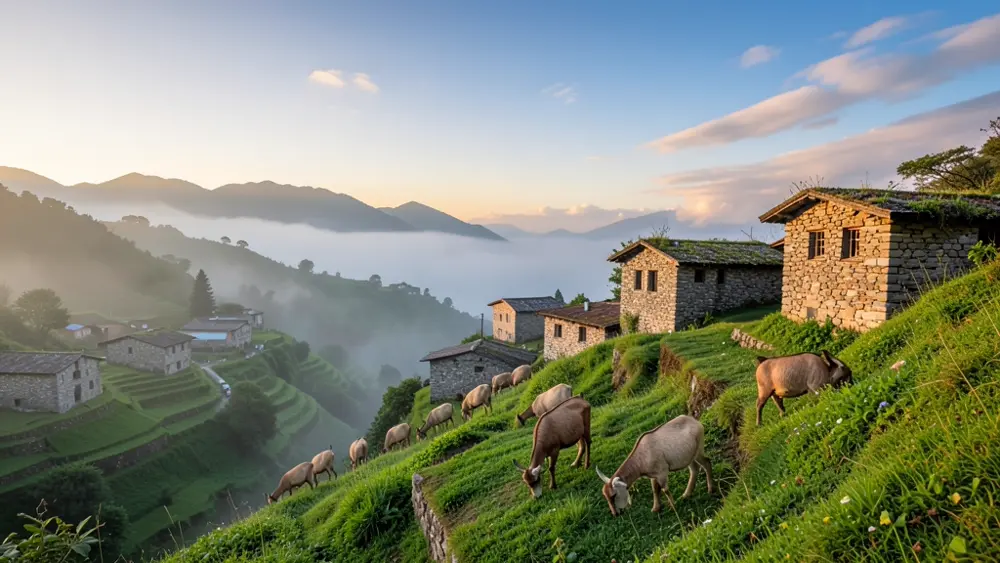
A Himalayan foothill village, morning. Image generated by AI.
Why audio and video beat the book
Asked how he sees books, audio, and video as tools for documenting his language, Alam does not hesitate: “Audio and video are the best mediums for documenting Van Gujjari for capturing our emotions through voice, expressions, and body language. These are very hard to capture in a book.”
The problem is deeper than convenience. Indigenous languages have their own sound patterns, and writing flattens them. “A word in Hindi, Van Gujjari or Punjabi might be spelled the same way, but the tone, the feeling, and the rhythm can be completely different,” he says. A reader from another region will read the written word in their own intonation and miss how high or low the tone goes, what expression accompanies it, what emotional weight it carries. “A book is simply not as ‘alive’ as audio and video, which capture many layers of meaning beyond the words.”
Different generations, different formats
For older members of the community, the choice is already made: they cannot read, and they are not going to start now. “For older people, audio and video always work better,” Alam says. Turning an elder’s interview into a book and handing it to someone who cannot read helps no one.
But the picture is changing. Alam belongs to one of the first generations of his community to reach college, and literacy is rising among children. That opens a new door: small stories, short narratives, and interview excerpts collected from the community could become books for schools. “It will help children’s contextual understanding if the knowledge comes from their own roots,” he says. “It connects their education to their lived reality.” The right format, in other words, depends on whose hands it lands in.
The songs whose meaning is already gone
The most haunting moment in the interview comes when Alam talks about speed. Documentation must happen early, because knowledge evaporates faster than anyone expects. He recently transcribed folk songs from his community, and made a chilling discovery: “for some songs, we no longer know the real meaning. People are still singing them, but those who truly understood the meaning have already passed away.”
The melodies survive; the meanings did not. People sing by ear, without knowing the literal sense, the emotions behind the song, or the occasions it was made for. “The full knowledge behind the song is gone,” he says. His rule is blunt: record, transcribe, translate, and share the material back with the community as fast as possible, because “the longer we wait, the more the quality of knowledge reduces and vanishes.”
Let the community do the documenting
Alam insists that language documentation must be participatory. The community’s young people, he says, “must be kept in the loop and showed the process, the methodology, what to pay attention to, and how we frame questions. If they learn this, they can later carry on the work themselves.” Outsiders can help, but the future archivists should come from inside.
Two more practical rules follow. First, the material must stay close to the people it came from: documented but locked far away, it is of limited use. “They should be able to see, hear, and use it.” Second, use decent equipment. When you sit down with a 70- or 80-year-old who carries knowledge no one else has, you may never get a second chance. “The data we capture from them is very precious; it should be of good quality so that it lasts and remains useful.”
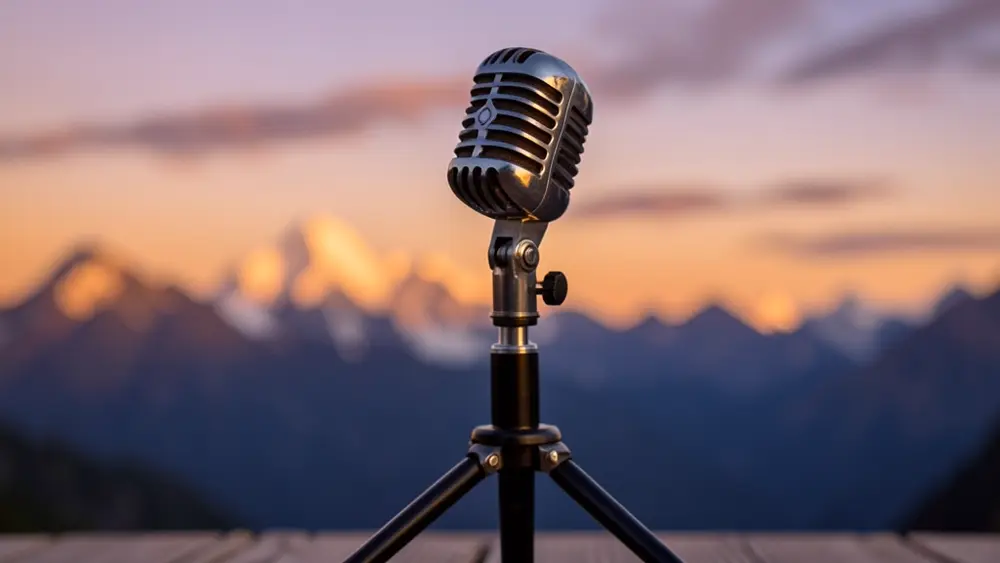
The tools of language documentation. Image generated by AI.
Who owns knowledge in the age of AI?
The sharpest questions in the interview concern what happens after documentation: who controls community knowledge once it is public, and what stops it from being exploited, including by AI systems trained on it.
Alam is candid about the fear. Medicinal knowledge, rituals, and practices refined over thousands of years could be marketed or misused once they leave the community’s hands. “We may document and record it with good intentions, but what happens to it later? How much right will the community retain over it?”
His answer is a framework, not a refusal. Before such knowledge goes public, it should be clearly marked as community knowledge, with the community’s rights acknowledged and proper consent and recognition required before it enters another domain. Then, he says, anyone using it would have to say, “This comes from the Van Gujjar community,” and respect that. Documentation itself is not the problem: “the main questions are how and where the material is stored, and how much control and rights the community retains over it.” It is a model of consent that the AI era, hungry for training data, would do well to learn from.
Why it matters
Languages are disappearing at a pace that makes every decade count, and most of them will never have a dictionary, let alone a Wikipedia. Alam’s interview is a field guide from inside that urgency: record the voice, not just the word; move fast; keep the archive close to home; and never confuse documenting a community with owning what it knows. In a world training machines on human expression, the question of who consents, and who is credited, belongs to all of us.
Related reading
For another story of a community keeping its language alive, read our interview feature Chabacano Poetry: A New Anthology in Asia’s Spanish Creole.
Frequently asked questions
Where is Van Gujjari spoken?
Van Gujjari is spoken by the Van Gujjar, a traditionally nomadic community living mainly in the Himalayan foothill regions of Uttarakhand in northern India, with speakers also in neighboring areas and Nepal.
How many people speak Van Gujjari?
Reliable speaker counts are hard to come by for small oral languages, which is part of the problem Alam describes. Sources describe Van Gujjari as a vulnerable indigenous language with a small speaker community.
What is OpenSpeaks Archives?
OpenSpeaks Archives is a digital language archive, started in 2024, that gives community language archivists the tools to document, transcribe, and archive their languages. It currently hosts nearly 20 languages from India, Nepal, and Sri Lanka, and its recordings also help Wikimedians cite Indigenous oral knowledge.
Sources
- Subhashish Panigrahi, “Language documentation needs community rights, consent, and recognition: Interview with Van Gujjari writer Taukeer Alam,” Global Voices, April 17, 2026. globalvoices.org (CC BY 3.0)
- “Van Gujari,” Wikipedia. en.wikipedia.org/wiki/Van_Gujari (language background, community)






0 Comments