

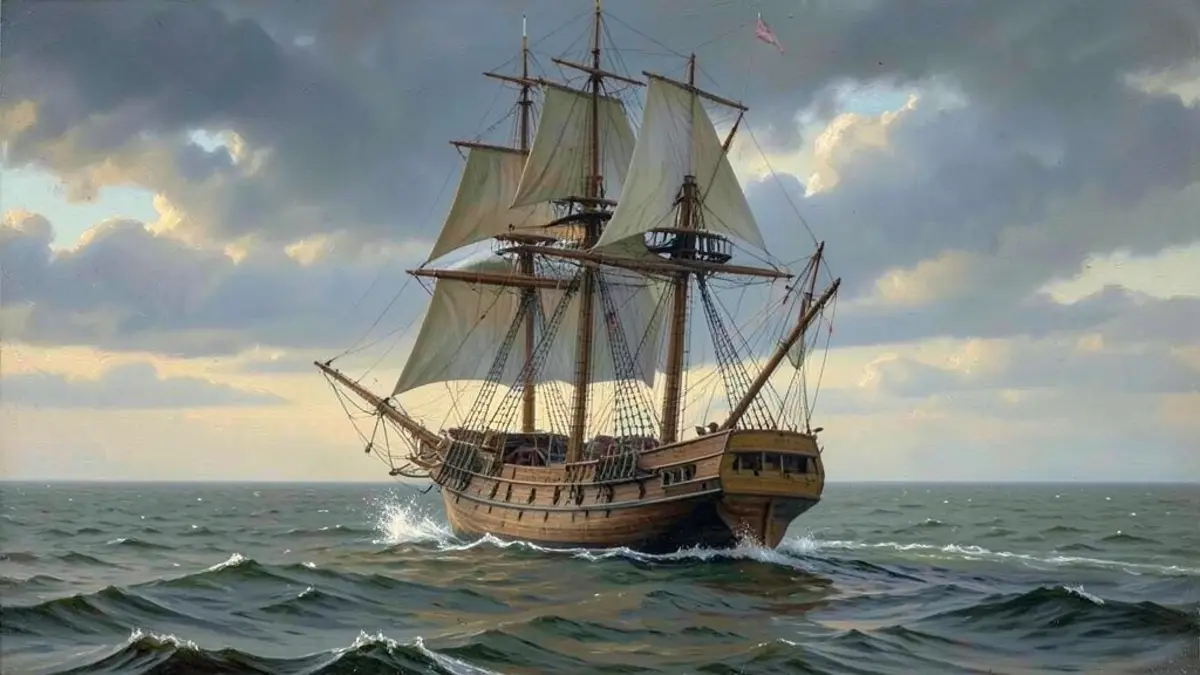
Our summary of Herman Melville’s Moby-Dick; or, The Whale (1851), now in the public domain. Written in our own words, with a few short verbatim quotations credited. Prepared by the TeaLamp Editorial Team with the help of AI.
This Moby Dick summary is for anyone who has always meant to read the great American whale novel and never quite dared. It is a big book with a fearsome reputation, and much of that reputation is unfair. Underneath the famous opening line and the whale chapters everyone warns you about sits one of the most exciting, strangest, and most human adventure stories ever written.
Key takeaways on Moby Dick
- Obsession can swallow a person whole. Captain Ahab’s hunt for the white whale starts as revenge and becomes the only thing he is, with terrible consequences for everyone around him.
- The whale is more than a whale. Moby Dick stands for everything humans cannot control or understand: nature’s power, fate, and the blank spaces where we project our fears.
- The book keeps interrupting itself on purpose. Melville halts the adventure for essays on whales, whaling, and rope. These “digressions” are the point: they turn a sea yarn into a whole world.
- The crew is a floating world. The Pequod carries sailors from every corner of the globe, and their friendships, especially Ishmael’s bond with Queequeg, give the novel its warmth.
- It flopped in 1851 and conquered the century anyway. Readers of Melville’s time wanted another adventure tale; what they got was decades ahead of them. The classic we know was rediscovered in the 1920s.
The story in brief: Ishmael, the Pequod, and Ahab’s quest
“Call me Ishmael.” With the most famous opening line in American literature, a restless young schoolteacher walks away from land and signs on as a common sailor aboard the whaling ship Pequod, sailing out of New Bedford. In port he befriends Queequeg, a tattooed harpooneer from a South Sea island, and the two become inseparable, sharing a bed, a purse, and eventually a ship.
Once at sea, the crew meets its captain: Ahab, a gaunt, commanding figure with one leg missing, lost to a legendary white whale. Ahab gathers the men on deck and nails a gold coin to the mast. It will go to whoever first sights Moby Dick, the white whale. This voyage, the crew slowly understands, is not about whale oil or wages. It is a hunt for one animal, driven by one man’s wound that never healed.
The crew is swept along, some willingly, some in dread. What follows is part sea adventure, part meditation, and part slow-motion disaster, as Ahab bends thirty men and a good ship toward a single white shape on the horizon.
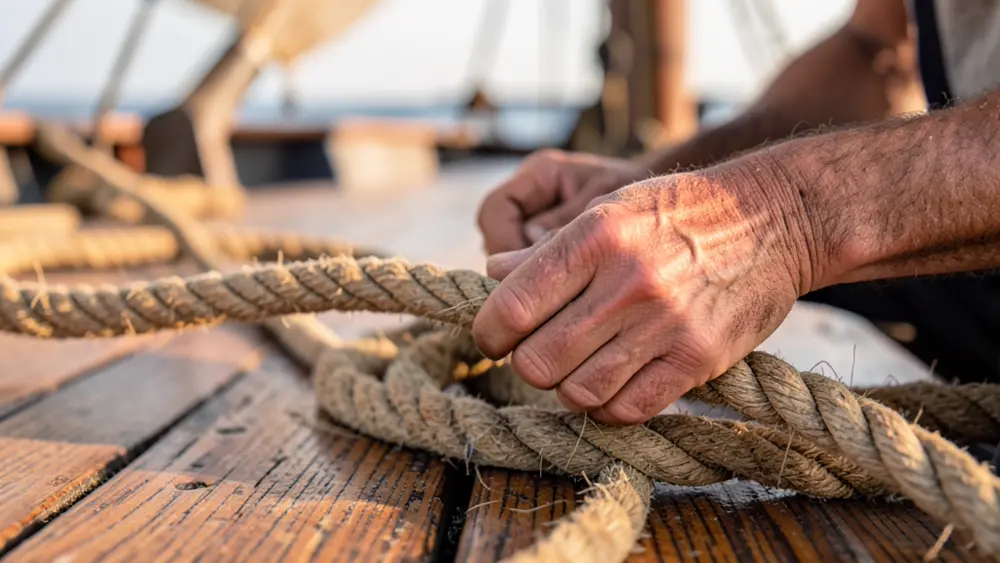
The working life of a whaling crew. Image generated by AI.
The whale means more than a whale
Moby Dick is a real animal in the story, a huge and cunning sperm whale. But almost nobody in the book treats him as just an animal. For Ahab, the whale wears all the evil and unfairness of the world. As Melville writes, Ahab “piled upon the whale’s white hump the sum of all the general rage and hate felt by his whole race from Adam down; and then, as if his chest had been a mortar, he burst his hot heart’s shell upon it.”
For the reader, the meaning stays open. The whale can be nature itself: vast, powerful, and completely indifferent to human plans. His whiteness, usually a symbol of purity, becomes eerie, a blank surface on which every character paints a different fear. That openness is why the book keeps generating new readings. Moby Dick is whatever each generation most needs to confront.
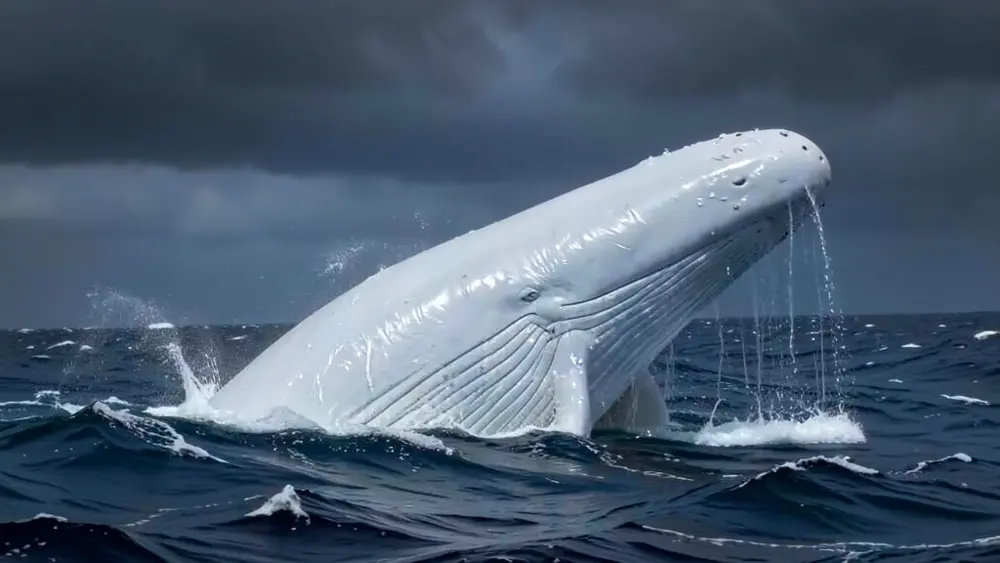
The white whale, surfacing. Image generated by AI.
Why the book keeps interrupting itself
Every reader is warned about the “whale chapters,” and every reader should ignore the warning. Melville regularly stops the story to deliver essays: on the anatomy of whales, the history of whaling, the different species, how to cut up a carcass, even long reflections on the color white.
These chapters do real work. They make Ishmael, and the reader, into experts, so the hunt feels grounded in a true working world. They slow the pulse between bursts of action, building tension for the chase. And they quietly turn the novel into something larger than an adventure: an encyclopedia of one man’s obsession with the sea, where the digressions are the story’s depth. Skim them if you must, but many readers end up loving them best of all.
A floating world: the crew of the Pequod
The Pequod is a small world under sail, and its people are the novel’s warm heart. Queequeg, the harpooneer, is noble, funny, and deeply loyal; his friendship with Ishmael crosses every boundary of culture and language, and it is the book’s great love story, platonic and profound.
Then there is Starbuck, the first mate, a thoughtful Quaker who sees Ahab’s quest as madness and says so, the voice of duty and common sense. Stubb, the second mate, answers the same danger with jokes and a shrug, a survivor’s philosophy. Around them: Tashtego, the proud Native American harpooneer; Daggoo, the towering African harpooneer; and Pip, the young Black cabin boy, whose mind breaks after he is lost at sea and who returns as a kind of innocent prophet. Each responds to Ahab differently, and together they show every way a person can meet the unknown: with reason, humor, courage, or surrender.
The ending, and what it leaves behind
The hunt ends in a three-day chase, some of the most intense pages in all of literature. Moby Dick proves stronger and stranger than any of them imagined, smashing boats and finally the Pequod herself. Ahab, tangled in his own harpoon line, is dragged under by the whale he could not let go. The ship goes down in a great whirlpool, and every soul is lost but one.
Ishmael survives by clinging to Queequeg’s coffin, which floats free and becomes a life buoy, one of the novel’s perfect, terrible images: the thing built for death becomes the thing that saves a life. A passing ship, the Rachel, picks him up. He lives to tell the tale, which is, of course, the book you have just finished. As Ishmael reflects on the lines that bind sailors to their dangerous work, “All men live enveloped in whale-lines,” and the ending lands like a warning about what happens when one line is pulled too tight.
Why 1851 said no, and why we say yes
When Moby-Dick appeared in 1851, readers mostly shrugged. Melville had made his name with lively South Seas adventures like Typee, and the public expected more of the same. Instead they received a sprawling, philosophical, half-essay novel with a bleak ending. Critics called it rambling. Sales were poor, and Melville’s career faded; he died in 1891 largely forgotten.
The revival came in the 1920s, when a new generation of readers and scholars picked the book up and saw what 1851 had missed: a modern novel before modernism, fearless about structure, rich with symbols, and asking questions about obsession, nature, and meaning that had only grown more urgent. Today it sits at the center of American literature, the rare “difficult” classic that repays every page.
It also carries one of literature’s great declarations of purpose, in Ahab’s own voice: “I am the Fates’ lieutenant; I act under orders.” Whether you read it as heroism or madness is the question the novel leaves with you, and it has no comfortable answer.
Why it matters
Moby Dick matters because it takes the oldest story there is, a person chasing something, and shows what the chase costs. It is also a reminder that difficulty is not the enemy of pleasure: the whale chapters, the philosophy, the strange structure are exactly what make the book feel alive more than 170 years later. And it proves that a book can fail completely in its own time and still win the long game, if what it says is true enough.
Related reading
If the 19th-century blend of adventure and big ideas appeals to you, try our summary of On the Origin of Species: Darwin’s Big Idea, Simply Explained, another Victorian classic that changed how we see the natural world.
Frequently asked questions
Is Moby Dick based on a true story?
Loosely. Melville drew on the true wreck of the whaleship Essex, sunk by a sperm whale in 1820, and on sailors’ reports of a real albino whale called Mocha Dick. The characters and the Pequod are his invention.
How long is Moby Dick?
The novel runs 135 chapters. Most modern editions fall between 500 and 650 pages, which puts it at roughly six to eight hours of reading.
Why is the whale white?
Melville devotes a whole chapter to the question. Whiteness can mean purity, but also emptiness and dread; Ahab and the reader alike project their own meanings onto it, which is exactly the point.
Can I skip the chapters about whales?
You can, but try a few first. They are shorter and livelier than their reputation, and they make the hunt scenes hit much harder.
Sources
- Herman Melville, Moby-Dick; or, The Whale (1851), Project Gutenberg ebook 2701, “Public domain in the USA.” gutenberg.org/ebooks/2701
- Open Library work record for Moby Dick, edition page-count data. openlibrary.org/works/OL102749W









0 Comments