

Key takeaways
- A University of Miami team mining environmental DNA has found unknown small viruses whose protein shells sit halfway between viruses and encapsulins, the cell’s own storage compartments.
- The discovery suggests viruses and cellular compartments may have swapped shell blueprints back and forth over evolutionary time, in both directions.
- The work is computational: the viruses were found in DNA databases, not isolated in a lab, so the model is evidence, not proof.
- It adds a new chapter to the old question of whether viruses are alive — but it does not settle it.
Are viruses alive? Biology students have argued about this for a century, and the answer still depends on whom you ask. Viruses cannot grow or make energy on their own, yet they carry genes and evolve like living things. This week a new discovery gave the old debate fresh material: researchers at the University of Miami found previously unknown viruses whose shells look like a halfway point between viruses and the cell’s own protein compartments, suggesting the two have swapped shells back and forth across evolutionary time.
Why the question is hard
Most textbooks list the traits of life: a cell membrane, metabolism, growth, reproduction. Viruses have none of these on their own. They are tiny packages of genetic material wrapped in a protein shell called a capsid. Outside a host cell, a virus is inert, like a letter without a reader. Inside a cell, it springs into action, hijacking the cell’s machinery to copy itself. That split personality is why some scientists call viruses “organisms at the edge of life” rather than dead or alive.
But the line is blurry. In 2013, the discovery of giant Pandoraviruses, with genomes bigger than some bacteria, was called a missing link between viruses and cells. That framing was about genome size. The new discovery is about something more fundamental: the shell itself.
Encapsulins: the cell’s own shells
Inside bacteria and archaea, there are small protein compartments called encapsulins. They are shells built by the cell, for the cell. Encapsulins store iron, help with sulfur metabolism, and protect against oxidative stress. They look like viral capsids under the microscope: geometric, hollow, precisely assembled.
That resemblance is not a coincidence. Both are built from a protein fold called the HK97 fold, named after a bacteriophage protein. Outside the world of viruses, the HK97 fold is found only in encapsulins. For years, the leading idea was that encapsulins descended from viral capsids: at some point in history, cells borrowed a viral shell and put it to work.
But there was a puzzle. The viral capsids we know are elaborate, complex structures. Encapsulins are simpler. If the simple shell evolved from the elaborate one, something is off. It is a bit like arguing that a simple cabin was built by stripping down a cathedral. The puzzle led the Miami team to go looking for simpler viruses that nobody had noticed.
What the team found
The researchers, led by PhD student Abelardo Aguilar and associate professor Antoni Luque, mined huge environmental DNA databases: samples from soil, seawater, wastewater, and human guts. They used hidden Markov models, protein language models, AlphaFold, and biophysical modelling to hunt for small viruses with the HK97 fold that previous searches had missed.
They found them. The new viruses are small, with simpler genomes than other HK97-fold viruses, and their shells share features with both viruses and encapsulins. In particular, the new viral genomes lack the portal and tail genes that full HK97 viruses carry, and encapsulins structurally resemble procapsids, the immature form of a viral capsid. When the team built evolutionary trees, viral and encapsulin proteins did not form two clean branches. They mixed together.
The proposed answer: the two have evolved from one another repeatedly, in both directions. A viral shell could be domesticated into a cellular compartment; a cellular compartment could be co-opted back into a virus. The team suggests that the procapsid, the unfinished shell, is the form that makes this back-and-forth possible. It is a two-way traffic model of evolution, replacing the old one-way story.
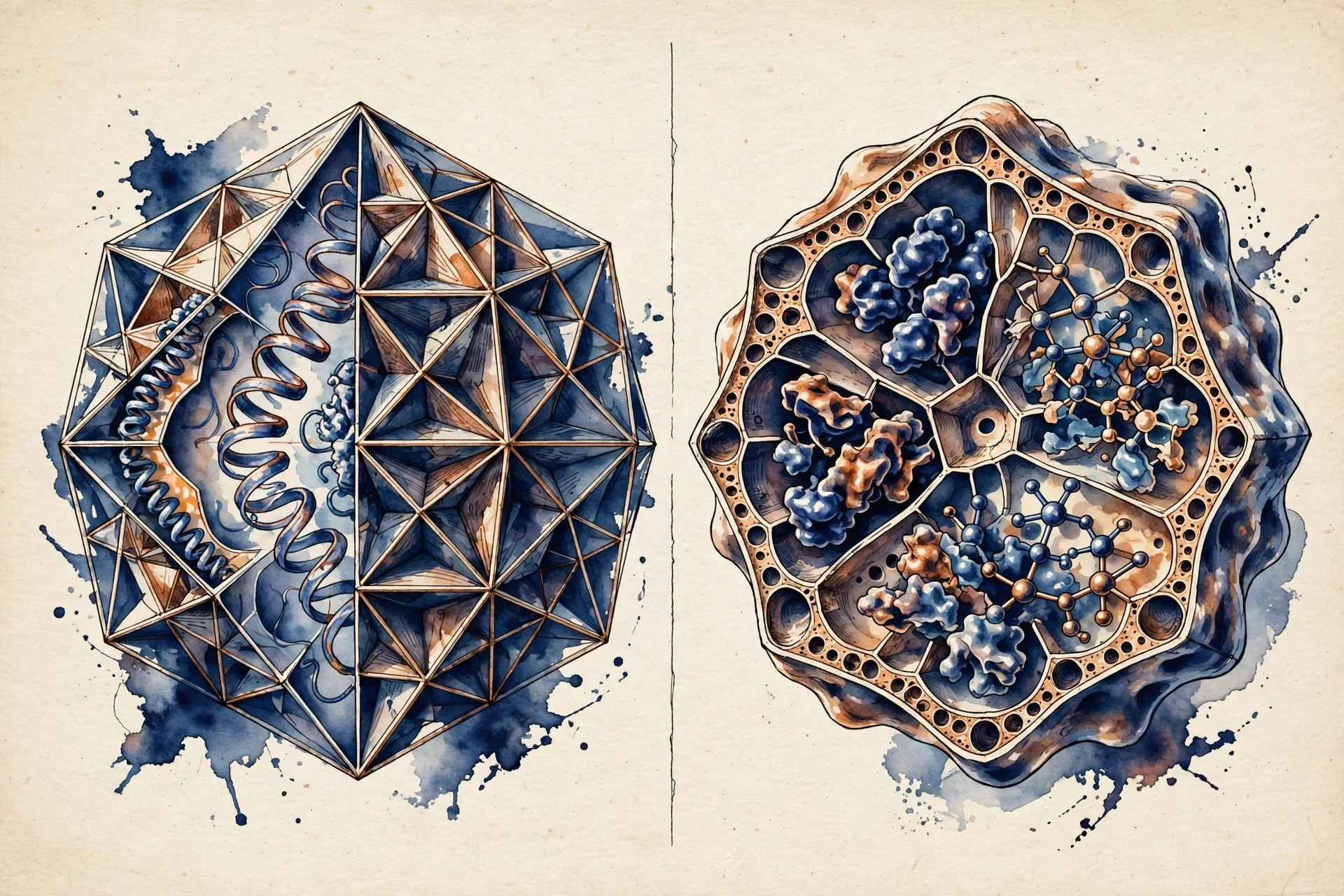
A viral capsid (left) and an encapsulin, the cell’s own protein compartment (right). Both are built from the same HK97 protein fold. Image generated by AI.
Are viruses alive? What this changes, and what it does not
The finding sharpens one side of the debate. If viruses and cells have been trading shell designs for billions of years, then viruses are not alien intruders standing outside biology. They are woven into the same fabric, sharing parts with the machinery of cells. That is a philosophical nudge toward the “alive” side.
But honest caveats matter, and the researchers do not hide them. The new viruses were discovered in databases. They were not isolated, grown, or observed in a lab. Their hosts are unknown. The model is built from patterns in sequences and structures, not from watching a virus become a compartment or the reverse. It is a plausible reconstruction, not a proven chain of descent, and it does not settle how viruses began, let alone how life began.
Some of the bolder extensions are predictions, not results. One idea is that viral shells might facilitate chemical reactions in nature, doing chemistry rather than just delivering genes. That is an inference from the model. It has not been demonstrated. The paper’s authors present it as a direction for future work, and that is exactly what it is.
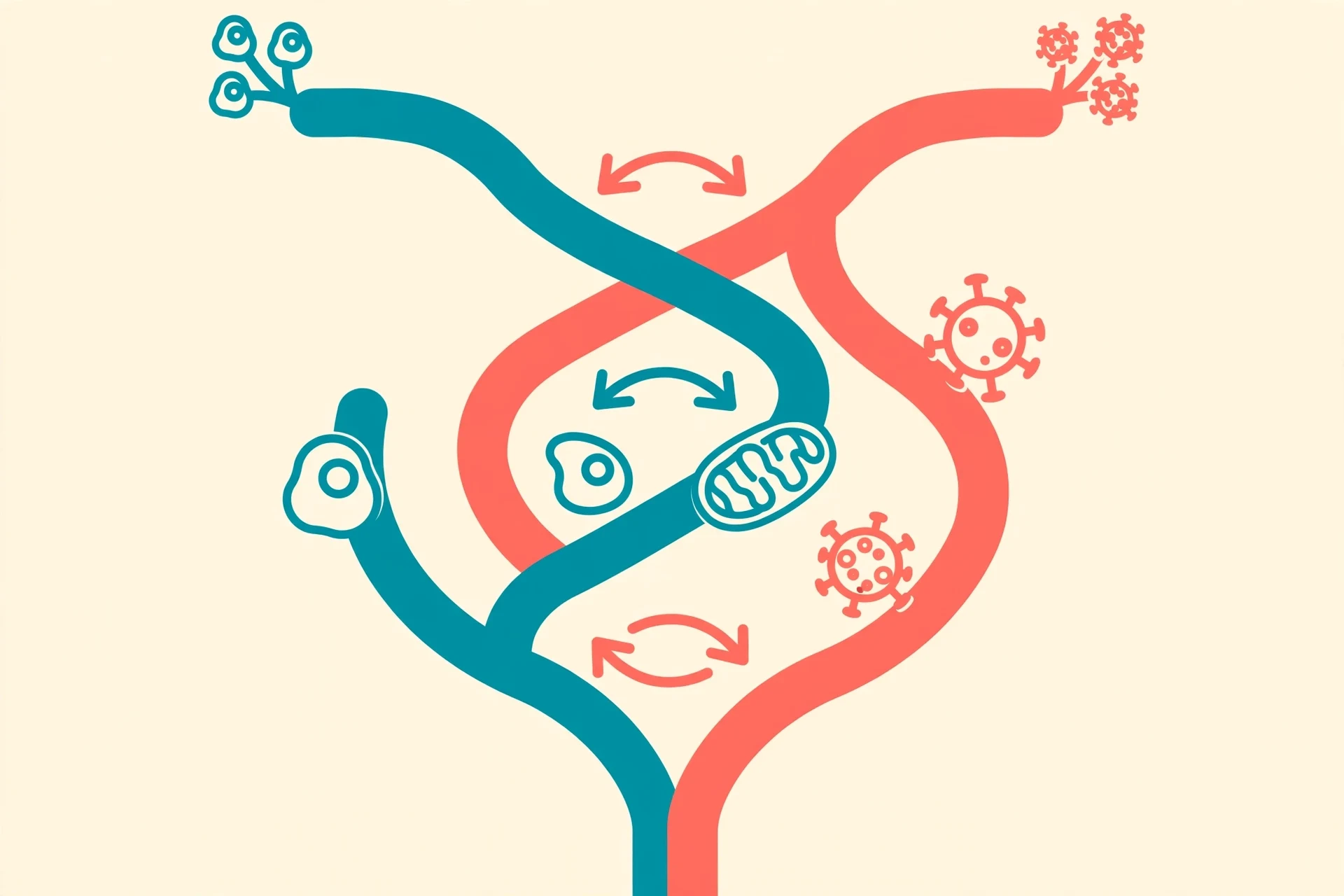
The new model: viruses and encapsulins traded shell designs back and forth across evolutionary time. Image generated by AI.
Why it matters
The question “are viruses alive” matters because it shapes how we look for life elsewhere and how we classify what we find. If the boundary between viruses and cells was always porous, then life is less a list of members and more a shared toolkit of parts, swapped and repurposed across billions of years. The Miami team’s two-way model also has a practical side: it tells virologists to pay more attention to virus-like particles that do not infect anything, which have been largely ignored. The smallest discoveries in the DNA databases may turn out to be the most revealing about how biology works.
Related reading
For another story about what only microbes can build, read Vitamin B12: The Vitamin Only Microbes Can Make, on the vitamin no animal or plant can make on its own.
Frequently asked questions
So are viruses alive or not?
There is no official answer. Viruses cannot reproduce or make energy without a host cell, which argues against them being alive. But they evolve, carry genes, and now appear to share shell designs with living cells. Most biologists treat them as “at the edge of life.”
What is an encapsulin?
A protein compartment built by bacteria and archaea to carry out chemistry, such as storing iron or handling oxidative stress. They are made from the same HK97 protein fold as many viral shells, which is why the two are compared.
Did the researchers discover these viruses in nature?
Not exactly. They discovered them in environmental DNA databases, using computational models. The viruses have not been isolated or grown in a lab, and their hosts are unknown. The findings are strong evidence for the model but not direct observation.
Sources
- Aguilar, A., Miranda Perez, I., Nadel, O. et al. “Small viruses reveal bidirectional evolution between HK97-fold viruses and encapsulins via procapsids.” Nature Communications 17, 10571 (2026). doi.org/10.1038/s41467-026-78136-1
- University of Miami press release, October 14, 2026: “Newly discovered viruses reveal an evolutionary missing link.” news.miami.edu
- phys.org, October 15, 2026: “Newly discovered viruses reveal an evolutionary missing link.” phys.org
- The Daily Inference, October 16, 2026: “Same Box, Different Contents: Viruses and Cells May Have Swapped Shells.” dailyinference.news
- Koonin et al., “Multiple origins of viral capsid proteins from cellular ancestors.” PNAS 2016. PMC5373398







0 Comments