

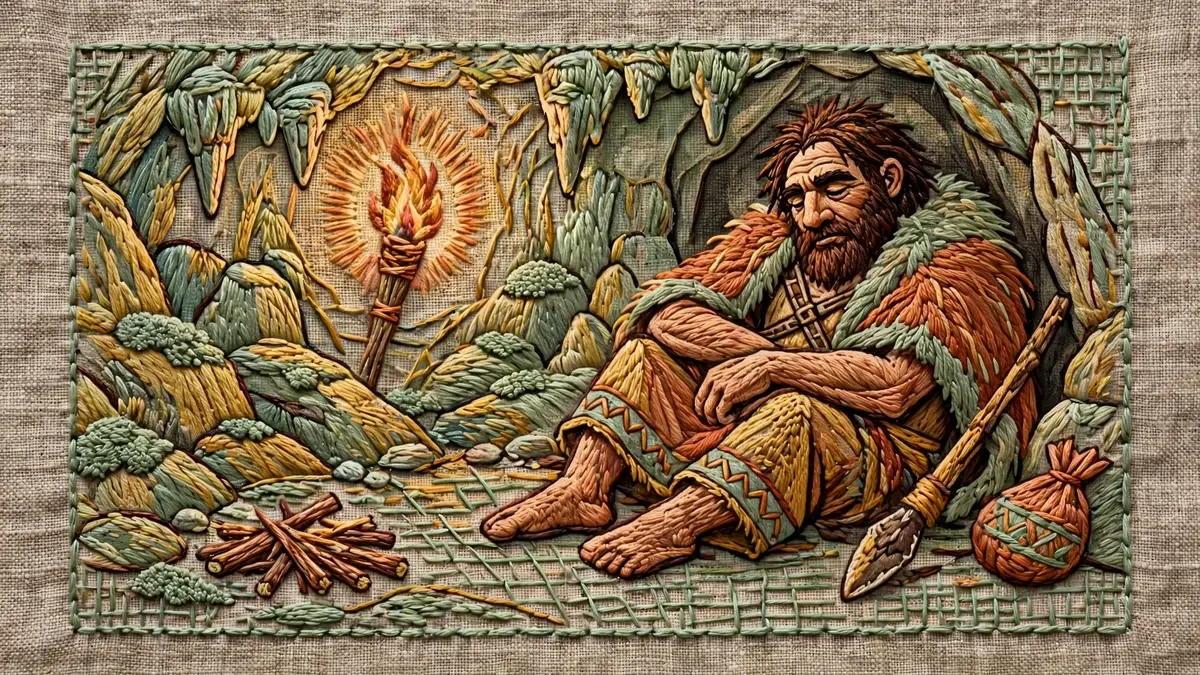
Source: Scientific Reports, by Emma Pomeroy et al., published October 15, 2026. Text adapted under CC BY 4.0.
Key takeaways
- A new 75,000-year-old Neanderthal skeleton from Shanidar Cave, dubbed Shanidar A, has a near-perfect 15-millimetre hole in the left shoulder blade, consistent with a wooden spear punched through the chest.
- Forensic analysis shows the wound happened around the time of death and was likely fatal. Whether it was a hunting accident or an act of violence cannot be known.
- The same individual had earlier survived a badly shattered tooth, hinting that Neanderthals looked after their injured.
- The body was laid among a tight cluster of burials, reopening the famous debate about Neanderthal funerary behaviour at Shanidar.
Seventy-five thousand years ago, in a cave in what is now northern Iraq, a Shanidar Neanderthal died with a hole through the shoulder. When scientists examined the bone with forensic tools, the story written into it was striking: a rounded wooden spear had driven through the shoulder blade from the front, straight into the chest, and it may be the oldest evidence yet of a human ancestor killed by a wooden spear. The same individual had also survived a terrible mouth injury years earlier, and the body was laid to rest among other dead, reopening a famous debate about Neanderthal burials.
The Shanidar Neanderthal’s 15-millimetre hole
Shanidar A, as the team calls the new individual, is only partially preserved: parts of a hand, ribs, teeth, and the left shoulder blade (scapula). But the scapula is extraordinary. It carries a near-perfect circular perforation about 15 millimetres across, cut through the thin flat part of the bone known as the infraspinous fossa. At least three fractures radiate outward from the hole, like cracks spreading from a bullet impact in glass. Using micro-computed tomography, the team ruled out the usual suspects, such as plant roots or insect burrows. They even found four small bone fragments embedded in the sediment below the hole, one of which fitted back into the perforation.
The angle of the wound tells the story of the strike. The hole is bevelled on the back (dorsal) side of the bone, which marks it as an exit wound. That means the weapon entered from the front (ventral side) and travelled through the chest, probably piercing the lungs and possibly major blood vessels. The wound would likely have caused a rapid death.
There was no bone healing around the hole. Bone starts to remodel within weeks of an injury, so the absence of any repair means the wound was inflicted around the time of death: it was perimortem, not an old injury the person lived with.
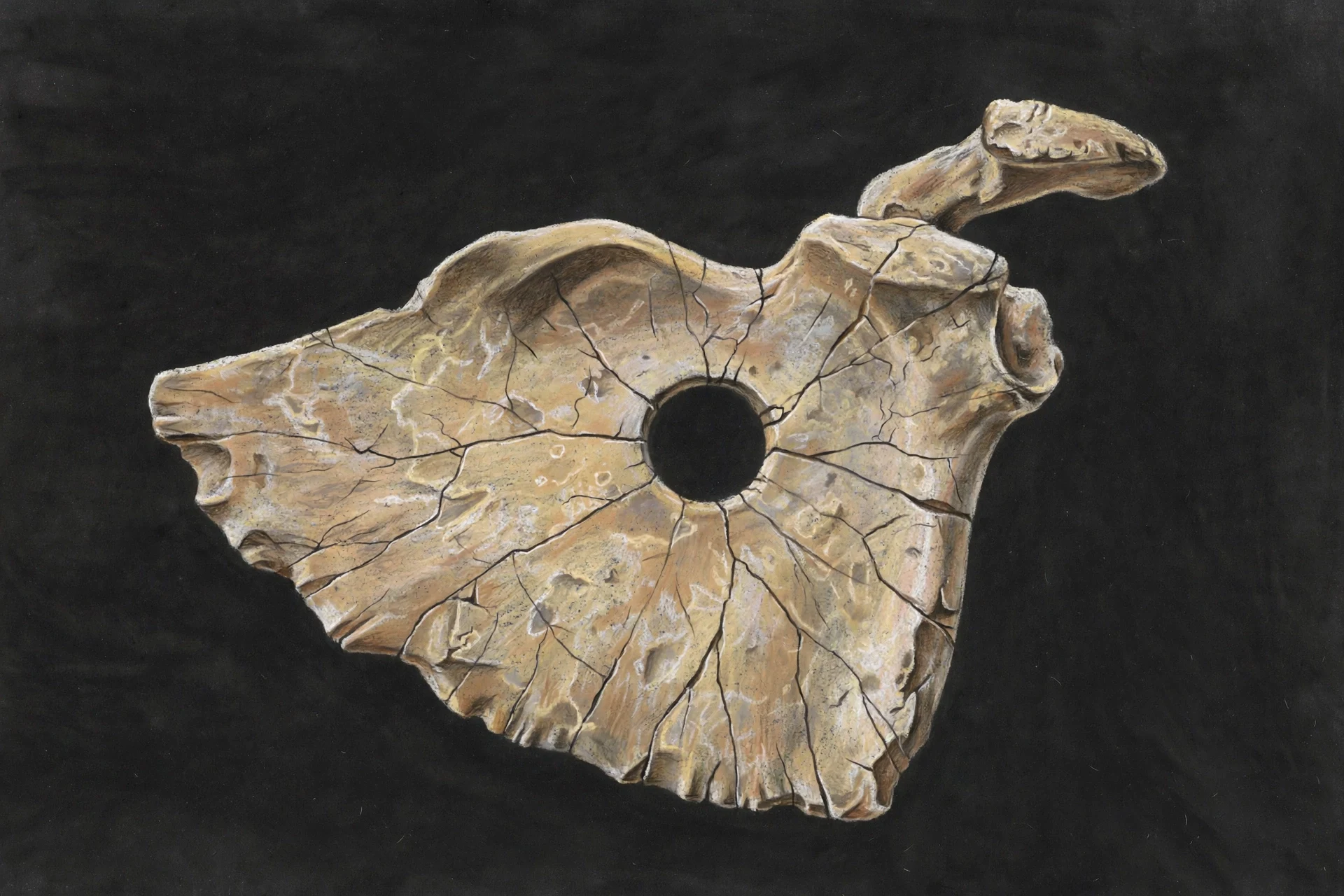
The Shanidar A shoulder blade, with its near-perfect circular perforation and radiating fractures. Image generated by AI.
A wooden spear, not a stone-tipped weapon
Why a wooden spear? The shape of the hole is the key. Stone-tipped weapons typically leave oval or lozenge-shaped holes. This hole is near-perfectly circular, matching what a rounded wooden projectile would make. The researchers recreated similar wounds in experiments with wooden projectiles, which produced lesions of the same shape. Wooden spears themselves are ancient: examples survive from Clacton-on-Sea in England and Schöningen in Germany, dating back hundreds of thousands of years, so the technology was well within the Neanderthals’ world.
There are limits to this reading, and the paper states them plainly. No spear tip was found in the bone, so the wooden-spear identification rests on the experimental comparison. The authors also note that they have further experimental work under way to test whether the features could come from high-energy versus low-energy impacts. And the biggest question of all, whether the wound “resulted from something like a hunting accident or from interpersonal violence, cannot be known.” A press release quotes Emma Pomeroy calling it a “kill shot directed at the heart,” but that is a quote to attribute, not a fact established by the bone.
An earlier injury that tells of care
Long before the fatal wound, Shanidar A survived another ordeal. A lower left incisor (SH 0230) was split along its length, with half of the tooth lost entirely. Yet the tooth stayed in the mouth and in use: a layered coating of dental calculus and continued chewing wear over the damage show the person carried on eating with the broken tooth. The paper notes that the facial injury “may have also required a level of care during the period of recovery.”
This matters because it adds to a pattern. Shanidar’s famous older finds already include individuals who lived for years with severe disabilities, something only possible if others helped them. Shanidar A seems to have been cared for too.
The burial cluster and the flower-burial debate
The body was not found alone. Shanidar A was laid reclining on the back, head pointing east, among a tight cluster of dead: Shanidar 4, 6 and 8 (adults) and Shanidar 9 (an infant) from the 1960 excavations, plus Shanidar Z, A and B from the recent digs. All date to roughly 70,000 to 75,000 years ago and were packed into an area about 1.5 metres by 1 metre, behind a large fallen boulder.
That tight arrangement reopens one of archaeology’s most famous arguments. In 1975, the excavator Ralph Solecki announced a “Neanderthal flower burial”: pollen around Shanidar 4 was read as evidence that flowers had been laid on the body. Later researchers challenged the claim, and this new paper states that the flower-burial theory “has not stood up to further scrutiny.” What remains, though, is strong evidence that the bodies were placed in sequence, one after another, before the earlier dead had fully decomposed. Whether or not there were flowers, the team argues that the cluster represents intentional funerary behaviour.
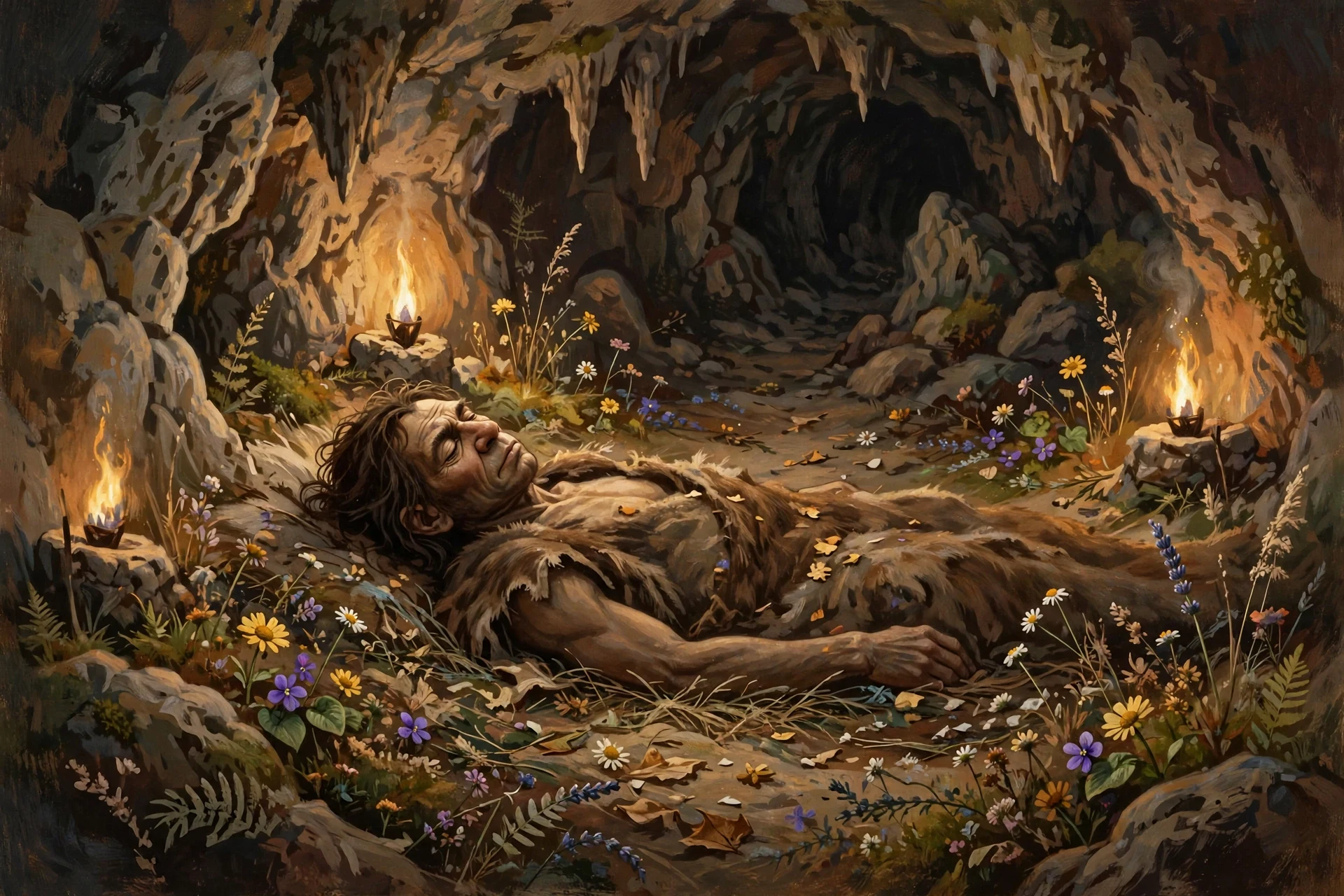
An artist’s impression of a Neanderthal burial in Shanidar Cave, where the flower-burial debate began. Image generated by AI.
Hunting accident or violence?
It is worth pausing on the paper’s honesty here. The wound is dramatic, and the imagination races to a scene of conflict. But the science does not pick a story. Shanidar 3, a Neanderthal found in the same cave about 25,000 years later, carries a different chest wound, one interpreted as coming from a stone-tipped projectile. The team could not say whether either person died in a hunting accident or at the hands of another human. A hunting accident seems at least as plausible: wooden javelins were the tools Neanderthals used to take down ibex and other prey, and a hunting spear gone wrong would leave exactly this kind of wound.
Why it matters
One skeleton does the work of several arguments here. The spear wound gives us possibly the oldest glimpse of a wooden spear killing a human ancestor. The healed tooth adds another line to the evidence that Neanderthals cared for their injured. And the burial cluster keeps open a fifty-year debate about what Neanderthals did with their dead. Put together, Shanidar A is a portrait of a species that could both kill and tend, both wound and honour, and the team keeps the boundary between evidence and interpretation admirably clear.
Related reading
For another story of ancient texts and modern forensics, read Herculaneum Scrolls: How Lead Ink Could Unlock Buried Texts, where scientists used X-rays to read carbonised Roman scrolls.
Frequently asked questions
Where is Shanidar Cave?
Shanidar Cave is in the Zagros Mountains of northern Iraq (Iraqi Kurdistan), about 400 kilometres north of Baghdad. It was first excavated by Ralph Solecki’s team in the 1950s and 1960s, and a new international team has been digging there since 2015.
How do scientists know the wound was from a wooden spear?
The hole is near-perfectly circular, which matches wooden projectiles; stone-tipped weapons usually leave oval holes. The team reproduced similar lesions experimentally with wooden projectiles. No tip was found, so the identification is based on that comparison, and further tests are planned.
Did Neanderthals really bury their dead with flowers?
The famous “flower burial” was proposed in 1975 based on pollen found around Shanidar 4. The new paper states the theory “has not stood up to further scrutiny.” But the sequence of bodies placed one after another still suggests deliberate funerary behaviour, flowers or not.
Sources
- Pomeroy, E. et al. “Evidence for funerary behaviour and lethal trauma in a new Neanderthal individual from Shanidar Cave.” Scientific Reports 16, 30042 (2026). https://www.nature.com/articles/s41598-026-69193-z
- Liverpool John Moores University press release, October 16, 2026. ljmu.ac.uk — Shanidar
- Archaeology Magazine, October 15, 2026: “Wound in 75,000-Year-Old Neanderthal Shoulder Blade.” archaeologymag.com










0 Comments