

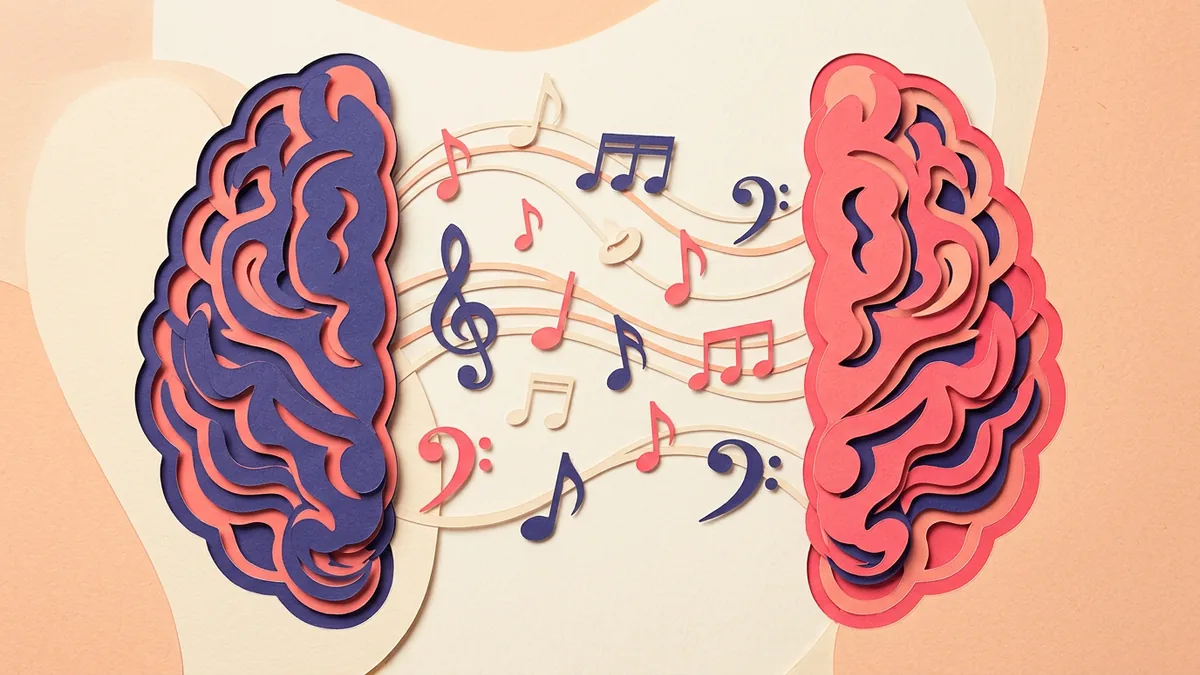
Adapted from “Music Training Changes How Our Brains Read Music” by Sara Tze Kwan Li and Wing Yung Wong in Frontiers for Young Minds, published June 29, 2026, under a Creative Commons licence (CC BY 4.0). Frontiers and the authors are not contributors to TeaLamp and do not endorse it or its use of their work. Changes: rewritten for general adult readers; condensed methods; TeaLamp Key takeaways, Why it matters, FAQ, Sources and related reading added; section headings rewritten. Prepared by the TeaLamp Editorial Team with the help of AI.
Key takeaways on music training and the brain
- Music training changes how people read musical notation: experts, learners and non-musicians rely on different brain-side strategies.
- In a Hong Kong study of 97 young adults, trained musicians performed similarly whether musical cues arrived via the left or right visual field — a sign both hemispheres were engaged.
- Music learners leaned left-hemisphere (detail-focused); non-musicians leaned right-hemisphere (shape-focused).
- Among musical-sophistication scores, formal music training — not singing ability or casual listening — was the factor tied to how lateralised music reading became.
- The authors argue music training is a demanding cognitive workout, not only a leisure pastime.
Can years at the piano rewire how you read a score? A Frontiers for Young Minds digest of peer-reviewed research says music training does more than polish technique: it shifts which side of the brain shoulders the work of matching notes, chords, rhythms and expressions. For anyone who has stared at a stave and felt lost — or fluent — the pattern is surprisingly orderly.
Why reading music is harder than it looks
Playing music packs many mental jobs into the same moment: decoding symbols, listening to pitch, counting time, coordinating eyes and hands, and sometimes syncing with other players. Psychologists call these cognitive tasks. The brain’s two hemispheres are not carbon copies. Language in English, for example, often leans left; face recognition often leans right. When one side has an edge on a task, researchers call it hemispheric lateralisation.
Experience can move that balance. Earlier work found musicians used both hemispheres more evenly when listening to music, while non-musicians stayed more right-lateralised. The Hong Kong team asked a sharper question: does music training also change how we read music on the page?
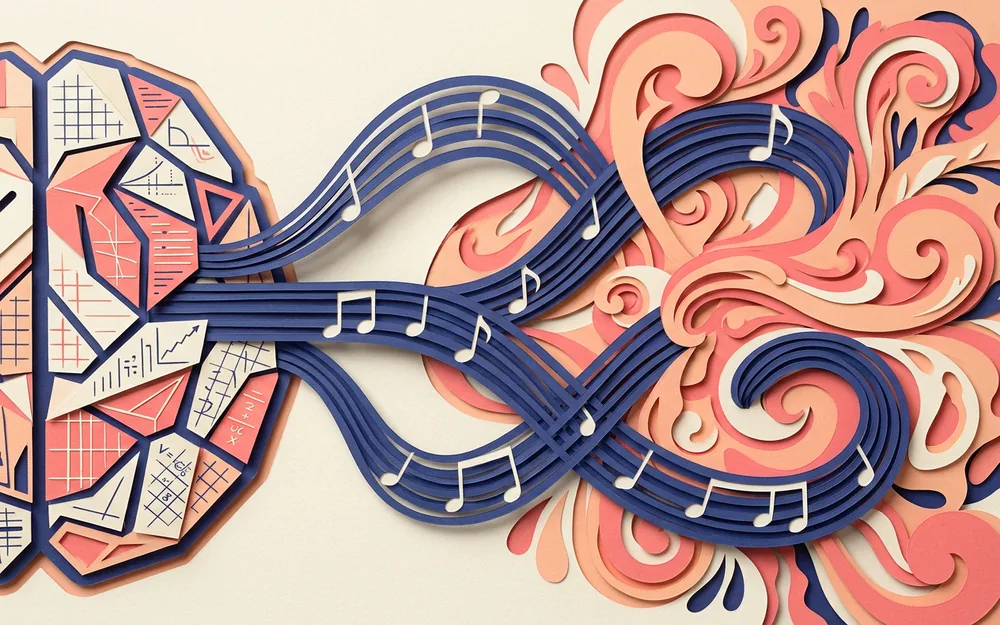
Image generated by AI
Three groups, one matching game
Researchers recruited 38 musicians, 26 music learners and 33 non-musicians, mostly aged about 20–21, from Hong Kong. Groups were similar in language background, education, handedness and memory. Musicians typically held ABRSM Grade 8 or higher, had started around age six, and averaged fourteen years of playing. Learners held roughly Grades 2–5, started near age eight, and averaged eight years. Non-musicians had no formal Western-instrument training and did not read scores.
Everyone completed matching tasks with single notes, chords, rhythms and musical expressions, plus the Goldsmiths Musical Sophistication Index questionnaire. On each trial, symbols flashed briefly in the left and right visual fields while an arrow marked which side was the target; a second symbol then appeared at centre. Participants judged “same” or “different.” Because the left visual field projects more strongly to the right hemisphere (and vice versa), better performance on one side hints which hemisphere is carrying the load. An eye-tracker checked that people kept their gaze centred so the trick would work.
How music training reshapes score reading
Musicians judged matches about equally well whether the first target came from the left or right field — consistent with both hemispheres contributing. Music learners did better when the target arrived via the right visual field / left hemisphere, a pattern the authors link to detail focus (lines and spaces on a score). Non-musicians did better via the left visual field / right hemisphere, as if leaning on overall shapes.
When the team looked across Goldsmiths scores, music training stood out as the component related to how strongly one side dominated. Active engagement, perceptual skill, singing, emotion and general sophistication did not show the same link. More training tracked with a stronger left-side tendency in music reading — possibly because formal training weaves listening, perception, reading and motor coordination into one complex skill set.
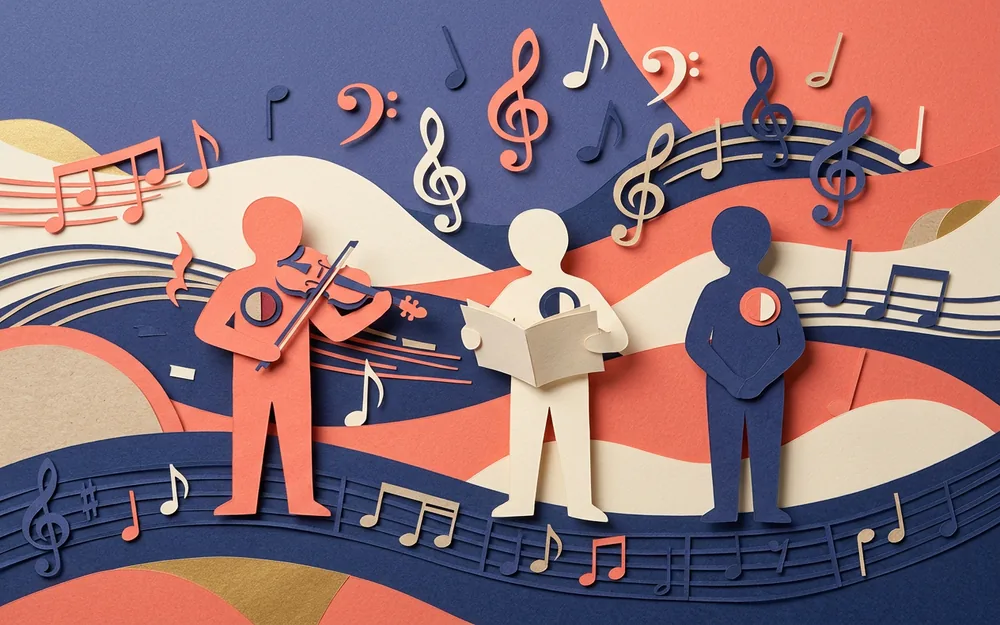
Image generated by AI
Why it matters
Classroom debates often treat music as enrichment. This study frames music training as brain-plastic evidence: expertise does not only make you faster; it can change which circuits you recruit. For parents, teachers and adult beginners, the takeaway is modest but useful — structured practice leaves a measurable fingerprint on how the brain reads symbols that once looked like squiggles.
Related reading
For another TeaLamp dive into sound and culture, see Hooked on Sonics: Experimenting with Sound in 19th-Century Popular Science.
Frequently asked questions
Does music training only help musicians?
The study compares musicians, learners and non-musicians on music-reading tasks. It does not claim music training cures unrelated cognitive problems; it shows lateralisation patterns shift with expertise.
Is the left brain “logical” and the right “creative”?
That slogan is too neat. Hemispheres specialise for some jobs, but many tasks — including expert music reading — recruit both sides working together.
Where was the original research published?
The FYM article digests Li’s 2024 paper in Frontiers in Cognition (doi: 10.3389/fcogn.2024.1403584). FYM and the research article are open access under CC BY.
Sources
- Li & Wong, Frontiers for Young Minds (2026) — primary adapted source (CC BY 4.0).
- Li, S. T. K. (2024), Frontiers in Cognition — original research article.
- Müllensiefen et al. (2014), PLOS ONE — Goldsmiths Musical Sophistication Index.










0 Comments