

Originally published by Lucas Thompson in The Public Domain Review on October 23, 2025, under a Creative Commons licence (CC BY-SA 4.0) (“The text of this essay is published under a CC BY-SA license”). Republished here under that licence. This adaptation is shared under the same licence (CC BY-SA 4.0). The Public Domain Review and the authors are not contributors to TeaLamp and do not endorse it or its use of their work. The essay looks at how Victorian science books left readers hooked on sonics. Changes: formatting, image captions rewritten, footnote markers omitted (see the original), a section on spiritual ideas about sound and its three illustrations left out, and a short “Key takeaways” section added by TeaLamp. All five illustrations are from public-domain books. Prepared for TeaLamp by the TeaLamp Editorial Team with the help of AI.
In 1777, the German physicist Ernst Chladni, who would later be crowned the Father of Acoustics, designed an experiment that revolutionized our understanding of sound. After placing grains of sand on a thin metal plate and drawing a violin bow along one edge, Chladni watched in wonder as the sand danced and jiggled into surprising shapes — all perfectly even and symmetrical, but changing their formations depending on how the bow was used. In their beauty and complexity, these shapes (which the physicist himself cannily called “Chladni figures”) seemed to be arranged by invisible hands. In one simple and elegant experiment, sound had become visible.
Here at last was clear proof that sound was not produced by generating tiny particles of matter within air, as the dominant theorists of the seventeenth and eighteenth centuries had insisted, but was instead the result of vibrations from waves. While earlier claims about the wave-like properties of sound (which in fact date back to Aristotle’s Physics) had fallen mostly on deaf ears, Chladni’s experiment provided undeniable evidence that sound was caused by waves that could move through both air and matter.
Chladni’s ingenious demonstration also showed that sound could be observed in a variety of new ways, and would no longer be consigned to the invisible aether. Moreover, it was an easy experiment to replicate for anyone who could get their hands on a copper plate, a violin bow, and some sand. In fact, it was so widely reproduced that, in 1901, Annie Besant and Charles Leadbetter, in their wonderful (and completely bizarre) theosophical study Thought-Forms, could write that Chladni figures were “already familiar to every student of acoustics”, being “continually reproduced in every physical laboratory”.
The students of acoustics Besant and Leadbetter had in mind were educated through a vast collection of primers, textbooks, and popular introductions to science that were widely read across the nineteenth century. Despite being little known today, such texts were part of an important wave of science popularization, whose authors, according to the historian Bernard Lightman, “saw themselves as providing both entertainment and instruction to their readers”. Written for a growing middle-class audience, such books and periodicals gave detailed descriptions of groundbreaking experiments, encouraging readers to imagine their own homes as sites of scientific discovery and playful experimentation. Genuine learning and rich enjoyment, these books proclaimed, could be had within the home, and any reader with patience, curiosity, and some basic equipment could follow along with the latest scientific revelations.
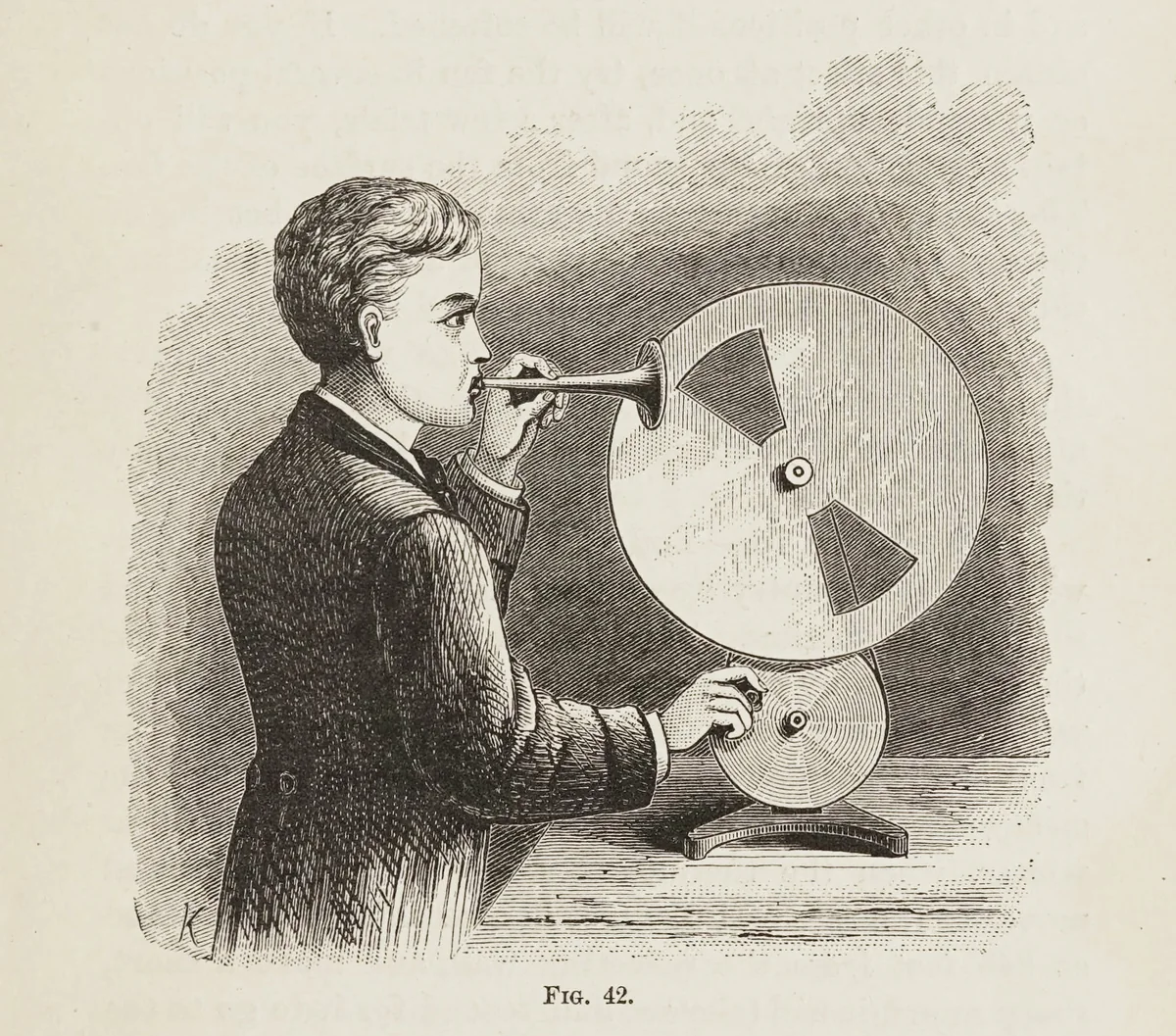
An experiment demonstrating the reflection of sonic vibrations, from Alfred Marshall Mayer’s Sound (1879). Public domain, via The Public Domain Review.
In fact, even children could do so, and the experiments in these books were democratically pitched to the whole family. Although they ranged over many scientific disciplines — including chemistry, optics, physics, magnetism, and astronomy — it is their presentation of the emerging subfield of acoustics that is particularly intriguing, since it reveals many facets of nineteenth-century culture. These books speak to a widespread amateur fascination with science and reveal a desire to initiate even the very young into a world of intellectual discovery and delight. In doing so, they set forth a new model of learning — based on play, beauty, and pleasure — that anticipates many later approaches to education. These popularizing books also offer a vision of science that has now largely been forgotten. While, in our own time, scientific understanding is usually thought of in terms of detachment and objectivity, here beauty and knowledge were often intertwined. Finally, and perhaps most unexpectedly, these books prompted readers to reflect on questions of spirituality and transcendence, since they positioned the science of acoustics as a fresh avenue for moving beyond the material plane.
The Century of Sound
These sonic experiments reflected new listening practices and new theories of sound that unfolded across the nineteenth century. It is a century that has been described by the literary critic John Picker as the “auscultative age”, extending the term that René Laennec coined for the invention of his stethoscope to describe the Victorians’ “careful listening to a world at large — and in flux”. The century also saw the birth of technologies designed to amplify, transmit, and record sound — the self-performing player piano, the phonograph, telephone, and radio, for instance. Of all the senses that the Victorians cultivated, it was the sense of hearing that experienced the most dramatic transformation. The Victorians, according to Jonathan Sterne, underwent what he terms “ensoniment”: an acoustic Enlightenment.
Part of this transformation included a new understanding of children’s sensitivity to sound. In his 1878 essay “Child’s Play”, Robert Louis Stevenson argued that children’s hearing is far more acute and developed than their other senses. He suggests that while children “have no great faculty for looking” (since “they do not use their eyes for the pleasure of using them, but for by-ends of their own”) and have a “sense of touch” that is not “so clean and poignant . . . as it is in a man”, both their hearing and their sense of smell are superior and “more developed” to that of their elders. But Stevenson was also convinced that the child’s naturally superior hearing could be further cultivated. For all the freshness of sound to a child, he wrote, “hearing is capable of vast improvement as a means of pleasure; and there is all the world between gaping wonderment at the jargon of birds, and the emotion with which a man listens to articulate music.” The writers of these popular books of science for children may well have shared Stevenson’s conviction: they, too, wanted to educate the ears and minds of young readers, allowing them to experience and understand sound with greater precision and sensitivity.
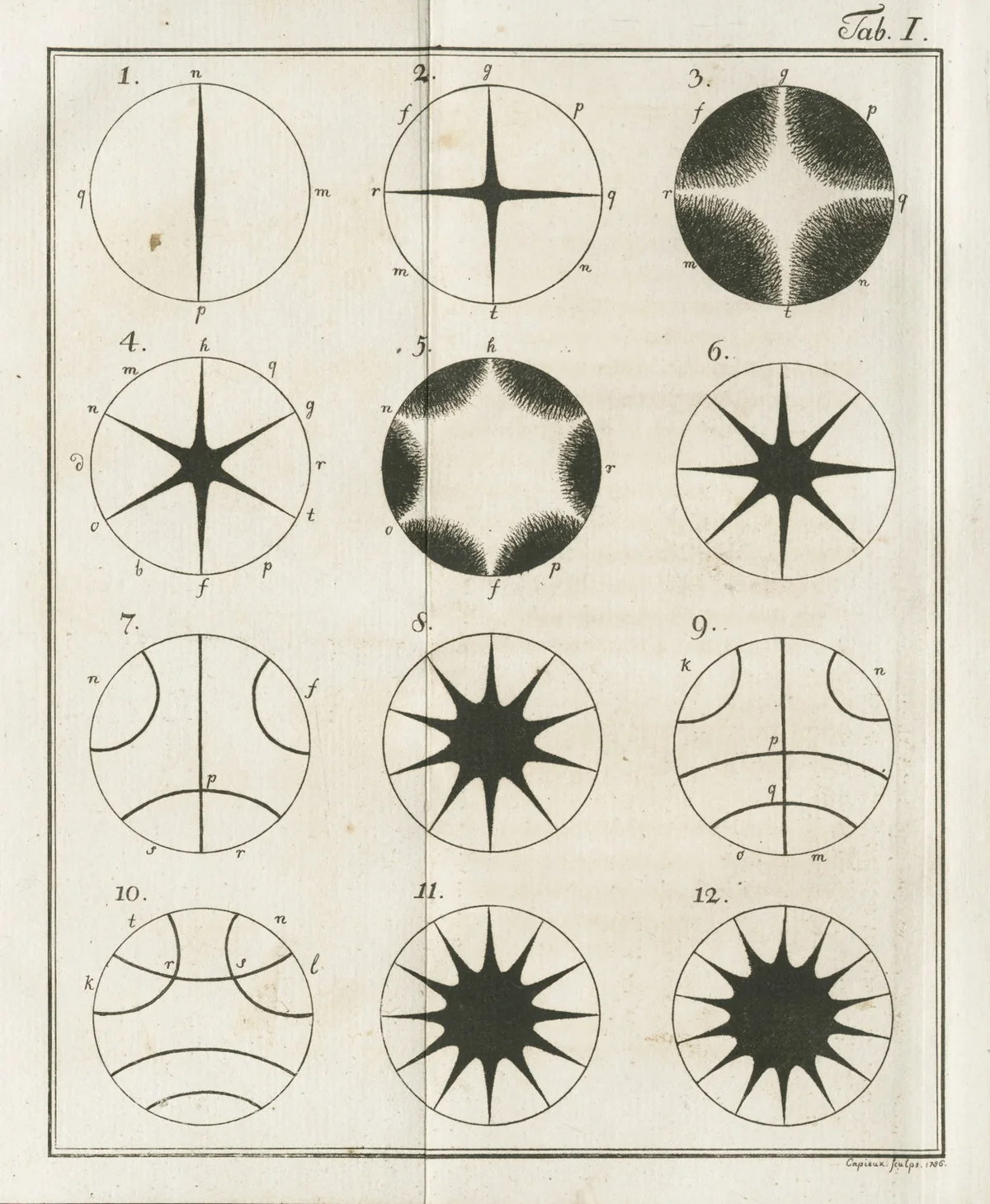
Diagram of Chladni’s figures from Entdeckungen über die Theorie des Klanges (1787). Public domain, via The Public Domain Review.
Middle-class families of this era often read aloud to one another from novels, poetry collections, newspapers, and periodicals — that is, even printed texts were very often experienced sonically, suggesting yet another everyday aspect of Victorian listening. But the long evenings of the pre-electric nineteenth century also allowed ample time for other pursuits, including amateur science. The authors of these books stressed that their experiments could be carried out by the entire family, and even the smallest children need not miss out on the fun.
Playful Discovery
And there was indeed fun to be had. Clearly, part of the appeal of these experiments was in their sheer entertainment value. These books often use the language of “scientific amusements”, “scientific recreations”, and even scientific “parlour magic” to stress how diverting and delightful science could be. A young child might easily create intricate “acoustic curves” with the help of a basic pendulum, or construct a small siren that allowed for instructive observations on differences in pitch. The books contained advice for finding and listening to various kinds of harmonics, vibrating cords, and for observing sounds being reflected by small flames. Even a very simple experiment, such as swinging a whistle around on a string at various speeds, could yield valuable knowledge about vibration and frequency.
Arabella Buckley’s whimsical Fairy-Land of Science (1879), for instance, encourages children to experiment with all manner of scientific principles, and her chapter “The Voices of Nature and How We Hear Them” included details of many intriguing sonic demonstrations. At one point, she instructs her readers to “take a poker and tie a piece of string to it, and holding the ends of the string to your ears, strike the poker against the fender.” After noting the way the sound travelled through the string, she then invites children to hold the string in their teeth and block their ears, demonstrating the power of bone to conduct sound waves in a simple — but surely unforgettable — experiment. Elsewhere, she explains how birds produce such complexly beautiful trills and calls, and explores other miracles of the natural world. Like many popular science writers of the era, she encourages her young readers to poke around in their own ear to investigate its features: “Put your finger round your ear and feel how the gristly part is curved towards the front of your head”, Buckley writes. “This concha makes a curve much like the curve a deaf man makes with his hand behind his ear to catch the sound.” By following her lead, anyone could acquire anatomical as well as acoustic knowledge.
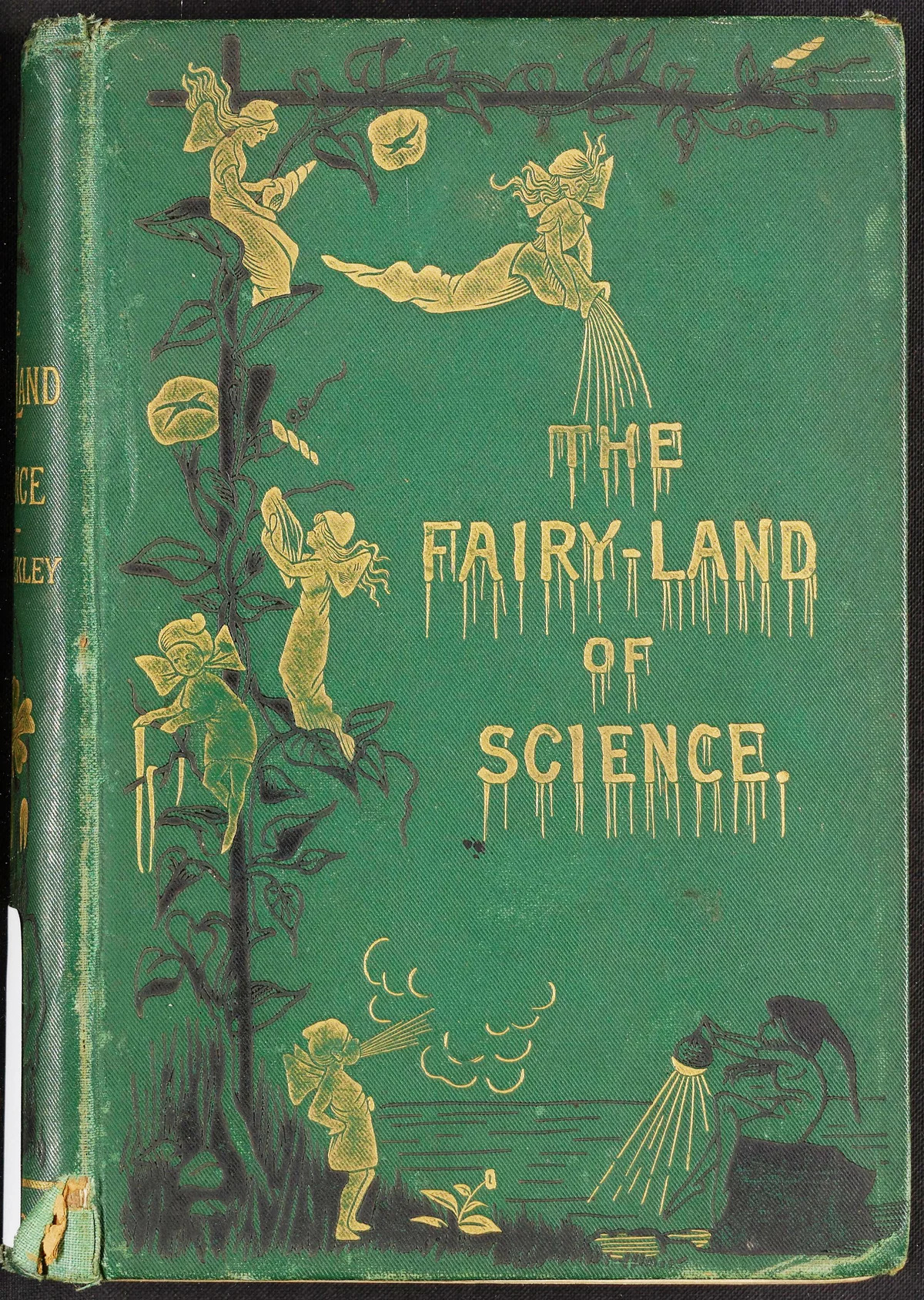
Cover of Arabella Burton Buckley’s The Fairy-Land of Science (1883), ten scientific lectures for children. Public domain, via The Public Domain Review.
Written in the same spirit of playful discovery, John Henry Pepper’s The Boys’ Playbook of Science (1860) and Scientific Amusements for Young People (1861) offer countless experiments and demonstrations of acoustic principles, as does Light Science for Leisure Hours (1871) by Richard Proctor. Other books, such as William Henry Stone’s Elementary Lessons on Sound (1879), Worthington Hooker’s Science for the School and Family (1863), and Rodolphe Radau’s Wonders of Acoustics (1870) emphasize sonic curiosities from history and the natural world, such as the ancient Horn of Alexander (which could reportedly be heard at a distance of many miles) and the complex interaction of echoes with rock formations. Many of these popular science books include detailed illustrations (The Boys’ Playbook, for instance, boasted of 470 engravings) showing either disembodied hands or well-dressed Victorian youths carrying out different experiments.
Luminous Flowers and Talking Machines
One of the most compelling of all the nineteenth-century books that popularized acoustics is Alfred Marshall Mayer’s Sound: A Series of Simple, Entertaining, and Inexpensive Experiments in the Phenomena of Sound, for the Use of Students of Every Age, from 1879. A professor of physics at the Stevens Institute of Technology in New Jersey, Mayer made important contributions to astronomy, optics, and acoustics, and wrote several books for the public that translated important scientific discoveries into language that any interested observer could follow. Like many other popular science writers before him, he was careful to centre his book (as its subtitle suggests) around “simple, entertaining, and inexpensive experiments”. Mayer tells his young readers that for the relatively low outlay of “just $27.50” (around £670 or $894 in today’s currency), they, too, can have a working laboratory for the investigation of acoustics, with the capacity not merely to replicate the demonstrations described in Sound, but to invent instructive experiments of their own.
Mayer patiently introduces children to many of the cutting-edge principles and theories of sound that were circulating in the late nineteenth century, covering topics such as reflection, transmission, vibration, and velocity, along with many newly discovered techniques for rendering sound visible, among them the ubiquitous Chladni figures. But in addition to imparting scientific knowledge, it is striking to note how many of these demonstrations are described in aesthetic terms, as being “beautiful”, “lovely”, or “harmonious”. Mayer clearly perceived both aesthetic and intellectual value in his experiments, and he encouraged his young readers to do the same. After one involving a pendulum that registered the vibrations of different musical intervals, for instance, Mayer advised them to frame the curves produced by the pendulum by fixing them onto glass, which will both “make beautiful ornaments for the window or mantel, and will remind you that you are becoming an experimenter”. Another “very beautiful and striking experiment” involved sprinkling silica powder into a wooden whistle, while elsewhere he describes the pleasure of discovering “beautiful little luminous flowers, like forget-me-nots” that are produced by a singing cone piped directly into a König’s flame. While science in the twenty-first century is often regarded as a dispassionate and purely rational endeavour, in these books beauty and scientific knowledge go hand in hand.
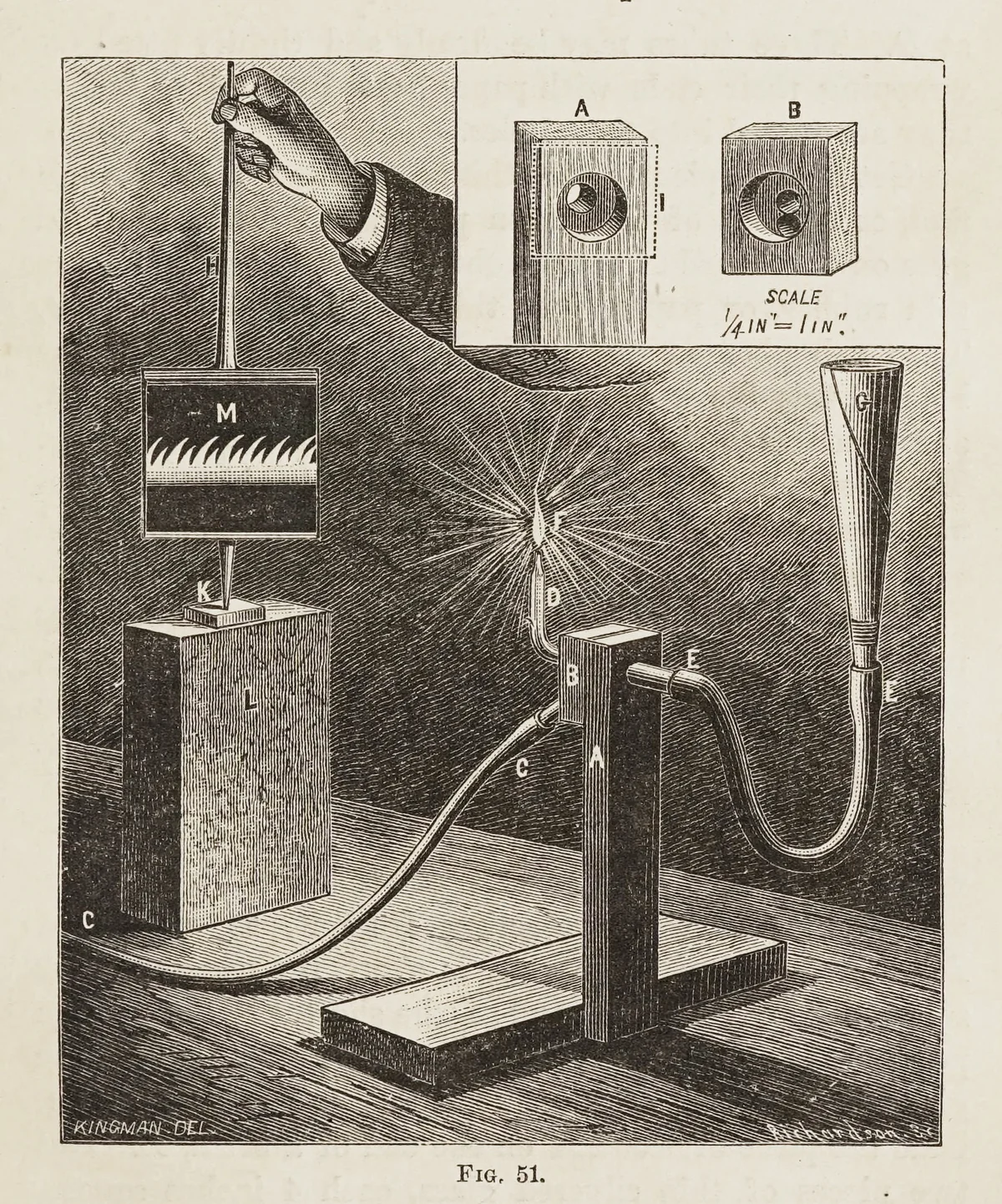
Illustration of “König’s Vibrating Flame”, from Alfred Marshall Mayer’s Sound (1879). Public domain, via The Public Domain Review.
It is hard to know what age group Mayer imagined himself to be addressing. Some of the simpler experiments could be carried out by young children (perhaps with adult supervision), such as the construction of a so-called “talking machine” from an orange with a peanut nose, black bean eyes, and completed (in a slightly unsettling touch) with a “baby’s cap”. By puffing air through a small tube, and carefully controlling the “mouth” aperture, a highly realistic imitation of a baby’s “Mama!” could be achieved. (The accompanying line drawing bears an uncanny resemblance to Sesame Street’s Grover.) Others are considerably more complex, and would surely require the dexterity and understanding of a teenager. (Several of the illustrations feature a youth of somewhere between ten and fifteen years, neatly dressed in a blazer, tie, and striped trousers.) It must be said, too, that many of Mayer’s experiments and demonstrations are highly dangerous. Bunsen burners, heliostats, gas flames of various kinds, fragile glass tubes, and even volatile substances like lycopodium and silica powder are commonly used.
Mayer’s introduction to acoustics is representative of many of the books in this genre, especially in its palpable enthusiasm for scientific discovery. The experiments in all of these popular science books on sound are often pitched to the reader as delightful diversions — entertaining escapes from daily life. Yet as delightful as such experiments were, many of the authors also went to great lengths to stress their educational value. Amateur experimenters were not just acquiring sophisticated party tricks for the sake of amusement, but were also gaining genuine knowledge of acoustic principles. Playing around with different kinds of pendulums, for instance, may well be enjoyable in and of itself, but was also imparting knowledge about sound waves. In the same way, clapping near small flames revealed important principles of sonic reflection, while using whistles and “lamp chimneys” instructed young scientists about the effects of vibrating columns of air. Here in these books was a new vision of what education might be — real knowledge, the authors insisted, might arise naturally from play. Simply by encouraging their natural curiosity, children could be gently nudged in the direction of scientific discovery. To read these books even today is to recapture a childlike thrill in the process of learning.
Such pedagogical principles were far from the norm during the nineteenth century, which largely took a joyless, authoritarian approach to educating the young. The Victorian vision of institutional education was characterized by “harsh and coercive lessons”, writes Elizabeth Gargano, centred on “rote recitations and enforced silence.” Many popular science books of this era stand in stark contrast to such principles, offering a very different vision of education that is based on a harmony between play and learning. Instead of the austere silences of institutional education, such books are alive with sound and show readers precisely how to produce unusual acoustic phenomena. During the early years of the twentieth century, such a vision would be central to many new and radical approaches to educating children, including those of Maria Montessori, Rudolf Steiner, and the Reggio Emilia community. Joy, play, tactile discovery, and self-directed learning were at the heart of such novel ways of learning. The popular scientific books for children that were so successful in the nineteenth century may well have anticipated these later advances in educational theory and practice.
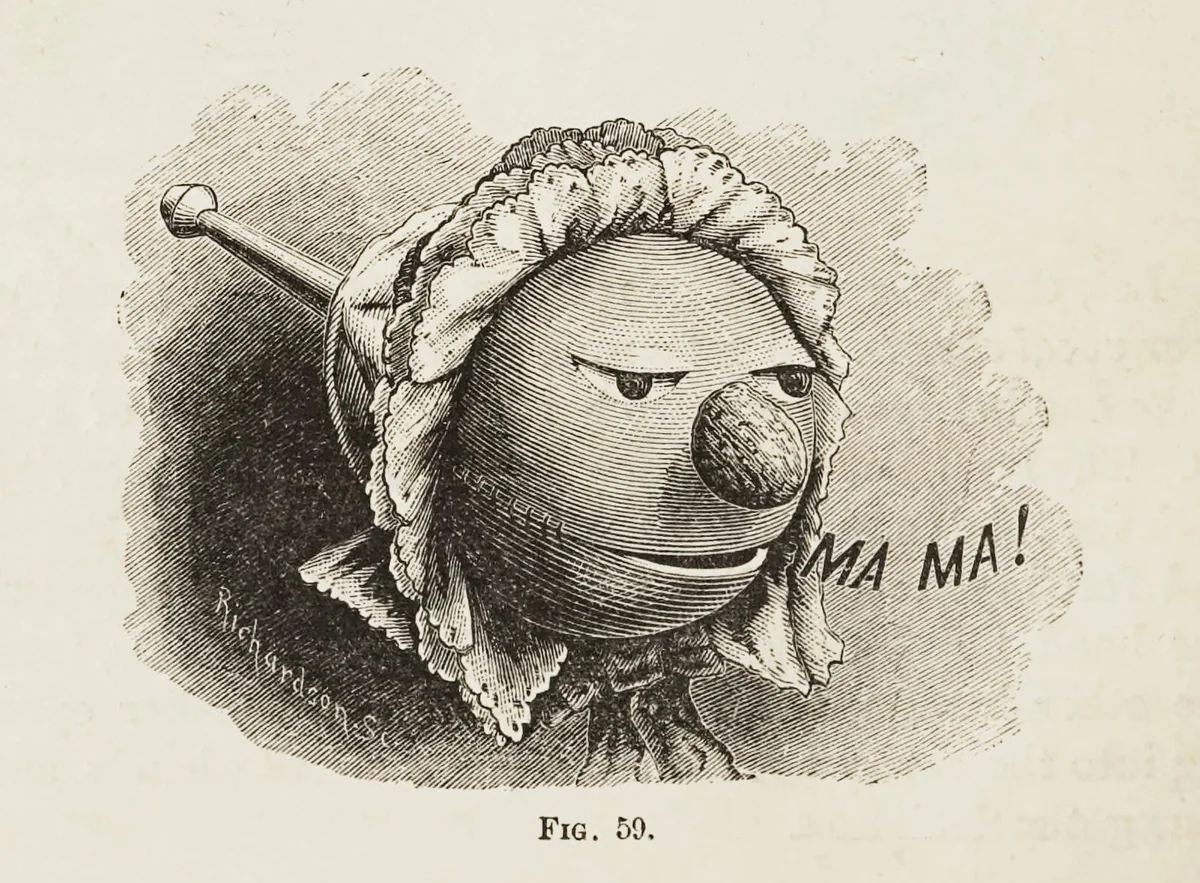
A talking machine fashioned from a thick-skinned orange, from Alfred Marshall Mayer’s Sound (1879). Public domain, via The Public Domain Review.
Amateur Enthusiasms
Nowadays, the term “pop-science” is often used disapprovingly, as though something important is always lost when genuine scientific research is translated into less nuanced terms that the public can comprehend. But the hard distinction between professional and amateur science in our own era — between expertise and general interest — was not yet fully present in the nineteenth century.
To read these surprising, delightful, and often beautiful popular science books is to be made aware of the enormous gulf that has opened up between professional scientists and the public. As science became increasingly specialized in the twentieth century, the public were no longer able to follow along with new findings, let alone have any hope of reproducing important experiments. It is difficult to imagine an amateur enthusiast recreating the latest research, regarding the quantum phenomena of sound, for example, or the way that spiders “listen” to their surroundings via vibrations in their webs, at home. Of course, contemporary publishers still put out science primers, textbooks, and explainers, but something vital has vanished. The frontier of scientific discovery has receded from view, moving far beyond what non-specialists can comprehend. These nineteenth-century popularizing books arose during a brief period in which even children could somewhat keep pace with scientific advancement. They offer a crucial window into what has been lost, and reveal how new understandings of sound filtered through Victorian culture and beyond.
Key takeaways on Hooked on Sonics
- In 1777 Ernst Chladni made sound visible by drawing a violin bow along a sand-covered metal plate, producing symmetrical “Chladni figures”.
- Nineteenth-century primers by authors such as Alfred Marshall Mayer, Arabella Buckley and John Henry Pepper invited children and families to explore acoustics with simple home experiments.
- These books pitched science as “amusement” and joined play with learning, in contrast to the rote, coercive style of much Victorian schooling.
- The author notes that the gap between professional scientists and the public has widened since then, which makes these amateur-friendly books feel especially delightful today.









0 Comments