

Key takeaways
- A study of 93 countries found that nations with more cats per person tend to score higher on national happiness — a strong correlation, but a correlation at the country level.
- The same study found that countries with higher exposure to Toxoplasma gondii, a parasite cats can carry, score lower on happiness.
- The authors’ proposed resolution: in wealthier countries, cats are more likely to live indoors with veterinary care and carry less parasite — so cat density tracks wealth and health systems, not just whiskers.
- The paper explicitly warns that these ecological associations cannot be used to infer individual-level effects — it is not evidence that getting a cat makes anyone happier.
The headline writes itself: countries with more cats are happier. A study published on September 30, 2026, in PLOS One looked at 93 countries and found a strong statistical link between national cat density and subjective well-being — but also found that a cat parasite points in the opposite direction. Here is what the data on cats and happiness actually says, and what it cannot say.
Cats and happiness: the headline numbers
The study, led by Javier I. Borráz-León of Mexico’s Secretariat of Science, Humanities, Technology and Innovation, with colleagues in Finland, Latvia and the United States, combined public datasets: Gallup-based happiness scores for 2022 to 2024, cat populations per 10,000 inhabitants from WorldStats, and country-level Toxoplasma gondii exposure data. Across the 93 countries with complete data, the pattern was striking. National happiness correlated positively with cat density — a correlation coefficient of 0.620, in statistical terms a strong association — and with GDP (0.800) and income levels (0.780).
A regression model using cat density, T. gondii antibody prevalence, and health spending explained 47% of the variation in national happiness — a large share for social-science data. In that model, cat density was the strongest positive predictor and recent Toxoplasma exposure the strongest negative one. A mediation analysis suggested that part of the cat-density association runs through the parasite channel: more cats, less parasite, more happiness — statistically speaking.
Readers should note the humility baked into the analysis itself. The authors describe it as exploratory, the sample of 93 countries was large enough to detect moderate effects but underpowered for small ones, and p-values were not adjusted for multiple testing. The numbers are suggestive, not definitive.
The parasite side of the story
The twist in the study is Toxoplasma gondii, a microscopic parasite for which cats are the definitive host — the only animal in which it reproduces. Humans are most often exposed through undercooked meat or contact with contaminated soil and cat faeces. In most healthy people, infection is silent, but the parasite has been the subject of decades of debate about subtle effects on the brain.
In this study, countries with higher T. gondii exposure scored lower on happiness: recent-exposure levels correlated at −0.540, past-exposure at −0.330. The exposure data came from pregnant women as a community proxy — the authors acknowledge the demographic bias — and were binned into five levels for analysis.
What does the broader science say about Toxoplasma and mental health? A systematic review in PLOS Neglected Tropical Diseases found toxoplasmosis to be an associated factor for bipolar disorder, schizophrenia and epilepsy — but not for depression. And the association is contested: a population-representative birth-cohort study in PLOS One found no link between T. gondii seropositivity and schizophrenia or neurocognitive deficits. So the parasite-mental-health connection is best described as a disputed association with plausible mechanisms — exactly how the country-level paper frames it.
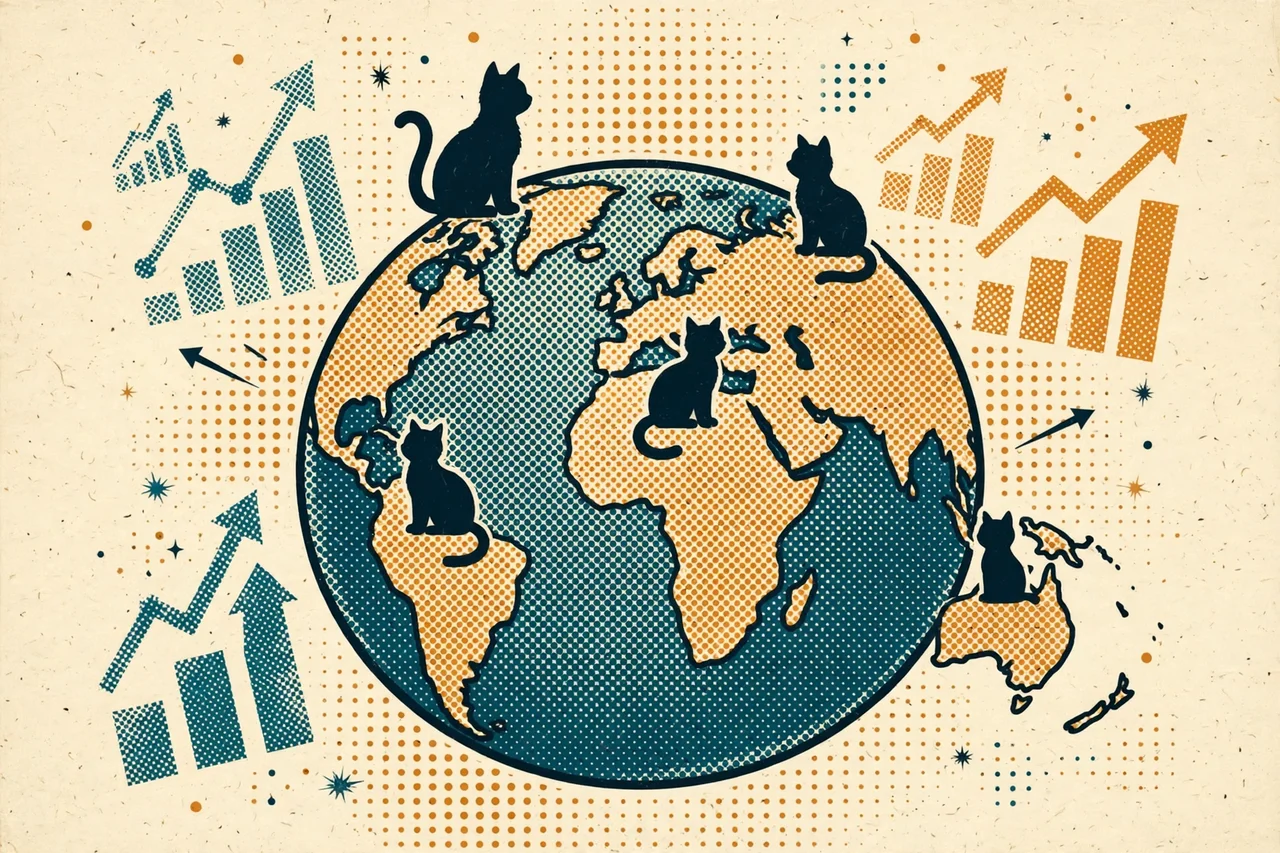
The 93-nation study linked national cat density to happiness scores – and cat-parasite exposure to lower scores. Image generated by AI.
Why more cats can mean fewer parasites
The apparent contradiction — cats linked to happiness, the cat parasite linked to unhappiness — is the most interesting part of the paper, and the authors propose an explanation. Cat density also correlated strongly with GDP (0.790) and income (0.770). In wealthier countries, cats are more likely to live indoors, be vaccinated, eat commercial food, and see a veterinarian regularly — conditions that reduce parasite transmission. In lower-income countries, free-roaming cats are more common, and T. gondii circulation is higher.
In other words, “cats per 10,000 people” may be measuring something bigger than cats: a cluster of wealth, sanitation, veterinary infrastructure, and pet-care norms. The authors put it carefully in the discussion: the relationship between humans, animals and infectious diseases depends not simply on the presence of animals, but on the social, economic and environmental conditions around them.
This is also why the “direct” statistical path from cats to happiness survived in their mediation model even after accounting for the parasite: cat density likely soaks up the influence of prosperity and pet-friendly culture that the model cannot separate. Cats, here, are partly a proxy for how people live.
What the study cannot tell you
The paper’s most important sentence is a caution. Its findings, the authors write, describe associations at the national level and “should not be used to infer individual-level effects or personal risks related to cat ownership, happiness, and T. gondii exposure.” This is the ecological fallacy, stated plainly: a correlation between countries does not mean that getting a cat will make you happier.
Several weaknesses deserve airing. The cat counts conflate pets, strays and feral cats. The parasite exposure comes from pregnant women only. Country averages hide enormous within-country variation. And the direction of causality is unresolved — it is entirely possible that happier, wealthier societies simply keep more cats, rather than cats making societies happy.
Why it matters
For all its caveats, the study is a good lesson in how to read global-correlation science: the fun headline is real (the association is strong), the twist is real (the parasite points the other way), and the resolution is the interesting part (context matters more than cat counts). It is also a reminder of how little we know about the everyday ecology of companion animals — cats have lived with humans for millennia, and we are only now quantifying what that cohabitation looks like at planetary scale.
Related reading: Neuroticism and the Pandemic: Why Some Minds Struggled More — how personality and environment interact to shape mental well-being.
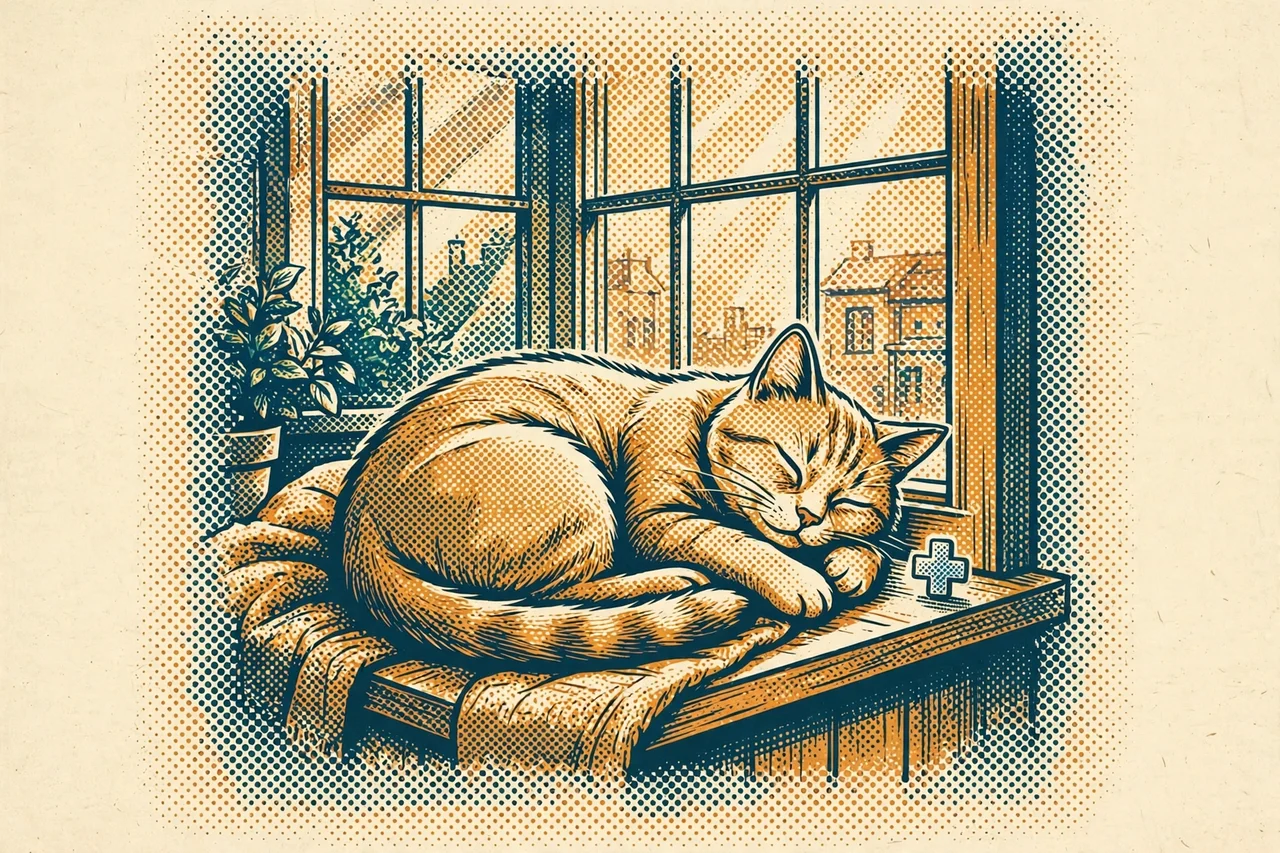
In wealthier countries, cats are more likely to live indoors with veterinary care – one reason the cat-parasite link flips. Image generated by AI.
Frequently asked questions
Does this mean getting a cat will make me happier?
No — or at least, this study cannot say that. It compares countries, not people. The authors explicitly warn against individual-level conclusions. There is separate evidence that pets can support well-being, but that comes from individual-level studies, not from this one.
What is Toxoplasma gondii?
A single-celled parasite whose life cycle completes in cats. People typically encounter it through undercooked meat or contaminated soil. Most infections cause no symptoms; the suggested links to mental-health conditions are association-based and contested. Standard hygiene — cooking meat thoroughly, washing hands after handling soil or litter — reduces exposure.
What did IgM and IgG measure?
Two antibody types used as exposure markers. IgM indicates more recent infection; IgG indicates past infection. In the study, recent-exposure (IgM) levels were the stronger negative predictor of national happiness.
Which countries had the most cats?
The paper works with cat density — cats per 10,000 inhabitants — rather than a ranking, and the exact country list depends on the WorldStats dataset. The key finding is the gradient across all 93 countries, not any single country’s position.
Sources
- Borráz-León JI et al., “Wealth, health, cats and Toxoplasma gondii: An ecological correlational study of subjective well-being across 93 countries”, PLOS One 21(9): e0357911 (2026). Full text (CC BY)
- Fekadu A et al., systematic review on toxoplasmosis and psychiatric disorders, PLOS Neglected Tropical Diseases. Full text (CC BY)
- Gale SD et al., birth-cohort study finding no T. gondii association with schizophrenia, PLOS One. Full text (CC BY)









0 Comments