

Key takeaways
- Scientists in Yunnan, China, have described a new giant fungus, Dianjunus rex — nicknamed “D-rex” — that can stand half a metre tall.
- It is not just a new species: the paper names a new genus and a new family, Dianjunaceae, a lineage about 65 million years old.
- Its fruiting bodies are the largest ever documented in Ascomycota, the sac fungi, which do not grow true mushrooms.
- The name honours the ancient Dian kingdom of Yunnan, the Chinese word jūn (mushroom or fungus), and the Latin rex, for king.
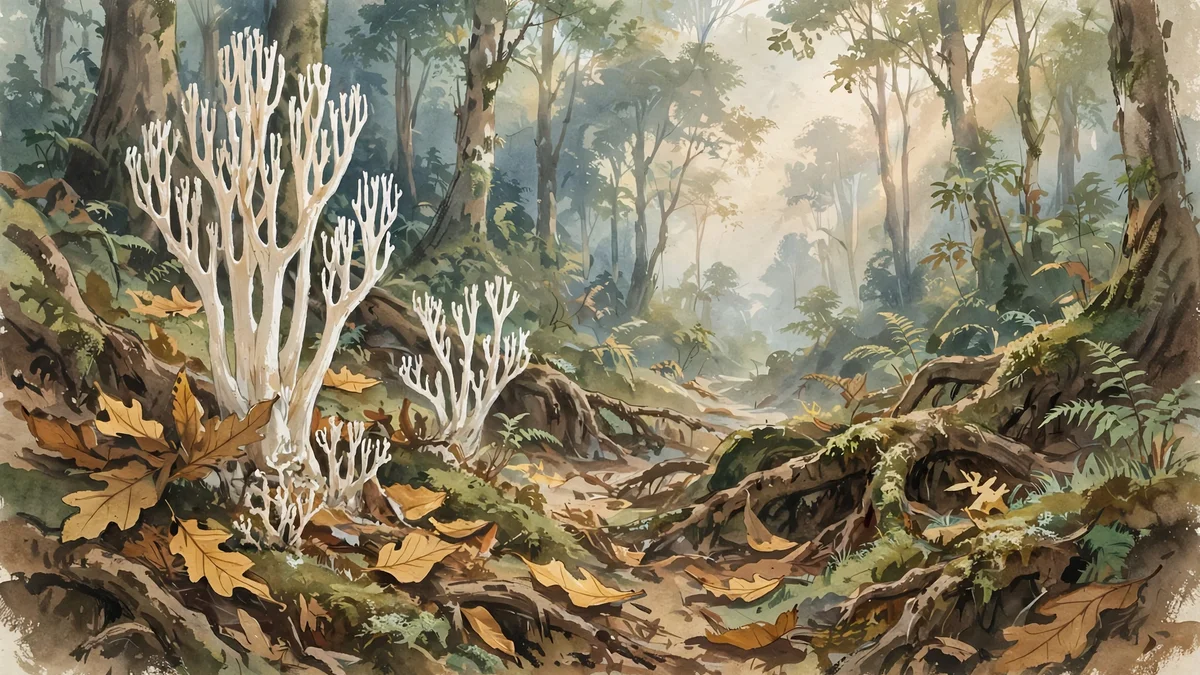
A giant fungus nicknamed D-rex is making scientists redraw part of the fungal family tree. Found in the forests of Yunnan, China, it rises up to 50 centimetres above the leaf litter — and genetic analysis shows it represents not just a new species, but a new genus and a new family all at once. The paper describing it, published September 29, 2026 in Frontiers in Fungal Biology, is the most dramatic fungal find of the year.
A king rises from the roots
The discovery came from fieldwork in three places in Yunnan: Damaidi Village near Kunming, where the team collected specimens in August and September 2024, and Nanbang Village and Yipinglang Town, where more were found in July 2025. The whitish stalks emerge from woody roots of the Chinese cork oak (Quercus variabilis), darkening toward yellow as they mature. The research team of 19 scientists, led by Jing Song and corresponding authors Indunil Senanayake and Fuqiang Yu of the Kunming Institute of Botany, gave it a name fit for its stature: Dianjunus rex. The first half honours the Dian kingdom, an ancient society in what is now Yunnan; jūn is the Chinese word for mushroom or fungus; and rex is Latin for king.
Not a mushroom at all
Strictly speaking, D-rex does not grow mushrooms. It belongs to Ascomycota, the sac fungi — the largest group of fungi, with more than 64,000 described species. Ascomycetes do not produce true mushrooms; instead they release their spores from tiny sac-like structures packed into or onto a fruiting body called a stroma. D-rex’s stromata are upright and fleshy, ranging from cylindrical to palm-shaped, with a whitish powdery surface when young. The specimen can weigh 2.2 kilograms individually — and at up to 50 centimetres high, these are the largest fructifications documented anywhere in Ascomycota.
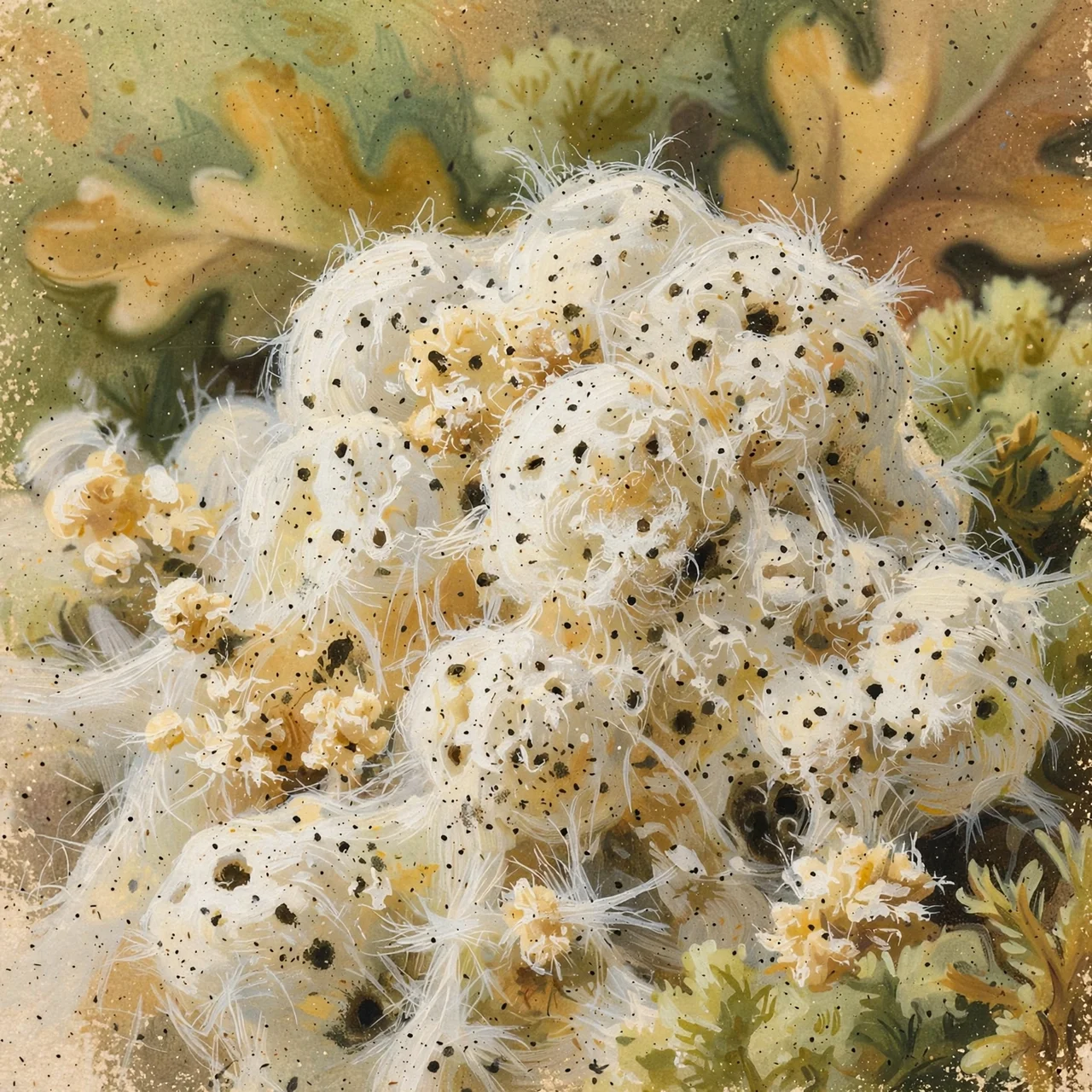
The powdery whitish surface of a young Dianjunus rex stroma, dotted with the openings where spores escape. Image generated by AI.
How the team knew it was new
Declaring a new family is a bold move, and the team backed it with the full modern toolkit. First came morphology: the shape, size and structure of the fruiting bodies, and even the lab-grown cultures from its spores, did not match anything on record. Then came the genes: sequences from four standard DNA regions (ITS, LSU, TUB2 and RPB2) placed the collections as a distinct sister clade to the family Graphostromataceae in the order Xylariales. Whole-genome phylogenomics confirmed the placement. Its closest known relative is Graphostroma platystoma, a fungus of dead hardwood across the northern hemisphere. The new names are formally registered in Index Fungorum, and voucher specimens rest in the collections of the Kunming Institute of Botany.
The giant fungus record book
Record-keeping in fungi needs care, because “biggest” depends on what you measure. The previous large ascomycete of note, Engleromyces goetzei of Kenya, grows lobes 30 centimetres long and can weigh 3.2 kilograms — bulkier than D-rex, but not taller. D-rex takes the height crown, and the paper describes its fruiting bodies as the largest documented in Ascomycota overall. The authors speculate that such towering fruiting bodies might help fling spores further through the still air of a dense forest — a nice idea, but explicitly speculation, not a finding.
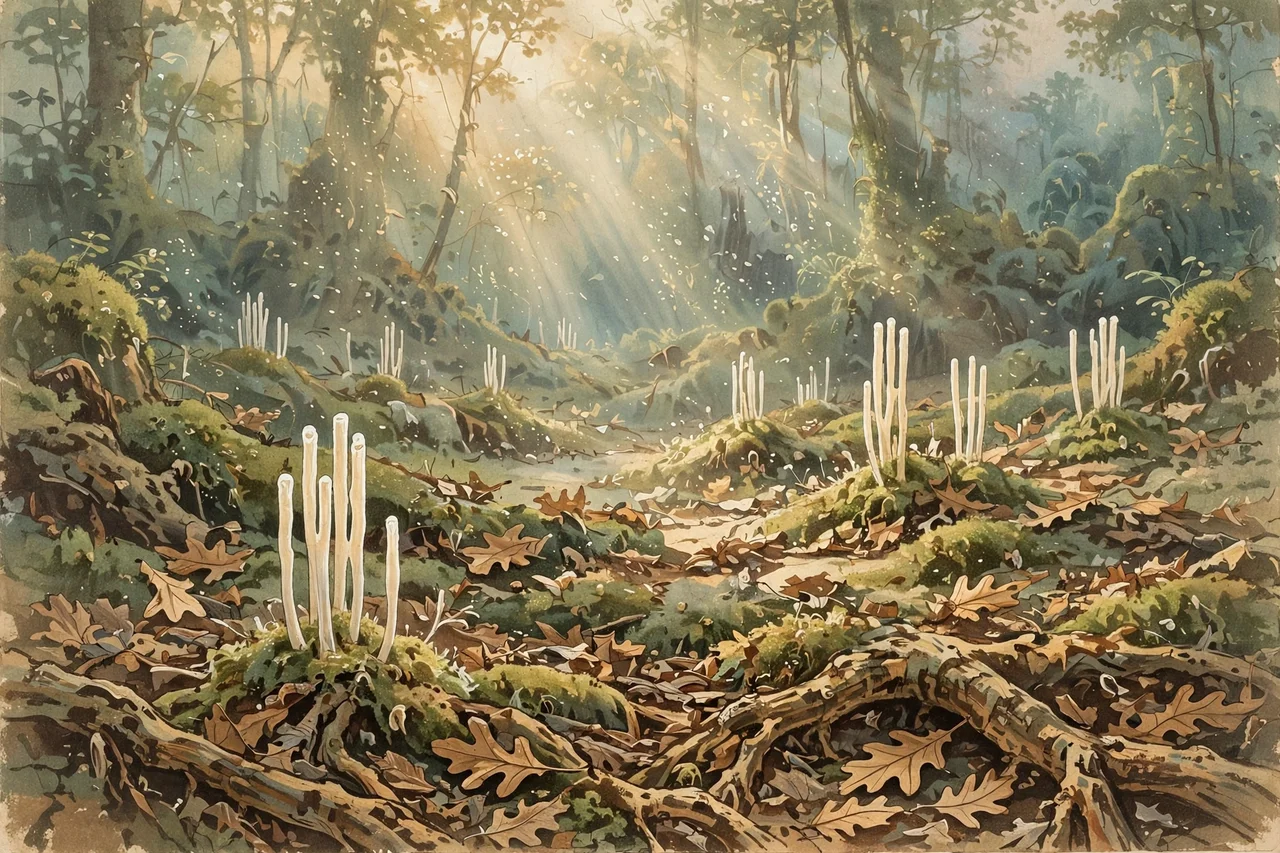
Giant stromata rise from oak roots on the Yunnan forest floor; the team collected specimens at three sites in 2024 and 2025. Image generated by AI.
A survivor from the world after the dinosaurs
The genetic clock dates the origin of the new family to about 65 million years ago, in the early Paleocene. That is just after the asteroid impact that ended the reign of the dinosaurs, wiping out roughly three-quarters of all species. In the reorganised world that followed, forests full of dead wood offered vast new territory for wood-decaying fungi. D-rex’s lineage appears to have been there from the start — a survivor from the first chapter of the age of mammals.
Related reading: The 32-Centimetre “Roly Poly” Hiding in a Museum Drawer — another record-breaking new species story, this one from the deep sea off Puerto Rico.
Why it matters
Fungi are the least mapped kingdom of large organisms. Estimates suggest more than three million fungal species may be waiting to be described, and East Asia’s forests are proving to be a rich frontier. That matters for more than curiosity: fungi are the planet’s decomposers, and wood-rotting groups like Xylariales drive carbon cycling through forests. They are also prolific chemists — the order is famous for secondary compounds and enzymes that digest tough plant molecules, some with real-world uses. Every new family is a new branch of that chemical library. A half-metre fungus standing in a Yunnan forest is a reminder of how much remains standing there, unnoticed.
Frequently asked questions
Is D-rex edible?
There are no data on edibility. The paper does not test it, and nothing about it should be eaten. Do not treat a scientific novelty as food.
Where exactly was it found?
Three sites in Yunnan Province, China: Damaidi Village in Luquan County near Kunming (collected August–September 2024), Nanbang Village in Mengla, Xishuangbanna (July 2025), and Yipinglang Town in Lufeng, Chuxiong (July 2025). It grows from the woody roots of Chinese cork oak.
Could there be more giants out there?
Almost certainly. With most fungal species still undescribed, forests like Yunnan’s remain full of surprises — the researchers themselves describe East Asia’s fungal diversity as largely unexplored.
What happens to the specimens?
Voucher specimens are deposited in the fungarium of the Kunming Institute of Botany, Chinese Academy of Sciences, and the species is registered in Index Fungorum under number IF904733, so any researcher can check the original material.
Sources
- J. Song, Z. Yan, J. Pérez-Moreno et al., “Unearthing a fungal giant: Dianjunaceae fam. nov., a novel Paleocene lineage of Xylariales harboring Dianjunus rex gen. et sp. nov”, Frontiers in Fungal Biology 7 (2026). Full text (CC BY)
- Frontiers news, October 13, 2026: “Scientists discover ‘D-rex’, a giant fungus from Chinese forests whose unique lineage dates back 65 million years”









0 Comments