

Key takeaways
- Scientists have named a new species of giant isopod, Bathynomus tuebingoborikensis, from a single specimen that sat unrecognized in a German museum collection for decades.
- The 32-centimetre crustacean was collected off Puerto Rico at 500 metres depth. Its name blends Boríken, the Indigenous Taíno name for Puerto Rico, with Tübingen, the city where it was rediscovered.
- The study reconstructs the deep history of the whole giant-isopod group: a worldwide spread millions of years ago, extinction in Europe, and a new wave of giants born as the planet cooled.
- The find is a reminder of how much undiscovered life hides in museum drawers, not just in the ocean.
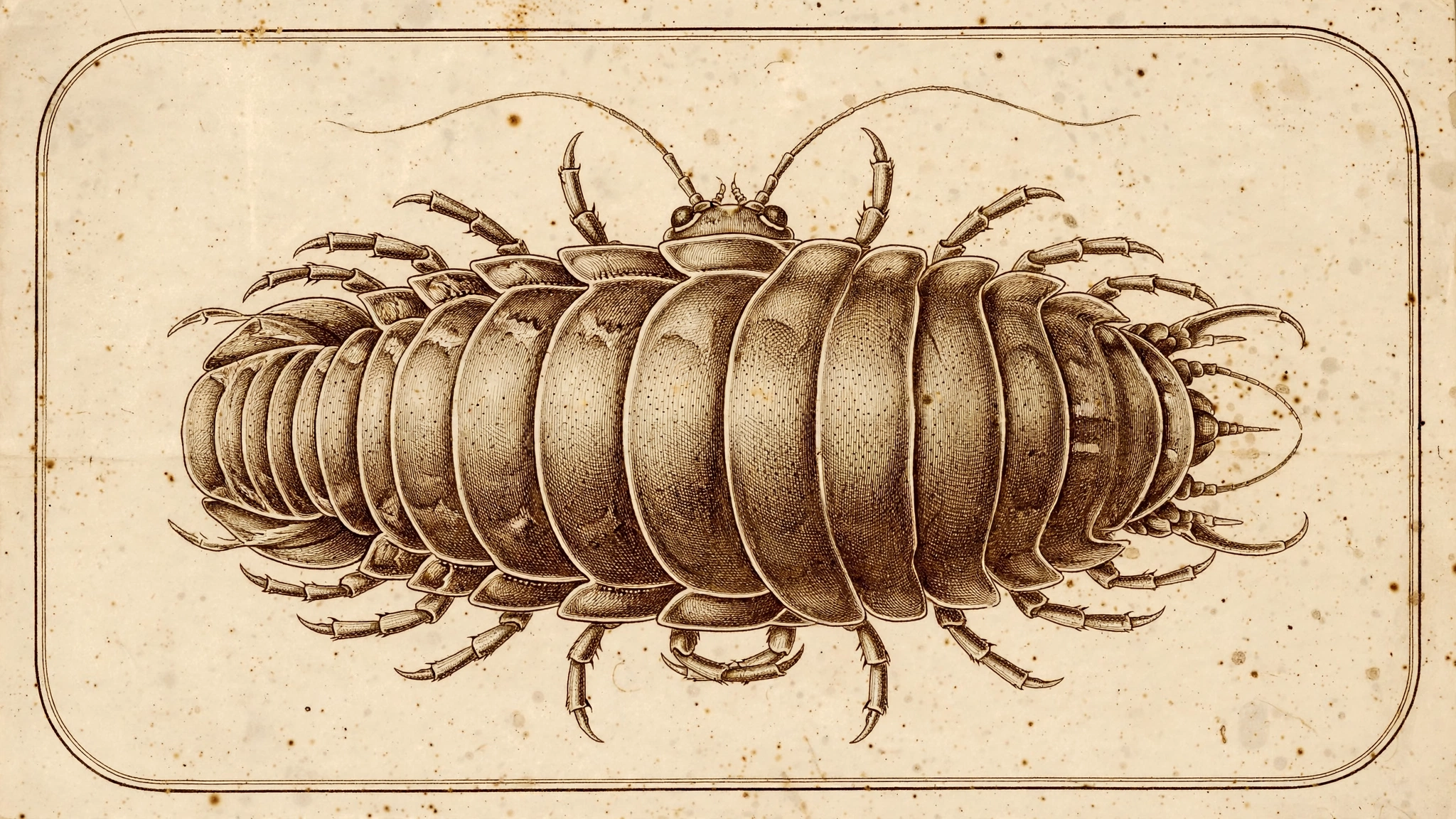
It looks like a woodlouse the size of a house cat, and it spent decades sitting in a museum drawer before anyone realized it was a species unknown to science. Researchers have now formally described the giant isopod Bathynomus tuebingoborikensis, a 32-centimetre deep-sea crustacean collected off Puerto Rico and then filed away in Tübingen, Germany.
The description appears in the journal Scientific Reports, where Ingmar Werneburg and colleagues used the specimen to rebuild the evolutionary history of the entire giant-isopod group. The work is published open access under a Creative Commons Attribution 4.0 licence, which allows adaptation with credit.
A giant isopod hiding in plain sight
Giant isopods are the deep sea’s most famous scavengers: armoured, many-legged relatives of the humble pill bug, some growing to half a metre long. The genus Bathynomus holds more than twenty living species, found between 70 and 2,500 metres down across the tropical Indo-Pacific and the western Atlantic. They feed on whatever drifts down, from fish and squid to whale carcasses. Biologists split the group into “giants” and “supergiants,” the latter defined as species whose adults pass 15 centimetres.
The new species is known from a single dried female, specimen GPIT-PV-94341, collected at 500 metres depth off Puerto Rico by the researcher Adolf Seilacher. It then waited in the Tübingen collection for decades. When the team finally examined it closely, with photographs, drawings, and CT scans of its mouthparts, the anatomy did not match any known species: the shape of its head shield, the set of spines on its tail fan, and the comb-like bristles on its seventh leg were all distinctive.
The species name tells the story of that journey. Boríken is the Indigenous Taíno name for Puerto Rico; Tübingen is where the animal was rediscovered. At 32.2 centimetres, the specimen falls into what the researchers call the “colossogiants,” and its closest relative appears to be another giant species found off Mexico’s Yucatán Peninsula.
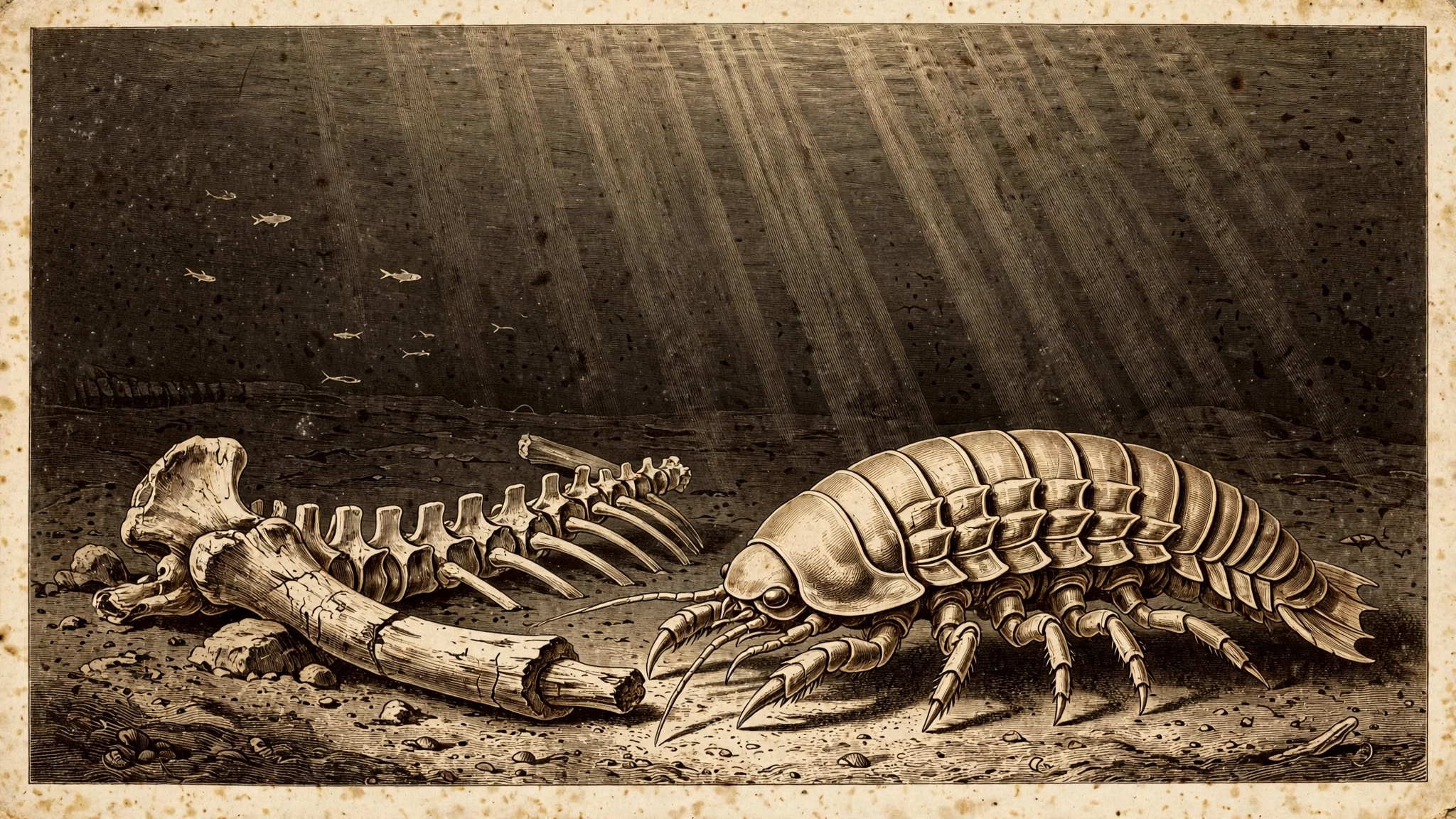
A giant isopod scavenging the deep-sea floor, in the style of a Victorian natural-history engraving. These armoured scavengers feed on whatever drifts down from above, from fish to whale carcasses. Image generated by AI.
Five million years of wandering
The paper goes well beyond naming one animal. By comparing four fossil and twenty-three living species, the team built the first morphological family tree for the genus and traced its travels across tens of millions of years.
The story they reconstruct runs like this. Early giant isopods spread westward to Australia and East Africa, and, before the Arabian and African tectonic plates collided, reached Europe too. There they died out at the end of the Miocene epoch. Then, as the Earth cooled at the boundary between the Miocene and Pliocene, about 5.3 million years ago, a new Indo-Pacific group evolved, with some individuals topping 25 centimetres and superbly tuned to the colder conditions.
From there the new giants kept moving: from Australia, around Antarctica, and up into South and Central America, where they met distant, smaller cousins left behind by the earlier expansion. The Puerto Rican species is one endpoint of that long migration, which is why Werneburg stresses the value of natural history collections as global archives of nature: the clues were already on a shelf.
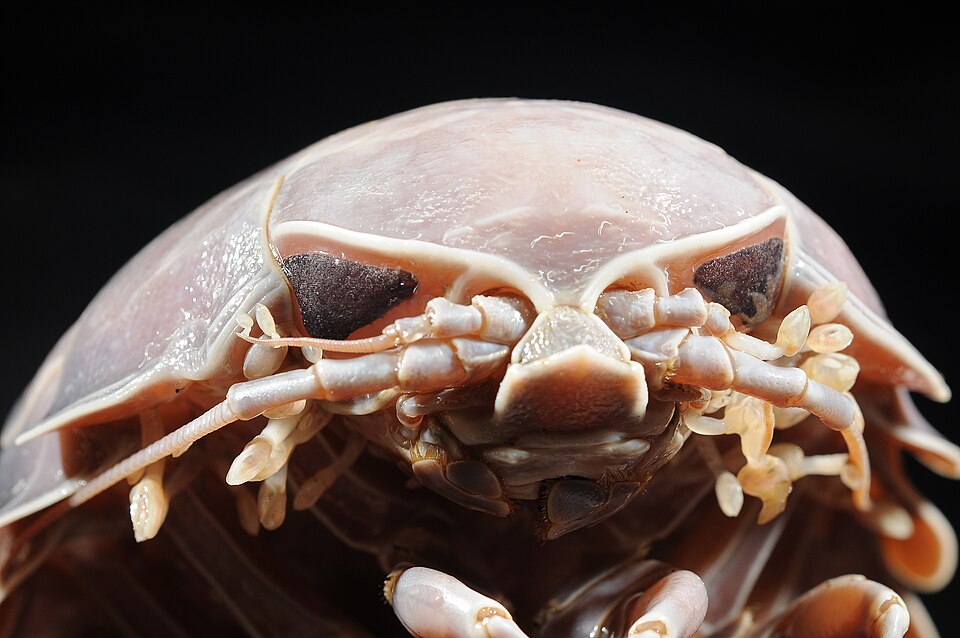
A preserved Bathynomus giganteus specimen, a close relative of the newly named B. tuebingoborikensis. Photo: Christian Ferrer (Corbari L.), CC BY 4.0, via Wikimedia Commons.
Why it matters
New Bathynomus species turn up at a rate of roughly one a year, and each one sharpens the picture of how life adapts to the deep ocean. These animals are masters of scarcity: a separate 2026 study in Cell found that giant isopods can survive five years without eating, thanks in part to a borrowed bacterial gene that dials their metabolism down in the cold. The new Caribbean species adds a geographic missing piece to that story of survival and spread.
There is also a quieter lesson. The specimen was collected, dried, and stored long before anyone knew what it was. Museums hold millions of such specimens, and a share of them are new species waiting for a second look. As the researchers put it, the archives of nature are already full; we just have not finished reading them.
Related reading
For another story of ancient specimens rewriting what we know about living animals, read Ancient DNA, Modern Bats: The Spotted Bat’s 2,000-Year Story.
Frequently asked questions
How big is the new giant isopod?
The single known specimen measures 322 millimetres, just over 32 centimetres, about the length of a ruler. Some related species reach 50 centimetres.
Are giant isopods dangerous?
No. They are deep-sea scavengers that feed on dead animals drifting down from above. They live hundreds of metres below the surface and never encounter people in the wild.
Why did it take decades to identify?
The specimen was collected, dried, and stored in a museum collection before being studied in detail. Distinguishing species requires close comparison of fine anatomical details, which only happened when the research team re-examined it with modern imaging.
What does the name mean?
Bathynomus tuebingoborikensis combines Boríken, the Taíno name for Puerto Rico where it was found, with Tübingen, the German city where it was rediscovered in the collection.
Source and licence
Adapted from: Werneburg et al., “A new Caribbean species of the giant isopod genus Bathynomus (Crustacea, Isopoda, Cirolanidae) with notes on its evolutionary history,” Scientific Reports (2026). DOI: 10.1038/s41598-026-69097-y. Published open access under the Creative Commons Attribution 4.0 International Licence (verified on the article page, October 9, 2026), which permits adaptation with credit to the authors and a link to the licence. This TeaLamp version is rewritten and expanded with additional context; no passage is reproduced verbatim. Minor TeaLamp wording edits (2026-10-11).










0 Comments