

Key takeaways on the Herculaneum scrolls
- When Mount Vesuvius erupted in 79 CE, it carbonized an entire Roman library at Herculaneum, the only intact library surviving from classical antiquity. Most scrolls are too fragile to unroll.
- The core problem is contrast: carbon-based ink and carbonized papyrus look nearly identical to X-rays, so hidden text is almost impossible to see.
- A September 2026 study reports that lead in some ancient inks changes everything: leaded ink absorbs up to 25 times more X-rays than the papyrus around it, making letters glow in scans.
- The team proved it by building their own burnt scrolls, writing on them with lead-spiked ink, carbonizing them in a furnace, and reading the text back with X-ray tomography and adapted software.
In the year 79, the eruption of Mount Vesuvius buried the Roman town of Herculaneum under 20 metres of rock and ash. In a seaside villa, a library of several hundred papyrus scrolls, now known as the Herculaneum scrolls, was baked into brittle charcoal, and there it stayed, discovered in 1752 and unreadable ever since. It is the only intact library known to survive from the ancient world, and it may hold lost works of philosophy and literature. Now, a study published on September 16, 2026, offers a surprisingly practical way in: look for the lead.
The library that survived by burning
The scrolls were found at the Villa of the Papyri, a grand house probably owned by a member of the Piso family, unearthed during excavations sponsored by the Bourbon kings of Naples. The eruption’s heat carbonized the papyrus at temperatures estimated between 400 and 900 degrees Celsius, turning each scroll into a fragile black cylinder while preserving its shape.
Early attempts to open the scrolls destroyed many of them. Hundreds were eventually unrolled and read, revealing mostly Epicurean philosophy, much of it by Philodemus of Gadara, plus works by Epicurus himself, some Stoic texts, and even Latin works including an epic on the Battle of Actium. But hundreds more remain rolled up, far too fragile to touch. They sit in the National Library of Naples as some of the most tantalizing unread books on Earth. As the researchers put it, every text in the library is new to us: none reached us through the usual route of monastic copying.
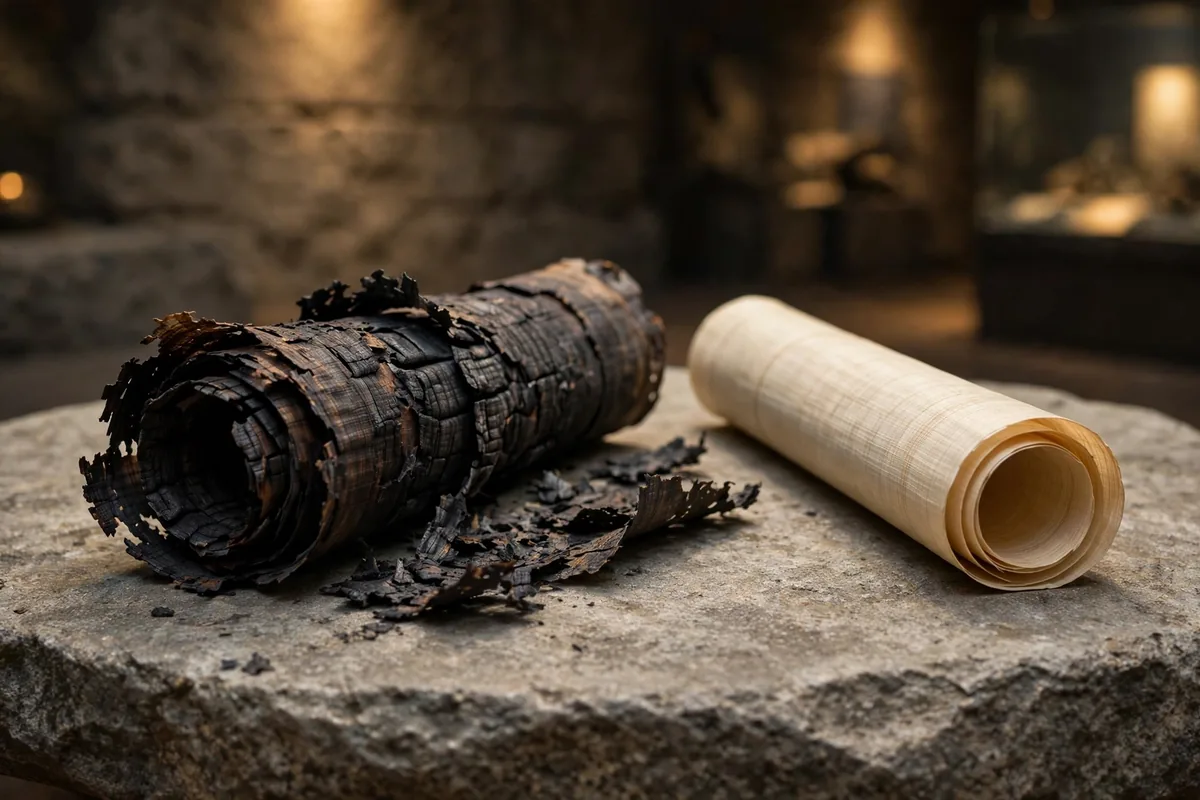
A Herculaneum scroll, carbonized by the heat of Vesuvius, beside a fresh papyrus roll. Image generated by AI.
The ink problem
Modern teams, notably the global Vesuvius Challenge, have learned to read parts of the scrolls without touching them: synchrotron X-ray tomography scans the rolls, and AI algorithms virtually unroll the layers. But there is a fundamental obstacle. Roman ink was carbon black, made from charcoal, soot or charred bone mixed with gum arabic. The papyrus itself is carbonized plant matter. To an X-ray beam, ink and paper are nearly the same material, so the signal is terribly weak.
Then came a clue. Using synchrotron-based X-ray fluorescence, researchers had found lead in the letters of two Herculaneum fragments, and lead also turned up in the inks of other ancient papyri. Lead is excellent at blocking X-rays. Where carbon ink is invisible against carbon papyrus, leaded ink would stand out sharply. The question was whether anyone could prove it without risking a priceless original.
Building a fake burnt scroll
Douglas Seiler, an affiliate of the University of California, Berkeley, decided to recreate the disaster in miniature. He sourced modern papyrus from Egypt and reed pens, bought traditional carbon ink from Japan, and paid some high school students to write lines from Star Wars, the Bible and the 1960s television show The Outer Limits on the sheets. Then came the alchemy: the team spiked the ink with lead nitrate, rolled the papyrus up, and baked it in a high-temperature furnace until it carbonized, mimicking what Vesuvius did in 79 CE.
The replica scrolls, about four and a half inches long, went to the National Institute of Standards and Technology (NIST), where Jacob Michael LaManna’s team scanned them with the Neutron and X-ray Tomography system. Crucially, Seiler did not tell the NIST scientists what the students had written, so the test was blind. Cyrus Daugherty, a NIST researcher, adapted an algorithm he had originally built to unroll the layers of lithium-ion batteries, reworking it in about a week to handle crushed, fused papyrus instead of a neat spiral. Within days, the software recovered the hidden text.
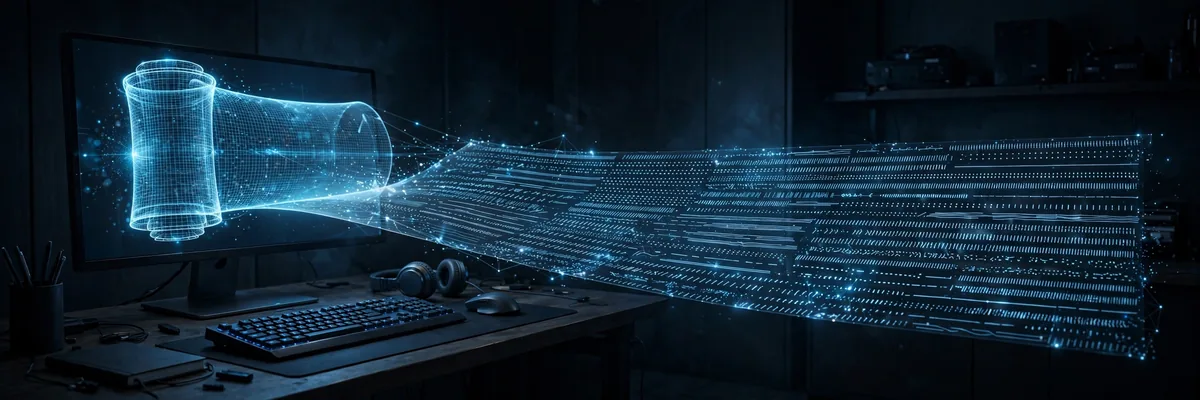
Software virtually unrolls the scroll to reveal hidden text. Image generated by AI.
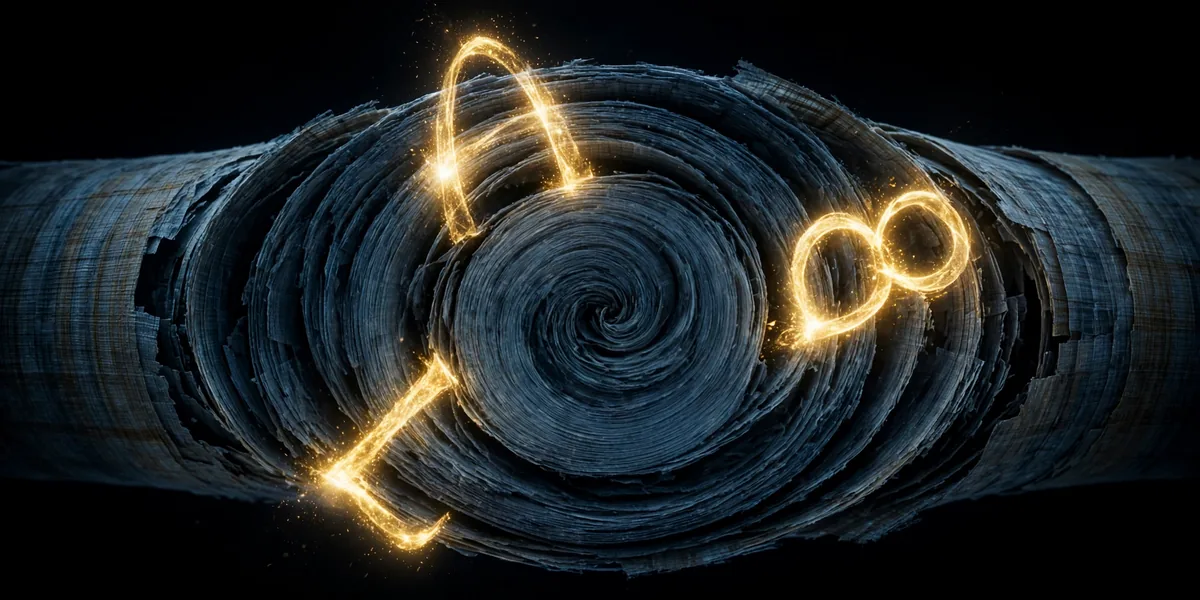
Lead in the ink makes letters glow in X-ray scans against the dark papyrus. Image generated by AI.
Lead lights up
The numbers are striking. In the scans, leaded ink absorbed as much as 25 times more X-rays than the surrounding charred papyrus, and lead concentrations near 25 micrograms per square centimetre were detectable by both tomography and X-ray fluorescence. The team also showed that an ordinary handheld X-ray fluorescence device could detect the lead, which suggests a practical two-step workflow: first, screen the library’s scrolls cheaply and non-destructively for lead with a handheld scanner, then commit only the promising ones to expensive synchrotron beam time and computational unrolling.
The replica scrolls have a second use. Because the team knows exactly what is written inside them, the fakes can serve as ground truth for training and testing text-detection algorithms, potentially sharpening the tools of the Vesuvius Challenge itself. The challenge’s leaders are aware of the study but have not yet decided whether to adopt its findings.
Why it matters
This is a proof of concept, and the authors are careful about its limits. Not all ancient inks contain lead, contamination from the environment could confuse the signal, and no systematic lead screening of the real collection has been carried out. Still, the logic is compelling: of the hundreds of unread scrolls, some unknown fraction were written with leaded ink, and those are precisely the ones most likely to yield their secrets. A cheap handheld scan could pick them out of the crowd.
What might they say? The scrolls already read include lost philosophy; the unread ones could hold anything from unknown plays to histories that exist nowhere else. Two thousand years after the ash fell, the key to the library may be a toxic metal, hiding in plain sight in the ink.
Related reading
Another story of 19th-century science, sound and strange experiments: Hooked on Sonics: Experimenting with Sound in 19th-Century Physics.
Frequently asked questions
Why not just unroll the scrolls?
They are carbonized and crumble at the slightest touch. Early attempts destroyed many scrolls, which is why modern efforts are entirely non-destructive.
What is the Vesuvius Challenge?
A global competition that awards prizes for virtually reading the Herculaneum scrolls using X-ray scans and AI. It has already recovered portions of ancient text from the rolls.
Did the Romans know the ink contained lead?
Probably not deliberately. The researchers say the precise mechanism is still under investigation: the lead may have come from ink ingredients or from additives used to dry the ink.
When will we read the real scrolls this way?
Not yet. Conservators would need to approve any screening programme, and the method has only been proven on replicas. The next step is testing it on genuine Herculaneum material.
Source
Adapted from: Seiler D, LaManna JM, McOsker M, Kreimer D, Daugherty MC, Dopke J (2026), “A model carbonized papyrus scroll opens a novel path to identifying readable scrolls of the Herculaneum Library,” PLOS One 21(9): e0353485, published September 16, 2026, under a CC0 public domain dedication. Read the original paper. Minor TeaLamp wording edits (2026-10-11).








0 Comments