

Key takeaways on mirror molecules
- Many molecules of life come in two mirror-image forms, like left and right hands. Living things use almost exclusively one of them, a phenomenon called homochirality.
- Henri B. Kagan and Kenso Soai won the 2026 Nobel Prize in Chemistry for showing how chemical reactions can be pushed to produce just one mirror image, solving a century-old mystery.
- Kagan discovered non-linear effects in the early 1980s; Soai then built the first reaction that creates only one mirror image, the Soai reaction, which copies itself like a molecular Xerox machine.
- Their work reshaped how medicines, flavours and materials are made, because the two mirror forms of a molecule can behave very differently in the body.
Mirror molecules won the Nobel Prize this week. On October 7, 2026, the Royal Swedish Academy of Sciences awarded the chemistry prize to Henri B. Kagan, 95, of France and Kenso Soai, 76, of Japan, for showing that chemical reactions can be taught to pick a side. Their citation reads: “for the discovery of non-linear effects and autocatalysis in asymmetric organic synthesis.” Behind the technical words is one of the oldest puzzles in science: why does life use only one of the two mirror-image forms of its molecules?
A left hand and a right hand
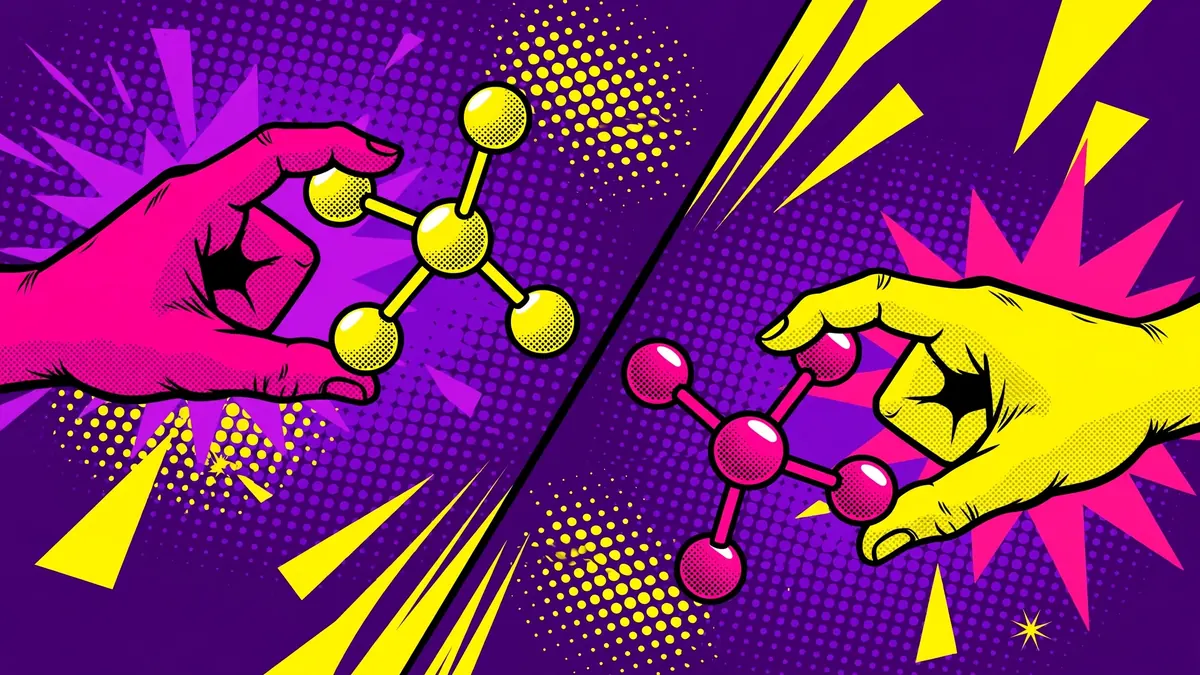
Hold your hands up. They are mirror images, but no amount of turning will make one lie perfectly on top of the other. Many molecules share this property. Chemists call it chirality, from the Greek word for hand, and the two mirror forms are called enantiomers.
The two versions contain exactly the same atoms, but they can behave like completely different substances. The chemical carvone is a favourite example: one mirror image smells of mint, the other of caraway seeds. In medicine the difference can be critical, because the two forms of a drug can have different effects in the body. Getting the right one, and only the right one, is one of the central jobs of modern chemistry.
Life chose one hand
The deeper mystery is not how to make these molecules, but why life picked just one. The amino acids that build our proteins exist in two mirror forms, yet every known living thing uses overwhelmingly one of them. The sugars that form the backbone of DNA show the same one-sided preference. This exclusive taste is called homochirality, and it has puzzled chemists for more than a century.
The story starts in the 19th century with the French chemist Louis Pasteur, who noticed that crystals of tartaric acid from wine barrels came in left- and right-handed forms and painstakingly separated them by hand. Ever since, chemists have wondered how nature ended up choosing one form, because laboratory reactions of that era stubbornly produced a 50-50 mix of both.
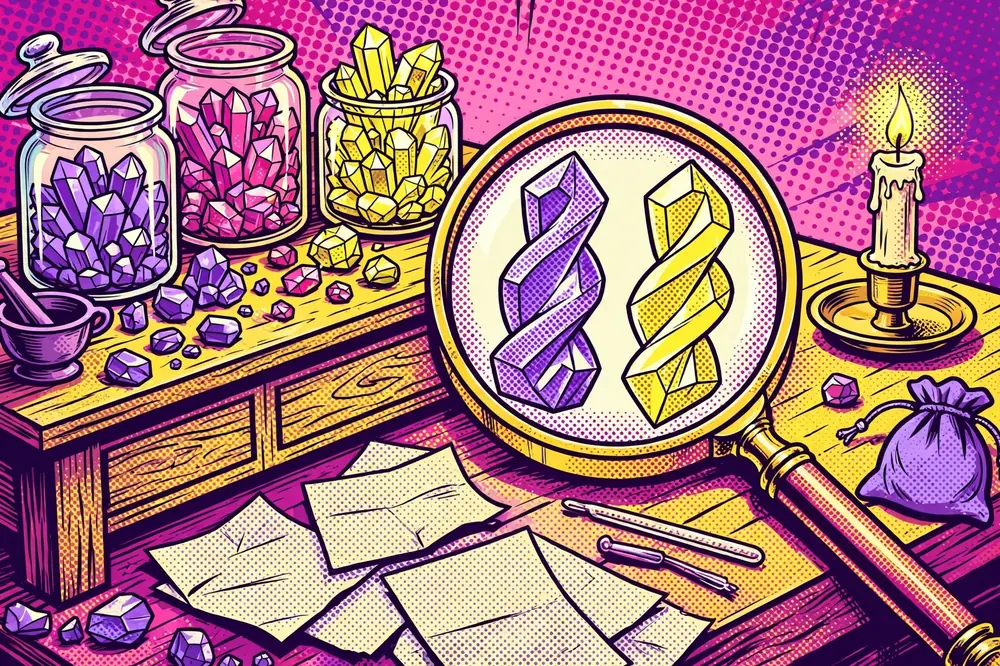
Pasteur separated left- and right-handed tartaric acid crystals by hand. Image generated by AI.
The 1953 prediction
In 1953, the theoretical physicist Charles Frank of the University of Bristol sketched the answer on paper. He proposed a mathematical model for a chemical reaction that would end with just one mirror image. His recipe had three ingredients: the reaction must use a chiral catalyst, the formation of one mirror image must be favoured over the other, and any mirror-image molecule produced should form its own catalyst, so the reaction catalyses itself. That last ingredient, autocatalysis, is the molecular equivalent of a photocopier: the product prints more of itself.
Frank’s model was elegant, but fulfilling all three conditions in a real flask took decades.
Kagan’s non-linear surprise
The first breakthrough came in the early 1980s from Henri Kagan. He combined unequal mixtures of left- and right-handed molecules with a metal catalyst and watched what came out. He found something unexpected: changing the ratio of the two catalyst forms changed the ratio of the two products, but not proportionally. The relationship was non-linear. Some combinations of catalyst and molecule were simply more effective than others, amplifying one mirror image over the other.
It was a new phenomenon, and it gave chemists a practical handle on a problem that had seemed purely theoretical. Kagan’s discovery has since become routine in the design of reactions for manufacturing pharmaceuticals, flavours, scents and new materials.
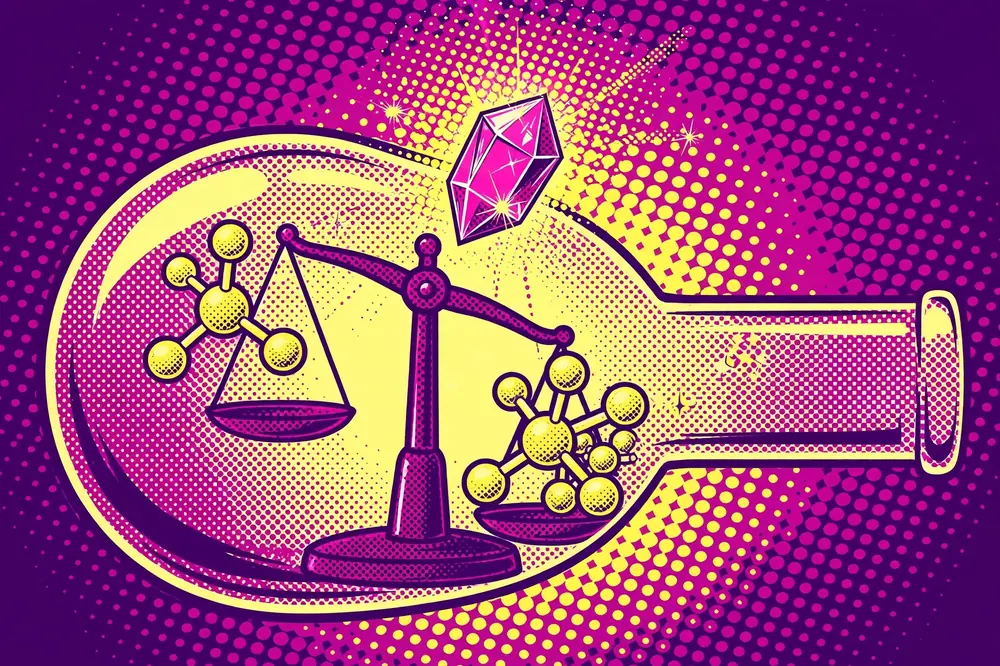
A catalyst that does not just speed up a reaction but amplifies one mirror image: Kagan’s non-linear effects. Image generated by AI.
The Soai reaction: a molecule that copies itself
Building on Kagan’s work, Kenso Soai went hunting for a reaction that would complete Frank’s recipe, including the hardest part: autocatalysis. In 2003, he found it. He reacted a chiral aldehyde-containing pyrimidine with an alkyl zinc reagent, adding a small amount of a chiral alcohol, the very product the reaction was supposed to make. Starting from a mixture with only a slight excess of one mirror image, the reaction ended up producing more than 99.75 percent of that same form.
The product was catalysing its own creation, and each round amplified the imbalance a little more. It was the first chemical reaction ever shown to produce only one of a molecule’s mirror images. Peter Somfai of Lund University, a member of the Nobel Committee for Chemistry, called the Soai reaction “probably the coolest experiment in organic chemistry.”
Taken together, Kagan’s non-linear effects and Soai’s autocatalysis ticked every box in Frank’s 1953 model. “Other than life itself, no one had previously achieved this feat,” the Nobel committee noted. Chemists now had a concrete demonstration of how homochirality could emerge spontaneously from a mixture that started nearly balanced.
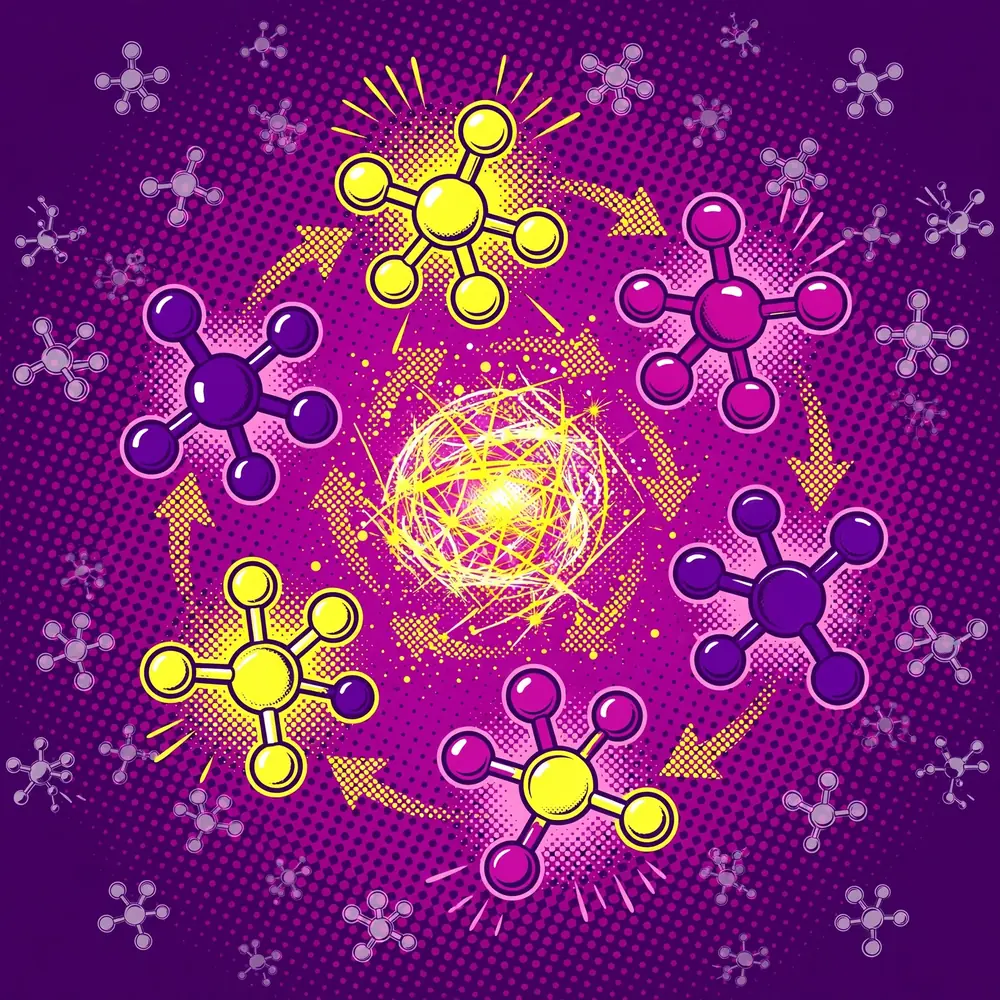
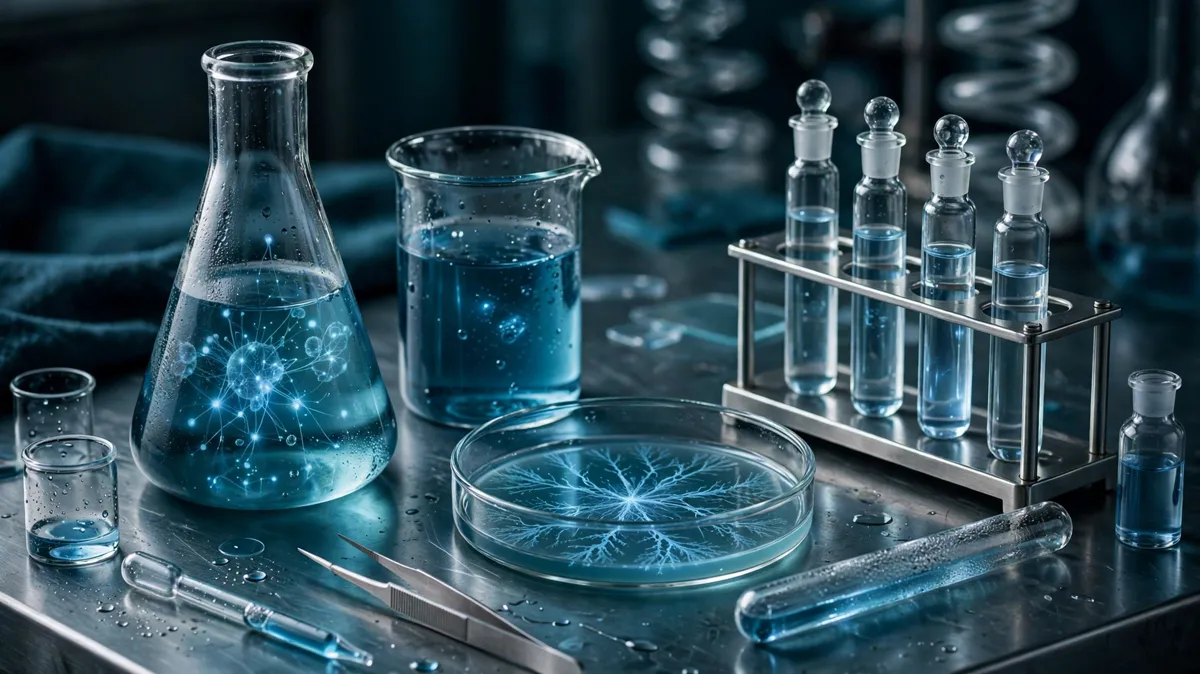
The Soai reaction: the product acts as a catalyst for its own formation, amplifying one mirror image to more than 99.75 percent. Image generated by AI.
Why it matters
This is not abstract chemistry. “The medicines we have today would not be possible without this chemistry,” said Rigoberto Hernandez, president of the American Chemical Society. Every year, pharmaceutical companies must produce single mirror-image forms of drug molecules at industrial scale, and the toolkit for doing so traces directly back to Kagan’s and Soai’s discoveries. The same chemistry shapes the flavours and fragrances industry and the design of new materials.
And the original mystery, how life’s one-handedness arose, remains open. The Nobel committee was careful on this point: Kagan and Soai showed how homochirality can emerge spontaneously, but exactly what happened when life’s homochirality first appeared is unlikely to ever be known. What they gave science is the mechanism, proven in a flask.
The long road to Stockholm
The prize also settles an old score. In 2001, the chemistry Nobel went to William Knowles, Ryoji Noyori and Barry Sharpless for work on asymmetric catalysts, a field Kagan had helped found, and Kagan was left out. The then French research minister complained to the Nobel Foundation. A quarter of a century later, at 95, Kagan became the third-oldest Nobel laureate in history.
Soai, meanwhile, learned the news while out shopping near his home. “This is one of the most exciting days in my life,” he told the press conference by phone. French President Emmanuel Macron and Japanese Prime Minister Sanae Takaichi both called to congratulate the pair. They will share 12 million Swedish kronor, about 1.2 million dollars.
Related reading
More from this year’s Nobel week: Optogenetics, Explained: Controlling Brain Cells with Light, on the medicine prize awarded for the tool that maps the brain with light.
Frequently asked questions
What is homochirality?
It is the fact that living organisms use only one of the two mirror-image forms of many molecules. For example, the amino acids in our proteins and the sugars in our DNA each come overwhelmingly in one “handed” form.
What are non-linear effects?
Kagan’s discovery that the mirror-image purity of a reaction’s product does not change proportionally with the purity of the catalyst. Small imbalances can be amplified into large ones, which is what makes them so useful for manufacturing.
What is the Soai reaction?
A chemical reaction in which the product acts as the catalyst for its own formation. Starting from a slight excess of one mirror image, it ends with more than 99.75 percent of that form, the first reaction to produce only one mirror image.
Why do mirror molecules matter for medicines?
The two mirror forms of a drug molecule can behave differently in the body. Chemists need reliable methods to produce just the desired form, and the laureates’ discoveries provide exactly those methods.
Sources
This article was synthesized from the following sources:
- The Nobel Prize in Chemistry 2026, NobelPrize.org, with press release, popular information and scientific background (retrieved October 8, 2026).
- Reactions that demonstrate how homochirality can emerge take chemistry Nobel prize, Chemistry World, October 7, 2026.
- Henri B. Kagan and Kenso Soai win Nobel Prize in chemistry, The Associated Press via KRVS, October 7, 2026.
- Nobel chemistry prize goes to pair who solved mystery of ‘mirror image’ molecules, BusinessWorld/Reuters, October 8, 2026.







0 Comments