

An original TeaLamp explainer based on the sources listed below. Prepared by the TeaLamp Editorial Team with the help of AI.
Girl with a Pearl Earring may be the most recognisable face in Dutch art, yet for most of its life it was a puzzle. Who was she? Why the turban? And what is that glowing pearl made of? A close scientific study by the Mauritshuis in The Hague, where the painting hangs, has answered some of these questions, and the answers make Johannes Vermeer’s small canvas even more intriguing.
Key takeaways on Girl with a Pearl Earring
- The painting is not a portrait of a real sitter. It is a “tronie”, a Dutch study of an imaginary character in costume.
- The dark background was once a green curtain. The translucent green paint has changed over time and now looks almost black.
- Vermeer painted tiny eyelashes that are invisible to the naked eye, and the famous pearl is a clever illusion with no hook to hang it from.
- His colours came from far away, including ultramarine made from lapis lazuli mined in what is now Afghanistan.
- The painting was bought at auction in 1881 for two guilders plus a thirty-cent fee.
A face that was never meant to be a portrait
Vermeer (1632–1675) spent his whole life in the Dutch city of Delft and left behind only a few dozen known paintings. Most show quiet interiors: women reading letters, pouring milk or playing music. Girl with a Pearl Earring, painted around 1665, is different. It is a head-and-shoulders view of a young woman turning towards us over her shoulder, lips slightly parted, against a dark background.
The Mauritshuis describes the work as a tronie, the Dutch word for “face”. In the 1600s, a tronie was a painting of a type or a character rather than a specific person. Painters used them to practise expressions, lighting and exotic costume, and buyers enjoyed them as appealing images in their own right. That is why the girl wears a blue and yellow turban, which was not everyday dress in Delft, and an earring that is, in the museum’s words, “too large to be real”.
So the long-running question “who was she?” may have no answer at all. She might have been a model from Vermeer’s household or neighbourhood, but the painting was never meant to record her identity.
The 2018 study: a painting under the microscope
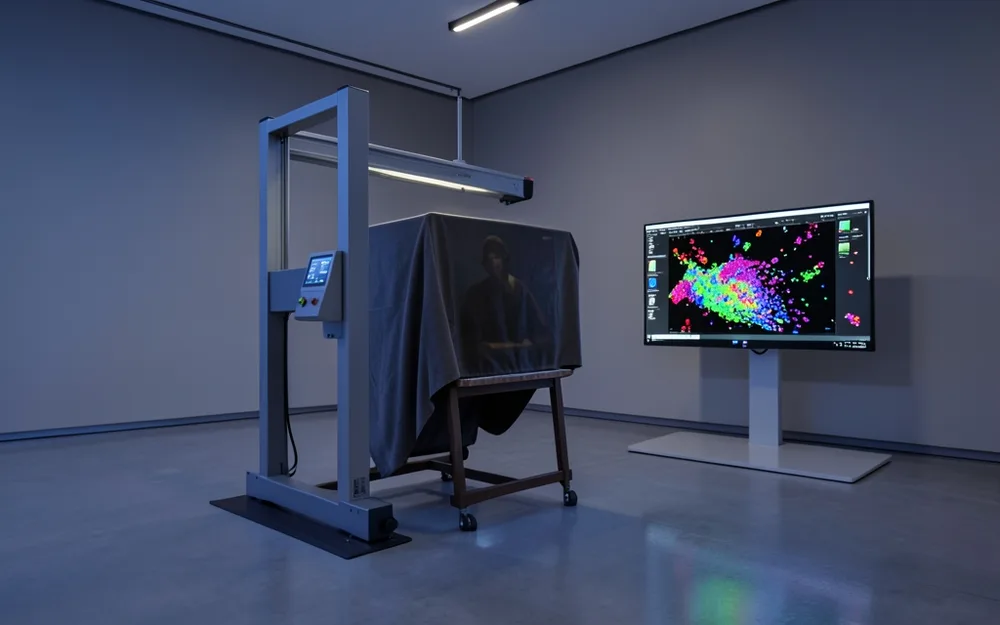
In February and March 2018, the Mauritshuis ran a project called The Girl in the Spotlight. For two weeks, an international team led by paintings conservator Abbie Vandivere examined the canvas in a glass studio inside the museum, so visitors could watch. The team used non-invasive scanning, infrared imaging, 3D digital microscopy and tiny paint samples, then published the results in 2020 in a set of open-access articles in the journal Heritage Science.
Modern scanners map pigments without touching the paint. Image generated by AI.
The green curtain that faded away
The biggest surprise was in the background. Imaging revealed diagonal lines and colour changes in the upper right corner that suggest folded fabric. Vermeer had painted the girl in front of a green curtain, using a translucent green glaze over a dark underlayer. Over the centuries, physical and chemical changes in that glaze made the curtain disappear, leaving the deep, empty darkness we see today.
Eyelashes, changes of mind and a signature
To the naked eye, the girl has no eyelashes. Under the microscope and in X-ray fluorescence scans, the team found tiny painted hairs around both eyes. The scans also showed that Vermeer moved things as he worked: the position of her ear, the top of the headscarf and the back of her neck all shifted. He started with broad brown and black underlayers, outlined the figure with thin black lines, and built up the picture from the background forward. Finally, he signed it “IVMeer” in the upper left corner.
The pearl is an illusion
The most famous detail turns out to be one of the simplest. The “pearl” is made of a few translucent and opaque touches of white paint, and there is no hook connecting it to the ear. Our eyes fill in the rest. The museum notes that it may represent a varnished glass drop, which was a popular imitation at the time, or it may simply be Vermeer’s invention. Pearls, real and fake, were fashionable in Dutch paintings from about 1650 to 1680.
This is a good example of Vermeer’s light. Rather than describe every surface, he placed small, exact highlights where light would catch, such as the gleam on the lips, the whites of the eyes and the curve of the drop. The study also found that he left a slight gap between the dark background and the edge of her face, which softens the contour and gives the impression of light circling around her cheek.
A palette gathered from around the world
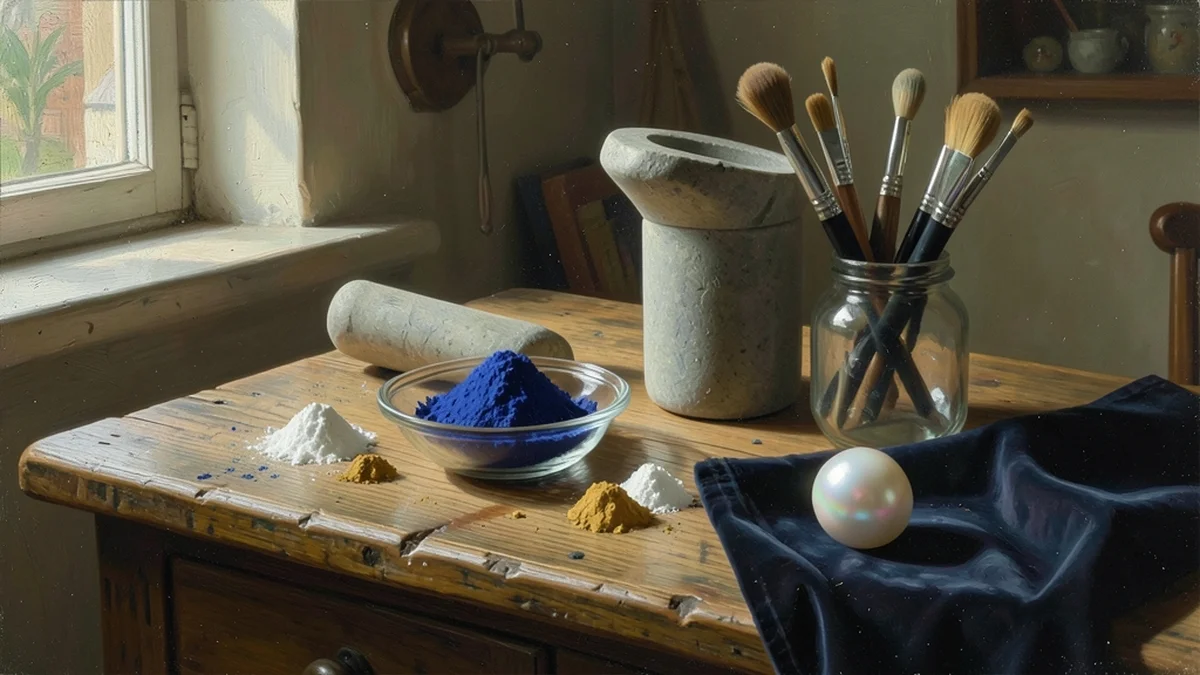
For the first time, the researchers mapped every colour Vermeer used in this painting. His palette included vermilion and a red lake made from cochineal, earth pigments, lead-tin yellow and yellow lake, ultramarine and indigo, charcoal and bone black, and lead white. According to the Mauritshuis, the raw materials came from regions that are now Mexico and Central America, England, and possibly Asia or the West Indies.

Vermeer’s colours came from minerals and insects gathered worldwide. Image generated by AI.
The most striking ingredient is natural ultramarine, the deep blue of the headscarf. It was made by grinding lapis lazuli, a semi-precious stone from what is now Afghanistan, and in the 1600s it cost more than gold. The study suggests the stone was first heated, which made it easier to grind and produced a more intense blue. Vermeer used this costly pigment generously, even mixing it into the yellow jacket.
Lead white told its own story. Lead isotope analysis traced the ore to England, and a separate X-ray study found several different kinds of lead white in the painting. Vermeer seems to have chosen brighter, more opaque whites for the lit parts of the face and a more transparent one for the shadows, which helps explain the smooth glow of her skin.
Two guilders and thirty cents
Little is known about where the painting spent its first two centuries. In 1881 it turned up at an auction in The Hague, so dirty that it was hard to judge. The cultural official Victor de Stuers and his friend, the collector Arnoldus Andries des Tombe, both noticed it, and they agreed not to bid against each other. Des Tombe bought it for two guilders plus a thirty-cent fee, which the Mauritshuis estimates at about 30 euros in today’s money. After cleaning revealed Vermeer’s signature, its reputation grew. When Des Tombe died in 1902, his will left twelve paintings to the Mauritshuis, including this one.
Why it matters
The research shows how much a single painting can still teach us. Modern imaging did not take away the mystery of the girl; it showed how carefully Vermeer built the illusion, from a vanished curtain to a pearl made of two or three brushstrokes. It also reminds us that many old paintings have changed since they were made, so what we see in a museum is partly the artist’s work and partly the work of time. And because the scientific papers are free to read, anyone curious can follow the evidence for themselves.
Related reading
For another story about famous art and who gets to use it, read our explainer on Mondrian’s masterpiece and the public domain. For more science in the service of art history, see how lead ink could unlock the buried Herculaneum scrolls.
Frequently asked questions
Who is the girl in Girl with a Pearl Earring?
Nobody knows. The painting is a tronie, a study of an imaginary type in costume, so it was not meant to record a particular person’s identity.
Where can I see the painting?
It belongs to the Mauritshuis museum in The Hague, in the Netherlands, where it is normally on display.
Is the pearl real?
Probably not. The museum says it is too large to be a real pearl; it may show a varnished glass drop or be Vermeer’s invention, painted with a few touches of white.
Sources
- Mauritshuis, Girl with a Pearl Earring collection page (tronie, pearl, 1881 purchase, bequest)
- Mauritshuis press release, Closer to Vermeer and the Girl (April 28, 2020)
- Mauritshuis blog, How much is The Girl worth?
- Vandivere et al., The Girl in the Spotlight: Vermeer at work, his materials and techniques, Heritage Science (2020)
- Vandivere et al., Beauty is skin deep: the skin tones of Vermeer’s Girl with a Pearl Earring, Heritage Science (2019)
- Science Advances, Macroscopic x-ray powder diffraction imaging reveals Vermeer’s discriminating use of lead white pigments in Girl with a Pearl Earring (2019)










0 Comments