


A TeaLamp book summary of Treasure Island by Robert Louis Stevenson, first published in 1883. In the public domain. Prepared by the TeaLamp Editorial Team with the help of AI.
This Treasure Island summary is for anyone who has always meant to read Stevenson’s pirate classic and never quite got around to it. Treasure Island is the pirate story that invented the pirate story: Robert Louis Stevenson’s 1883 novel gave us the treasure map marked with an X, the parrot crying “Pieces of eight,” and Long John Silver, the one-legged cook who remains the most charming villain in adventure fiction. Told by the young Jim Hawkins, it is a coming-of-age tale wrapped in a mutiny, and it has never been out of print.
Key takeaways
- Jim Hawkins, a boy helping at his parents’ inn, finds a treasure map in a dead sailor’s chest and sails for a distant island.
- The ship’s cook, Long John Silver, is secretly leading a band of mutinous pirates after Captain Flint’s buried gold.
- On the island, Jim navigates shifting loyalties, a marooned castaway, and a battle for the treasure.
- At its heart, the novel is about a boy learning to judge character, and discovering that charm and villainy can live in the same person.
- Published in 1883, it defined the modern pirate adventure and is in the public domain.
The map in the sea chest
The story opens at the Admiral Benbow, a quiet inn on the English coast, where Jim Hawkins helps his parents. A new lodger arrives: Billy Bones, a rough old seaman who pays in gold, drinks rum, and sings the same sea-song over and over: “Fifteen men on the dead man’s chest — Yo-ho-ho, and a bottle of rum!” Bones lives in fear of a one-legged man, and when two sinister visitors track him down, he dies of a stroke. In his sea chest, Jim finds what the visitors were after: a map of an island, marked with the hiding place of the buried treasure of the feared Captain Flint.
Jim takes the map to Squire Trelawney and Dr. Livesey, the local gentleman and doctor. They decide at once to fit out a ship, the Hispaniola, and sail for the island. Trelawney hires a crew in Bristol, and among them is the ship’s cook: a cheerful, quick-witted man with one leg and a parrot on his shoulder, named Long John Silver.
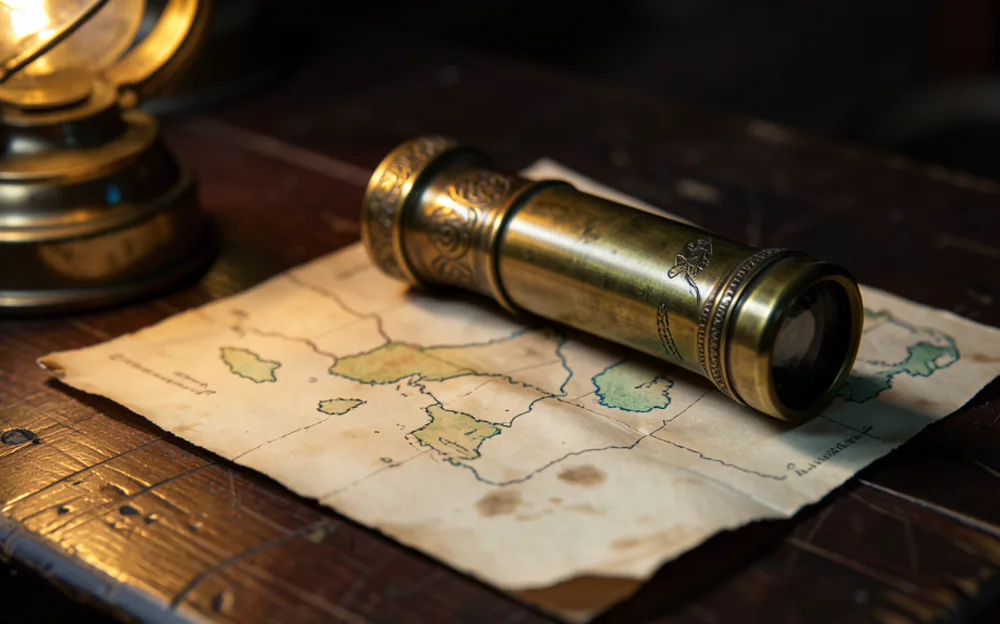
A brass telescope and a hand-drawn map, the tools of Stevenson’s treasure hunt. Image generated by AI.
The cook with the parrot
Silver is the novel’s great creation. He is warm, funny and kind to Jim, and his parrot, Captain Flint, shrieks “Pieces of eight! Pieces of eight!” through the voyage. But hidden in an apple barrel one night, Jim overhears Silver plotting with the crew: most of them are old shipmates of Captain Flint, and they plan to mutiny and take the treasure for themselves. Silver, the friendly cook, is their ringleader. Jim has stumbled on the oldest lesson of the book: never trust a smile without checking what stands behind it.
Mutiny on the island
When the Hispaniola reaches the island, the honest party, Captain Smollett, Dr. Livesey, Squire Trelawney and Jim, splits from the mutineers. Jim slips ashore with the pirates’ boat and meets Ben Gunn, a marooned sailor left on the island three years before, half-mad, dreaming of cheese. Back at the stockade, an old log fort on the island, the two sides trade shots and stratagems. Jim, acting alone and against orders, cuts the Hispaniola adrift, kills a mutineer in a desperate fight aboard the ship, and returns to find the stockade in pirate hands. Taken prisoner by Silver, Jim watches the pirates’ discipline crack under greed and drink.
The people who sail with you
A word on the company. Jim Hawkins is one of fiction’s great boy narrators: brave without being fearless, and honest about his mistakes. He disobeys orders, gets captured, and survives as much by luck as by sense, which is exactly why young readers trust him. Dr. Livesey is the story’s calm center, a gentleman doctor whose courage never needs announcing. Squire Trelawney is well-meaning and hopelessly indiscreet; his loose talk in Bristol is how the pirates learn about the voyage in the first place. Captain Smollett is the professional seaman, stern and competent, the only man aboard who spots trouble before it starts. And Ben Gunn, the marooned man, is the story’s wild card: three years alone have left him strange, but his lonely discovery of the treasure quietly decides everyone’s fate.
Above them all stands Silver. He has been played as a monster and as a rogue, but Stevenson wrote something rarer: a villain with a real inner life. Silver loves his parrot, respects courage even in enemies, and is genuinely fond of Jim. He is also a murderer who would cut any throat for the gold. Jim’s education, and the reader’s, is learning to hold both facts at once.

A rowboat on a tropical shore, not unlike the one Jim rows to the island. Image generated by AI.
The treasure and the reckoning
Silver marches his men to the spot marked on the map, only to find the treasure already dug up. Ben Gunn, it turns out, had found Flint’s gold long ago and moved it to his cave. In the final scramble, Livesey’s party ambushes the remaining mutineers, and the gold is loaded aboard the Hispaniola. Silver, ever the survivor, talks his way into a share of mercy and a passage home, then slips away at the first port with a bag of coins. Jim closes the story a young man, rich, haunted, and wiser, dreaming still of Silver’s parrot crying over the gold.
How the book was written
Stevenson wrote Treasure Island in the summer of 1881, on holiday in Braemar, Scotland, where bad weather kept the family indoors. His twelve-year-old stepson, Lloyd Osbourne, had drawn a map of an imaginary island, and Stevenson, enchanted, began a story to fit it, writing a chapter a day to read aloud each evening. Chapters began appearing in the children’s magazine Young Folks that October under the title “Treasure Island or the Mutiny of the Hispaniola” (Stevenson had wanted to call it “The Sea Cook”), and the novel was published as a book on 14 November 1883 by Cassell & Co. It became his first financial and critical success. Stevenson later said the tale was stitched together from everything he had ever read about pirates and the sea, from Daniel Defoe to Washington Irving, retold, as his dedication poem puts it, “exactly in the ancient way.”
Why it matters
Treasure Island endures because Stevenson understood something deeper than adventure. Jim begins the book as a boy who fetches brandy for sailors and ends it as someone who has killed, been betrayed, and learned to read people. Silver is not a monster but a man: loyal to his own crew, genuinely fond of Jim, and utterly ruthless when the gold is near. That moral complexity, wrapped in a rattling good yarn of maps, mutinies and maroons, is why the book became the template for every pirate story since, from stage to screen. It is also simply one of the best-paced novels ever written: every chapter ends with the reader needing the next.
Related reading
For another seafaring classic retold, see our summary of Moby Dick: The Obsession Behind the Whale.
Frequently asked questions
Is Treasure Island based on a true story?
No, though Stevenson wove in real pirate lore. Captain Flint is fictional, but the novel draws on the legends of real buccaneers, buried treasure tales, and Stevenson’s own imagination, sparked by a map he drew with his stepson.
What age is Treasure Island suitable for?
It was first serialized for young readers and is often read from around age ten up, though its violence and rum-soaked pirates suit slightly older readers best. Adults return to it for Silver, one of literature’s great characters.
Did Treasure Island invent pirate clichés?
Many of them, yes. The treasure map with an X, the parrot on the shoulder, the “arr”-style sea talk and the one-legged pirate all entered popular culture through this book, though Stevenson drew on older sailor traditions.










0 Comments