

A TeaLamp book summary of Alice’s Adventures in Wonderland by Lewis Carroll, first published in 1865. In the public domain. Prepared by the TeaLamp Editorial Team with the help of AI.
This Alice in Wonderland summary is for anyone who knows the grin, the teacups and the rabbit hole, but has never actually read the book they came from. It is a short book with an outsized shadow. Lewis Carroll’s 1865 story of a girl who follows a talking rabbit underground invented half the rules of modern fantasy, filled the English language with phrases people quote without knowing why, and remains the rare children’s book that adults read for completely different reasons than children do.
Below is the whole journey, told in full: how the story began on a real river trip, what actually happens chapter by chapter, who all those strange people are, the scenes the world never forgot, and what the nonsense is quietly doing underneath. If you only know Alice from films, most of the best of her is still waiting for you in these pages.
A story born on a river
On 4 July 1862, a shy Oxford mathematics lecturer named Charles Lutwidge Dodgson rowed up the River Thames with his friend the Reverend Robinson Duckworth and three young sisters: Lorina, Alice and Edith Liddell, the daughters of the Dean of Christ Church. To pass the golden afternoon, Dodgson invented a story about a girl named Alice who tumbles down a rabbit hole into a world where nothing behaves. Alice Liddell asked him to write it down for her, and he did, by hand, illustrating it himself and giving it to her as a Christmas gift in 1864 under the title Alice’s Adventures Under Ground.
Friends who read the little manuscript urged him to publish. Writing as Lewis Carroll, he expanded the story, and the artist John Tenniel drew the famous illustrations, more than forty of them, so exact in the author’s mind that Carroll supervised them closely. Macmillan published Alice’s Adventures in Wonderland in November 1865. The first printing was withdrawn because Carroll and Tenniel were unhappy with how the pictures had printed, and a fresh edition followed. The book has never been out of print since, and its sequel, Through the Looking-Glass, arrived in 1871.
The story, in full
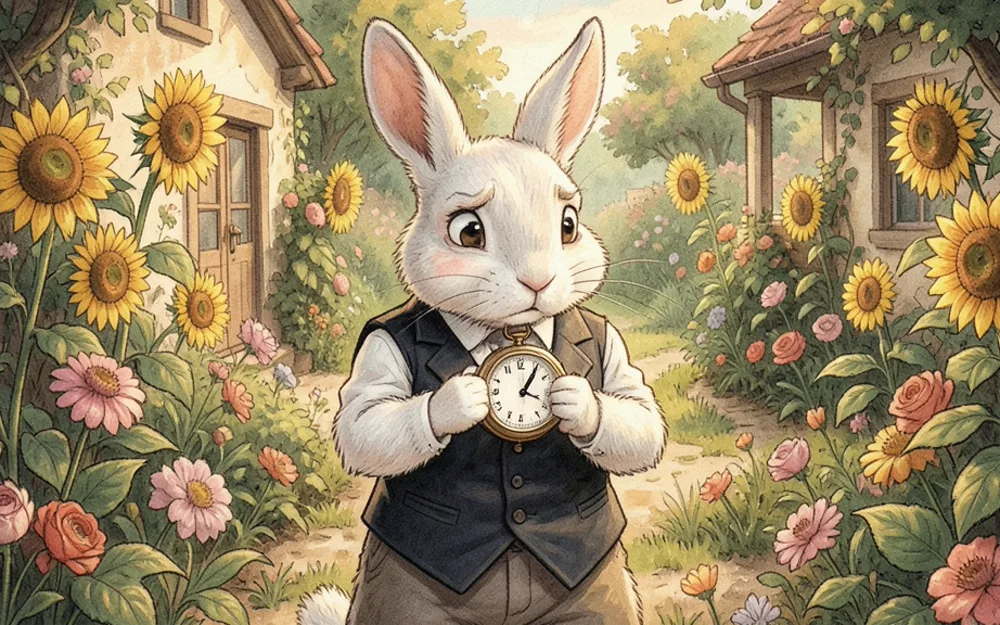
Alice is sitting on a riverbank beside her sister, bored by a book with no pictures or conversations, when a White Rabbit hurries past. Nothing unusual in that, except that this rabbit is wearing a waistcoat, takes a watch out of its pocket, and complains aloud that it is late. Alice follows him, tumbles down a very deep rabbit hole, and lands in a hall full of locked doors. Behind one tiny door she glimpses a beautiful garden she cannot reach, and so begins the book’s running pattern: a bottle marked Drink Me shrinks her, a cake marked Eat Me makes her grow enormous, and Alice spends much of the story the wrong size for everything, including her own tears, in which she nearly drowns after shrinking again.
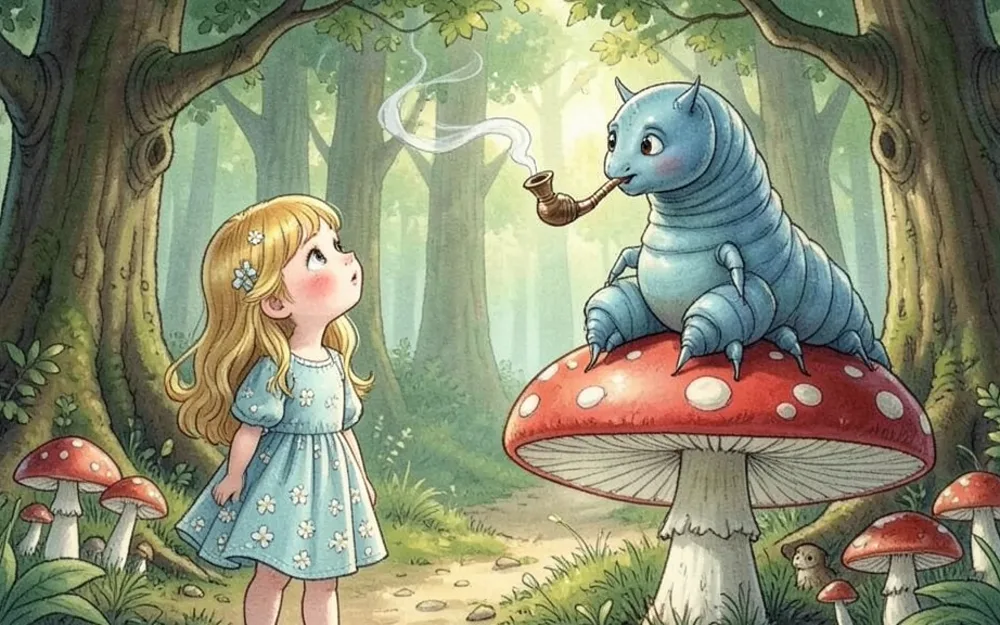
Swept along by a crowd of wet animals and birds, she joins a Caucus-race that everyone wins, then is mistaken for a servant by the White Rabbit and nearly grows out of his house altogether. Escaping into the wood, she meets the Caterpillar, perched on a mushroom, smoking a hookah and asking her, in a sleepy voice, who she is. Alice has to admit she hardly knows, she has changed so many times that morning. The Caterpillar’s parting gift is the book’s most practical magic: one side of the mushroom will make her taller, the other shorter, if she can only remember which is which.
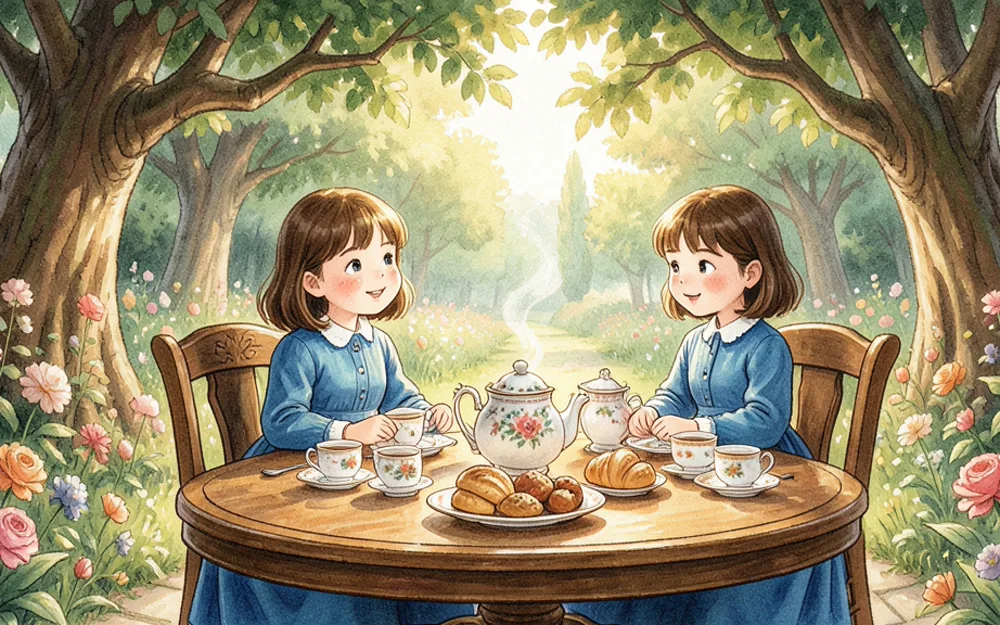
At the house of the Duchess she finds a cook throwing everything in reach, a baby that turns into a pig in her arms, and a Cheshire Cat that can vanish slowly, beginning with the tail and ending with the grin. Directed by the Cat, Alice visits the Mad Hatter and the March Hare, who are holding a tea party that never ends, because Time has stopped at six o’clock for them. There she hears the famous riddle with no answer, is told she is wasting time by a very rude dormouse’s companions, and walks off, quite sensibly, from the silliest tea party in literature.
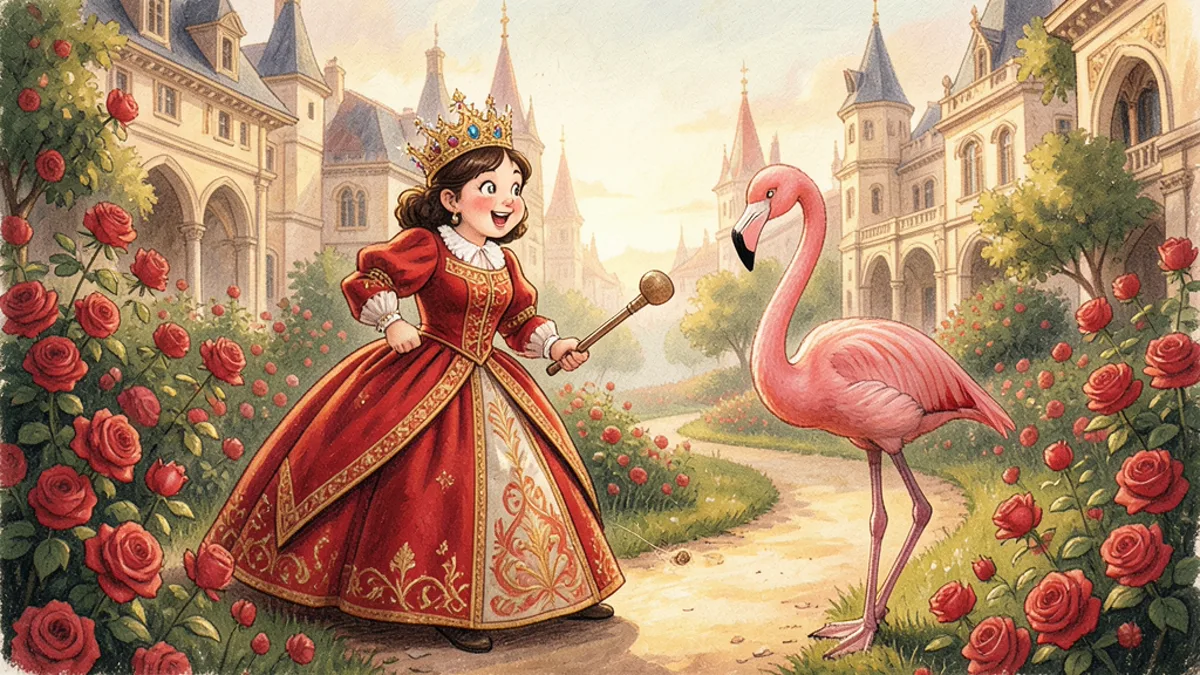
In the garden she has been seeking all along, Alice finds gardeners painting white roses red to hide their mistake from the Queen of Hearts, who arrives in procession shouting for heads to come off. Nobody’s head actually does, in this book; the King quietly pardons everyone. Alice is invited to play croquet, a match like no other: the mallets are live flamingoes, the balls are hedgehogs that unroll and wander off, the hoops are soldiers who keep moving, and the Queen argues with everyone at once. The Cheshire Cat’s head appears without its body, and the executioner refuses, on principle, to cut off a head that has no body attached to it.
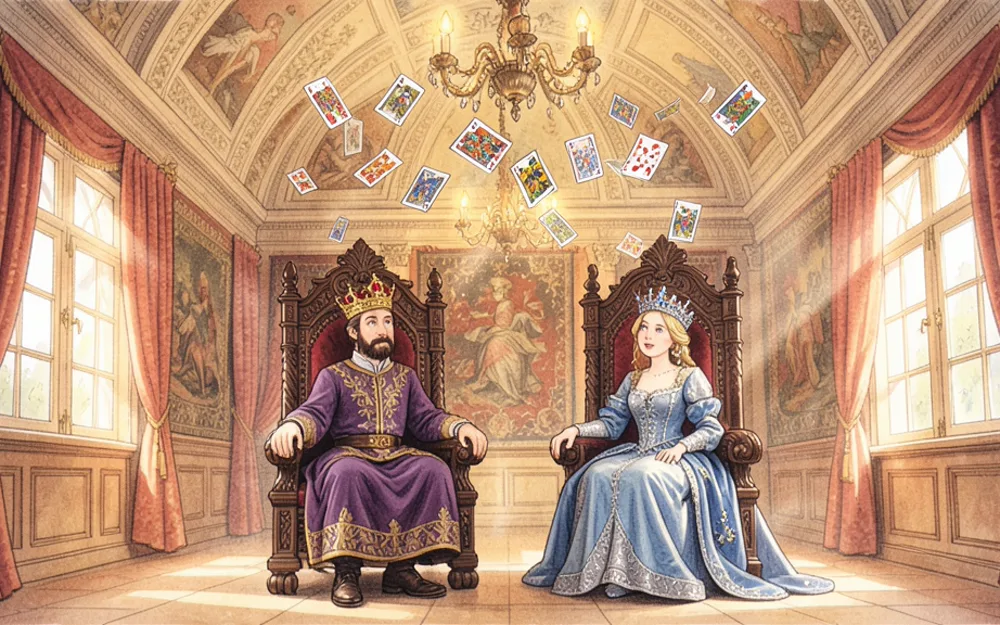
The Gryphon then takes Alice to hear the Mock Turtle’s sad history and to watch the Lobster Quadrille danced on the shore. At last comes the trial of the Knave of Hearts, accused of stealing the Queen’s tarts, a courtroom where the evidence is a nonsense poem, the jury writes down its own names so as not to forget them, and the Queen keeps demanding the sentence before the verdict. Alice, who has been growing quietly back to her full size, finally loses patience with the whole performance. “You’re nothing but a pack of cards!” she cries, and the entire court rises into the air and comes flying down on her. She wakes on the riverbank, beside her sister, with dead leaves on her face, and tells her the whole curious dream before running in to her tea.
The people of Wonderland
Alice is the calm centre of the madness: polite, literal, curious, and quietly unconvinced by nonsense dressed up as rules. She corrects herself when she says something silly, apologises when she should, and argues back when an adult, or a cat, is clearly wrong. The comedy works because she treats Wonderland with complete Victorian seriousness.
The White Rabbit is anxiety in a waistcoat: a nervous herald always late, always fussing, terrified of the Duchess and the Queen. He is funny because every adult reader recognises him. The Caterpillar is the opposite, slow and unbothered, the one creature who asks Alice the real question of the book: who are you, now that you keep changing?
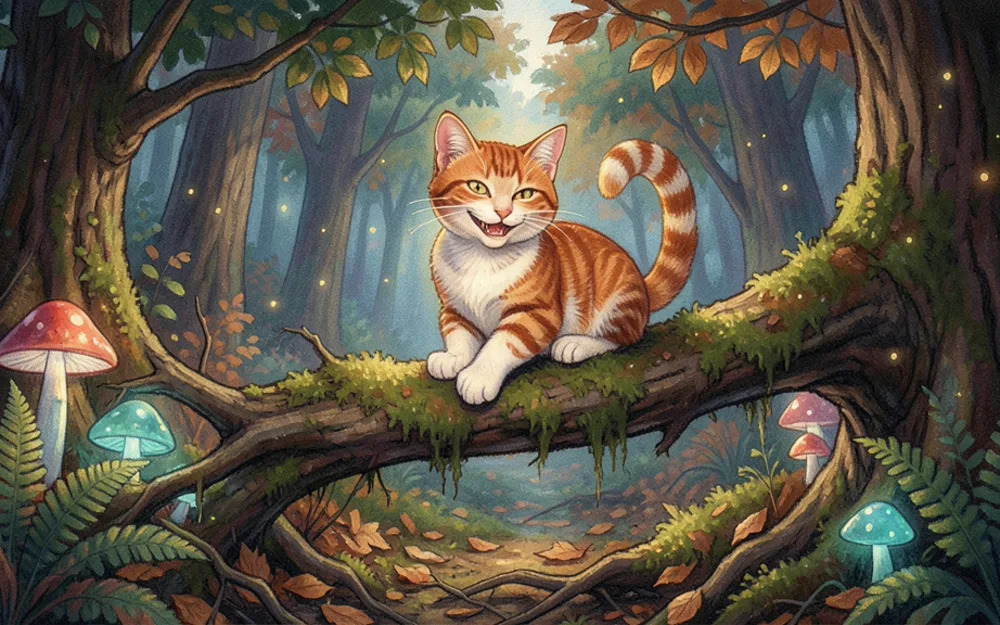
The Cheshire Cat is Wonderland’s philosopher, the only one who admits the place is mad, including himself. His grin outlasts him, and his logic is maddeningly sound: a dog growls when angry and wags its tail when pleased, so a cat purring and wagging must be consistent too. The Mad Hatter and the March Hare are rudeness perfected into an art form, hosts who offer wine they do not have and ask questions they refuse to answer.
The Queen of Hearts is a tantrum with a crown, a parody of every petty authority: loud, certain, and forever ordering executions that somehow never happen. Beside her, the King of Hearts shuffles along pardoning everybody when she is not looking. And the Mock Turtle, who is what mock turtle soup is made from, is gently, permanently sad about his school days under the sea, while his friend the Gryphon treats everything as a game, because to him, it all is one.
Scenes the world never forgot
Four scenes have walked out of this book and into the whole culture. The fall down the rabbit hole is now the universal shorthand for entering any strange new world; people speak of going down the rabbit hole without thinking of Alice at all. The Mad Tea Party is the eternal image of a meeting that circles forever and feeds nobody, complete with a riddle, “Why is a raven like a writing-desk?”, that Carroll pointedly never answers in the book.
The grin without a cat is the book’s strangest and most quoted idea: Alice remarks that she has often seen a cat without a grin, but never a grin without a cat. And the croquet match, with its flamingo mallets and argumentative Queen, is Carroll’s perfect picture of a game whose rules exist mainly for the powerful to shout about. Each scene is funny on the page in a way no adaptation quite keeps, because the joke lives in the sentences, in Alice’s dry and reasonable replies.
What the nonsense is really doing
Carroll was a logician, and the book is built like a game of logic played by a cheat. Characters misuse words with total confidence, draw conclusions that almost follow, and correct each other’s grammar while talking rubbish. Children laugh at the silliness. Adults start to recognise the meetings, classrooms and courtrooms of their own lives inside it, where the forms are all observed and the sense has quietly left the room.
Under the jokes sits a serious subject: growing up. Alice changes size a dozen times, forgets her lessons, misremembers her poems, and keeps being asked who she is. It is the experience of childhood itself, where your body, your knowledge and your name for yourself will not stay still from one hour to the next. Alice survives it the way Carroll clearly hoped a child would: by keeping her manners, her questions and her nerve. A generation later, the surrealist artists happily claimed the book as one of their own, and readers have been finding new meanings in it ever since; Carroll himself insisted it was, before anything else, a story told to make three girls in a boat laugh on a summer afternoon.
Lines the world kept
“Curiouser and curiouser!” Alice cries, early in her fall from one surprise into the next, in grammar that would horrify her governess and that the whole world now uses on purpose. The Cheshire Cat explains the local rules without blinking: “We’re all mad here. I’m mad. You’re mad.” The Queen contributes the book’s most famous order, “Off with their heads!”, issued like a weather report and obeyed by nobody. And the King, running his impossible trial, gives the soundest advice in Wonderland: “Begin at the beginning, and go on till you come to the end: then stop.”
Why Alice still matters
Alice’s Adventures in Wonderland has never been out of print in over 160 years and has been translated into well over a hundred languages. It quietly set the template for the modern fantasy story: an ordinary child steps through a small door, a hole or a wardrobe into a world with its own mad logic, and comes home changed. Nearly every portal fantasy written since walks through the door Carroll built. Its characters have escaped into daily speech, into films, plays, ballets and operas, into the name of a real medical condition, Alice in Wonderland syndrome, which affects how people perceive size, and even into mathematics and philosophy lectures, where its arguments are still used to teach logic.
Most of all, it lasts because it respects children. Carroll never talks down, never adds a moral, and never explains the joke. Alice is not taught a lesson by Wonderland. She simply visits it, keeps her head while everyone else loses theirs at the Queen’s suggestion, and comes home in time for tea.
Before you pick it up
It is a short book, around two hundred pages in most editions, and a quick, easy read that rewards reading slowly, because the jokes are in the sentences. Choose an edition with John Tenniel’s illustrations if you can; his Alice, calm and severe in a sea of eccentrics, is the one the world pictures. Read it aloud to children from about seven and they will laugh at the animals and the tea party; read it again as an adult and you will laugh at the officials. And if the sequel tempts you, Through the Looking-Glass is where Alice meets Tweedledum and Tweedledee and the White Queen; it is a different book, from 1871, and just as good. Like all of Carroll’s classics, this one is free to read in full at Project Gutenberg.
Frequently asked questions
Is Alice in Wonderland a children’s book or a book for adults? Both, in layers. Carroll wrote it for children and children still love its animals, food and chaos. Adults find the logic games, the parodies of Victorian school lessons, and the satire of courts and officials. It is one of the few books that genuinely grows up with its reader.
How long is Alice’s Adventures in Wonderland? The first edition ran to 192 pages, and most modern editions are around two hundred pages. At an easy pace it is a day or two of reading, or a week of bedtime chapters. The twelve chapters are short, and each one is a small adventure of its own.
Are Alice in Wonderland and Through the Looking-Glass the same book? No. They are two separate novels: Alice’s Adventures in Wonderland (1865), with the Queen of Hearts and the Mad Tea Party, and Through the Looking-Glass (1871), a chess game of a book with the White Queen and the poem Jabberwocky. Films often blend the two, which is why so many people remember them as one.
Was Alice based on a real girl? Partly. Alice Liddell was the real girl who asked for the story on the 1862 boat trip and whose name the heroine carries. Carroll always kept a playful distance about how much of her is in the character, and scholars still enjoy arguing about it; the name, the date and the boat trip are facts.
Sources
Lewis Carroll, Alice’s Adventures in Wonderland (Macmillan, 1865), public domain, read in full at Project Gutenberg (ebook 11). Publication history, the 1862 boat trip and first-edition details cross-checked against the book’s reference entry. Quotations in this summary were checked word for word against the Gutenberg text.
Prepared by the TeaLamp Editorial Team with the help of AI. Also on TeaLamp: our summaries of Treasure Island and Moby Dick.





0 Comments