


Originally published by Famira Racy in the Public Knowledge Project (PKP) blog on March 31, 2026 (updated April 10, 2026), under a Creative Commons licence (CC BY 4.0) (the PKP site footer reads “© Simon Fraser University CC-BY 4.0”). Republished here under that licence. PKP, Simon Fraser University and the interviewee are not contributors to TeaLamp and do not endorse it or its use of their work. This interview with Teresa Lee, PKP’s new Managing Director, was published in the Archipelago community newsletter. Changes: formatting, the interviewee’s photo reused, two AI-generated illustrations and a short “Key takeaways” section added by TeaLamp. The questions and answers are reproduced as published. Prepared for TeaLamp by the TeaLamp Editorial Team with the help of AI.
PKP welcomes our new Managing Director, Teresa Lee, in this interview segment of Archipelago, our community newsletter. Teresa shares her thoughts on what attracted her to the role, how her experience has prepared her to serve our communities, opportunities and challenges in making knowledge public, priorities, and visions of success.
Thank you, Teresa, for joining me in this interview. And welcome to PKP! To start, what attracted you to this role?
PKP has always been a place I’ve admired, but I became a proper fan when a previous organization I was with, the International Agency for Research on Cancer (IARC), considered adopting OMP. My interactions with the team as a potential client left a lasting and wholly positive impression. Add this to PKP’s vision of a world where everyone has the chance to create and access open knowledge for the greater good, and I was convinced the Managing Director role would be a dream job.
We’re so glad you joined us and that our mission speaks to you. How does your prior experience prepare you to lead an organization serving researchers, publishers, and the scholarly community?
My relatively low threshold for boredom has kept me moving around in my career. I started as a health sciences reference librarian at UBC, went from there to managing e-resources, then decided that I wanted to better understand the publishing side of the field, which led to a memorable stint in France as IARC’s Knowledge Manager. There I had the opportunity to try my hand at everything from advising scientists on scholarly communications, to launching an online subscription platform for a bestselling flagship publication. I recently made my return to Canadian academia as Associate Dean, Research and Open Scholarship, at York University. This was also an eye-opening experience that gave me a sense of what university libraries and researchers are currently up against.
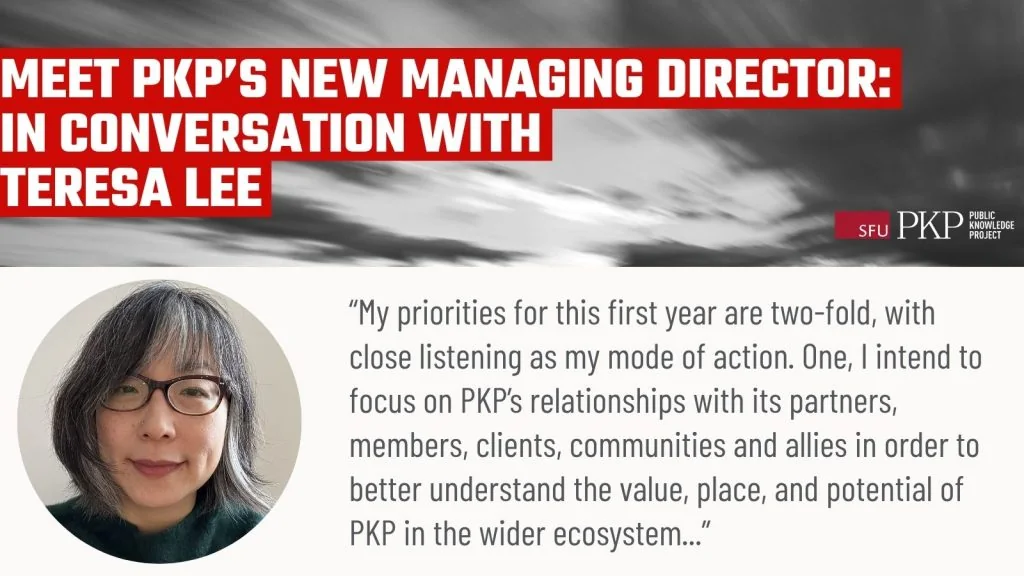
Teresa Lee, Managing Director of the Public Knowledge Project. Photo from the PKP blog (CC BY 4.0).
Your experience clearly gives you a wide window into the world of open. What do you see as the biggest opportunities and challenges for making knowledge public today?
In terms of challenges there’s the sheer heft, scale and influence of commercial publishing to contend with. The problem of financial sustainability of open access publishing isn’t one that’s going to go away easily, and there’s also the deep rootedness of the academic reward model that puts pressures on the system to favour quantity over quality and to shortcut with expeditious metrics rather than engage in critical evaluation. But at the moment there may also be an upside to some of the depressing news. There’s growing awareness of and conversation about data and information as public goods, and a concern for their governance, accuracy, and long term stability. Knowledge sovereignty is being discussed. And in Canada and abroad I think this is a timely moment to set a global example by championing a national digital infrastructure, the Diamond Hub envisioned by Coalition Publica.
There is indeed much opportunity to make change. In your first year as Managing Director, what areas are you most focused on, and why?
My priorities for this first year are two-fold, with close listening as my mode of action. One, I intend to focus on PKP’s relationships with its partners, members, clients, communities and allies in order to better understand the value, place, and potential of PKP in the wider ecosystem. PKP cannot be all things to all people, but it is, and needs to be, multiple things to many people. We will continue to define and strengthen PKP as we make judicious decisions about priorities, and turn our strategic plan into a multiyear plan of work. My second area of focus is bringing rigour and clarity to our internal processes without losing that sense of the personal and scrappy that is a hallmark of PKP culture.

Open knowledge, shared for everyone. Image generated by AI.
These are strong priorities that will no doubt help guide our team into continued success. What are a couple of examples of what success looks like for you, both for the organization and for the communities it serves?
In the near term I hope that the Open Research Europe (ORE) platform flourishes once it’s out in the wild, showcasing the robustness and technical strength of OJS 3.6. But beyond this, I think success for PKP and Coalition Publica, the partnership between Érudit and PKP, will always be bound to our impact on the individuals and communities we serve, to how we’re able to advance open knowledge ecosystems. To have these two organizations be able to grow and innovate with sustainability and wisdom – that seems like a good direction for success.

A growing community around open knowledge. Image generated by AI.
Thank you Teresa, for this illuminating and inspiring conversation! We certainly look forward to growing together as we enter into this next era of the Public Knowledge Project.
Key takeaways on Teresa Lee
- Teresa Lee says PKP’s vision of a world where everyone can create and access open knowledge is what convinced her the Managing Director role would be a dream job.
- Her career runs from health sciences librarian to e-resources, to Knowledge Manager at the International Agency for Research on Cancer, to Associate Dean at York University.
- She sees both opportunity and challenge in making knowledge public, from the scale of commercial publishing to growing public interest in data and information as public goods.
- Her first-year priorities are close listening to partners and communities and bringing clarity to internal processes while keeping PKP’s personal culture.










0 Comments