

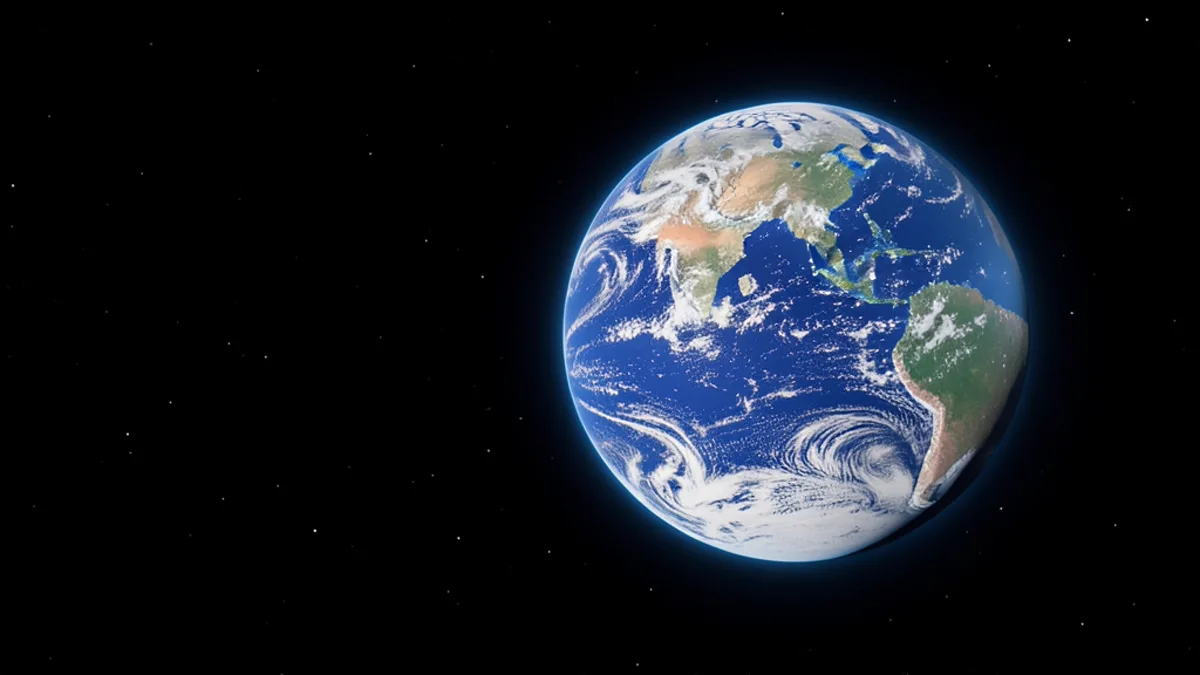
An original TeaLamp explainer based on the sources listed below. Prepared by the TeaLamp Editorial Team with the help of AI.
On Christmas Eve in 1968, three astronauts circled the Moon and looked back at the place they had come from. The crew of Apollo 8 had gone to the Moon, but the picture they brought home was of Earth: a small blue-and-white marble rising over a grey lunar horizon, alone in the black. The photograph, taken by William Anders, became known as Earthrise. For the astronauts, the change went deeper. Seeing Earth whole from space, they said, shifted how they thought about home and about what matters. That shift has a name: the overview effect.
Key takeaways on the overview effect
- The overview effect is the change in outlook some astronauts report when they see Earth whole from space: awe, a sense of connection, and a new feeling for how fragile the planet is.
- The term was coined by the writer Frank White in 1987, after he interviewed astronauts about what the view had done to them.
- A 2016 study by David Yaden and colleagues framed the experience as awe with self-transcendent qualities, triggered by a striking sight.
- The thin line of the atmosphere is the detail astronauts mention most: every person they know lives inside it, and outside it there is nothing to breathe.
- Virtual reality can give people a small taste of the feeling, but the studies so far show it changes how connected people feel more reliably than how they behave.
What astronauts actually see
From the International Space Station, about 400 kilometres up, Earth fills the window. The station circles the planet once every 90 minutes, travelling at about 28,000 kilometres an hour, so a crew member watches about 16 sunrises and 16 sunsets in a single day. Continents slide past below, and weather systems that fill a week of news on the ground are visible as single spiral shapes that pass in under an hour.
Farther out, the geometry changes. From lunar distance, Earth is a disc you could cover with an outstretched thumb. There are no visible borders, no fences, no flags, just one blue-and-white sphere hanging in absolute black. Apollo 8 commander Frank Borman, looking back from about 240,000 miles away, said the planet looked so fragile that it was hard to understand how there could be so much conflict on it.
The detail that returns most often in astronaut accounts is the atmosphere. Seen edge-on, it is a thin blue rim around the planet, and on the night side a faint green line. Astronaut Ed Lu estimated that the band at the horizon looked about one degree wide, roughly the width of an index finger held at arm’s length. NASA notes that the whole atmosphere has a mass of about one-millionth of the mass of Earth itself.
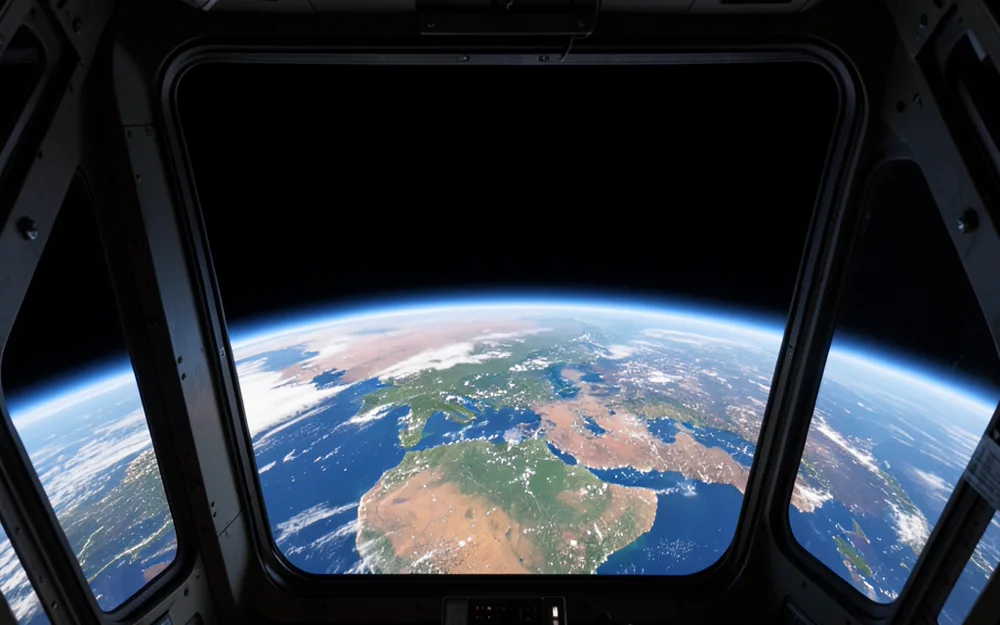
The view from the cupola: Earth’s curved horizon and its thin blue line.. Image generated by AI.
A name for the feeling
The man who named the effect was not an astronaut. Frank White was a writer trained in philosophy who noticed, while flying commercially at about 30,000 feet, that his own thinking shifted with altitude. He began interviewing the small pool of people who had seen Earth from farther out, and in 1987 he published The Overview Effect: Space Exploration and Human Evolution, collecting accounts from Apollo, Skylab and Shuttle crews and arguing that the shift they described was consistent enough to deserve a technical name.
What White documented was specific. Astronauts reported a heightened sense of Earth as a living system, a weaker attachment to national identity, and a feeling that the planet’s problems were shared rather than separate. Apollo 14 astronaut Edgar Mitchell, who walked on the Moon in 1971, described the sight as an “explosion of awareness”. Not every astronaut reports the same thing, but the pattern White found has held up across decades of interviews.
What the science says
For years the overview effect lived mostly in interviews and memoirs. The first major academic treatment came in 2016, when a team led by David Yaden, then at the University of Pennsylvania, published a study in the journal Psychology of Consciousness called “The Overview Effect: Awe and Self-Transcendent Experience in Space Flight”. The researchers analysed astronaut accounts and framed the experience using existing work on awe and self-transcendence.
Their conclusion was careful and useful. They proposed that the overview effect might best be understood as “a state of awe with self-transcendent qualities, precipitated by a particularly striking visual stimulus”. In plain words: an overwhelming sight triggers awe, and that awe briefly pulls attention away from the self and toward something larger. Yaden suggested the awe works through two kinds of vastness at once: perceptual vastness, the simple scale of the sight, like standing at the edge of the Grand Canyon, and conceptual vastness, the big ideas it forces on you, like the fact that everyone you have ever known is on that one small ball.
The study has honest limits. It was a thematic analysis of self-reported accounts, not an experiment. The sample was small. Astronauts are a highly selected group: trained, screened, and primed to describe what they see. The analysis finds patterns in language; it does not measure changes in brain function or long-term behaviour.
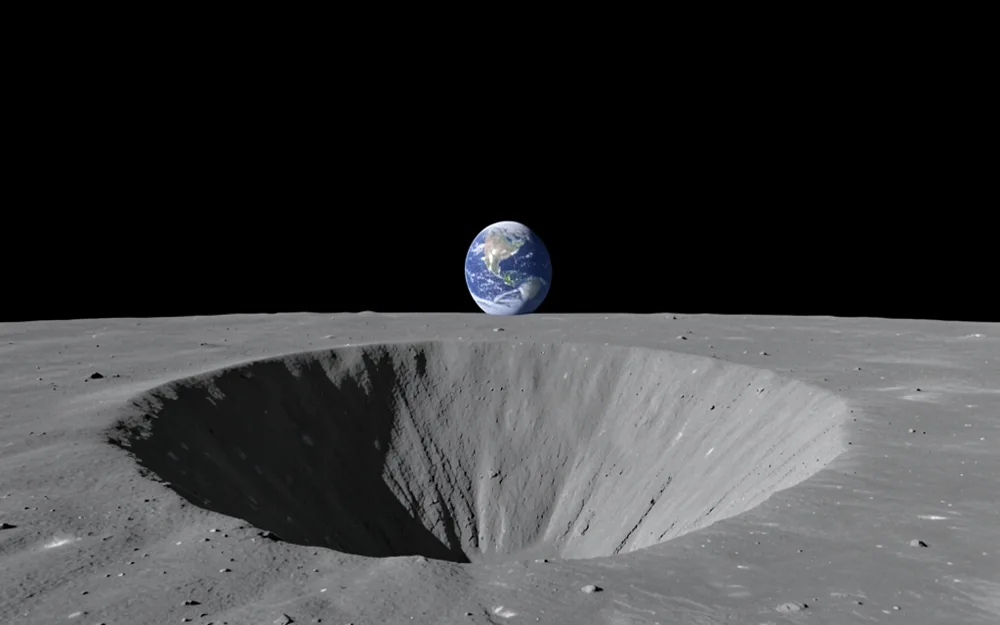
Earthrise over the Moon: the small blue marble that changed how astronauts see home.. Image generated by AI.
The thin blue line
NASA’s November 2025 collection of astronaut perspectives, marking 25 years aboard the International Space Station, returns to the thin atmosphere again and again. Artemis II mission specialist Christina Koch described the view through the station’s seven-windowed cupola: “You see the thin blue line of the atmosphere, and then when you’re on the dark side of the Earth, you actually see this very thin green line that shows you where the atmosphere is. What you realize is every single person that you know is sustained and inside of that green line and everything else outside of it is completely inhospitable. You don’t see borders, you don’t see religious lines, you don’t see political boundaries. All you see is Earth and you see that we are way more alike than we are different.”
Her crewmate Victor Glover linked the effect to what he called the “sea level effect”, the shared human experience of living on the surface of the same planet. Retired astronaut Mike Foreman was blunt about what the view did to him. “I think if you’re not a conservationist before you go to space, you’re at least partly a conservationist when you come back,” he said. “Because when you see how thin that atmosphere is, you think, wow, we really have to take care of this because it does look so fragile from space.”
When the Artemis II crew flew around the Moon in April 2026, the same shift showed up again in almost the same words. Pilot Victor Glover described the view of the lunar far side and the receding blue marble as profoundly transformative and hard to put into words.
Can you feel it without leaving Earth?
Spaceflight is out of reach for almost everyone, so researchers have tried to bring a version of the experience down to Earth with virtual reality: a headset, a simulated launch, and a slow orbit around a computer-modelled planet. The question is whether a simulated view can produce any of the real feeling, and whether that feeling changes anything afterwards.
The results so far are mixed in an instructive way. A 2024 study in PLOS One, led by Femke van Horen at the University of Amsterdam, tested the idea in two experiments. A short seven-minute virtual reality video of Earth from space had no measurable effect on pro-environmental behaviour afterwards. A longer 15-minute version, with meditative music and a voice-over, did increase people’s sense of connection with nature, and donations to an environmental charity rose, though not by enough to count as statistically significant.
A smaller pilot study at the University of Stirling, published in 2024 in Frontiers in Virtual Reality, found a clearer signal on feelings: 60 students who took a 180-degree virtual reality overview experience reported significantly stronger human-nature connectedness than a control group. A 2024 study in the journal Virtual Reality recorded brain activity with EEG during an immersive simulated space journey and found lower power in the beta and gamma bands during the defining moments.
Put together, the picture is honest rather than magical. A headset can reliably stir awe and a sense of connection. What it has not yet been shown to do is change what people do the next day.
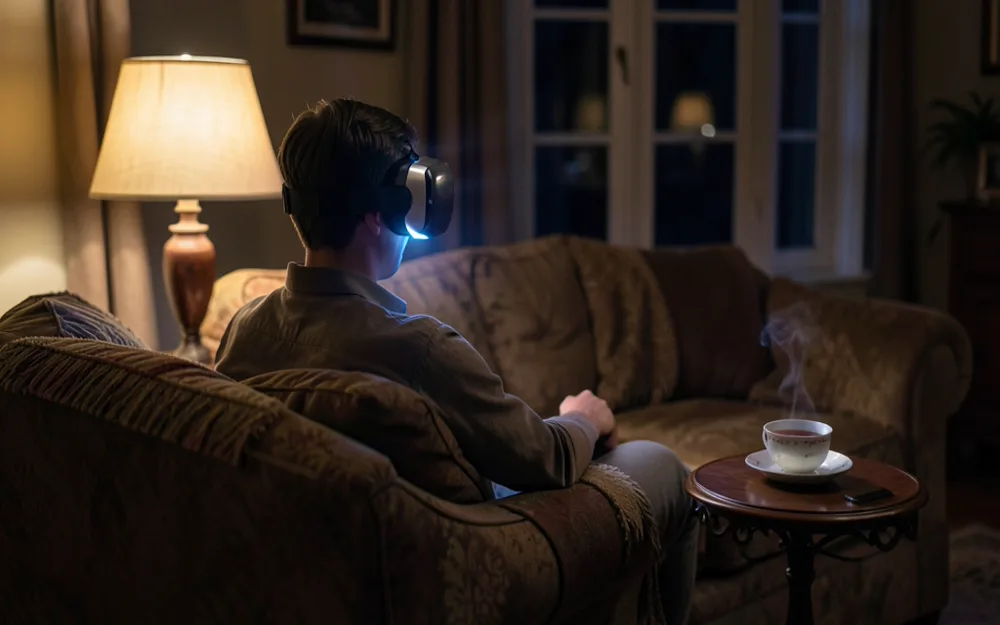
A virtual reality headset brings a small taste of the overview effect into the living room.. Image generated by AI.
Why it matters
The overview effect matters because it is a natural experiment in perspective. Most of us live inside the world, close up, where borders, headlines and arguments fill the whole frame. Astronauts get the one view nobody on the ground can have: the whole frame at once, with everything they care about on a single small object in a very large dark. The change they report is not about learning a new fact. They already knew the Earth was round and the atmosphere was thin. It is about feeling a fact they already knew, all at once, with their eyes.
That is also why the virtual reality research matters, even with its modest results. If a simulated view can stir even a little of the same awe, then the feeling is not only for the few hundred people who have flown. The astronauts’ lesson is not that we must all go to space. It is that the planet is one thing, it is fragile, and everyone we know is inside the same thin line.
Frequently asked questions
Does every astronaut experience the overview effect?
No. Astronauts describe the view in different terms, and some report a beautiful sight without a deep shift in outlook. Personality seems to play a part in how strongly someone feels it.
Can I experience the overview effect without going to space?
Partly. Virtual reality simulations of Earth from orbit can stir awe and a stronger sense of connection with nature, according to studies published in 2024. Planetarium shows and the Earthrise photograph can do something similar on a smaller scale.
Does the overview effect really change how astronauts behave?
Many astronauts say it changed them, and several trace their later conservation and humanitarian work to the view from orbit. But the evidence is mostly testimony, not measurement. The virtual reality studies have not yet shown a reliable change in everyday behaviour.
Related reading
If you enjoyed this piece, you may like Mycorrhizal Networks: The Wood Wide Web, our explainer on the hidden fungal networks that connect trees underground, another story about how much of the living world is joined together out of sight.
Sources
- NASA (2025). The Overview Effect: Astronaut Perspectives from 25 Years in Low Earth Orbit. Quotes from Christina Koch, Victor Glover and Mike Foreman; 25 years of International Space Station testimony.
- Overview effect. Wikipedia. Term coined by Frank White (1987); Yaden et al. (2016) findings; Edgar Mitchell’s “explosion of awareness”.
- Yaden, D. B., Iwry, J., Slack, K. J., Eichstaedt, J. C., Zhao, Y., Vaillant, G. E., & Newberg, A. B. (2016). The overview effect: Awe and self-transcendent experience in space flight. Psychology of Consciousness: Theory, Research, and Practice, 3(1), 1–11.
- van Horen, F., Meijers, M. H. C., Zhang, Y., Delaney, M., Nezami, A., & Van Lange, P. A. M. (2024). Observing the earth from space: Does a virtual reality overview effect experience increase pro-environmental behaviour? PLOS One, 19(5), e0299883.
- McKeever, N., Nezami, A., & Kourtis, D. (2024). The overview effect and nature-relatedness. Frontiers in Virtual Reality, 5, 1196312. 60-student pilot study; human-nature connectedness increase.
- van Limpt-Broers, H. A. T., Postma, M., van Weelden, E., Pratesi, S., & Louwerse, M. M. (2024). Neurophysiological evidence for the overview effect: a virtual reality journey into space. Virtual Reality, 28, 3. EEG study; lower beta and gamma power during defining moments.










0 Comments