


A TeaLamp book review. Prepared by the TeaLamp Editorial Team with the help of AI.
This Siddhartha review is about a short, quiet novel that has travelled a very long way. Hermann Hesse, a German-born writer who later won the Nobel Prize in Literature, published Siddhartha in 1922. It tells the story of a young man in ancient India who leaves everything behind to search for the meaning of life, and finds it, in the end, beside a river. The book is barely 150 pages long, yet it has been read by generations of seekers, students and travellers, and it still feels like a cup of something warm on a cold evening.
Key takeaways on Siddhartha review
- Siddhartha, the gifted son of a Brahmin, leaves home with his friend Govinda to become a wandering ascetic in search of enlightenment.
- He meets the Buddha, called Gotama in the book, admires him deeply, but decides that wisdom cannot be taught and must be lived.
- He spends years in the city as a rich merchant and the lover of the courtesan Kamala, until he grows sick of his own life.
- He finds peace as a ferryman with the kindly Vasudeva, learning from the river that everything is connected.
- Written in simple, musical prose, the novel became a favourite of the 1960s counterculture and has never lost its readers.
A Seeker Who Leaves Home
Siddhartha begins his life with every advantage. He is handsome, clever and loved, the pride of his father and the hope of the other Brahmins. His friend Govinda follows him everywhere. Yet Siddhartha is restless. The prayers and rituals he has learned do not satisfy him, and he suspects that the wise men around him have not found the peace they talk about.
So he decides to leave and join the Samanas, wandering ascetics who give up food, comfort and possessions in the hope of escaping the self. His father refuses at first. In one of the book’s most memorable early scenes, Siddhartha simply stands in the room all night, waiting, until his father understands that the decision has already been made. Govinda goes with him.
Hesse tells all of this in a calm, rhythmic voice, with sentences that repeat and return like the verses of an old story. It reads less like a modern novel and more like a parable, and this is part of its charm.
The Meeting With Gotama
Years of fasting and meditation teach Siddhartha many things, but not what he wants to know. He and Govinda hear of a great teacher, Gotama, the Buddha, and walk to the grove where he is teaching. Govinda is won over at once and joins the Buddha’s followers. Siddhartha is moved by Gotama’s calm and kindness, but he does not join.
Their conversation is the philosophical heart of the book. Siddhartha tells the Buddha, with great respect, that the teaching is clear and true, but that the Buddha did not reach enlightenment by listening to teachings. He reached it through his own search. Siddhartha decides he must do the same. It is a bold idea for a novel set in the Buddha’s own time, and Hesse handles it gently: Gotama is not proved wrong, and Siddhartha leaves with deep admiration. He has lost his friend, but, as the novel puts it, he has gained himself.

A quiet grove, like the one where Siddhartha meets Gotama. Image generated by AI.
The City, Kamala and the Merchant’s Life
The second half of the novel turns in a surprising direction. Siddhartha crosses a river with a friendly ferryman who asks no fare and predicts that he will come back one day. On the far side he reaches a city, and there he meets Kamala, the most beautiful and accomplished courtesan in town. She tells him, with amusement, that a man in a ragged cloak cannot win her. He will need fine clothes, shoes and money.
Siddhartha sets out to earn them. When the rich merchant Kamaswami asks what he can do, Siddhartha says he can think, he can wait and he can fast. These skills from his ascetic years turn out to be useful in business, because Siddhartha never panics and never cares too much about a deal. He becomes wealthy, and Kamala teaches him the art of love.
But Hesse shows how slowly comfort can turn into a trap. Over many years, Siddhartha begins to gamble, drink and feel the same worries and appetites he once looked down on. The calm that made him special fades away. Waking from a dream one day, he sees his life clearly and is filled with disgust. He walks out of the city, leaving everything behind, and does not look back.
The River and the Ferryman
Siddhartha wanders back to the river in despair, and here comes the book’s turning point. Close to giving up altogether, he hears inside himself the sacred word Om, and falls into a deep sleep. When he wakes, he feels new. The ferryman he met long ago, Vasudeva, takes him in, and Siddhartha decides to stay and learn to work the ferry.
Vasudeva is a simple man who has never studied scripture, but he is the best listener Siddhartha has ever met, and he has learned everything he knows from the river. Siddhartha begins to listen too. He hears in the water all the voices of the world, happy and sad, and comes to feel that the river is the same at its source and at its mouth, so that time itself seems to fall away. Hesse wrote in a letter that his hero learns true wisdom not from a teacher, but from a river and a kindly old man who always smiles, and this section shows exactly what he meant.
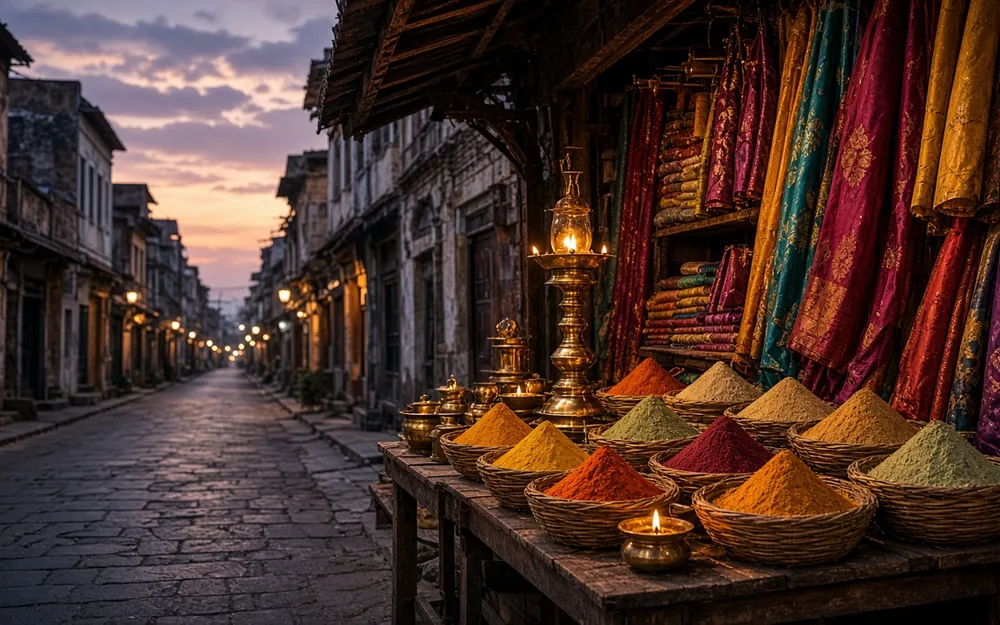
The busy city where Siddhartha becomes a merchant. Image generated by AI.
A Father, a Son and Letting Go
The novel saves one of its most human chapters for late in Siddhartha’s life. Kamala, now a follower of the Buddha, comes along the river with a young boy, and Siddhartha learns that the boy is his own son. After Kamala’s death, he tries hard to raise the child, a spoiled and angry city boy who wants nothing to do with ferries or old men. Siddhartha, who once left his own father, now feels the pain of a parent who cannot hold on to a child.
When the boy runs away, Vasudeva gently advises him to let his son find his own path, just as Siddhartha once did. It is a moving reversal, and it gives the book a warmth that pure philosophy could not. Many readers find these pages the most memorable in the novel.
Style, Themes and What Readers Love
Siddhartha is easy to read but rewards slow reading. Hesse’s sentences are clear, his scenes are few, and his characters are drawn with a light hand. The central idea is that wisdom cannot be handed from one person to another; it has to be lived. Each stage of Siddhartha’s life, from the strict self-denial of the Samanas to the pleasures of the city, looks like a wrong turn at the time, yet each one teaches him something he needs. In the final chapter, an elderly Govinda comes to the ferry, still searching, and the two old friends meet once more. Their last conversation brings the whole book together.
Hesse struggled to finish it. He completed the first part in 1920 and published it in 1921, then went through a long period of depression before he could write the rest. The full novel appeared in October 1922 from S. Fischer Verlag. He dedicated the first part to the French writer Romain Rolland and the second to his cousin Wilhelm Gundert, a scholar of Japan. Hesse had grown up among missionaries who knew India well, and he had travelled in Asia in 1911, but the book is not a guide to Buddhism or Hinduism. It is a European writer’s personal, poetic response to Indian thought.
That is worth knowing before you start. Readers looking for a history of the Buddha or a fast-moving plot may find the pace dreamy, and some passages are more meditation than story. But for readers in the right mood, that slowness is a gift.

The river teaches Siddhartha to listen. Image generated by AI.
Why Siddhartha Still Matters
For decades Siddhartha was hardly known in English. Hilda Rosner’s translation was published in the United States by New Directions in 1951, and its paperback edition in 1957 found a huge new audience among young readers of the 1960s, who were curious about Eastern ideas and suspicious of material success. Hesse won the Nobel Prize in Literature in 1946, and Siddhartha remains one of his most widely read books.
The story has inspired other artists, too: a 1972 film directed by Conrad Rooks and filmed in India, a symphonic poem by the composer Claude Vivier, and a song called The Ferryman by Pete Townshend. Many readers return to the book at different ages and find it says something new each time.
If you enjoy reflective classics, you might also like our review of Meditations by Marcus Aurelius, another short book about finding calm inside a busy life, or our list of quiet Japanese novels to read over tea.
Frequently asked questions
Is Siddhartha about the Buddha?
Not quite. The hero shares the Buddha’s birth name, and the Buddha appears in the book as Gotama, but Siddhartha is a different, fictional man who chooses his own path.
Is Siddhartha hard to read?
No. The language is simple and the book is short, about 150 pages, so many people read it in two or three sittings. The ideas are deep, but Hesse presents them through a story rather than through argument.
Which translation should I choose?
Hilda Rosner’s 1951 translation is the classic English version. Several newer translations are available, and a free, public-domain English edition can be read online from Project Gutenberg or Standard Ebooks.
Sources
- Siddhartha (novel), Wikipedia (publication history, dedications, Rosner translation 1951 and 1957 paperback, plot, themes, Hesse letter on the river and the ferryman, adaptations)
- Hermann Hesse, facts, The Nobel Prize in Literature 1946, NobelPrize.org
- Hermann Hesse, Wikipedia (life, family background, 1911 journey to Asia)
- Siddhartha by Hermann Hesse, Standard Ebooks (free public-domain English translation)









0 Comments