


An original TeaLamp explainer based on the sources listed below. Prepared by the TeaLamp Editorial Team with the help of AI.
Run your fingers across a letterpress invitation and you can feel the words. Each letter sits in a shallow dip in the paper, pressed there by hand. Letterpress printing is the oldest way of printing with movable type, and after nearly vanishing in the late twentieth century, it has come back as a craft. Small studios now print wedding invitations, posters, greeting cards and fine books on machines that are often older than the people running them.
Key takeaways on letterpress printing
- Letterpress printing presses inked, raised type directly into paper, leaving an impression you can feel with your fingertips.
- Johannes Gutenberg built the first practical system around 1440 in Mainz, combining movable metal type, oil-based ink and a screw press.
- Traditional printers aimed for a barely-there touch called the kiss, while many modern studios press deeper on purpose, for the look and feel.
- Offset and digital printing pushed letterpress out of everyday use by the 1970s, but cheap second-hand presses brought it back.
- Today most studios mix old and new, cutting designs on photopolymer plates from a computer file and printing them on restored vintage presses.
A press that changed the world
Printing itself is far older than Gutenberg. Movable type was first made in China, where the inventor Bi Sheng cast individual characters from fired clay around the year 1040, during the Northern Song dynasty. Korean printers later cast movable metal type and printed the Jikji, a Buddhist text, in 1377. What Gutenberg did in Mainz, around 1440, was put the pieces together into a system that could print whole books quickly and cheaply.
He was a goldsmith by trade, and that mattered. He designed a hand mould that could cast hundreds of identical metal letters a day, each one exactly the same height. He mixed an alloy of lead, tin and antimony that flowed into the mould cleanly and stood up to repeated pressing. He made an oil-based ink that clung to metal type instead of beading off it, as water-based ink would. And he borrowed the screw press from wine making, so that a whole page of type could be pressed evenly onto a sheet of paper in one pull.
His great demonstration was the Bible of 42 lines, printed in Mainz and finished around 1455. About 180 copies were printed, and the work took Gutenberg and his staff of about twenty people nearly three years to complete. Forty-eight copies survive intact today. Within a few decades, printing workshops had appeared in some 270 cities across Europe, and by 1500 European presses had produced more than twenty million books. Canada got its first letterpress printer in 1752, when John Bushell printed the Halifax Gazette in Halifax, Nova Scotia, on March 23 of that year. Only one copy of that first issue is known to survive.
How a letterpress actually works
At its heart, letterpress is relief printing. The printing surface is raised, like the letters on a rubber stamp. Ink is rolled over the raised surface, a sheet of paper is pressed against it, and the ink transfers.
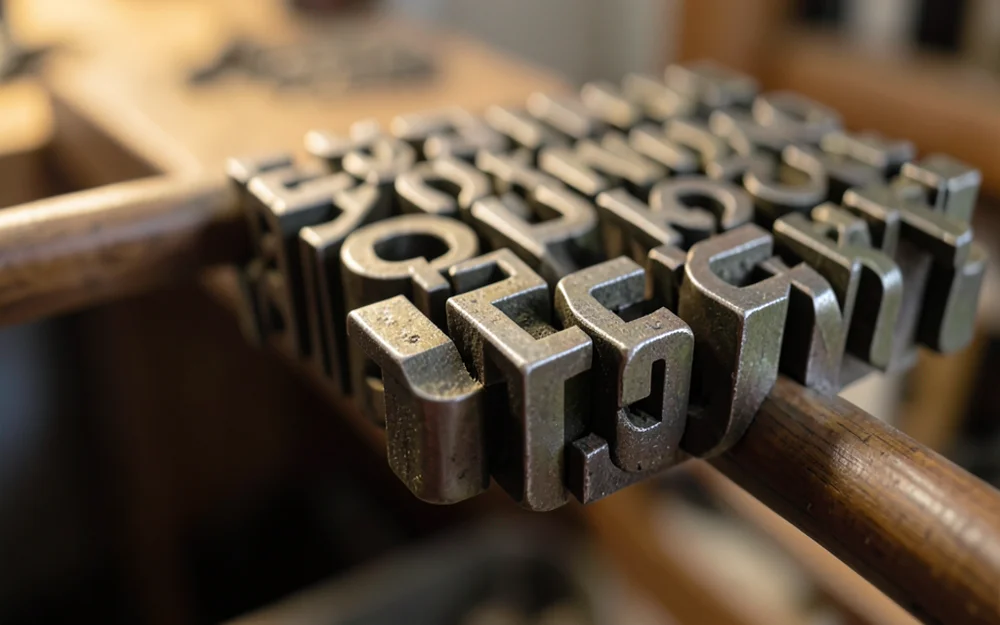
Metal type, set letter by letter. Image generated by AI.
A print job moves through three stages. First comes composition, or typesetting. The compositor picks individual metal letters from a type case, one at a time, and sets them in a small tray called a composing stick, letter by letter and line by line. The lines are then moved to a larger tray called a galley, tied up so they can be carried without falling apart, and a proof is printed and checked.
Next comes imposition and lock-up. The tied pages of type are arranged in a frame called a chase, with low blocks of wood or metal, known as furniture, filling the blank spaces. The printer taps the type level with a mallet and a block, then tightens wedge-shaped quoins with a key until the whole forme is locked solid. A single loose letter at this stage can wreck a print run.
Then comes the printing itself. On a platen press, the type sits upright in the bed while a hinged plate, the platen, swings a sheet of paper against it. On a cylinder press, the paper wraps around a drum and rolls across the flat bed of type. Either way, the press operator feeds paper one sheet at a time, by hand. There is a strict rule about height: everything that prints must stand exactly 0.918 inches tall from the bed to the paper. Printers call this type-high, and in theory anything at that height, from metal type to a carved linoleum block, can be printed on a letterpress.
The kiss and the deep bite
The deep impression that modern buyers adore was once considered bad printing. For most of its history, the goal of letterpress was to leave no mark on the paper at all, only ink. Printers called the perfect touch the kiss: the type barely grazed the paper, just enough to transfer the ink cleanly.
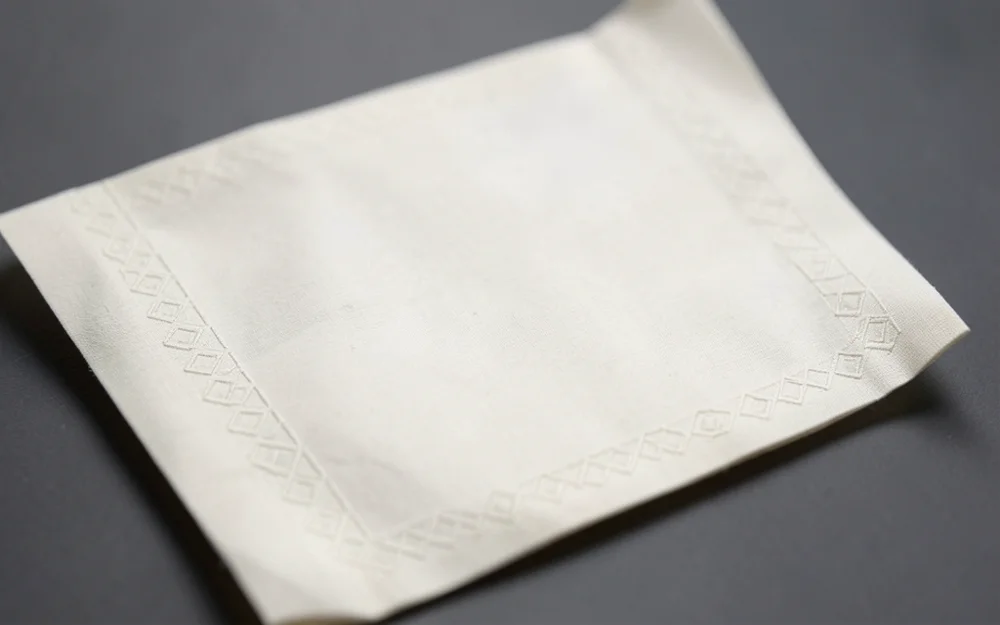
Blank cotton paper, ready for the press. Image generated by AI.
A deep bite was a fault, not a feature. Pressing too hard wears out the type, bruises the paper and strains the press. Many working printers still print with a light touch, keeping the impression faint. But the revival has split the craft in two. Plenty of modern studios press deeper on purpose, because the dent in the paper is the whole point for their customers. It is the visible proof that a human hand and an old machine made the thing, and not a laser printer.
Neither side is wrong. The kiss shows the printer’s skill; the deep impression shows the printer’s charm. What matters is that the choice is deliberate and the type stays crisp.
Why it nearly disappeared
Letterpress ruled printing for five hundred years, then lost its crown in less than one lifetime. Offset printing, developed in the early twentieth century, printed from flat plates instead of raised type, and it was faster, cheaper and better at photographs. By the 1970s, computers and new printing methods had finished the job. Commercial print shops closed or converted, and their heavy iron presses were sold off, scrapped or simply given away.
That sell-off, oddly enough, is what saved the craft. A Chandler and Price platen press or a Vandercook proof press that once cost a print shop a fortune could suddenly be had for the price of moving it. Artists, hobbyists and young designers bought them, hauled them into garages and basements, and taught themselves to print. The machines outlived the industry that had built them.
The comeback, one wedding at a time
The revival gathered pace in the 1990s, and wedding stationery led the way. Martha Stewart Weddings magazine began picturing letterpress invitations, and couples fell for the texture and the romance of it. The dent of the letters and the thick cotton paper suited a day meant to feel personal. Small studios found they could survive by printing fine invitations, greeting cards and business cards one sheet at a time, work that big commercial printers no longer wanted.
At the same time, the craft quietly went digital, in the best sense. Affordable photopolymer plates let a printer turn a design made on a computer into a raised printing plate, exposed under ultraviolet light and washed out to leave the image standing proud. Mounted on a base to bring it to type-high, the plate prints on a press built a century ago. This blend of new plates and old iron is now the normal way of working: the design starts on a screen, and the printing still smells of ink and oil.
A museum full of wooden letters
If you want to see how big this world once was, drive to Two Rivers, Wisconsin, on the shore of Lake Michigan. The Hamilton Wood Type and Printing Museum holds the world’s largest collection of wood type: more than one and a half million pieces, in over a thousand styles and sizes, from a quarter of an inch tall to four feet. The museum opened in 1999, in the former factory of the Hamilton Manufacturing Company, founded by J. Edward Hamilton in 1880.
The museum is a working one. Its presses still print, its studio teaches classes, and visitors can set type and pull a print themselves. Much of the collection was rescued from the scrap heap by collectors. Walking among the drawers, you can read the history of advertising in the shapes of the letters: fat display faces for circus posters, tall condensed faces for newspaper headlines, ornate Victorian faces for shop signs.
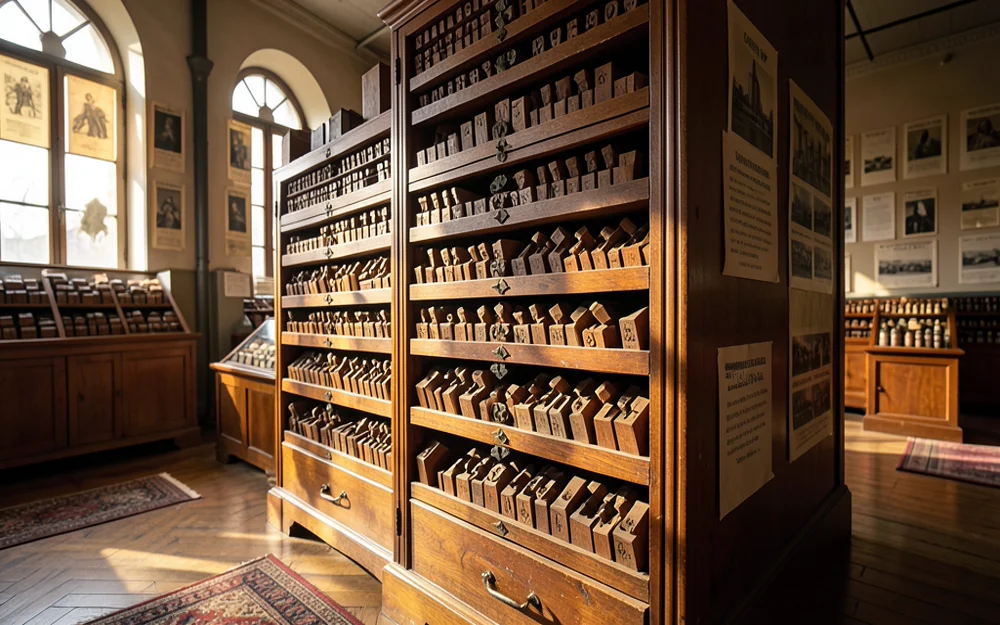
Drawers of wooden type in the Hamilton museum. Image generated by AI.
Why it matters
Letterpress matters for a simple reason: it reminds us that printing is a physical act. A screen shows us words; a letterpress card lets us touch them. In a world where most of what we read arrives as weightless pixels, there is a quiet pleasure in an object that carries the mark of the machine that made it. It also keeps alive skills that almost vanished: setting type by hand, mixing ink, judging pressure by feel. Each small studio that survives is a small school, passing those skills to the next person who walks in and asks how it works.
And the revival is not only nostalgia. It shows how an old technology can find a new place instead of disappearing. Letterpress no longer prints newspapers or novels, and it never will again. It prints the things we want to keep: an invitation, a poster, a book made in a numbered edition. The press that changed the world five centuries ago now makes the objects we save in drawers and pin to walls. That seems like a good second act.
Related reading: Why Handwritten Letters Are Making a Quiet Comeback — another slow, paper-based pleasure finding its way back.
Frequently asked questions
Is letterpress printing expensive?
Yes, compared with digital printing. Each colour needs its own plate and its own pass through the press, and every sheet is fed by hand, so a letterpress invitation can cost several dollars apiece. You are paying for the time, the thick cotton paper and the craft, not just the ink.
Can letterpress print photographs?
Not well. Letterpress is a relief process, so it suits bold shapes, solid colours and crisp text. Photographs and soft gradients belong to offset or digital printing, which can reproduce fine shades of tone that raised type cannot.
What is the difference between letterpress and engraving?
They are opposites in feel. Letterpress presses ink into the paper, leaving a dent you can feel on the front. Engraving raises the ink above the surface, so the letters stand proud and you can feel them on the back of the sheet. Both are slow, costly and beautiful, which is why both turn up on wedding invitations.
Sources
- Letterpress printing — Wikipedia
- The Printing Revolution in Renaissance Europe — World History Encyclopedia
- Printing — Encyclopedia.com
- Letterpress Printing: How It Works — Print Codex
- This Wisconsin Museum Preserves and Prints With the World’s Largest Collection of Wood Type — Arts Midwest
- Letterpress Printing Plate — Ink Systems








0 Comments