


A TeaLamp reading list. Prepared by the TeaLamp Editorial Team with the help of AI.
Books written in letters have a special kind of warmth. Instead of a narrator standing outside the story, we read what the characters write to one another, with all their hopes, jokes, worries and small daily news. These epistolary books, as they are called, make us feel like we are reading over someone’s shoulder, or opening a bundle of old envelopes found in an attic. Here are five of our favourites, from a Russian classic to a modern bestseller, each one perfect for a quiet evening with a cup of tea.
Key takeaways on books written in letters
- Epistolary books tell their stories through letters, and sometimes diaries, written by the characters themselves.
- The form creates closeness: we hear each voice directly, and we often know more than any single letter-writer does.
- This list moves from 1846 to 2008 and covers Russia, the United States, Austria and the Channel Islands.
- It includes novels for adults, a much-loved children’s book and a real collection of letters full of advice about writing and life.
Why Stories in Letters Feel So Close
Letter novels were hugely popular in the eighteenth century, and the form has never really gone away. Part of the appeal is intimacy. A letter is written to one person, so it can be honest in a way that public speech rarely is. Another part is suspense. Letters cross in the post, arrive late or go unanswered, and readers wait, just as the characters do, for the next reply. The gaps between letters can be as meaningful as the words themselves.
The books below use the form in very different ways. Some are funny, some are sad, and one is not a novel at all. What they share is the pleasure of a voice speaking directly to someone who matters.
Poor Folk by Fyodor Dostoevsky (1846)
Dostoevsky’s first novel is a series of letters between two poor neighbours in St Petersburg: Makar Devushkin, a shy, ageing copy clerk, and Varvara Dobroselova, a young woman who lives across the courtyard. They are distant relatives, and they write to each other almost every day. Makar sends her sweets and flowers he cannot really afford; Varvara scolds him gently and worries about his health. Through their letters we see cramped rooms, unpaid rent and the small humiliations of poverty, but also deep tenderness.
Published in January 1846, when Dostoevsky was in his early twenties, the book made him famous almost overnight. The influential critic Vissarion Belinsky praised it as one of Russia’s first social novels. It is short and sad, but its kindness and humour shine through, and it is a gentle way into the work of a writer better known for his huge later novels.
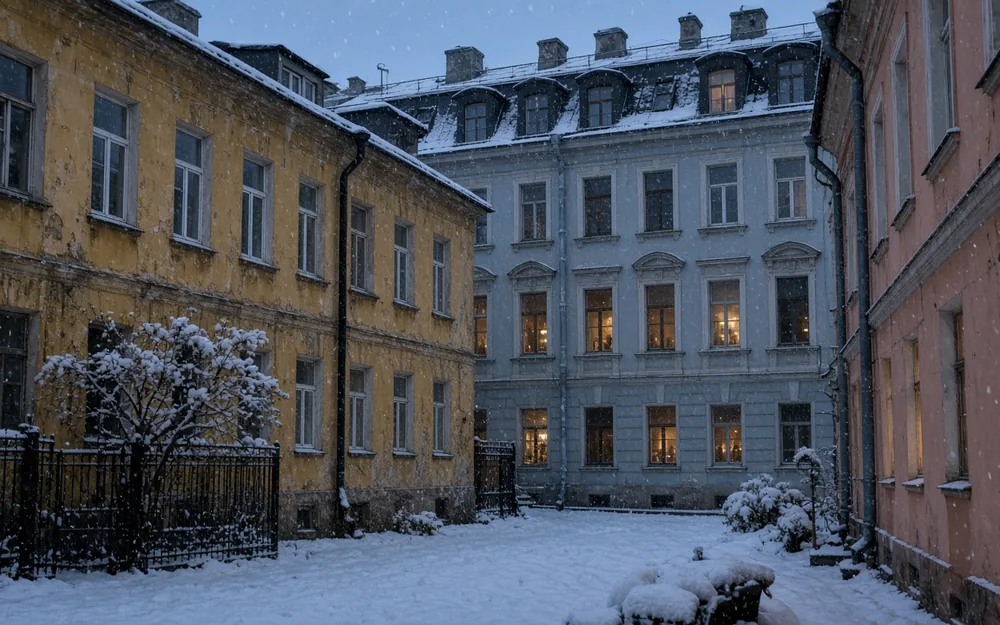
A snowy courtyard like the one Makar and Varvara write across. Image generated by AI.
Daddy-Long-Legs by Jean Webster (1912)
Jerusha Abbott, known as Judy, has grown up in a strict, old-fashioned orphanage. One day she learns that an anonymous trustee will pay for her to go to college, on one condition: she must write to him every month, and he will never reply. She has seen only his tall shadow on a wall, so she nicknames him Daddy-Long-Legs.
The novel is made up of Judy’s letters, decorated with her own funny little drawings, which Jean Webster drew herself. Judy writes about her classes, her friends, the books she reads for the first time and her plans to become a writer. Her voice is witty, warm and full of life, and watching her grow in confidence is a real pleasure. First serialised in the Ladies’ Home Journal and published as a book in 1912, Daddy-Long-Legs has been adapted many times for stage and screen, and its gentle mystery about the identity of Judy’s benefactor still delights new readers.
Letters to a Young Poet by Rainer Maria Rilke (1929)
This little book is not a novel but a real collection of letters. In 1902 Franz Xaver Kappus, a nineteen-year-old cadet at a military academy in Austria, sent some of his poems to the poet Rainer Maria Rilke and asked for advice. Rilke wrote back, and the two corresponded for several years. After Rilke’s death, Kappus published ten of the letters in 1929.
Rilke gently declines to judge the poems. Instead he encourages the young man to look inward, to ask whether he truly must write, and to be patient with the questions in his heart rather than rushing to find answers. He writes about solitude, love, nature and the slow work of becoming yourself. Many readers keep this book by the bed and return to it at turning points in their lives. It is short enough to read in an afternoon, and calm enough to read slowly, a page or two at a time.
Letters written slowly, one at a time. Image generated by AI.
Dear Mr. Henshaw by Beverly Cleary (1983)
Leigh Botts is a boy in the sixth grade who has written every year to his favourite author, Boyd Henshaw. This time, for a school assignment, he sends a list of questions. Mr. Henshaw writes back with questions of his own, and suggests that Leigh keep a diary. Through Leigh’s letters and diary entries, we come to know a lonely new kid at school, missing his father after his parents’ divorce and trying to catch the mystery thief who keeps stealing the best things from his lunch bag.
Beverly Cleary, the much-loved author of the Ramona books, said she wrote the novel after two boys asked her for a story about a child whose parents were divorced. Illustrated by Paul O. Zelinsky, it won the Newbery Medal in 1984. It is simple enough for young readers, yet honest and touching enough for adults, and it shows beautifully how writing things down can help a child understand his own feelings.
The Guernsey Literary and Potato Peel Pie Society by Mary Ann Shaffer and Annie Barrows (2008)
In January 1946, the London writer Juliet Ashton is looking for a subject for her next book when a letter arrives from a stranger. Dawsey Adams, a farmer on the island of Guernsey, has found her old copy of a book by Charles Lamb and wants to know more. Soon Juliet is writing to a whole circle of islanders, members of a book club with a very odd name that began as an excuse during the German occupation of the Channel Islands in the Second World War.
Through dozens of letters from different people, the novel builds a warm, often funny portrait of a small community that survived hard years with the help of books and friendship. There are serious moments, especially in the story of Elizabeth McKenna, the club’s brave founder, but the overall mood is kind and hopeful. Mary Ann Shaffer began the book, and her niece Annie Barrows finished it when Shaffer became ill. It became an international bestseller and a 2018 film.

An island harbour in the Channel Islands. Image generated by AI.
How to Enjoy Books Written in Letters
Epistolary books reward slow reading. Try reading one letter at a time, as the characters would have done, and imagine the days or weeks between them. Pay attention to who is writing and who is not, and to what each person chooses to share or keep back. If you are reading with a book club, these books are wonderful to read aloud, with different people taking different voices.
You might even be inspired to write a letter yourself. After a few chapters of Judy Abbott or Juliet Ashton, a handwritten note to a friend can feel like a small, lovely adventure.
If you enjoy this list, you may also like our reading list of books about bookshops and libraries, which includes another famous story told in letters, or our books set in winter to read with tea.
Frequently asked questions
What is an epistolary novel?
An epistolary novel is a story told mainly through documents written by the characters, usually letters, but sometimes diary entries, emails or messages. The word comes from epistle, an old word for a letter.
Which book on this list is best for children?
Dear Mr. Henshaw is written for young readers, about eight to twelve years old, and Daddy-Long-Legs is also a favourite with older children and teenagers. Both are enjoyable for adults too.
Are any of these books free to read?
Poor Folk, Daddy-Long-Legs and older English translations of Rilke’s letters are in the public domain in many countries and can be found on free library sites such as Project Gutenberg. The other two are newer and still in copyright.
Sources
- Poor Folk, Wikipedia (Dostoevsky’s first novel, published 15 January 1846, letters between Devushkin and Dobroselova, Belinsky’s praise)
- Daddy-Long-Legs (novel), Wikipedia (Jean Webster, Ladies’ Home Journal serial, 1912 book, plot, Webster’s drawings)
- Letters to a Young Poet, Wikipedia (Rilke and Kappus, ten letters 1903 to 1908, published by Insel Verlag in 1929)
- Dear Mr. Henshaw, Wikipedia (Beverly Cleary, Paul O. Zelinsky, 1984 Newbery Medal, plot, Cleary on why she wrote it)
- The Guernsey Literary and Potato Peel Pie Society, Wikipedia (Shaffer and Barrows, 2008, setting in 1946, plot, 2018 film)
- Daddy-Long-Legs by Jean Webster, Project Gutenberg (free public-domain edition)









0 Comments