


A TeaLamp reading list of five books about cats, chosen and described in our own words. Prepared by the TeaLamp Editorial Team with the help of AI.
Cats have a way of walking into stories and making themselves at home. They settle on the manuscript, sleep on the warm pages, and watch the humans with an expression that says they have seen all of this before. This list of books about cats gathers five very different titles, from a pompous feline narrator in Japan to a talking cat at an English house party, and each one is best read slowly, with a cat nearby and a cup of tea in hand.
Key takeaways on books about cats
- A cat narrator is a wonderful device: cats notice everything, judge freely, and never feel obliged to be polite about what they see.
- These five books span more than a hundred years, from a Japanese satire of 1905 to a gentle Japanese road novel of 2012.
- Two of the books are in translation from Japanese, and both are quiet, tender reads that suit a slow evening.
- One book is poetry, one is a short story, and three are novels, so the list works as a tasting menu as well as a reading list.
- Every book here is warm at heart, even when the cat in it is being gloriously rude.
I Am a Cat by Natsume Sōseki (1905)
The best place to begin is with the cat who started it all. I Am a Cat is told by a nameless stray kitten who wanders into the house of a Tokyo schoolteacher and decides to stay. The cat has no name, very little patience, and a grand opinion of himself, and he spends the novel listening in on his master’s conversations and reporting back with dry, superior commentary.
Sōseki first published the story in the literary magazine Hototogisu in 1905, and readers liked it so much that he kept going until it became a full novel. The cat watches his master and his friends argue about art, science, business and marriage, and he finds nearly all of it ridiculous. The satire is gentle rather than cruel: the joke is that the cat, who understands nothing of human ambition, sees it more clearly than the humans do.
“I am a cat. As yet I have no name.”
— Natsume Sōseki, I Am a Cat
That opening line sets the whole tone. The cat is pompous, funny and oddly lovable, and the book is a fine introduction both to Sōseki and to the long Japanese tradition of writing about cats. Best for readers who enjoy wit, satire and a narrator with whiskers.
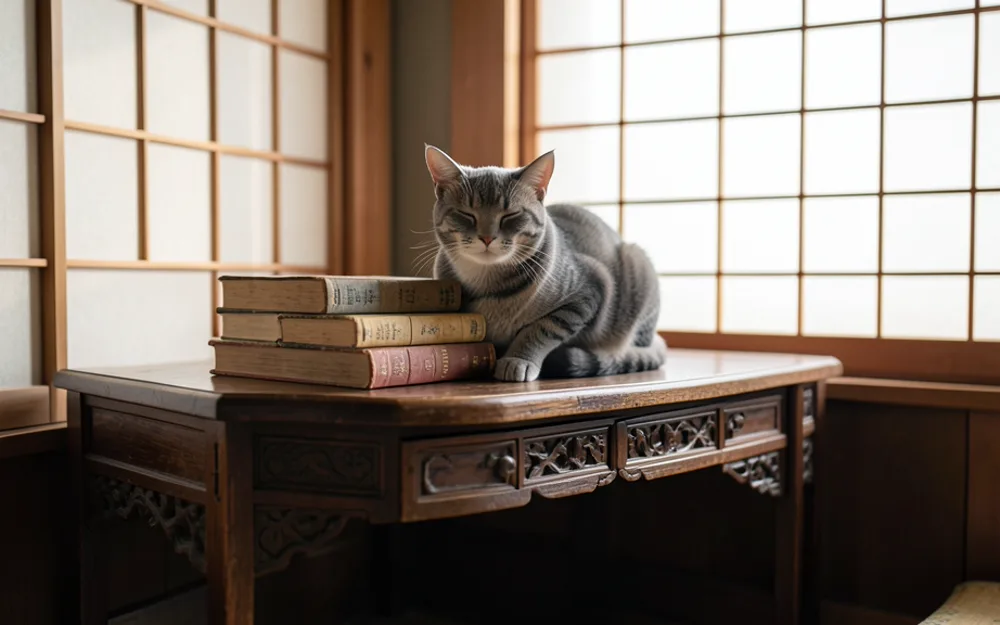
A quiet study, a cat, and a pile of books. Image generated by AI.
Tobermory by Saki (1911)
What if the cat could answer back? That is the delicious question at the heart of “Tobermory”, a short story by Saki, the pen name of Hector Hugh Munro. At a country house party on a rainy afternoon, a guest named Cornelius Appin announces that he has taught the household cat to speak. Nobody believes him until Tobermory strolls in, asks for his tea in a perfectly natural voice, and begins repeating everything he has overheard.
The trouble is that a cat hears everything and forgets nothing. Tobermory has spent years dozing in corners while the guests gossiped, schemed and insulted each other, and now he reports it all back with cool indifference. The party’s polite surface cracks within minutes, and the guests realise, too late, that they have said far too much in front of the cat.
The story first appeared in the Westminster Gazette in 1909 and was collected in The Chronicles of Clovis in 1911. It is short, sharp and very funny, and it is the only story in this list. Best for readers who like their humour dry, their satire quick, and their cats dangerously well informed.
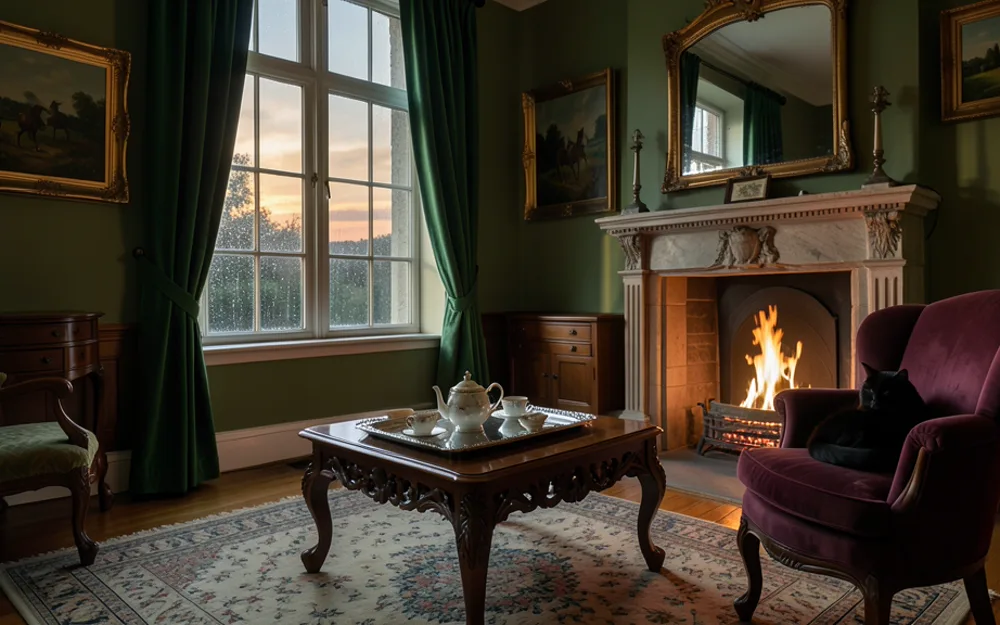
Tea by the fire, with a cat on the armchair. Image generated by AI.
Old Possum’s Book of Practical Cats by T. S. Eliot (1939)
Some cats in books are characters. The cats in T. S. Eliot’s book of poems are a whole society. Old Possum’s Book of Practical Cats, published by Faber and Faber in October 1939, is a collection of light, playful poems about feline psychology and social order, written first as letters to Eliot’s godchildren. Each poem introduces a different cat: the Rum Tum Tugger, who is difficult about everything; Macavity, the mystery cat; Mr. Mistoffelees, the conjuring cat; and Jennyanydots, the practical cat who keeps the house in order.
The poems are meant to be read aloud, and they reward it. Eliot writes with a twinkle, giving each cat a personality so clear that readers remember them long after the book is closed. The book also has a famous second life: Andrew Lloyd Webber turned the poems into the musical Cats, which opened in London in 1981 and ran for many years.
This is the lightest book on the list and the easiest to dip into, a poem or two at a time, perhaps with a cat asleep on the arm of your chair. Best for readers who love poetry, wordplay and cats with strong opinions about how a household should be run.
The Guest Cat by Takashi Hiraide (2001)
Not every book on this list is funny. The Guest Cat is quiet, tender and a little sad, and it is the most beautiful book here. A young couple rent a small house in a Tokyo neighbourhood in 1988, and a neighbour’s cat, a small tabby they call Chibi, begins to visit them through a gap in the fence. She comes and goes as she pleases, and the couple’s days begin to revolve around her visits.
Hiraide, a poet as well as a novelist, writes in short, careful chapters that feel like diary entries. The book is really about attention: how watching a small animal can teach two busy people to slow down and notice the light, the seasons and each other. The cat never belongs to them, and that is the point. She is a guest, and guests leave.
First published in Japanese in 2001 and translated into English by Eric Selland in 2014, the novel won Japan’s Kiyama Shohei Literary Award and became a bestseller in France. Best for readers who like quiet books, gentle prose and stories that linger after the last page.
The Travelling Cat Chronicles by Hiro Arikawa (2012)
The final book is a road trip, and the cat is in the front seat. In The Travelling Cat Chronicles, a streetwise cat named Nana is adopted by a kind young man called Satoru, and the two set off across Japan in a silver van, visiting old friends from Satoru’s past. Nana narrates the journey in his own voice: proud, grumbling and secretly devoted to his owner.
Each stop on the road brings a small story about friendship, and each one shows a different side of Satoru. Nana pretends he is only along for the ride, but the reader can see what he cannot quite admit, that the journey matters more than the destination. The ending is bittersweet, so keep a handkerchief nearby, but the book is full of warmth, humour and kindness along the way.
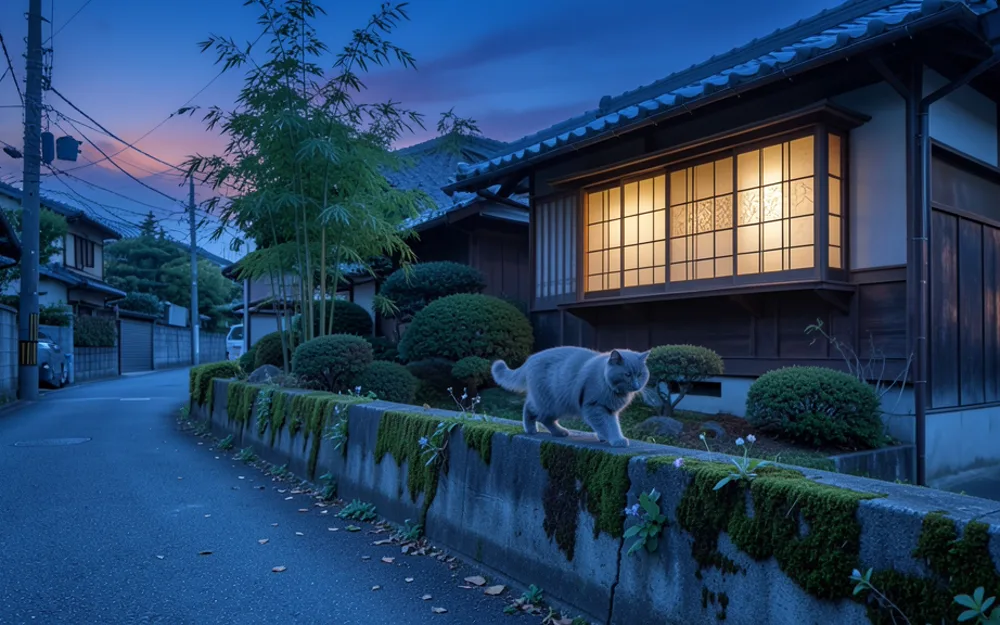
A cat out for its evening walk in Tokyo. Image generated by AI.
Arikawa’s novel was first published in Japanese in 2012 and translated into English by Philip Gabriel in 2017. It became a bestseller around the world, and it is easy to see why. Best for readers who love road stories, animal narrators and books that are both funny and tender.
Why these books matter
Cats make wonderful company for a reader because they ask for so little and give so much back. They do not need a plot to be interesting, only a sunny windowsill and something to watch. These five books understand that. Each one uses a cat to say something true about people: that we are funnier than we think, kinder than we admit, and often in need of a small, patient creature to remind us to slow down.
The list also shows how far a single idea can travel. A stray cat in Tokyo in 1905, a talking cat in an English country house, a book of cat poems, a neighbour’s cat in a Tokyo garden, and a road trip in a silver van: five very different books, one shared truth, that life is better with a cat in it.
Related reading
For more Japanese reading, see our list of Japanese novels to read over tea.
Frequently asked questions
Are these books suitable for children?
Old Possum’s Book of Practical Cats is the most child-friendly book on the list, and it was written for children in the first place. “Tobermory” and I Am a Cat are witty adult satires that older teenagers will enjoy. The Guest Cat and The Travelling Cat Chronicles are gentle adult novels, best suited to grown-up readers.
Do I need to love cats to enjoy these books?
Not at all. The cats are the narrators and the scene-stealers, but the books are really about people: their friendships, their vanities and their kindness. Even readers who have never kept a cat will recognise the humans in these pages.
Which book should I start with?
Start with Old Possum’s Book of Practical Cats for something light, or with The Guest Cat for something quiet and short. If you like a strong narrator’s voice, begin with I Am a Cat, and save The Travelling Cat Chronicles for a long, unhurried evening.
Sources
Tobermory (short story) — Wikipedia
Old Possum’s Book of Practical Cats — Academy of American Poets









0 Comments