


A TeaLamp book summary. Prepared by the TeaLamp Editorial Team with the help of AI.
This Wizard of Oz summary follows a Kansas farm girl, her little dog and three unlikely friends along a yellow brick road to a city of green glass, and then all the way home again. L. Frank Baum published The Wonderful Wizard of Oz in 1900, with pictures by W. W. Denslow, and it became one of the best-loved children’s books ever written in the United States. Many people know the story from the 1939 film, but the book is its own thing: stranger, a little darker in places, and full of quiet jokes about what people already carry inside them.
Key takeaways on Wizard of Oz summary
- A cyclone carries Dorothy and her dog Toto from a grey Kansas farm to the colourful Land of Oz, where her falling house lands on the Wicked Witch of the East.
- To get home, Dorothy follows the yellow brick road to the Emerald City to ask the great Wizard for help, wearing the witch’s silver shoes.
- On the way she gathers three companions: a Scarecrow who wants brains, a Tin Woodman who wants a heart and a Cowardly Lion who wants courage.
- The Wizard turns out to be an ordinary man from Omaha, and the book’s great idea is that the friends already had the qualities they were looking for.
- Dorothy finally learns from Glinda, the Good Witch of the South, that her silver shoes could have carried her home all along.
From Grey Kansas to the Land of Oz
The book opens on the Kansas prairie, and Baum paints it almost entirely in grey. Dorothy lives in a one-room farmhouse with her Aunt Em and Uncle Henry, who work hard and rarely smile. The grass is burnt grey by the sun, the house is grey, and the grown-ups have grown grey too. The only thing that keeps Dorothy laughing is Toto, a small black dog with silky hair.
One day a cyclone sweeps across the prairie. Aunt Em and Uncle Henry reach the storm cellar, but Dorothy runs back for Toto, and the whole house is lifted into the air with the two of them inside. It spins for hours, and Dorothy, rather sensibly, falls asleep. When the house finally comes down with a bump, she opens the door onto a land of bright flowers, fruit trees and sparkling streams.
This contrast is the first key idea of the book. Oz is everything Kansas is not: colourful, magical and full of strange, friendly people. Yet from the very first page Dorothy wants only one thing, and that is to go home. Readers notice this straight away, and it gives the whole adventure its gentle heartbeat.
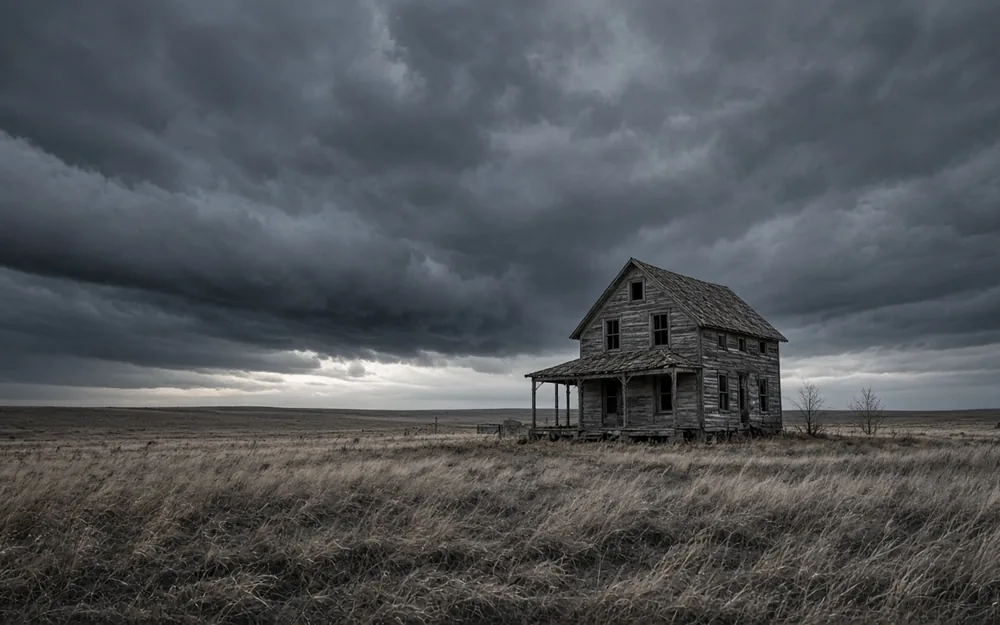
Grey Kansas, just before the cyclone. Image generated by AI.
The Silver Shoes and the Yellow Brick Road
Dorothy has landed in the country of the Munchkins, small people dressed in blue. Three of them arrive with the Good Witch of the North, who thanks Dorothy warmly for killing the Wicked Witch of the East. Dorothy is shocked: she has killed nobody. But her falling house has landed right on top of the wicked witch, and only her silver shoes are left sticking out from underneath it.
The Munchkins are free at last, and the shoes are given to Dorothy. In the book they are silver, not the ruby red of the famous film, and nobody yet knows exactly what they can do. The Good Witch of the North cannot send Dorothy back to Kansas. She suggests that the Wizard of Oz, who lives in the Emerald City at the centre of the land, might be able to help. To get there, Dorothy must follow the road paved with yellow brick. Before she leaves, the witch kisses her forehead, leaving a mark that will protect her from harm.
Three Friends With Something Missing
The heart of this Wizard of Oz summary is the friendship Dorothy builds on the road. First she helps a Scarecrow down from his pole in a cornfield. He is cheerful and polite, but sad that his head is stuffed with straw, and he would like a brain. Next, in a forest, she finds a Tin Woodman rusted solid with his axe raised in the air. After she oils his joints, he explains that he was once a man, and that a witch’s curse led to his body being replaced, piece by piece, with tin. The tinsmith forgot to give him a heart, and he would like one back. Then a great Lion leaps out of the trees and roars, but when Dorothy smacks him on the nose for threatening Toto, he admits he is a coward. He would like courage.
Each friend joins her, hoping the Wizard will grant his wish as well. Here Baum has his best fun. Throughout the journey, the Scarecrow keeps having the cleverest ideas, the Tin Woodman cries so easily over a crushed beetle that he rusts his own jaw, and the Lion, frightened as he is, keeps stepping forward when danger comes. The reader can see what the characters cannot: they already have what they think they lack.
The road brings real dangers. The friends must cross a deep ditch and escape the Kalidahs, fierce beasts with the bodies of bears and the heads of tigers. They build a raft to cross a river, and the Scarecrow is left stranded on a pole in the middle of it. Then they walk through a great field of scarlet poppies whose scent sends Dorothy, Toto and the Lion into a deadly sleep. The Scarecrow and the Tin Woodman, who do not breathe, carry Dorothy and Toto out, and the Queen of the Field Mice and thousands of her subjects pull the sleeping Lion to safety on a little cart. It is one of the book’s loveliest scenes: kindness repaid by the smallest creatures in Oz.

The field of sleepy poppies on the road to the Emerald City. Image generated by AI.
The Emerald City and a Great and Terrible Wizard
At last the travellers reach the Emerald City. The Guardian of the Gates locks green spectacles over their eyes, explaining that the city’s brightness would otherwise blind them. Everything inside looks green: the streets, the houses, even the lemonade.
The Wizard sees each visitor alone and appears in a different shape every time. To Dorothy he is an enormous head without a body; to the Scarecrow, a lovely lady; to the Tin Woodman, a terrible beast; to the Lion, a ball of fire. His answer is the same for all of them. He will grant their wishes only after they kill the Wicked Witch of the West, who rules the land of the Winkies.
This is a hard thing to ask of a little girl who has never meant to hurt anyone, and Dorothy says so. But she wants to go home, so the friends set off west.
The Wicked Witch of the West
The Wicked Witch has only one eye, but it works like a telescope, and she sees the travellers coming a long way off. She sends a pack of wolves, and the Tin Woodman fights them off with his axe. She sends a flock of crows, and the Scarecrow deals with them. She sends a swarm of black bees, and they break their stings on the Tin Woodman. She sends her Winkie soldiers, and the Lion’s roar sends them running. Finally she uses a magic Golden Cap to summon the Winged Monkeys, who scatter the Scarecrow’s straw, drop the Tin Woodman on sharp rocks and carry Dorothy and the Lion off to the witch’s castle.
The witch dares not hurt Dorothy, because of the Good Witch’s kiss on her forehead, so she makes her a servant instead. When the witch finally tricks Dorothy out of one of her silver shoes, Dorothy grows so angry that she throws a bucket of water over her. To everyone’s amazement, the witch melts away to nothing. The Winkies are freed, they help mend the Tin Woodman and restuff the Scarecrow, and Dorothy uses the Golden Cap to have the Winged Monkeys fly everyone back to the Emerald City.
The Humbug Behind the Screen
Back in the throne room, the friends demand their reward, and Toto accidentally knocks over a screen in the corner. Behind it stands a little old man with a bald head and a wrinkled face. The great Wizard, he confesses, is a humbug. He was a balloonist from Omaha who drifted to Oz long ago, and the people took him for a great wizard because he dropped out of the clouds. He has ruled ever since by keeping out of sight, and even the green of the Emerald City is a trick of the spectacles.
Still, the Wizard keeps his promises in his own way. He fills the Scarecrow’s head with bran, pins and needles, gives the Tin Woodman a heart made of silk and stuffed with sawdust, and offers the Lion a green drink he calls courage. They are delighted. The joke is gentle but clear: none of these gifts is magic. What changes is that each friend finally believes in something he already had. For Dorothy, the Wizard plans a new balloon. But on the day they are meant to leave, Toto runs after a kitten, Dorothy runs after Toto, and the balloon floats away with only the Wizard aboard.

Silver shoes that could have carried Dorothy home all along. Image generated by AI.
Glinda and the Way Home
The soldier with the green whiskers suggests one last hope: Glinda, the Good Witch of the South. The friends set out once more, through fighting trees, a little country where everything is made of china, and a forest where the Lion defeats a giant spider and is asked to become king of the beasts. At last they reach Glinda’s castle in the land of the Quadlings.
Glinda is beautiful and kind, and she has wonderful news. Dorothy’s silver shoes can carry her anywhere in the world in three steps. She could have gone home on her very first day in Oz. But if she had, Glinda points out, the Scarecrow would never have found his brains, the Tin Woodman his heart, or the Lion his courage. Each friend now has a kingdom to rule: the Scarecrow the Emerald City, the Tin Woodman the land of the Winkies, and the Lion the forest. Dorothy says a tearful goodbye, knocks her heels together three times and is whirled back to Kansas, where Aunt Em comes running to hug her.
Where the Story Came From
Baum said in his introduction that he meant the book to be a modernized fairy tale, keeping the wonder and joy of older stories but leaving out the frightening lessons. Some of his ideas came from his own life. Dorothy shares her name with his wife Maud’s baby niece, Dorothy Louise Gage, who died in 1898 at five months old. Uncle Henry was partly modelled on Maud’s father, Henry Gage. And in 1890, while living in Aberdeen in drought-stricken South Dakota, Baum wrote a newspaper sketch about a farmer who gave his horses green goggles so that wood shavings would look like grass, an idea that came back in the Emerald City.
The George M. Hill Company of Chicago published the book in September 1900, with a first printing of 10,000 copies and bold colour pictures by Denslow on almost every page. A stage musical followed in 1902, and Baum went on to write thirteen more Oz books.
Why It Still Matters
The Wonderful Wizard of Oz has never really left the shelves. It had sold about three million copies by 1956, when it entered the public domain in the United States, and it has been translated into most major languages. The 1939 film made its images famous all over the world, and the story keeps being retold, from the stage musical The Wiz in 1974 to new films and books today. In 2000 the Library of Congress called it “America’s greatest and best-loved homegrown fairytale”.
Its lessons are simple and still useful. The cleverest, kindest and bravest people are often the ones who doubt themselves most. Friends bring out what is already in us. And the most magical place in the world is still, for most of us, home.
If you enjoyed this journey, you may like our summary of Alice in Wonderland, another girl’s trip through a topsy-turvy land, or our review of The Hobbit, a cozy road story of a very different kind.
Frequently asked questions
Is the book very different from the 1939 film?
The main story is the same, but the book has more adventures, such as the Kalidahs, the field mice and the china country. Dorothy’s shoes are silver rather than ruby, and in the book Oz is a real place, not a dream.
What age is The Wonderful Wizard of Oz for?
It is a lovely read-aloud for children from about six, and confident readers of eight or nine can enjoy it alone. A few scenes, such as the wolves and the crows, are a little fierce for very young listeners. Adults often find it funnier than they remember.
How long is the book?
The first edition ran to a little over 250 pages with many pictures, in 24 short chapters. Most readers finish it in a few evenings, and it is free to read online because it is in the public domain.
Sources
- The Wonderful Wizard of Oz, Wikipedia (publication by George M. Hill, September 1900; 10,000-copy first printing; plot; Baum’s inspirations; sales by 1956; adaptations)
- The Wonderful Wizard of Oz by L. Frank Baum, Project Gutenberg (the public-domain text, including Baum’s introduction)
- The Wizard of Oz: An American Fairy Tale, Library of Congress exhibition (2000)









0 Comments