

An original TeaLamp explainer based on the sources listed below. Prepared by the TeaLamp Editorial Team with the help of AI.
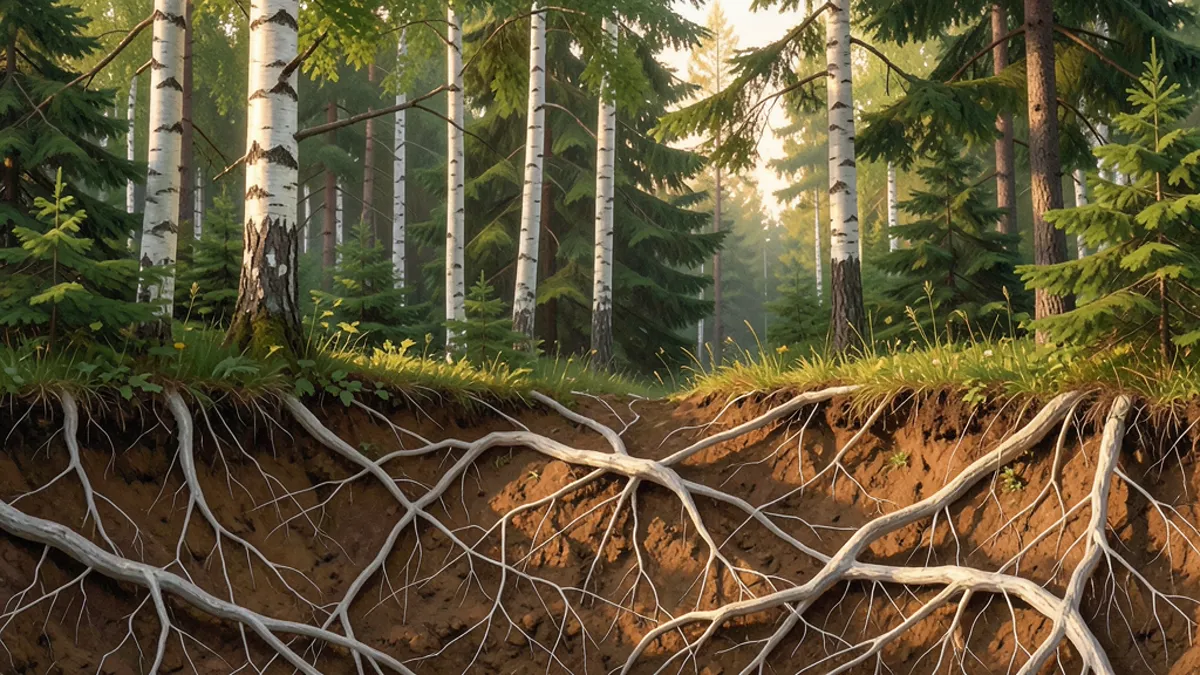
Walk into a forest and you stand on a second forest, one you cannot see. Beneath your feet, mycorrhizal networks of fungal threads join tree to tree, carrying water, nutrients and chemical signals through the soil. Scientists call them common mycorrhizal networks; the rest of us know them as the wood wide web.
Key takeaways on mycorrhizal networks
- Around nine in ten land plant species partner with fungi that live on and inside their roots.
- The fungi trade soil nutrients, mainly phosphorus and nitrogen, for sugars the plant makes by photosynthesis.
- In a famous 1997 field experiment, carbon moved between birch and Douglas fir through a shared fungal network.
- Connected plants can pass on warnings of insect attack, raising neighbours’ defences before the insects arrive.
- Some popular claims go further than the evidence: the idea that old “mother trees” feed their own seedlings has no peer-reviewed proof.
A partnership older than the forests
The deal between plants and fungi is one of the oldest partnerships on land. Fossils around 407 million years old, from the Rhynie chert in Scotland, show fungi already living inside the first land plants, and some scientists think plants could only have colonised dry land because fungi helped them draw water and minerals from bare rock.
The German botanist Albert Bernhard Frank gave the partnership its name in 1885: mycorrhiza, from the Greek for fungus and root. A fungus cannot photosynthesise, so it cannot feed itself from sunlight; a plant can, but its roots are clumsy miners. Together they trade, and both sides do better than either would alone.
Today the partnership is almost everywhere: around 90 percent of land plant species form mycorrhizae, from grasses and garden flowers to the tallest forest trees. The fungi stay hidden; a mushroom is only the fruiting body of a much larger organism living below.
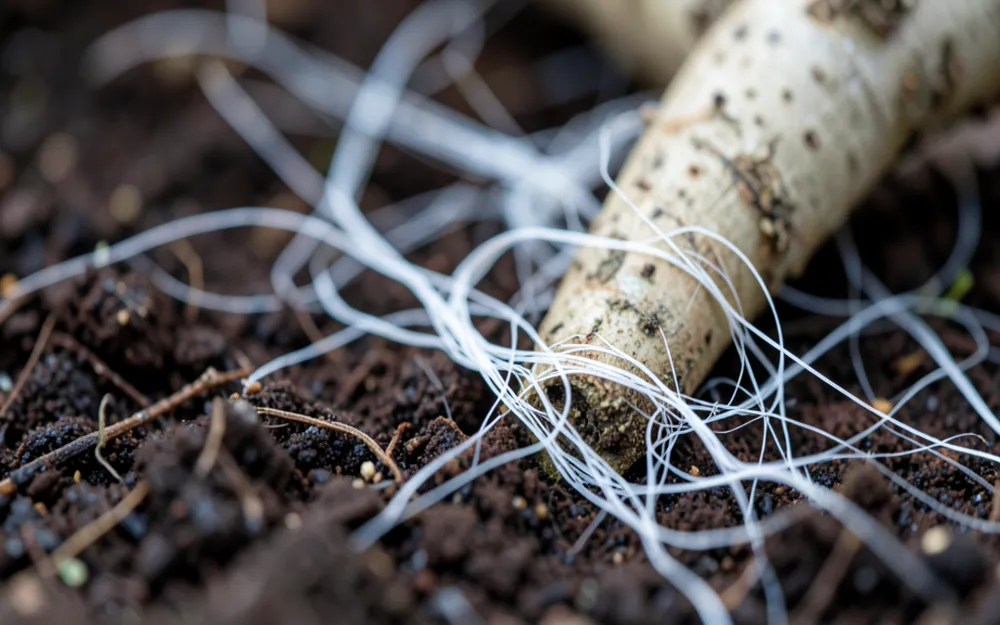
The threads are far too fine to see as a network, but lift a plant and you may spot them clinging to the roots. Image generated by AI.
How the trade works
The trade has two main forms. Arbuscular mycorrhizae are the common kind, found in around 80 percent of plant species: their fungi push tiny branched structures called arbuscules inside the root cells, and the exchange happens across that surface. Ectomycorrhizae are rarer, found on only about 5 percent of plant species, but they include most forest trees, pines, oaks, birches, beeches and Douglas firs: their fungi wrap each root tip in a sheath and grow a net of threads, the Hartig net, between the root cells.
Either way, the fungus extends the plant’s reach. A single fungal thread, a hypha, is far thinner than a root hair, and a network of them can spread centimetres or metres beyond the roots. That matters most for phosphorus, which barely moves in soil, but the fungi also bring nitrogen, zinc, copper and water, a lifeline in a dry summer.
The plant pays in sugar, typically handing over around 4 to 20 percent of the carbon it fixes through photosynthesis. And because one fungal individual can link the roots of many plants at once, the trade scales up into a network shared by a whole patch of forest floor.
The experiment that started it all
For a long time, all of this was known mainly from pots and petri dishes. Then, in 1997, the Canadian forest ecologist Suzanne Simard and her colleagues took the question into a real forest in British Columbia.
The team worked with seedlings of paper birch and Douglas fir growing side by side. They sealed the birch in plastic bags and fed them air rich in carbon-14, while the fir got carbon-13, so each species carried its own chemical label. Western red cedar grew in the same plots as a control, because cedar does not share the same mycorrhizal fungi. Days later, the labels had crossed over: carbon from the birch turned up inside the fir, and carbon from the fir turned up inside the birch. The cedar, outside the network, picked up almost none.
The flow followed need, not kindness. When the fir seedlings stood in shade, they gained about six percent of the carbon they took up through photosynthesis, drawn from the sunlit birch. When the light changed, the flow changed with it. Nature’s editors put the finding on the cover of the August 7, 1997 issue under a phrase that stuck: the wood-wide web.
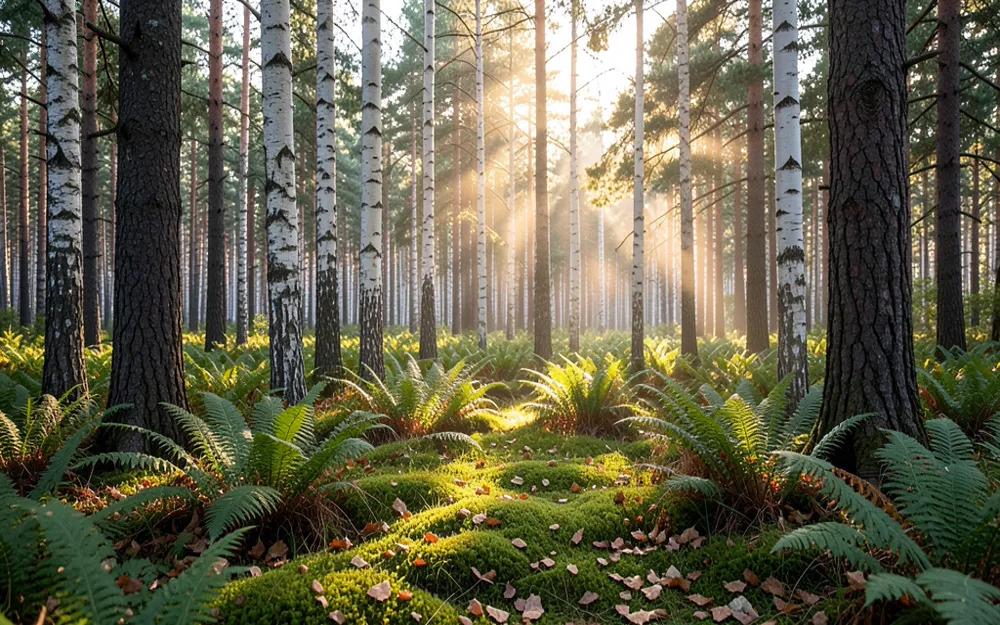
Birch and fir are the classic partners in the wood wide web story. Image generated by AI.
Warnings travelling underground
The network carries more than food. In 2013, researchers at the University of Aberdeen worked with broad bean plants and pea aphids, the small insects that suck sap from leaves. When aphids attacked one bean plant, its unattacked neighbours, connected only through the fungal network, began releasing methyl salicylate, a scent that repelled aphids and attracted parasitoid wasps, the aphids’ natural enemies. The warned plants had never been touched, yet their defences were already up.
Tomatoes showed the same pattern. In 2010, a team in China found that tomato plants linked by a fungal network passed on a warning of leaf blight, and the warned plants sickened less than unconnected ones. The network, in other words, can act as an early warning system.
Even here, the story needs care. A 2025 study in the Proceedings of the National Academy of Sciences modelled such warnings and found that warning neighbours is rarely a stable strategy in evolution: the plant pays the cost, and its neighbours take the benefit. The authors suggest the fungi themselves may be doing the signalling, passing the news along because a healthy network serves the fungus. The effect is real in the laboratory; how much of it happens in a wild forest is still open.
Mother trees and the great debate
The most loved version of the story goes further still. In her 2021 memoir Finding the Mother Tree, Simard described great old trees as hubs of the network, feeding and sheltering their own seedlings, recognising their kin through chemical cues in the soil. It is a beautiful image, and it made the wood wide web famous. But in 2023, three ecologists pushed back hard.
Justine Karst, Melanie Jones and Jason Hoeksema reviewed the field studies behind three popular claims. First, that the networks are widespread in forests: the structure had been mapped in only five studies, in two forest types, covering two tree species and three fungal species, out of roughly 73,300 tree species worldwide. Second, that resource transfer through the networks improves how seedlings grow: the results were mixed, and other explanations, like nutrients moving through the soil itself, had often not been ruled out. Third, that mature trees preferentially send resources and defence signals to their own offspring: for that claim they found no peer-reviewed published evidence at all.
They also found a quieter problem: claims the evidence did not support had doubled over 25 years, as later papers cited earlier ones in stronger terms than the originals had used.
Simard answered in 2025, arguing that the review had searched the literature too narrowly and used unclear criteria to choose its studies. The debate is still running. The honest position today is this: the networks are real, the movement of carbon through them is real, and the warmer story of trees caring for their young is, for now, unproven.
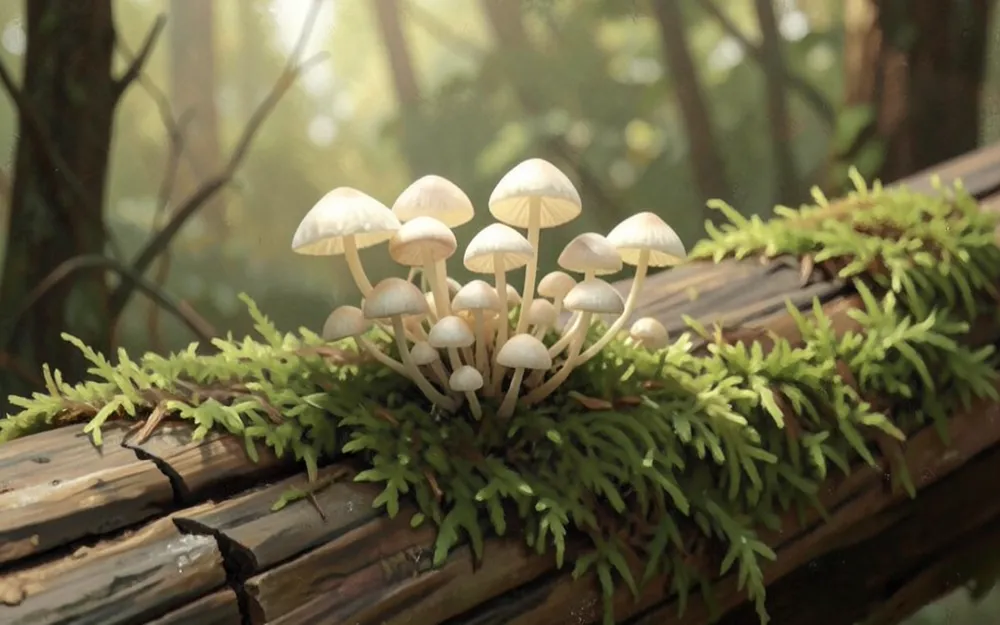
A mushroom is only the fruiting body of a much larger organism living below. Image generated by AI.
Why it matters
Even without the fairy tale, the network matters. In 2023, researchers estimated that plants send around 13.12 gigatonnes of carbon dioxide equivalent a year into the mycelium of their mycorrhizal fungi, roughly 36 percent of what burning fossil fuels releases each year. Much of that carbon ends up stored in the soil. A forest is not only a stand of trees; it is a carbon store, and the fungi are part of the vault.
That gives foresters a practical reason to care. Clear-cutting a patch of forest does not only remove trees; it breaks the network underneath, and seedlings in bare ground must rebuild those connections from scratch. Keeping some older trees standing may help the next generation take hold. In gardens the same logic applies in miniature: mycorrhizal products now sit on shop shelves, but the evidence is mixed, and the benefit is clearest in poor or disturbed soil. In healthy soil, the fungi are usually already there.
Much is still unknown. Mapping a network means tracing threads thinner than a hair through tonnes of soil, and most of what we know comes from a handful of forest types. The wood wide web is real, but it is smaller, stranger and less settled than the stories suggest.
Frequently asked questions
Can I see a mycorrhizal network?
Not really. The threads are far too fine to see as a network, though if you lift a plant carefully you may spot white threads clinging to the roots, and some fungi show themselves as mushrooms after rain. A mushroom is only the fruiting body, and most of these fungi never make one at all.
Do trees really talk to each other?
They exchange chemicals, and those chemicals can change how a neighbour behaves. But “talk” is a metaphor, not a description: there is no evidence that trees intend to send messages, or that they understand each other. The fungi in the middle may be doing the work, moving chemicals where the flow of nutrients already runs.
Should I buy mycorrhizal fungi for my garden?
It depends on your soil. In new beds or poor, dug-over soil, a mycorrhizal product may help young plants settle in. In an established garden with healthy soil, the fungi are almost certainly there already, and no product beats good soil care, compost and leaving the ground undisturbed.
Related reading
For another story about the hidden life of roots, read Why Houseplants Make a Home Feel Alive.
Sources
- Simard, S. W., Perry, D. A., Jones, M. D., Myrold, D. D., Durall, D. M., & Molina, R. (1997). Net transfer of carbon between ectomycorrhizal tree species in the field. Nature, 388, 579–582.
- Karst, J., Jones, M. D., & Hoeksema, J. D. (2023). Positive citation bias and overinterpreted results lead to misinformation on common mycorrhizal networks in forests. Nature Ecology & Evolution, 7, 501–511.
- Babikova, Z., Gilbert, L., Bruce, T. J. A., Birkett, M., Caulfield, J. C., Woodcock, C., Pickett, J. A., & Johnson, D. (2013). Underground signals carried through common mycorrhizal networks warn neighbouring plants of aphid attack. Ecology Letters, 16, 835–843.
- Song, Y. Y., Zeng, R. S., Xu, J. F., Li, J., Shen, X., & Yihdego, W. G. (2010). Interplant communication of tomato plants through underground common mycorrhizal networks. PLOS ONE, 5, e13324.
- Hawkins, H.-J., et al. (2023). Mycorrhizal mycelium as a global carbon pool. Current Biology, 33, 1487–1501.
- Bonfante, P., & Genre, A. (2010). Mechanisms underlying beneficial plant–fungus interactions in mycorrhizal symbiosis. New Phytologist, 188, 787–802.
- The evolution of signaling and monitoring in plant–fungal networks. Proceedings of the National Academy of Sciences, 122(4), e2420701122 (2025).










0 Comments