

A TeaLamp reading list. Prepared by the TeaLamp Editorial Team with the help of AI.
Some books are best read in an armchair, and some make you want to put the book down and go outside. These five books about walking do both. Each one follows a real journey made on foot, from a comic stumble along the Appalachian Trail to a two-month trek high in the Himalayas, and each shows what walking does: it slows the mind, sharpens the senses, and leaves room for thoughts that never arrive in a hurry. Put the kettle on, pick the walk that calls to you first, and read a little before your own next walk.
Key takeaways on books about walking
- The five books span eighty years of walking, from a teenager crossing Europe in 1933 to a Himalayan trek in 1973 and a modern wander along England’s old paths.
- None of the writers set out to prove anything. They walked to see a place properly, to grieve, to recover, or simply because the road was there.
- Each book is shaped differently by its walk: comedy in Bryson, history in Leigh Fermor, spiritual searching in Coelho, landscape in Macfarlane, and quiet grief in Matthiessen.
- Every book can be read in short sittings, a chapter at a time, ideal for slow evenings and full cups of tea.
- You do not need walking boots to enjoy any of them.
A Walk in the Woods, by Bill Bryson (1998)
At forty-four, Bill Bryson decided to walk the Appalachian Trail, the long footpath that runs for about 2,200 miles along the east coast of the United States, from Georgia to Maine. After twenty years in Britain, he wanted to reacquaint himself with his own country, on foot, the slow way. His old friend Stephen Katz agreed to come along, and the two set off in the spring of 1996, cheerfully unprepared, with heavy packs and very little idea of what lay ahead.
They did not walk the whole trail, and Bryson is honest about that from the start. The two men covered about 850 miles of it in several stretches, skipping the middle section by car and rejoining the path further north, and the book follows their blisters, their wrong turns, their run-ins with bears, mice and weather, and the long silences of the forest. Bryson writes about the history of the trail and the life of the woods as he goes, so the comedy sits alongside real knowledge.
What makes the book last is its warmth. Katz is funny and exasperating in equal measure, and Bryson never pretends walking is a test of character: it is a way of paying attention. The book became a bestseller and was later made into a film, but the book itself is the better walk. Best for: readers who want to laugh, and anyone who has ever looked at a long trail and wondered what the first mile feels like.
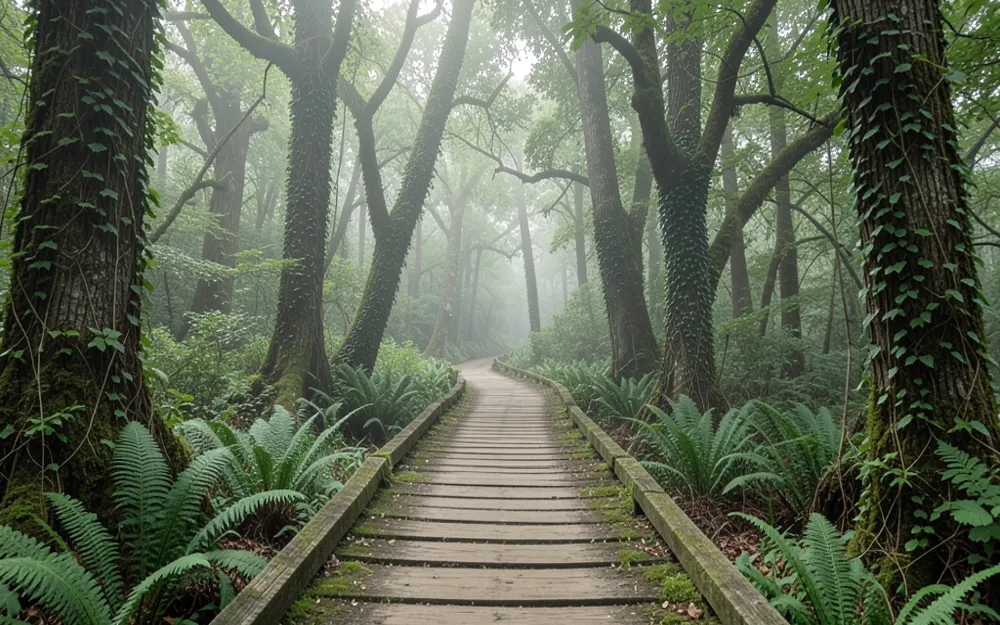
A forest trail in the Appalachian mountains, morning mist. Image generated by AI.
A Time of Gifts, by Patrick Leigh Fermor (1977)
In December 1933, at the age of eighteen, Patrick Leigh Fermor left London with a little money, a few letters of introduction and two books of poetry, and set out to walk across Europe, from the Hook of Holland to Constantinople. He slept in barns, castles and monasteries, and walked through the snow into Germany, up the Rhine and down the Danube, reaching Constantinople on New Year’s Day in 1935, thirteen months after he began.
A Time of Gifts tells only the first part of that journey, as far as Hungary, and it was not published until 1977, more than forty years after the walk. Leigh Fermor wrote it from memory and from the notebooks he kept on the road, and the long wait gave the book its depth. It is full of the Europe that was about to disappear: small inns, open doors and long conversations, crossed on foot just before the Second World War changed it for ever. The young walker meets monks, shepherds, scholars and aristocrats, and records their hospitality with a gratitude that never fades.
The prose is the richest in this list, and rewards slow reading. Leigh Fermor loved words the way other walkers love maps, and his sentences carry the history of every place he passes through. The book won the WH Smith Literary Award in 1978, and two sequels followed, carrying the journey on to Greece. Best for: readers who love history and language, and anyone who dreams of a journey with no timetable at all.
The Pilgrimage, by Paulo Coelho (1987)
In 1986, the Brazilian writer Paulo Coelho walked the Camino de Santiago, the ancient pilgrim road across northern Spain to the cathedral city of Santiago de Compostela. He went with a guide, a man he calls Petrus, on a journey that was also a test: Coelho had failed an initiation into a small order he calls RAM, and he was told that he must walk the road to recover his sword, the symbol of his acceptance. The Pilgrimage, first published in Portuguese in 1987 as O Diário de Um Mago, tells the story of that walk.
The book is part adventure and part spiritual guide. Along the road, Petrus teaches Coelho simple exercises: how to walk slowly and pay attention, how to listen, how to love, how to face fear. Some of the lessons are practical, others stranger, and the book does not pretend otherwise. Coelho writes plainly about what he felt and what he learned, and he leaves the reader free to take the exercises seriously or simply to enjoy the road.
Coelho has since said he did not walk every mile of the road on foot, and the book reads more like a spiritual memoir than a strict diary of the trail. That does not spoil it. The road, the towns and the long evenings still come through clearly. The book became Coelho’s first success and led, a year later, to The Alchemist. Best for: readers who like a journey with a question at its heart, and anyone curious about the Camino itself.
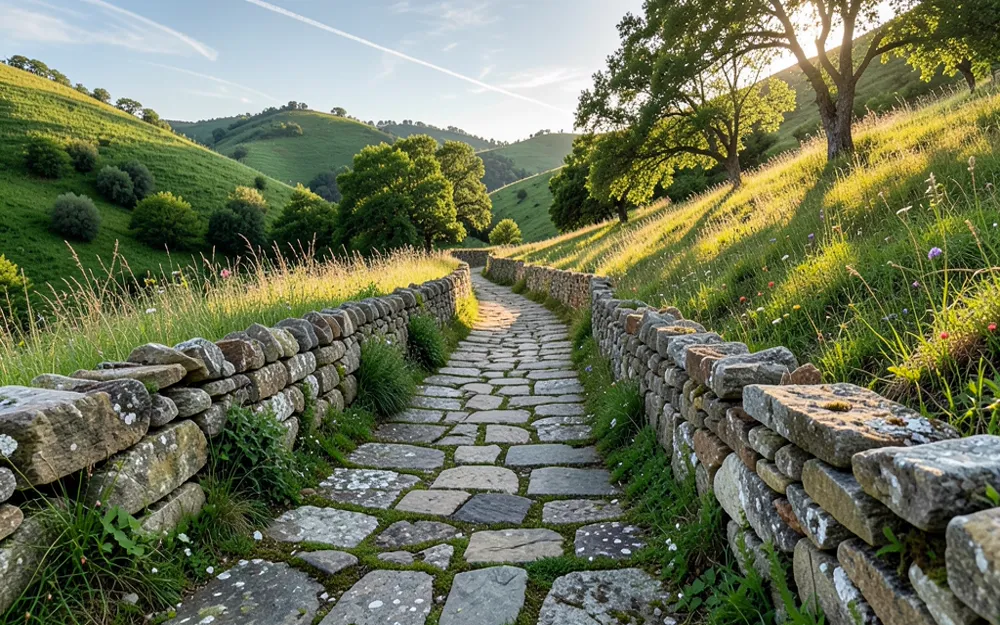
The old pilgrim road to Santiago, stone walls and green hills. Image generated by AI.
The Old Ways, by Robert Macfarlane (2012)
Robert Macfarlane’s subject is not one walk but many, and not one road but the old network of paths that crosses Britain and reaches beyond it: pilgrimage routes, drove roads, hollow ways worn deep into chalk, sea paths that appear only at low tide. In The Old Ways, published in 2012, he follows these tracks on foot, from his home in Cambridge across the chalk downs of southern England and the bird islands of the Scottish north-west, and further afield to Spain, Palestine and the mountains of Sichuan.
Each chapter pairs a walk with a writer who walked before him, above all the poet Edward Thomas, who walked the English countryside a century earlier. The book is full of the pleasures of path-following: the way a track remembers the feet that made it, and the company of other walkers met along the way. One chapter describes the Broomway, a tidal path off the Essex coast that can only be walked safely with a guide, between the sea and the sky.
He writes about landscape with knowledge, curiosity and delight, and without ever showing off. The Old Ways spent six months in the bestseller lists, won the Dolman Prize for Travel Writing and was shortlisted for the Samuel Johnson Prize. Best for: readers who love maps, words and wild places, and anyone who has ever followed a footpath and wondered who walked it first.
The Snow Leopard, by Peter Matthiessen (1978)
In the autumn of 1973, the American writer Peter Matthiessen set out with the field biologist George Schaller on a two-month trek into the Dolpo region of Nepal, high on the Tibetan Plateau. Their purpose was scientific: to study the Himalayan blue sheep in their remote home, and if they were lucky, to glimpse the snow leopard that hunts them. His wife, Deborah, had died of cancer the year before, and he carried his grief with him up the mountain.
The Snow Leopard, published in 1978, is the journal of that journey. The walking is hard: thin air, cold nights and steep passes. Matthiessen writes about the villages, the monasteries and the Sherpa guides with a clear, unhurried eye, and about the natural world with the care of a lifelong observer. The leopard itself stays out of sight for almost the whole book, and that absence becomes the point: the search matters more than the sighting.
The book won the National Book Award twice, and it is still read as one of the finest works of travel writing in English: a record of how walking, attention and wild country can steady a grieving mind. Best for: patient readers, lovers of mountains and nature writing, and anyone who wants a book that stays with them long after the last page.
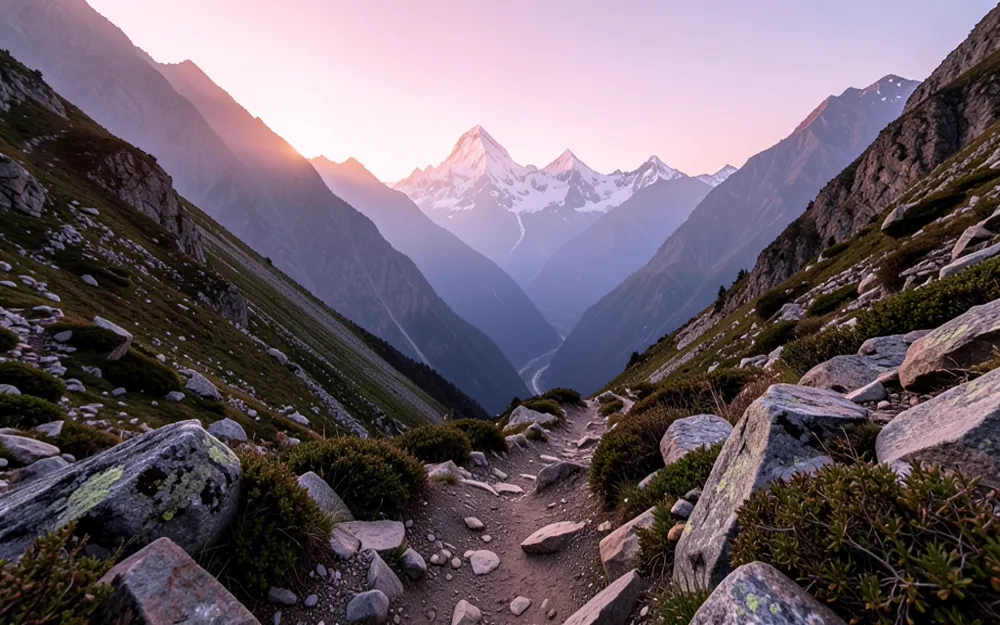
A high trail toward the snow peaks, at dawn. Image generated by AI.
How to enjoy these books
Read them slowly, a chapter at a time, the way their authors walked. Start with Bryson if you want laughter, with Coelho if you want a question to carry, with Matthiessen if you want quiet. Keep a map nearby: the books grow richer when you can see where the feet are going. And take one of them outside: a park bench or a window seat makes the walking pages feel closer.
Why it matters
Walking is the oldest way of travelling, and these five books are a reminder of what it gives back: the change in the light, the sound of a stream, the way a town arrives slowly over a hill. Each of these writers came home different, not because the walk changed the world, but because it changed the pace at which they saw it. In a fast century, that is a gift worth keeping.
If you enjoy walking on the page, you may also like our story on why a walk helps you think more clearly, and our list of classic nature books for slow autumn evenings.
Frequently asked questions
Do I need to be a walker to enjoy these books?
Not at all. They are written for anyone who enjoys a good story, a vivid place and a writer paying close attention. The walking is the subject, not a requirement.
Which book should I read first?
Start with A Walk in the Woods for the funniest and easiest entry point. Try The Pilgrimage for a journey with a spiritual question, and The Snow Leopard for the deepest read of the five.
Are these books suitable for younger readers?
Bryson and Macfarlane suit confident teenage readers well. The Snow Leopard deals gently with grief, and The Pilgrimage touches on spiritual ideas, so both suit older teenagers and adults best. A Time of Gifts suits any older reader who loves words.
Sources
- A Walk in the Woods, Wikipedia (Bill Bryson, published 1998, Appalachian Trail, about 850 miles walked, 2015 film)
- A Time of Gifts, Wikipedia (Patrick Leigh Fermor, John Murray 1977, walk from the Hook of Holland, December 1933, WH Smith Literary Award 1978)
- The Pilgrimage, Wikipedia (Paulo Coelho, O Diário de Um Mago, 1987, Camino de Santiago, guide Petrus, order of RAM)
- The Old Ways, Wikipedia (Robert Macfarlane, Hamish Hamilton, June 2012, Dolman Prize, Samuel Johnson Prize shortlist)
- The Snow Leopard, Wikipedia (Peter Matthiessen, Viking 1978, 1973 Dolpo trek with George Schaller, National Book Award)










0 Comments