

Key takeaways
- Astronomers have caught the most distant fast radio burst ever recorded: a millisecond-long flash of radio waves that spent more than 10 billion years crossing the cosmos before reaching Earth.
- The burst, named FRB 20240304B, was spotted by South Africa’s MeerKAT telescope and traced to its home galaxy with the James Webb Space Telescope. It erupted when the universe was only about 3 billion years old.
- Its tiny, star-forming host galaxy points to a young magnetar, a highly magnetized dead star, as the source, strengthening the leading theory of what causes these mysterious flashes.
- On its journey, the signal acted as a cosmic flashlight, lighting up invisible gas and two huge structures between galaxies that astronomers could not otherwise see.
A fast radio burst, a flash of radio light lasting less than the blink of an eye, has just become the farthest signal of its kind ever detected. The burst, catalogued as FRB 20240304B, travelled for more than 10 billion years before washing over Earth, and it has given astronomers a new way to probe the hidden scaffolding of the universe.
The discovery was led by Dr. Manisha Caleb and Dr. Themiya Nanayakkara at the University of Sydney and is published in the journal Science. The burst was first picked up by the MeerTRAP project running on South Africa’s MeerKAT radio telescope, and NASA’s James Webb Space Telescope then pinpointed the faint galaxy where it was born.
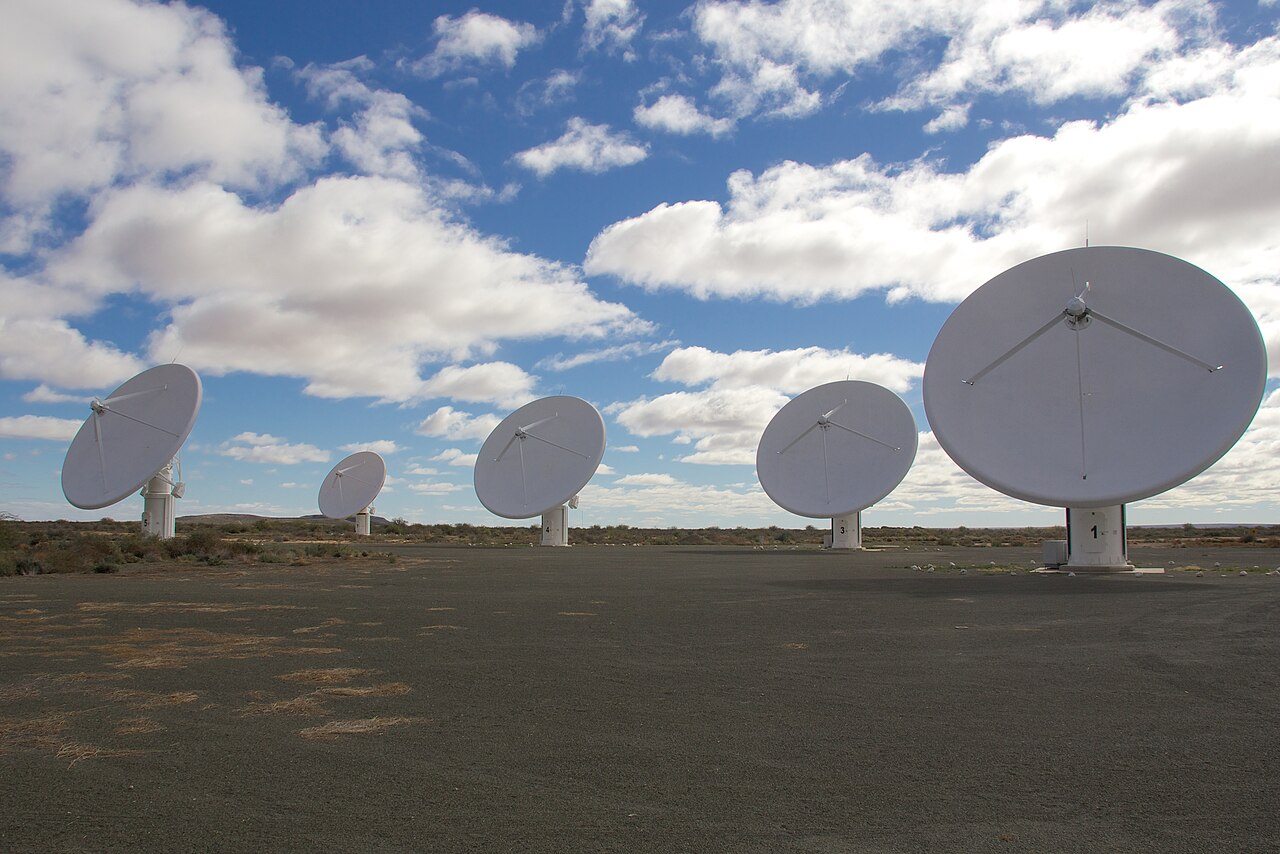
Radio dishes at the South African SKA site in the Karoo, home to the MeerKAT telescope that caught the record-breaking burst. Photo: Mike Peel, CC BY-SA 4.0, via Wikimedia Commons.
What is a fast radio burst?
Fast radio bursts, or FRBs, are among the strangest phenomena in astronomy. Each one is an intense pulse of radio waves that lasts only milliseconds yet releases more energy than the Sun produces in an entire year. The first was discovered by accident in 2007, and radio telescopes around the world have since recorded thousands of them.
Their origins are still debated, but most astronomers now suspect magnetars: neutron stars with magnetic fields trillions of times stronger than Earth’s, left behind when massive stars explode as supernovas. A violent disturbance on a magnetar, sometimes called a starquake, could release the colossal energy seen in a burst.
Some FRBs repeat, firing off again and again from the same spot, while others flash once and go silent. A 2025 analysis by researchers Zhang and Hu proposed a unifying idea: isolated magnetars and magnetars in binary star systems produce different burst patterns, which could explain why the population looks so varied. The details, though, are still an active argument.
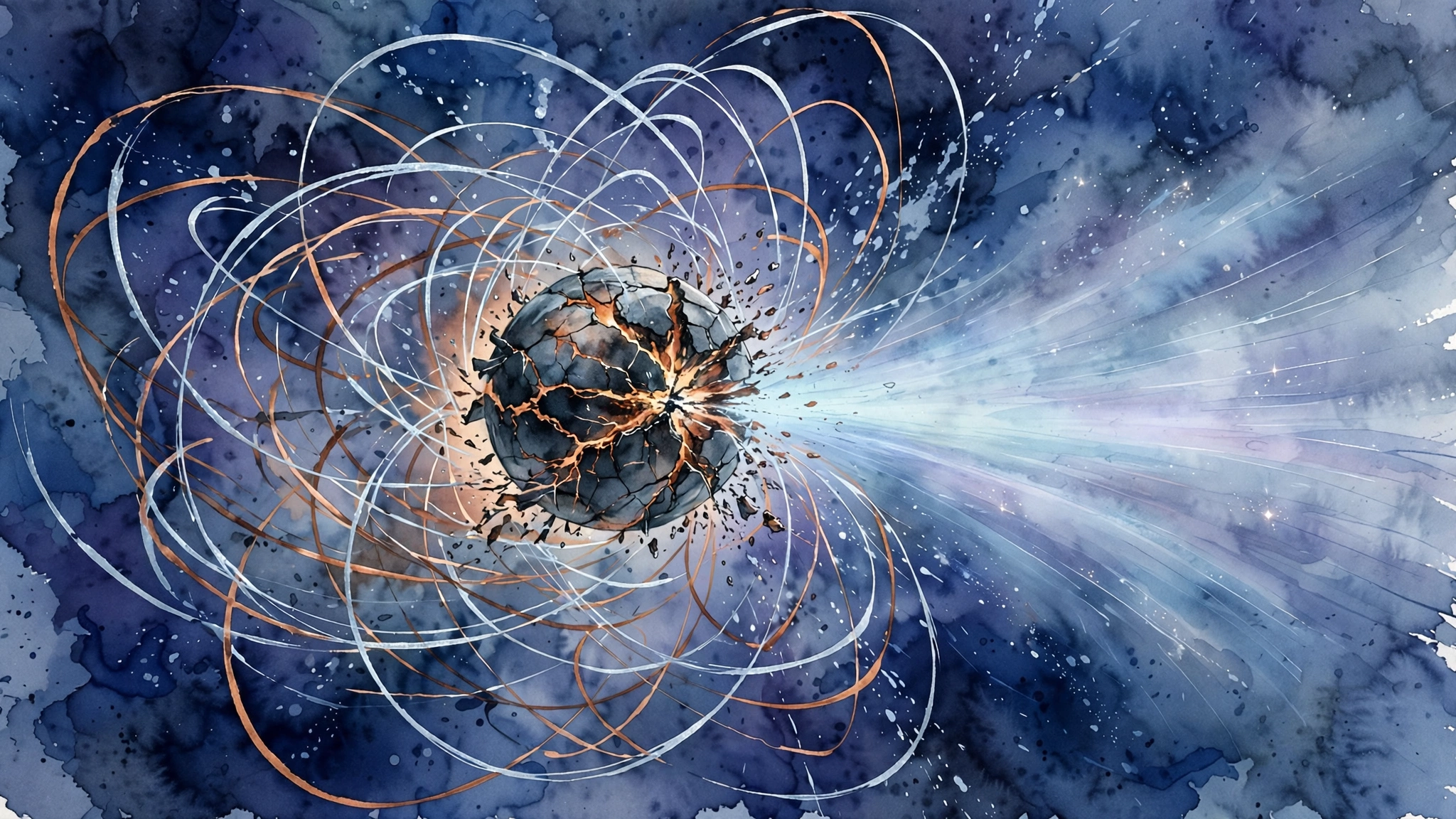
An artist’s impression of a magnetar, the prime suspect behind fast radio bursts: a city-sized stellar corpse with a magnetic field trillions of times stronger than Earth’s. Image generated by AI.
A record broken by a factor of two
The new burst more than doubles the previous distance record. That record belonged to FRB 20220610A, found in 2023 at a distance of about 8 billion light-years. The new signal comes from a time when the universe was only around 3 billion years old, a period astronomers call cosmic noon, when galaxies were forming stars at a furious rate.
“This is an extraordinary glimpse into the distant universe,” Caleb said. The team used the brief flash of radio light to study the matter the signal had crossed over billions of years.
The host galaxy is a surprise
Finding the burst was only half the job. A radio flash alone gives a rough distance estimate, because low-frequency waves are delayed slightly more than high-frequency ones as they cross thin gas in space. Astronomers call this the dispersion measure, and it works as a crude proxy for distance. A precise distance, however, requires identifying the burst’s home galaxy, and this one was far too faint for the largest ground-based telescopes.
That is where Webb came in. Its infrared eyes found a small, metal-poor galaxy undergoing a vigorous episode of star formation. That environment matters: young magnetars are born in the violent deaths of massive, short-lived stars, so a young, star-bursting galaxy is exactly where magnetar-made FRBs should come from. A merger of two old neutron stars, the main rival theory, looks far less likely here.
That environment matters: young magnetars are born in the violent deaths of massive, short-lived stars, so a young, star-bursting galaxy is exactly where magnetar-made FRBs should come from. A merger of two old neutron stars, the main rival theory, looks far less likely here. Co-author Dr. Laura Driessen of the University of Sydney said the result gives an important clue about the environments where FRBs are born and shows the flashes can teach us about galaxy evolution too.
A flashlight shining through the dark
The burst’s real power may be as a probe rather than as a puzzle. Between its home galaxy and Earth, the signal crossed almost the entire observable history of the cosmos, passing through galaxies, clusters, and vast stretches of nearly invisible gas. Matter along the way left subtle fingerprints in the radio emission, and the team could read them.
The analysis revealed two major structures the signal passed through: a previously unknown galaxy cluster about 3.5 billion light-years away, and the nearby Virgo Cluster, some 54 million light-years from Earth. In other words, a single millisecond flash mapped enormous structures spread across the universe.
Nanayakkara added that the result shows off what the Webb telescope makes possible, pushing past limits ground-based observatories could not cross.
How close to the beginning can we see?
The team sees this as the start of a new reach, not the end of one. Shaji noted that sufficiently powerful bursts could in principle be detectable from the very early universe. The next goal, said co-author Ben Stappers of the University of Manchester, is “to push this frontier further and see how close we can get to the first generations of stars.”
Not every FRB fits the magnetar picture neatly. A burst found in the nearby M81 galaxy was traced to a globular cluster full of ancient stars, a place where young magnetars should not exist, suggesting that old white dwarfs collapsing or merging might sometimes make magnetars too. The field is converging on an answer, but the universe keeps adding footnotes.
Why it matters
Fast radio bursts are becoming one of astronomy’s most versatile tools. They are brief enough to act as precise probes and powerful enough to be seen across cosmic time. Each new record-holder does double duty: it tests our theories of extreme physics and lights up the invisible matter that makes up most of the ordinary stuff in the universe. FRB 20240304B does both, from further away than any burst before it.
Related reading
If this caught your interest, read Neutrinos, Explained: The Ghost Particles IceCube Hunts, another TeaLamp explainer about a different kind of cosmic messenger that crosses the universe almost untouched.
Frequently asked questions
How far away was the burst?
The signal travelled for more than 10 billion years. It left its galaxy when the universe was about 3 billion years old, at what astronomers measure as redshift 2.
What caused it?
Most likely a young magnetar, a highly magnetized neutron star. The small, vigorously star-forming host galaxy fits magnetar formation far better than the rival idea of two old neutron stars merging.
Could it be aliens?
There is no evidence for that, and astronomers do not consider it a serious explanation. The burst’s properties match natural, extreme astrophysical processes.
Why do astronomers care about the gas between galaxies?
Most of the universe’s ordinary matter hides in thin, hot gas between galaxies that is nearly impossible to see directly. A fast radio burst passing through it leaves measurable fingerprints, turning the burst into a probe of otherwise invisible structure.
Sources
- University of Sydney / phys.org, “Astronomers pinpoint the most distant fast radio burst ever detected,” October 8, 2026.
- Caleb et al., “A fast radio burst at redshift 2, three billion years after the Big Bang,” Science (2026). DOI: 10.1126/science.adz2675
- Sky & Telescope, “Fast Radio Burst Shatters Distance Record,” October 2026.
- AAS Nova, “A Unified Explanation for Fast Radio Bursts,” December 2025 (Zhang & Hu magnetar framework).
- Physics World, “Source of fast radio bursts surprises astronomers” (M81 globular-cluster burst, alternative magnetar formation).










0 Comments