

Key takeaways
- People who score high on neuroticism, the tendency to worry and react strongly to uncertainty, suffered larger and longer-lasting increases in anxiety and depression during the pandemic.
- The finding comes from one of the longest studies of its kind: 4,030 American adults surveyed again and again from 2019 into early 2024.
- The effect ran through everyday channels: people high in neuroticism perceived higher risks of death, job loss, and financial hardship, and coped with less exercise, less relaxation, and more alcohol.
- The other four Big Five personality traits mattered far less. Conscientiousness offered modest protection, mostly among adults over 60.
Two neighbours could live through the same lockdowns, watch the same news, and walk out the other side in very different shape. A new study argues that neuroticism, the personality trait that governs how strongly we react to worry and uncertainty, explains a large part of that difference.
Researchers led by Marco Angrisani at the University of Southern California followed 4,030 American adults from 2019 into early 2024, questioning them repeatedly as the COVID-19 pandemic unfolded. People in the top quarter for neuroticism experienced substantially larger increases in anxiety and depression symptoms when the crisis hit, and the gap was still measurable years later. The paper was published in PLOS ONE on October 7, 2026.
A five-year natural experiment
The team drew on the Understanding America Study, a nationally representative panel run by USC’s Center for Economic and Social Research. More than 100,000 survey responses were collected across 34 waves, stretching from before the pandemic into early 2024. Mental distress was tracked with the PHQ-4, a short, validated screening questionnaire for anxiety and depression.
Because personality was measured before the crisis began, the design works a little like a natural experiment. Researchers could watch the same people pass through the same shock and see whose mental health bent and whose stayed standing.
The headline result from earlier research still holds: at the population level, there was no lasting “tsunami of mental illness.” Average distress spiked in the spring of 2020, then partly receded as people adapted. But averages hide the real story. The new work shows that beneath the average, personality carved out very different trajectories, and one trait dominated the picture.
Neuroticism stood out from the crowd
Of the Big Five traits, only neuroticism consistently predicted how someone’s mental health moved through the crisis. People scoring in the highest quartile saw a pronounced jump in their PHQ-4 scores at the pandemic’s onset, followed by only partial recovery. Their distress stayed above pre-pandemic levels, and the differences remained statistically significant well into the aftermath.
The pattern held across all three age groups the team studied, 18 to 39, 40 to 59, and 60 and above, with broadly similar strength. In other words, the vulnerability linked to high neuroticism is not confined to any stage of life; it looks like a risk factor that spans the whole life course.
Extraversion, openness, and agreeableness, by contrast, showed weak, inconsistent, or statistically insignificant links to mental-health trajectories. Conscientiousness, the trait associated with self-discipline and steady routines, was modestly protective, but the benefit showed up mainly among adults aged 60 and above, who kept lower distress scores throughout the pandemic.
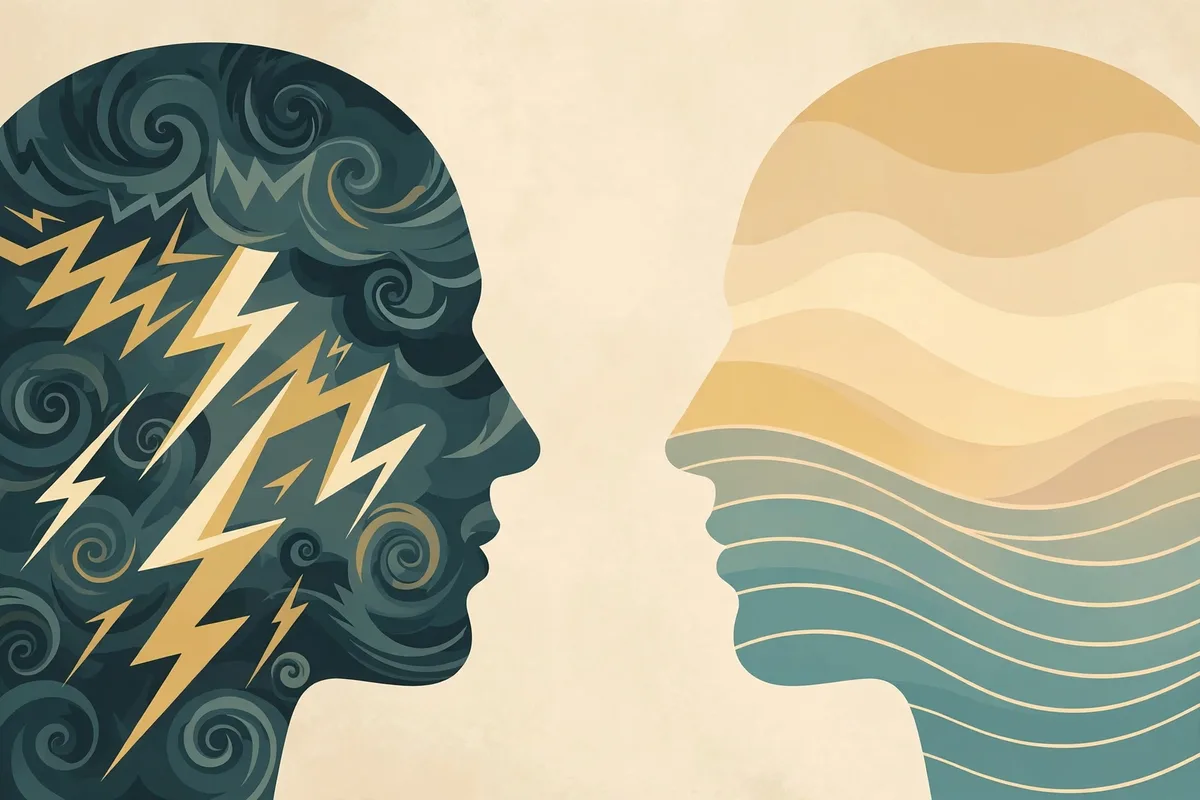
An anxious mind (left) versus a calm one (right). The study found that neuroticism shapes distress largely through how people judge risk and how they cope. Image generated by AI.
Three channels: risk, behaviour, and coping
The paper’s most interesting contribution is what it says about why neuroticism mattered. Three channels stood out.
First, risk perception. A one-standard-deviation increase in neuroticism was linked to significantly higher perceived chances of dying from COVID-19, losing a job, or facing financial hardship. Those associations peaked during waves of high infection and faded only gradually, still lingering into late 2022.
Second, protective behaviour. People higher in neuroticism were more likely to wash their hands frequently, wear masks, and avoid public spaces. The link grew steadily through 2021. Interestingly, avoiding public spaces seemed driven almost entirely by heightened risk perception, while handwashing and mask-wearing were not, suggesting habit and diligence played a role too.
Third, coping. Higher neuroticism was associated with less relaxation and less physical activity, but more alcohol consumption. Taken together, the authors write, these patterns point to multiple, complementary mechanisms through which the trait translates into greater distress during a major societal shock.
The quiet four
For the remaining traits, the machinery was far less systematic. Some showed modest links to risk perception or behaviour in specific periods, but the effects were small and often statistically insignificant. The authors conclude that non-neuroticism traits are unlikely to be useful targets for personality-informed intervention in crisis settings, a sobering note for anyone hoping for a simple resilience recipe.
It is worth stressing what the study does not claim. Neuroticism is not a diagnosis, and a high score does not doom anyone to poor mental health. The trait sits on a continuum, and its expression depends on context, resources, and coping strategies. The study is also observational: it finds associations, not proof of causation. All measures were self-reported, and the findings come from the United States, which lacks universal health insurance, so they may not travel neatly to other countries.
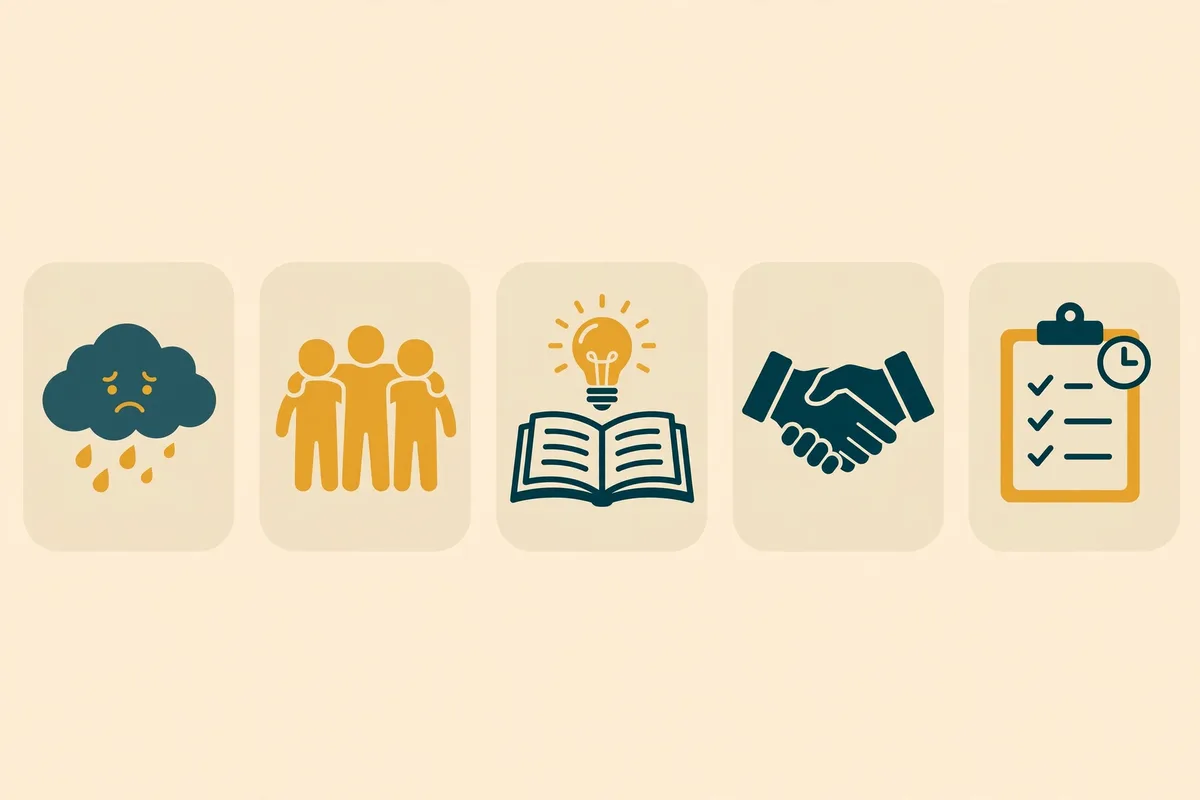
The Big Five personality traits. Only neuroticism, the tendency to worry and react strongly to uncertainty, consistently predicted pandemic distress. Image generated by AI.
Why it matters
Crises will keep coming: pandemics, natural disasters, economic shocks. The practical upshot of this work is that emergency planners and clinicians could use personality-linked vulnerability to spot who may need closer follow-up after a disaster, alongside symptoms, history, and circumstances. The authors advocate stepped care: monitoring people over time and offering treatments such as cognitive behavioural therapy or emotion-regulation training when significant, persistent symptoms emerge, rather than labelling anyone by a personality score.
There is also a message for crisis communication. Campaigns that inform people without unnecessarily raising distress among the most worry-prone, emphasizing practical, controllable actions, could protect the psychologically vulnerable while helping everyone else. And on a personal level, the findings point to levers anyone can reach for: exercise, relaxation, and keeping alcohol in check were the behaviours that separated the trajectories.
Related reading
For more on the everyday links between habits and mental health, read An Apple a Day Keeps the Stress Away: How Food Can Lower Stress Levels.
Frequently asked questions
What is neuroticism?
Neuroticism is one of the Big Five personality traits. It describes a tendency to experience worry, emotional sensitivity, and stronger reactions to stress or uncertainty. It is a normal, measurable trait, not a diagnosis.
Does being high in neuroticism mean I will develop depression in a crisis?
No. The study finds that, on average, people high in neuroticism experienced larger and more persistent increases in distress. It is a risk factor, not a destiny, and coping strategies, resources, and support all shape the outcome.
Why did the other personality traits matter so little?
The authors found that extraversion, openness, and agreeableness had weak or inconsistent links to distress trajectories, and conscientiousness helped only modestly, mainly among older adults. Their conclusion is that non-neuroticism traits are unlikely to be strong targets for crisis interventions.
What can worry-prone people do?
The study points to concrete levers: regular exercise, deliberate relaxation, and limited alcohol use were the coping behaviours linked to better trajectories. If distress becomes significant and persistent, the authors recommend seeking professional support such as cognitive behavioural therapy.
Source and licence
Adapted from: Angrisani M, Atella V, Bruine de Bruin W, Kopinska J, “How personality traits shape susceptibility to mental distress in times of crisis: Evidence from the COVID-19 pandemic,” PLOS ONE 21(10): e0358371 (published October 7, 2026). DOI: 10.1371/journal.pone.0358371. Published open access under the Creative Commons Attribution 4.0 International Licence (verified on the article page, October 10, 2026), which permits adaptation with credit to the authors and a link to the licence. This TeaLamp version is rewritten and expanded with additional context; no passage is reproduced verbatim.










0 Comments