

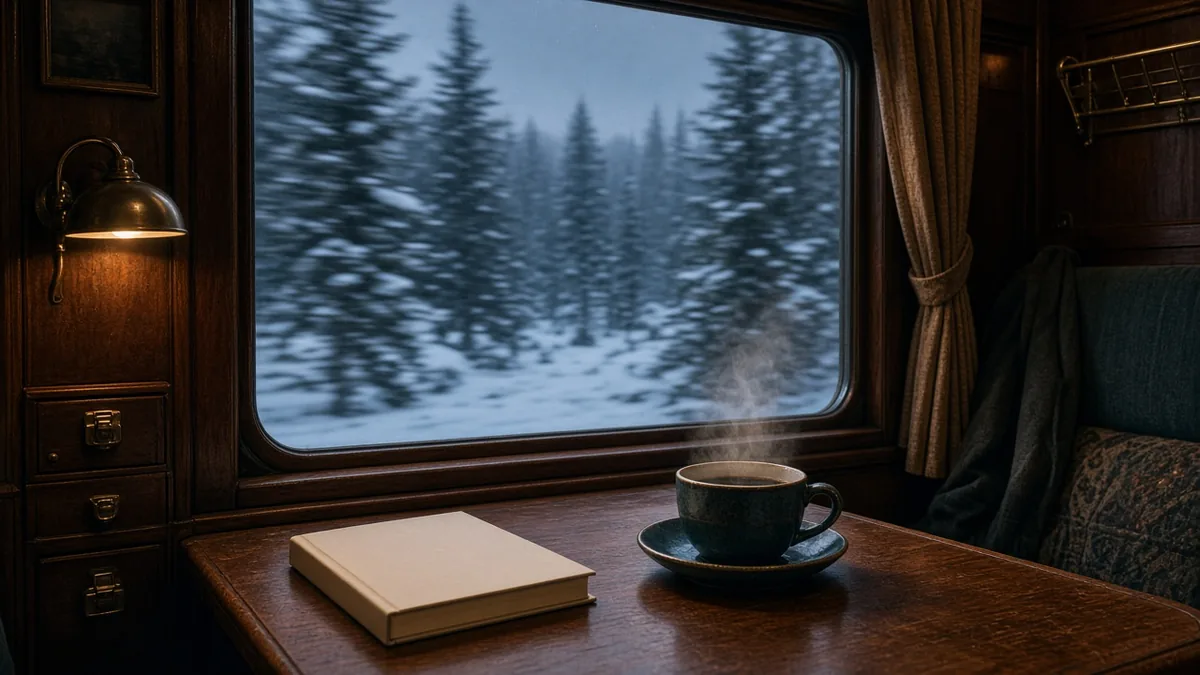
A TeaLamp reading list of five books about train journeys, chosen and described in our own words. Prepared by the TeaLamp Editorial Team with the help of AI.
There is something about a train that makes a good story feel even better. The rhythm of the wheels, the view sliding past the window and the small, temporary world of strangers sharing a carriage all make railways a natural setting for adventure, mystery and quiet reflection. This list gathers five books about train journeys from England, Japan, the United States and Switzerland: a beloved children’s classic, a famous snowbound mystery, a dreamy Japanese fantasy, a landmark of travel writing and a thoughtful modern novel. Each is very different, and each is lovely to read on a winter evening with a cup of tea.
Why books about train journeys work so well
A railway journey has a built-in shape: a departure, a passage through changing country and an arrival. That makes it a gift to storytellers. A train can carry characters away from their ordinary lives, trap a group of suspects together, or give a traveller long hours to think. Trains also stand for change itself, from the new industrial world of the nineteenth century to the slow, deliberate travel many people seek out today. The five books below use the train in five different ways, which is part of the pleasure of reading them side by side.
The Railway Children by E. Nesbit (1906)
When their father is suddenly taken away for reasons the children do not understand, Roberta, Peter and Phyllis move with their mother from a comfortable London home to a small cottage in the country, close to a railway line. Money is short and their mother writes stories to pay the bills, but the railway becomes the children’s new world. They wave to a passing train each day, make friends with the station porter, and find themselves in a series of brave, kind and sometimes funny adventures, including one famous moment when quick thinking prevents a disaster on the line.
First serialised in The London Magazine in 1905 and published as a book in 1906, Nesbit’s novel is warm without being sugary, and it treats children as capable people. The 1970 film made it even more famous in Britain. It is a perfect starting point for this list and a gentle read for any age.
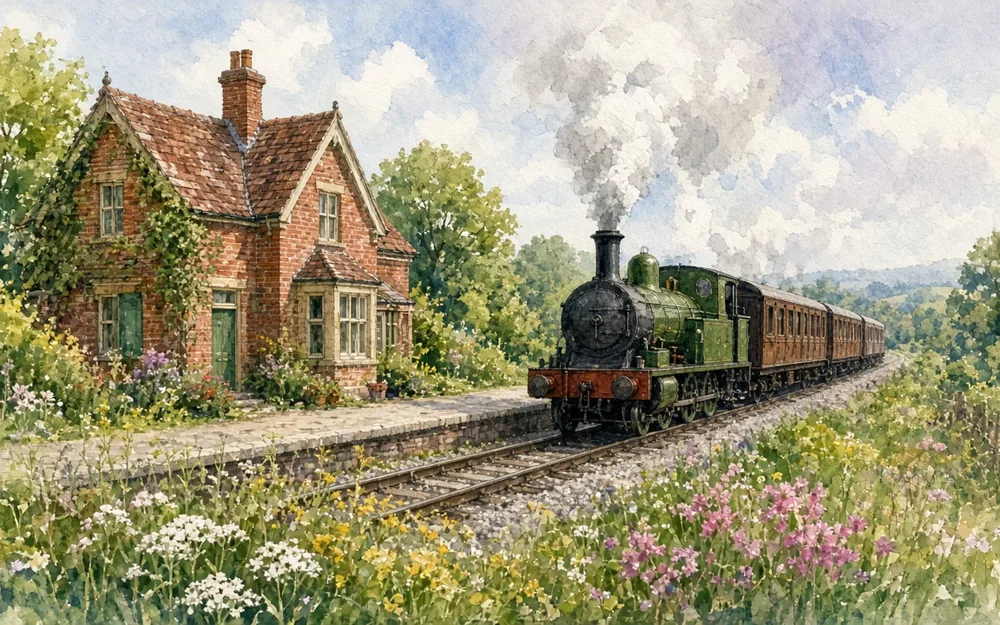
A quiet country line, the kind beside which the railway children make their home. Image generated by AI.
Murder on the Orient Express by Agatha Christie (1934)
A luxury train crossing Europe in winter is stopped by a snowdrift in the middle of the night. By morning, one of the passengers has been found dead in his compartment, and the famous Belgian detective Hercule Poirot happens to be on board. With no way off the train and no police nearby, Poirot interviews a carriage full of travellers from many countries and walks of life, each with an answer for everything.
Christie makes brilliant use of the setting. The train is both glamorous and claustrophobic, and the snow seals the suspects in with the reader. The solution is one of the most talked-about in crime fiction, so if you have somehow avoided hearing it, guard that luck carefully. It is a short, elegant novel and a classic of the golden age of detective fiction.
Night on the Galactic Railroad by Kenji Miyazawa (written around 1927)
On the night of a star festival, Giovanni, a lonely boy from a poor family, lies on a hill looking at the Milky Way. Suddenly he finds himself aboard a train travelling through the stars, with his friend Campanella sitting beside him. Their journey takes them past glowing riverbanks of light, strange stations and fellow passengers with their own stories, in a world that is at once beautiful and a little melancholy.
Kenji Miyazawa, a poet, teacher and agricultural scientist from northern Japan, worked on the story for years and left several versions when he died in 1933. It was published after his death, in 1934, and has since become one of the best-loved works of Japanese children’s literature, adapted into a much-admired 1985 animated film. It is short and dreamlike, and it gently asks what true happiness is and what we owe to one another. Read it slowly, perhaps on a clear night.

A train among the stars, in the spirit of Miyazawa’s dreamlike journey. Image generated by AI.
The Great Railway Bazaar by Paul Theroux (1975)
In 1973 the American writer Paul Theroux set off from London on a four-month journey by train across Europe, the Middle East, the Indian subcontinent and Southeast Asia, travelling as far as Japan before returning home on the Trans-Siberian Railway. The Great Railway Bazaar is his account of the trip, told carriage by carriage through the people he met, the meals he ate and the landscapes he watched from the window.
The book is widely regarded as a classic of modern travel writing, and it sold strongly on publication. Theroux’s voice is sharp, curious and sometimes prickly; he can be blunt about places and people, and some passages reflect the attitudes of their time. Yet his love of trains, and of the slow, sociable travel they allow, shines through on every page. It is the non-fiction pick on this list, and an ideal book for anyone who daydreams about long rail routes.
Night Train to Lisbon by Pascal Mercier (2004)
Raimund Gregorius is a quiet, precise teacher of classical languages at a school in Bern, Switzerland, whose life has run along the same tracks for decades. One rainy morning, a brief encounter with a stranger and a chance discovery of a book by a Portuguese doctor, Amadeu de Prado, unsettle him so deeply that he walks out of his classroom and boards a night train to Lisbon. There he begins to piece together the life of the author, who lived through the years of António de Oliveira Salazar’s dictatorship.
First published in German as Nachtzug nach Lissabon and in English in 2008, the novel became an international bestseller and was adapted into a 2013 film. Pascal Mercier is the pen name of the Swiss philosopher Peter Bieri, and the book is as much about ideas as events: memory, loyalty, courage and the lives we might have led. It is the most reflective book on this list, best enjoyed slowly with a pot of tea.
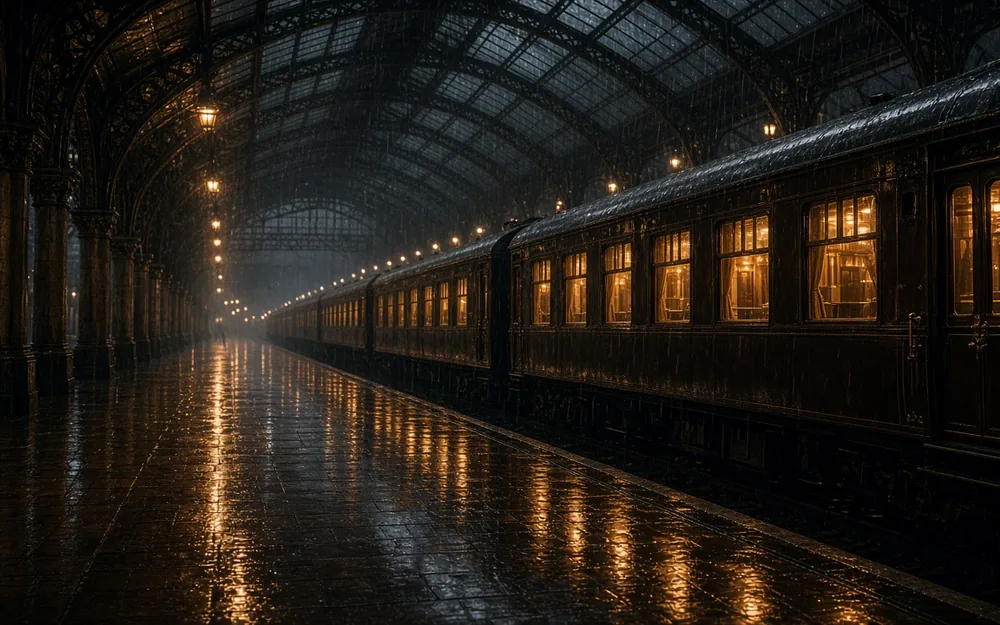
Night trains still carry travellers, and readers, towards new chapters. Image generated by AI.
How to choose your first book about train journeys
If you want something warm and short, begin with The Railway Children or Night on the Galactic Railroad; both can be read in an evening or two and suit readers of any age. For a puzzle to solve by the fire, Murder on the Orient Express is hard to beat. If real journeys appeal more than invented ones, The Great Railway Bazaar will carry you halfway around the world. And if you are in the mood for something thoughtful that lingers after the last page, choose Night Train to Lisbon.
Whichever you pick, these books share the quiet magic of rail travel: the sense that between one station and the next, almost anything can change.
Related reading
For more journeys in fiction, read our Around the World in Eighty Days review. And for more cold-weather comfort, see our list of books set in winter.
Sources
- The Railway Children by E. Nesbit, free public-domain text (Project Gutenberg)
- The Railway Children: publication and adaptations (Wikipedia)
- Murder on the Orient Express: background and publication (Wikipedia)
- Night on the Galactic Railroad: writing, publication and adaptations (Wikipedia)
- The Great Railway Bazaar: the 1973 journey and reception (Wikipedia)
- Night Train to Lisbon: publication and film adaptation (Wikipedia)










0 Comments