

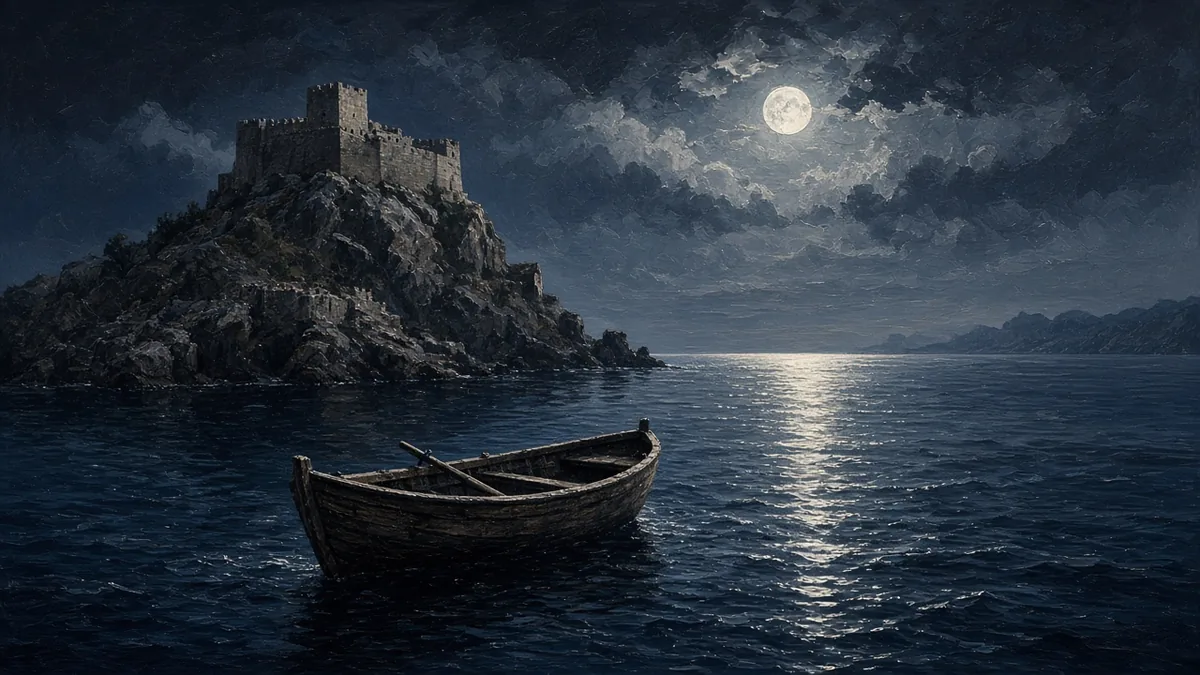
A TeaLamp book review of The Count of Monte Cristo by Alexandre Dumas (serialised 1844–1846), written in our own words. Prepared by the TeaLamp Editorial Team with the help of AI.
This Count of Monte Cristo review looks at one of the great page-turners of world literature: the story of a young sailor betrayed on the happiest day of his life, buried alive in an island fortress, and reborn years later as a mysterious nobleman with a fortune and a plan. Alexandre Dumas first published it in instalments in the Paris newspaper Journal des Débats between 1844 and 1846, and readers have been staying up late with it ever since. It is long, but it rarely feels slow. Here is what the book is about, what makes it work, the questions it raises about justice, and who will enjoy it most.
Key takeaways from our Count of Monte Cristo review
- A French adventure novel by Alexandre Dumas, written with his collaborator Auguste Maquet and serialised from 1844 to 1846.
- It follows Edmond Dantès, a young merchant sailor from Marseille who is falsely accused, imprisoned without trial and, after a daring escape, returns as the wealthy Count of Monte Cristo.
- It is a revenge story, but also a long reflection on justice, patience, forgiveness and the limits of any one person’s power.
- Its structure, built for newspaper readers, is full of cliffhangers, disguises, hidden identities and surprising reunions.
- Best for readers who love big, absorbing stories, and who are happy to settle in with a long book over several weeks.
What the book is about
The story opens in Marseille in 1815. Edmond Dantès, nineteen years old, brings his ship safely home after its captain dies at sea, and the owner, the kindly Monsieur Morrel, plans to make him captain. Dantès is also about to marry Mercédès, the woman he loves. Everything seems to be going right, and that is the problem. Several men around him have reasons to resent his luck: Danglars, a jealous shipmate who wants the captaincy; Fernand, a fisherman who loves Mercédès; and Caderousse, a neighbour who watches and says nothing.
An anonymous letter accuses Dantès of carrying a message for the exiled Napoleon. The case lands with Villefort, an ambitious deputy prosecutor, who quickly realises that the letter could ruin his own career because of whom it is addressed to. To protect himself, he makes the problem disappear, and Dantès with it. Without a trial, the young sailor is locked away in the Château d’If, a grim fortress on a rocky island off Marseille.
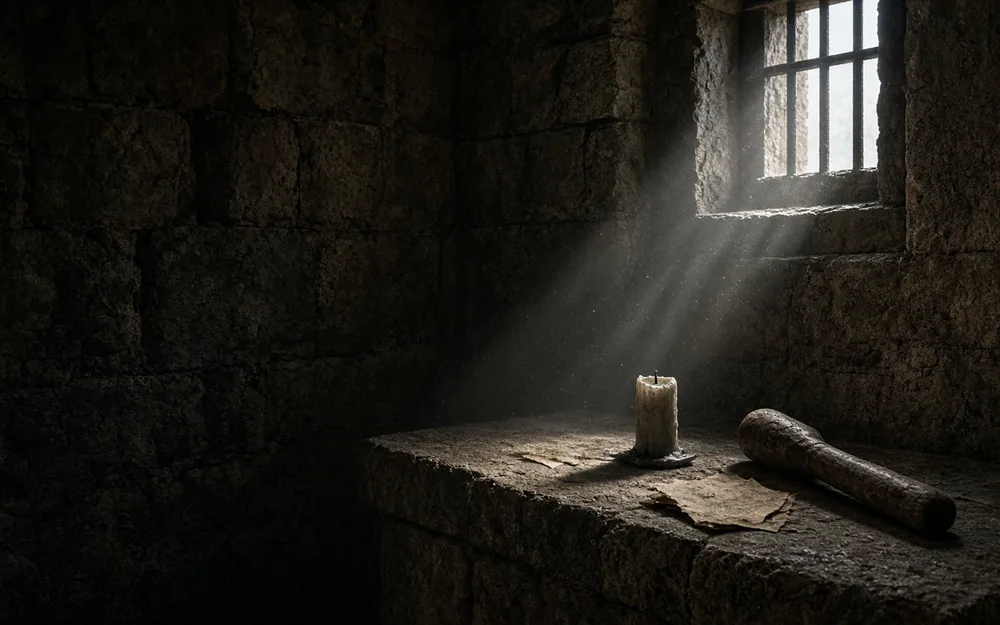
A cell in an island fortress, where Edmond Dantès spends his lost years. Image generated by AI.
The prison years and the escape
The prison chapters are among the most memorable in the book. Alone and close to despair, Dantès hears scratching in the wall one day. It belongs to the Abbé Faria, an elderly Italian prisoner digging a tunnel that has gone the wrong way. The two become friends, and Faria becomes his teacher, sharing languages, history, science and a way of thinking. He also helps Dantès work out, step by step, who betrayed him and why.
Faria has one more secret: the location of a vast hidden treasure on the small island of Monte Cristo. After many years in captivity, a desperate gamble gives Dantès his chance to escape, and the scene is one of the most famous in adventure fiction. We will not spoil the details, but it is a moment of pure suspense that shows Dumas at his very best.
A second life and a long plan
Free at last, Dantès finds the treasure and disappears. When he returns to the world, he does so under new names, most famously as the Count of Monte Cristo: elegant, learned, unimaginably rich and impossible to read. He first finds ways to repay those who were kind to him, especially the Morrel family. Then he turns to the men who destroyed his life, each of whom has risen high in Paris society in the years he was away.
The middle of the novel is a slow, intricate unfolding of his plan. Dumas moves between drawing rooms, banks, courtrooms and country houses, and gradually reveals how each enemy’s success rests on a hidden wrong. The pleasure for the reader lies in watching the pieces fall into place, often long after Dumas has quietly set them up. Along the way we meet a large cast, including young lovers, a fierce old man who can communicate only with his eyes, and Haydée, a young woman with her own story of betrayal.

A lonely island, keeper of a hidden treasure. Image generated by AI.
Revenge, justice and their limits
It would be easy to read the book as a simple fantasy of getting even, and part of its appeal is exactly that. Yet Dumas is more thoughtful than that. As the count’s plans unfold, innocent people are caught up in them, and he is forced to ask whether he is acting as an instrument of justice or simply taking the place of the men he condemns. The question is never answered in a neat sentence. Instead, the novel lets the consequences speak, and the final chapters lean towards mercy, hope and the possibility of starting again.
That shift is what lifts the book above many revenge stories. Dantès begins as a trusting young man, becomes a figure of almost supernatural control, and ends as someone who has learned something about the limits of that control. The famous closing advice of the novel, roughly “wait and hope”, sums up its deeper message: patience and trust in the future matter more than settling every score.
How it reads today
Because it was written for newspaper readers, the book is built to keep you turning pages. Chapters often end on a twist, and Dumas loves disguises, secret passages, poison, buried letters and dramatic revelations. Some readers find the middle section, with its many characters and subplots, a little crowded, and the full text runs to well over a thousand pages in most editions. The reward for patience is real, though, because almost every thread pays off.
A few practical notes help. Unabridged versions are best if you want the full richness of the plot, but they are a commitment; abridged editions exist for younger or busier readers, though they lose some of the subtlety. Robin Buss’s 1996 translation for Penguin Classics is often recommended, and an older public-domain translation is free to read online. Many readers enjoy taking it slowly, a few chapters each evening with a pot of tea, much as its first readers waited for the next instalment.

The glittering Paris salons where the count sets his plan in motion. Image generated by AI.
Who will enjoy The Count of Monte Cristo
This novel suits anyone who enjoys a big, immersive story with a strong central character, from fans of historical fiction and thrillers to readers who love long nineteenth-century novels. It works especially well for people who like slowly unfolding plans and the satisfaction of seeing small details matter later. Readers who prefer short books or spare, modern prose may want to begin with an abridged edition, or with Dumas’s more compact adventure The Three Musketeers.
It is also a fine choice for a shared read, because there is always something to talk about: whether the count goes too far, which character you would trust, and how you would have used a fortune like his.
Why it matters
The Count of Monte Cristo was a sensation in its own day and has never gone out of print. It has been adapted for the stage, radio, television and film many times, including a lavish French film released in 2024 that introduced the story to a new generation. Its outline, the wronged innocent who returns transformed to confront those who betrayed him, has shaped countless later stories. Dumas himself, the grandson of a French nobleman and an enslaved woman from Saint-Domingue (now Haiti), and son of a celebrated general, became one of the most widely read French writers in the world. Above all, the novel lasts because it combines the thrill of a great adventure with a serious question that never goes out of date: what do we owe to justice, and what do we owe to mercy?
Related reading
For another great nineteenth-century adventure from France, read our Around the World in Eighty Days review. And for a very different story of ambition and second chances, see our Great Expectations review.
Sources
- The Count of Monte Cristo, free public-domain English translation (Project Gutenberg)
- The Count of Monte Cristo: publication, plot and adaptations (Wikipedia)
- Alexandre Dumas: life and works (Wikipedia)
- Château d’If: history of the island fortress (Wikipedia)










0 Comments