

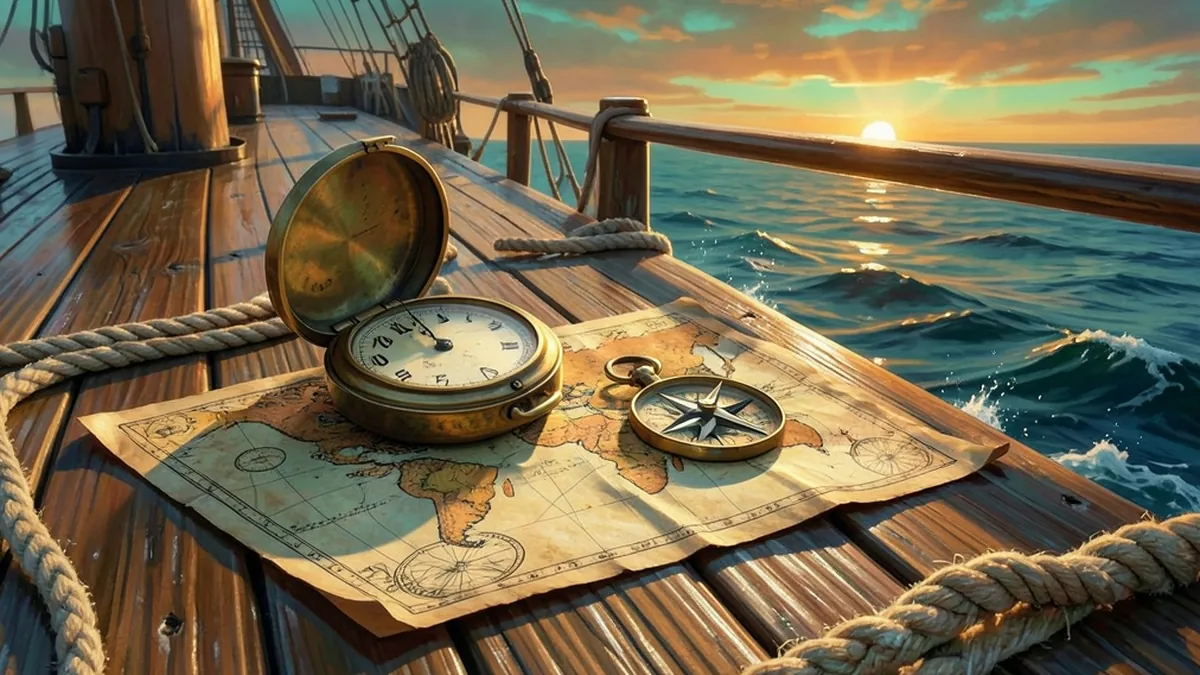
A TeaLamp book review of Around the World in Eighty Days by Jules Verne (1872), written in our own words. Prepared by the TeaLamp Editorial Team with the help of AI.
This Eighty Days review looks at one of the great travel stories of all time: a calm English gentleman bets half his fortune that he can circle the globe in eighty days, then sets off that same evening with a new French servant and a bag full of banknotes. Jules Verne’s novel first appeared in 1872, when the idea was brand new and almost possible. More than 150 years later, it still reads like a lively race against the clock. Here is what the book does, why it has lasted, and who will enjoy it most.
Key takeaways from our Eighty Days review
- An adventure novel by the French writer Jules Verne, serialised in the Paris newspaper Le Temps from November 6, 1872, and published as a book soon after.
- Phileas Fogg, a wealthy and very precise Londoner, wagers £20,000 at the Reform Club that he can travel around the world in eighty days, with his valet Passepartout at his side.
- The book is a fast, funny relay of trains, steamships and surprises, with a detective on their trail and a famous twist at the very end.
- It is best for readers who enjoy brisk plots, gentle humour and armchair travel more than deep psychological drama.
A story born from new railways and canals
Verne did not invent the idea of a quick trip around the world out of thin air. Three real changes made it thinkable. In 1869 the first transcontinental railroad across the United States was completed and the Suez Canal opened, cutting the sea route between Europe and Asia. In 1870 the railways across India were linked up. For the first time, an ordinary traveller with a timetable and enough money could, at least on paper, buy tickets for a journey that once belonged only to explorers.
Verne turned that possibility into a story. He was going through a hard time when he wrote it, after the Franco-Prussian War, money worries and the recent death of his father, yet the book is one of his most playful. It ran in Le Temps in daily instalments, and the newspaper timed the ending so that Fogg’s deadline of December 21 matched the real calendar. Some readers reportedly believed the journey was actually happening and placed bets on the outcome.
What happens in Around the World in Eighty Days (without spoilers)
The story opens in London on October 2, 1872. Phileas Fogg lives by the clock: he eats at the same table, plays whist at the same hour and has just dismissed a servant for bringing shaving water two degrees too cold. That evening, an argument at his club about a newspaper article ends with Fogg betting £20,000 that he can go around the world in eighty days. He leaves the same night with Jean Passepartout, a cheerful Frenchman who had hoped for a quiet job.
From there the book becomes a chain of connections. There are steamers to Suez and Bombay, a railway line in India that turns out to be unfinished, and a ride on an elephant through the forest. Along the way the travellers rescue a young widow named Aouda, who joins them. There are storms off the coast of China, a train across the American West and a dash across the Atlantic. All the while, Detective Fix of Scotland Yard follows them, convinced that Fogg is a bank robber on the run. We will not tell you whether Fogg makes it, or how.

A steam train crosses a canyon trestle, the kind of railway that made a trip around the world thinkable in 1869. Image generated by AI.
Phileas Fogg and Passepartout: an odd couple on the move
Much of the book’s charm comes from its two main characters. Fogg is almost a machine at first. He rarely shows feeling, never seems to look at the countries he passes through and treats every delay as a sum to be solved. Verne has fun with this: while the world rushes past the window, Fogg plays cards.
Passepartout is his opposite. He is curious, warm-hearted and easily distracted, and he gets into most of the book’s scrapes, from a misadventure in a temple in Bombay to an unexpected career as a circus acrobat in Japan. Readers often find that he is the true heart of the story. Watching the two men slowly come to trust each other, and watching Fogg reveal a generous and even brave side, is one of the quiet pleasures of the book.
Speed, money and the thrill of the timetable
Around the World in Eighty Days is, at heart, a book about time. Every chapter seems to end with a missed connection, a late ship or a broken bridge, and the reader keeps a running count of the days alongside Fogg. Verne makes the timetable itself exciting, which is no small feat.
The book is also frank about money. Fogg solves many problems by simply paying for them, whether that means buying an elephant or hiring a whole ship. Modern readers may smile at how far a fat wallet goes, but it adds to the comedy. Verne seems to enjoy the idea that a man who never spends anything at home will spend almost everything once he is on the road.

An elephant on a forest path, a nod to the unplanned elephant ride across India in the novel. Image generated by AI.
A window on the Victorian world
Verne packs in facts about ports, railways, currencies and customs, in the encyclopedic style that runs through his series of “extraordinary voyages”. For readers today, this makes the novel a kind of time capsule of how a European writer imagined the world in the 1870s. Some of its descriptions of other cultures reflect the attitudes of its time and can feel dated or simplified. The book works best for readers who are happy to treat it as a period piece and enjoy the adventure on those terms. Parents reading it with children may want to talk through those passages together.
The famous twist, and why it works
The novel ends with one of the best-known surprises in popular fiction, and it rests on a simple piece of science: the way time changes as you travel around the planet. We will not spell it out here, but it is worth knowing that scholars still debate whether a man as exact as Fogg would really have missed it. That debate is part of the fun. Even readers who know the ending tend to enjoy watching Verne set it up.
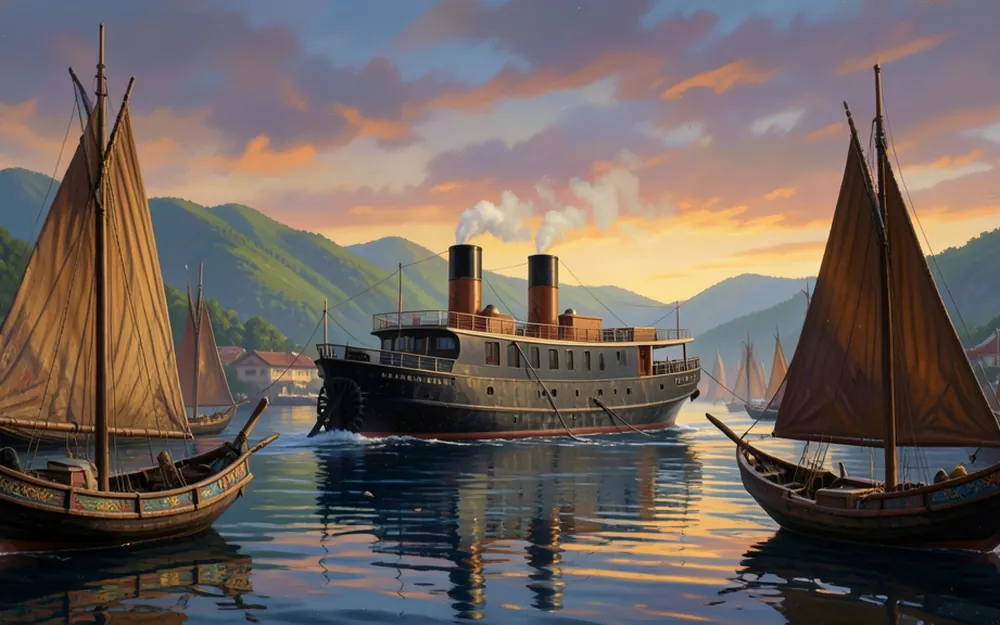
A paddle steamer leaving an Asian harbour, like the ships Fogg races to catch. Image generated by AI.
Real travellers who raced Phileas Fogg
The book inspired real journeys almost at once. In 1889 the American journalist Nellie Bly set out from New York to beat Fogg’s fictional record for her newspaper, the New York World. She completed the trip in about 72 days and even stopped in Amiens, France, to meet Verne himself on the way. A rival reporter, Elizabeth Bisland, raced her in the opposite direction and finished in around 76 days. The novel had turned a daydream into a real challenge.
Who will enjoy this book most
This is an easy book to recommend widely, but it fits some readers especially well:
- Armchair travellers who love maps, trains and ships, and enjoy following a route across the world.
- Families and young readers from about ten upward, especially in a good modern translation, since the chapters are short and the plot never stands still.
- Readers who prefer light, brisk storytelling to long descriptions of inner feelings. Verne’s characters are drawn with quick strokes, and the pleasure lies in the race.
- Anyone curious about the 1870s, when steam power and telegraph lines were making the world feel smaller for the first time.
Readers looking for rich emotional depth or modern views on travel may find it lighter than they expect. For a cozy weekend of adventure, though, it is hard to beat. The text is in the public domain, so English translations are easy to find, including free ones from Project Gutenberg.
Why it matters
Around the World in Eighty Days captured a turning point: the moment when the whole planet first seemed reachable within a season. It helped make global travel feel exciting rather than frightening, and it has been adapted for stage, film, radio and television ever since. Its title has become a common phrase for any race against time. Underneath the speed is a gentle message that still lands: Fogg sets out to win a bet and comes home having found friendship, which turns out to be worth more than the money.
Related reading
If you enjoy Verne’s seafaring side, see our list of five sea stories for stormy nights, which includes his Twenty Thousand Leagues Under the Seas. For another classic adventure across the waves, read our Treasure Island summary.
Frequently asked questions
Is there a hot-air balloon in the book?
No. The balloon many people remember comes from later film adaptations, especially the 1956 movie. In the novel, Fogg travels by train, steamship, elephant and even a sledge with sails, but never by balloon.
What age is Around the World in Eighty Days suitable for?
Many children enjoy it from about ten, and it works well as a family read-aloud. There is some peril and a few tense rescues, but no graphic violence. Some period attitudes are worth discussing with younger readers.
Which translation should I read?
The book was written in French, and several English translations exist. Older translations are free online; newer ones tend to read more smoothly and often include helpful notes on places and history.
Sources
- Around the World in Eighty Days: background, serialisation and real-life imitations (Wikipedia)
- Jules Verne: life and the Voyages extraordinaires (Wikipedia)
- Nellie Bly and her 72-day trip around the world (Wikipedia)
- Around the World in Eighty Days, free public-domain English text (Project Gutenberg)









0 Comments