

An original TeaLamp book summary of Jane Austen’s novel Pride and Prejudice (1813), which is in the public domain. Short quotations are taken from the Project Gutenberg edition of Pride and Prejudice. Prepared by the TeaLamp Editorial Team with the help of AI.
This Pride and Prejudice summary walks you through Jane Austen’s best-loved novel in about eight minutes: the story, the people, the big ideas and why readers still fall for it more than two centuries later. Pour a cup of tea, and let’s visit the Bennet family of Longbourn.
Key takeaways from this Pride and Prejudice summary
- The novel follows Elizabeth Bennet, a quick-witted young woman, and the proud, wealthy Mr Darcy, who misjudge each other badly before learning to see clearly.
- Both title faults belong to both lovers: Darcy starts out proud, Elizabeth prejudiced, and each has to change.
- Behind the romance sits a sharp look at money and marriage in an age when most women could not inherit or earn a living.
- Austen tells the story with gentle irony, letting us see the world through Elizabeth’s eyes while quietly showing where she gets it wrong.
- The book is a comedy at heart: warm, funny and hopeful about people’s ability to grow.
The book at a glance
Austen drafted the story in her early twenties under the title “First Impressions” and reworked it for years before it appeared in January 1813. It was published anonymously, credited only to “the Author of Sense and Sensibility”, her first novel. The book came out in three volumes and runs to 61 short chapters. It is set among the country gentry of Hertfordshire, with important visits to Kent and Derbyshire, and it famously opens with one of the most quoted lines in English fiction: “It is a truth universally acknowledged, that a single man in possession of a good fortune must be in want of a wife.”
That opening is a joke, and a clever one. The “truth” is really what the neighbours want to believe, and the rest of the novel tests what people assume about wealth, rank and love.
Volume one: first impressions
Mr and Mrs Bennet have five daughters and a problem. Their estate is “entailed”, meaning it can pass only to a male heir, so when Mr Bennet dies it will go to a distant cousin, the clergyman Mr Collins. Mrs Bennet’s mission in life is therefore to see her girls married, and quickly.
Hope arrives when a rich young man, Mr Bingley, rents the nearby house of Netherfield. At a local ball he is charmed by Jane, the eldest and gentlest Bennet sister. His friend Mr Darcy, who is even richer, is another story. He refuses to dance, and Elizabeth overhears as Darcy says: “She is tolerable: but not handsome enough to tempt me.” Elizabeth laughs about it with her friends, but the remark stings, and her opinion of Darcy is fixed.
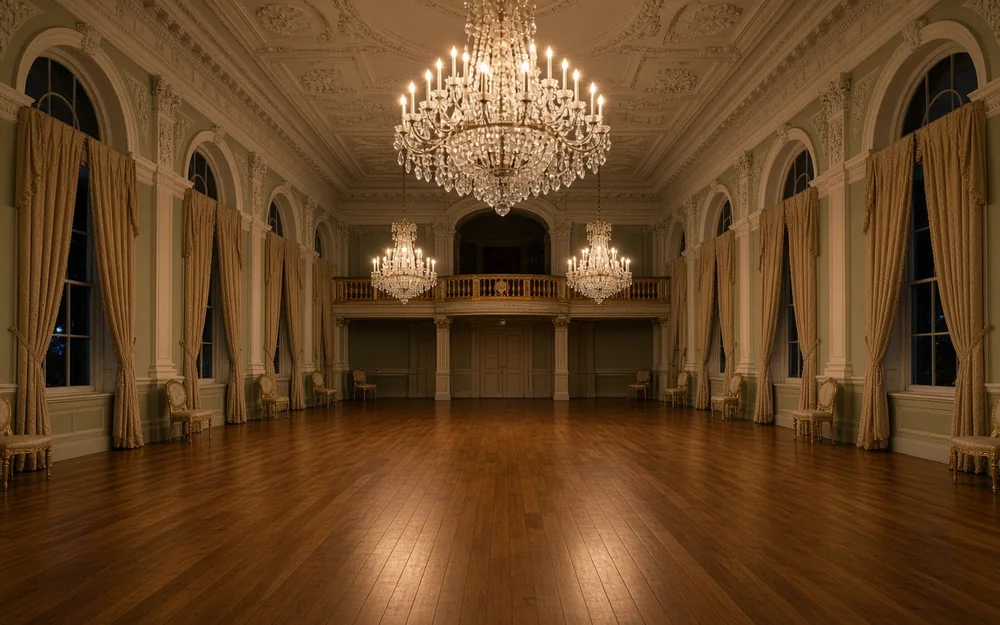
A country assembly room, where first impressions are made. Image generated by AI.
Darcy, meanwhile, soon finds himself drawn to Elizabeth’s fine eyes and lively mind. She notices none of it. Instead she is charmed by George Wickham, a handsome young officer who tells her that Darcy cheated him out of an inheritance. The story fits her first impression perfectly, so she believes it without question.
Then Mr Collins visits, pompous and eager to please his patroness, Lady Catherine de Bourgh. He proposes to Elizabeth, who turns him down. Mrs Bennet is furious, but her husband sides with his favourite daughter in one of the book’s funniest moments, as Mr Bennet tells her: “An unhappy alternative is before you, Elizabeth. From this day you must be a stranger to one of your parents. Your mother will never see you again if you do not marry Mr. Collins, and I will never see you again if you do.” Days later, Elizabeth’s practical friend Charlotte Lucas accepts Mr Collins herself, for the security he offers. At the same time, Bingley leaves Netherfield suddenly, and Jane is left heartbroken.
Volume two: a proposal and a letter
In spring, Elizabeth visits Charlotte in Kent, near Lady Catherine’s grand house, Rosings. Darcy, who is Lady Catherine’s nephew, turns up too. Elizabeth learns from his cousin that Darcy recently “saved” a friend from an unwise marriage, and she realises he means Bingley and Jane.
Just then, Darcy calls on her alone and proposes. Darcy says passionately: “In vain have I struggled. It will not do. My feelings will not be repressed. You must allow me to tell you how ardently I admire and love you.” But he also dwells on how far beneath him her family is. Elizabeth refuses him, and angrily lists her reasons: Jane, Wickham and his own arrogance.
The next morning Darcy hands her a long letter. In it he explains that he truly believed Jane did not return Bingley’s feelings, and he tells the real story of Wickham, who had wasted his inheritance and tried to elope with Darcy’s fifteen-year-old sister, Georgiana, for her fortune. Elizabeth reads the letter again and again. Slowly she sees that she has been blind, flattered by Wickham’s attention and hurt by Darcy’s slight. Honest and pained, Elizabeth tells herself: “Till this moment, I never knew myself.”
Volume three: Pemberley and a family crisis
That summer, Elizabeth tours Derbyshire with her kind aunt and uncle, the Gardiners, and they visit Darcy’s estate, Pemberley, believing him away. The housekeeper praises him as a generous master and brother. Then Darcy arrives unexpectedly, and he is changed: polite, warm and eager to meet her relatives, the very people he once looked down on.
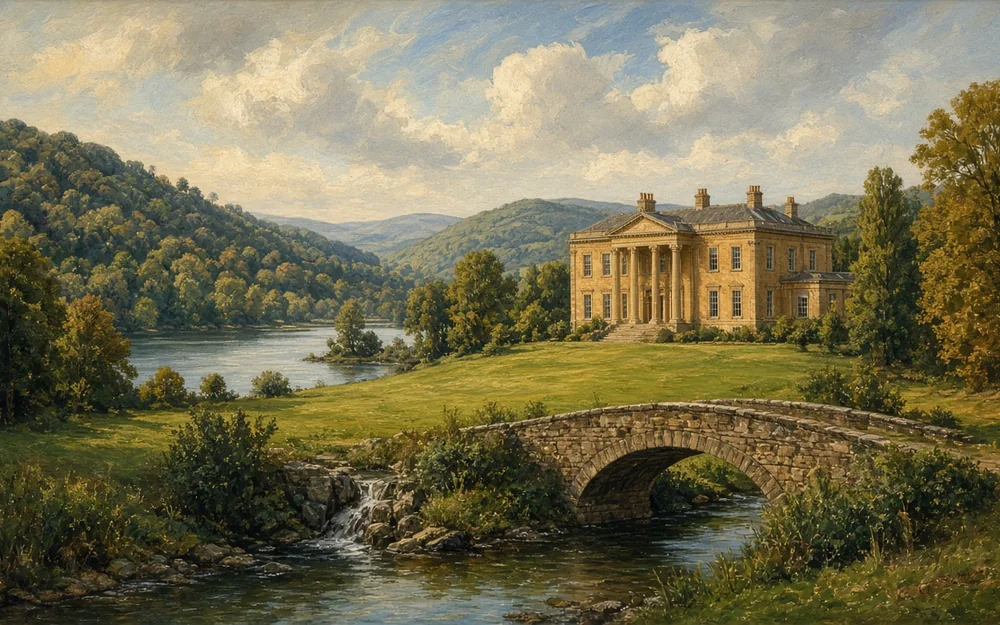
A great house beside a lake, like Pemberley in Derbyshire. Image generated by AI.
The new mood is broken by terrible news. Elizabeth’s youngest sister, Lydia, still in her teens and thoughtless, has run off with Wickham, who has no plans to marry her. In that society, the scandal could ruin the whole family’s prospects. Soon, though, word comes that the couple are married after all. Elizabeth later learns that it was Darcy who found them, paid Wickham’s debts and arranged the wedding, and that he asked for no credit.
Bingley returns and proposes to Jane, who accepts with joy. Lady Catherine storms into Longbourn to forbid any engagement between Elizabeth and her nephew. Elizabeth politely refuses to promise anything. When Darcy hears of it, he dares to hope, and asks again. This time, two people who have each learned something about themselves say yes.
Key ideas in Pride and Prejudice
Pride and prejudice cut both ways
It is tempting to say Darcy is the proud one and Elizabeth the prejudiced one, but the novel is subtler. Darcy is prejudiced against the Bennets’ manners and connections, and Elizabeth is proud of her own judgement. In an early chapter her serious sister Mary says: “Vanity and pride are different things, though the words are often used synonymously.” The happy ending only comes once both characters admit their mistakes.
Money, marriage and women’s choices
Austen never forgets that marriage was also an economic question. Charlotte marries Mr Collins for a home; Lydia nearly loses everything; Mrs Bennet’s nerves are partly a fear of poverty. The novel asks readers to take these pressures seriously while hoping, through Elizabeth and Jane, for marriages built on respect and real affection.
Learning to read people
Much of the plot turns on reading character from appearances: a cold manner, a charming smile, a story told at a party. Darcy’s letter is the turning point because it forces Elizabeth to look at evidence instead of impressions. It is one reason the novel feels so modern.
Family, for better and worse
The Bennets are loving but chaotic. Mr Bennet’s wit hides a habit of not getting involved, and his neglect partly explains Lydia’s crisis. By contrast, the sensible Gardiners show what steady family support can look like.
How Austen tells the story
Austen writes mostly from Elizabeth’s point of view, slipping in and out of her thoughts in a style critics call free indirect speech. We share her jokes and her certainty, so when the letter arrives we are as surprised as she is. The dialogue is quick and sparkling, the comic characters, from Mr Collins to Lady Catherine, are drawn with affection as well as satire, and the narrator’s quiet irony keeps the romance from ever becoming syrupy.
Why it matters
Pride and Prejudice has never been out of print, and it has inspired countless adaptations, retellings and modern romances, from television series to novels set in other countries and times. Its secret is simple: it shows two intelligent people changing their minds. That makes it a love story, a comedy of manners and a gentle lesson in humility all at once, and it rewards rereading at every age.
Related reading
For another look at the people behind famous books, read Typing for Love or Money: the hidden women’s labour behind modern literary masterpieces. You can read the full novel free in the Project Gutenberg edition of Pride and Prejudice.
Frequently asked questions
What is Pride and Prejudice mainly about?
It is about Elizabeth Bennet and Mr Darcy, who dislike each other at first because of hasty judgements, and who come to love and respect each other once they recognise their own faults.
Why is the novel called Pride and Prejudice?
The title names the two faults that keep the lovers apart: Darcy’s pride in his rank and Elizabeth’s quick prejudice against him. Each character shows a bit of both.
Is Pride and Prejudice hard to read today?
The sentences are longer than in modern novels, but the chapters are short, the dialogue is lively and the humour still lands. Many readers find it easier than they expect after the first few chapters.








0 Comments