


An original TeaLamp explainer based on the sources listed below. Prepared by the TeaLamp Editorial Team with the help of AI.
If you want to sleep more deeply, the question may not be how hard you exercise, but how often. A new study from the University of Texas at Austin found that young adults who spread movement across the week — even just ten minutes a day — spent more of the night in the deep, restorative stages of sleep. The link between exercise and sleep, it turns out, may depend on frequency as much as effort.
Key takeaways on exercise and sleep
- More days with at least ten minutes of moderate-to-vigorous activity were linked to more deep, non-REM sleep in the first three hours of the night.
- How activity was spread across the week mattered more than the total amount of exercise.
- Light movement — walking, standing breaks — was also linked to healthier sleep patterns and better next-day mood and energy.
- The study was observational, so it shows associations, not proof that daily movement causes better sleep.
- The research team is now testing the pattern in a larger, more diverse five-year study.
What the researchers actually did
The study, published in the Journal of Physical Activity & Health in 2025, followed 69 adults with an average age of 21.5. Each wore a wrist-mounted fitness tracker for two data-collection periods spanning eight months in total, under ordinary living conditions — not in a sleep lab. Along the way, participants answered short surveys three times a week about their energy, stress, contentment and sleep quality.
Led by Chris Corral with research assistant professor Benjamin Baird, the team asked a question most earlier studies had skipped. Previous work had focused on how much people exercise. This team wanted to know whether the number of days someone moves makes a difference to how they sleep.
“We wanted to know whether it matters if someone spreads out their exercise over the week versus doing it all at once, like a ‘weekend warrior,’” Baird said. “And for sleep health, frequency does seem to matter.”
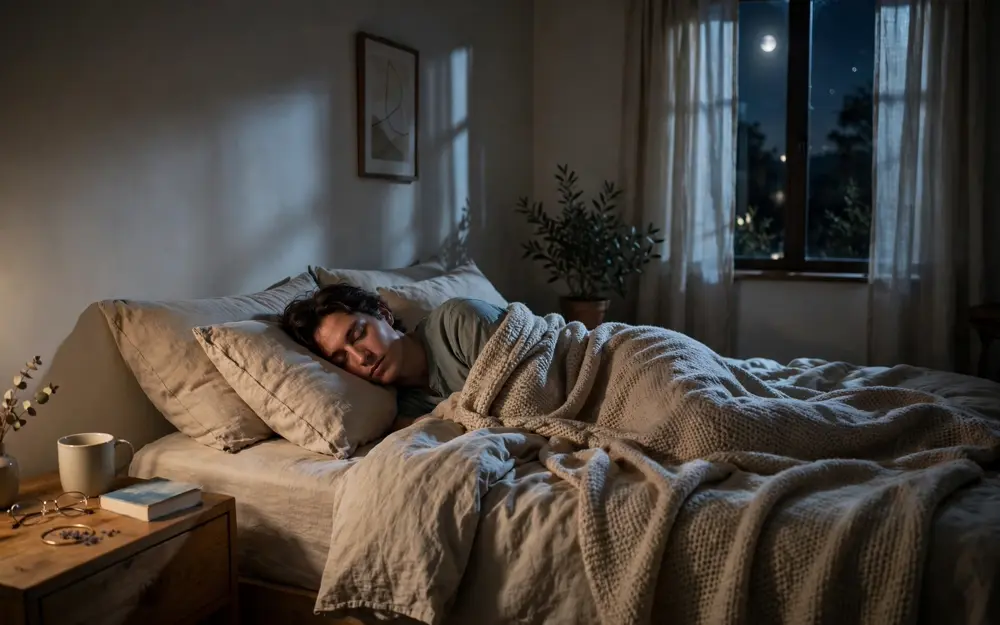
Deep, restorative sleep was the key outcome linked to daily movement. Image generated by AI.
Why frequency may beat the weekend warrior
The clearest result concerned the first 180 minutes of sleep — the early part of the night when the body does most of its physical recovery. Participants who logged more days with at least ten minutes of moderate-to-vigorous activity within a five-day window showed a lower ratio of REM to non-REM sleep in that window. In plain terms: proportionally more of their early-night sleep was the deep, non-REM kind.
That detail matters because deep sleep is when the brain strengthens memories, clears waste products built up during the day and steadies emotional regulation. “Better sleep means better brain health and potentially lower risks of chronic disease and depression,” Corral said.
Current guidance from public-health bodies calls for around 150 minutes of moderate activity a week, with no requirement to spread it evenly. Many people meet the target with long weekend sessions. These findings suggest the daily-movement pattern may carry an extra sleep benefit — though the authors caution that more research is needed to compare equal amounts of exercise done daily versus all at once.
How little is enough?
One of the most encouraging findings was the small dose involved: ten minutes a day of moderate-to-vigorous activity. That level of effort does not mean an exhausting workout. The researchers describe it as breathing harder than usual while still being able to hold a conversation — about a six out of ten on an effort scale. A brisk walk, an easy bike ride or dancing in the kitchen all qualify.
“You don’t need to run marathons,” Corral said. “Just moving a little each day helps. Light activity counts too. Doing something is better than doing nothing.”
Light movement counts too
The gentler end of the scale held up as well. Total light-intensity activity was linked to the same deep-sleep effect, and to higher energy the next morning. Zooming in further, the researchers found that within a single day, the more hours that contained at least three minutes of light activity — a short walk, getting up from the desk — the more total sleep and the more deep sleep in the first six hours of the night. Hours with at least three minutes of harder activity were linked instead to feeling more content the next morning.
The next-day effects went beyond the night itself. Participants who moved more regularly tended to feel more energetic and less stressed the following day. “We saw that more non-REM sleep was tied to better next-day mood and energy,” Baird noted.

Short walks and standing breaks counted too. Image generated by AI.
What this does not prove
A few honest limits. The study was observational: it found associations between movement patterns and sleep, but it cannot prove that exercising more often causes better sleep. The participants were young university students, so the pattern may not hold for older adults or people with very different routines — which is exactly what the team’s planned five-year study in a larger, more diverse group aims to test. And wrist trackers estimate sleep stages rather than measuring them the way a lab does.
Still, the direction of the evidence is consistent: across months of everyday life, the people who moved a little most days slept more deeply than those who saved it all for the weekend.
Why it matters
Sleep advice usually comes as a list of things to avoid — screens, caffeine, late nights. This study points to something to add instead: a short daily dose of movement. Ten minutes is small enough to fit between meetings, and unlike a strict training plan, it survives busy weeks. If frequency really is a lever for deeper sleep, it is one almost anyone can pull.
Related reading
Your bedroom plays its own role in the night: read how room temperature sets the stage for sleep.
Frequently asked questions
Is ten minutes of exercise really enough to matter?
In this study, yes — ten minutes of moderate-to-vigorous activity per day was the threshold linked to deeper sleep. The researchers stress it is an association, not a prescription, and that any amount of movement beat none.
Does it matter what time of day I exercise?
This study did not test exercise timing, only frequency and intensity. Earlier research on late-night vigorous exercise and sleep is mixed, so if evening workouts keep you wired, mornings or afternoons are the safer bet.
Do I need a fitness tracker to benefit?
No. The trackers were the researchers’ measuring tool, not the intervention. The takeaway is behavioural: build short movement into most days, whether or not anything counts it.
Should public-health guidelines change?
Not yet. “Current guidelines don’t reflect the importance of frequency for sleep health,” Baird said — but he frames the study as a starting point for that conversation, pending confirmation in larger groups.
Sources
- Corral CJ et al., “Physical Activity Frequency Patterns Influence Sleep Architecture in Young Adults,” Journal of Physical Activity & Health 22(8):1042–1050 (2025), DOI 10.1123/jpah.2024-0844 (abstract via PubMed, PMID 40615118).
- “Just 10 minutes of daily exercise could unlock deeper sleep,” University of Texas at Austin via ScienceDaily, October 8, 2026.
- “10 minutes daily exercise linked to deeper sleep,” health.news, October 13, 2026.










0 Comments