

Key takeaways
- A new study in Science offers the first compelling molecular explanation for why big dogs age faster than small ones.
- Across nearly 900 dogs from about 120 breeds, the largest breeds showed the steepest age-related loss of DNA methylation — concentrated at “jumping genes” called LINE1s.
- More than 40% of LINE1-associated regions lose methylation with age, and the age effect was about 35% stronger in giant breeds than in small ones.
- The pattern is observational, not proven causal — and it is about dogs, not people — but it points to a concrete mechanism for lifespan compression within a species.
Every dog owner has noticed it, and the numbers back it up: big dogs age faster than small dogs. A Great Dane may live 7 to 10 years; a Chihuahua can reach 15 to 20. For a phenomenon this well documented, biology has had surprisingly little to say about why. A study published on October 8, 2026, in the journal Science now gives the first compelling molecular answer: the answer may lie in jumping genes losing their epigenetic control.
The dog-aging paradox
Across mammals, the rule of thumb is simple: bigger bodies, longer lives. A mouse burns through its life in about two years; some whales live past 200. But within a single species, the rule reverses, and dogs are the flagship example. Over centuries of selective breeding, dogs have diversified in body mass more than any other mammal — from the ~1.5-kilogram Chihuahua to the 70-kilogram-plus Great Dane — and the largest breeds pay for their size with the shortest lives.
This size-longevity reversal is the dog-aging paradox. Theories have floated around it for decades: faster growth rates, higher cancer incidence in big dogs, differences in metabolism. But none had produced a mechanism operating at the level of the genome itself — until now.
Reading age in the epigenome
To understand the new study, it helps to know what an epigenetic clock is. DNA methylation — small chemical tags attached to DNA — changes in predictable patterns as an animal ages. Some methylation marks are added, others are lost, and the overall pattern correlates with age so reliably that researchers can build a statistical model, a “clock”, that estimates an animal’s age from its methylation alone.
The idea took off in 2013, and a landmark 2020 study applied it to dogs: analyzing 104 Labradors, researchers at UC San Diego found that a dog’s physiological age tracks human aging through a logarithmic curve — roughly, human age equals 16 times the natural log of dog age, plus 31. That finding effectively debunked the “multiply by 7” rule of thumb. More importantly, it showed that canine and human aging share deep molecular machinery. Dogs make sense as models of aging in general.
What the new study did
The new work, led by Noah Snyder-Mackler of Arizona State University with Blaise Mariner and co-lead Brianah McCoy, scales that clock approach up enormously. The team drew on the Dog Aging Project, a long-running citizen-science cohort of more than 55,000 dogs, and analyzed methylation across more than 3 million sites in the genome — using repeat blood samples to build 1,640 methylation profiles from nearly 900 dogs spanning roughly 120 breeds.
That scale let the researchers do something previous studies could not: compare the pace of epigenetic aging across the full range of dog sizes. They found that the methylation-based clock predicted a dog’s chronological age to within about a year, and that dogs whose epigenetic age ran ahead of their real age were more likely to die within the next two years. The clock was not just keeping time — it was measuring biological wear.
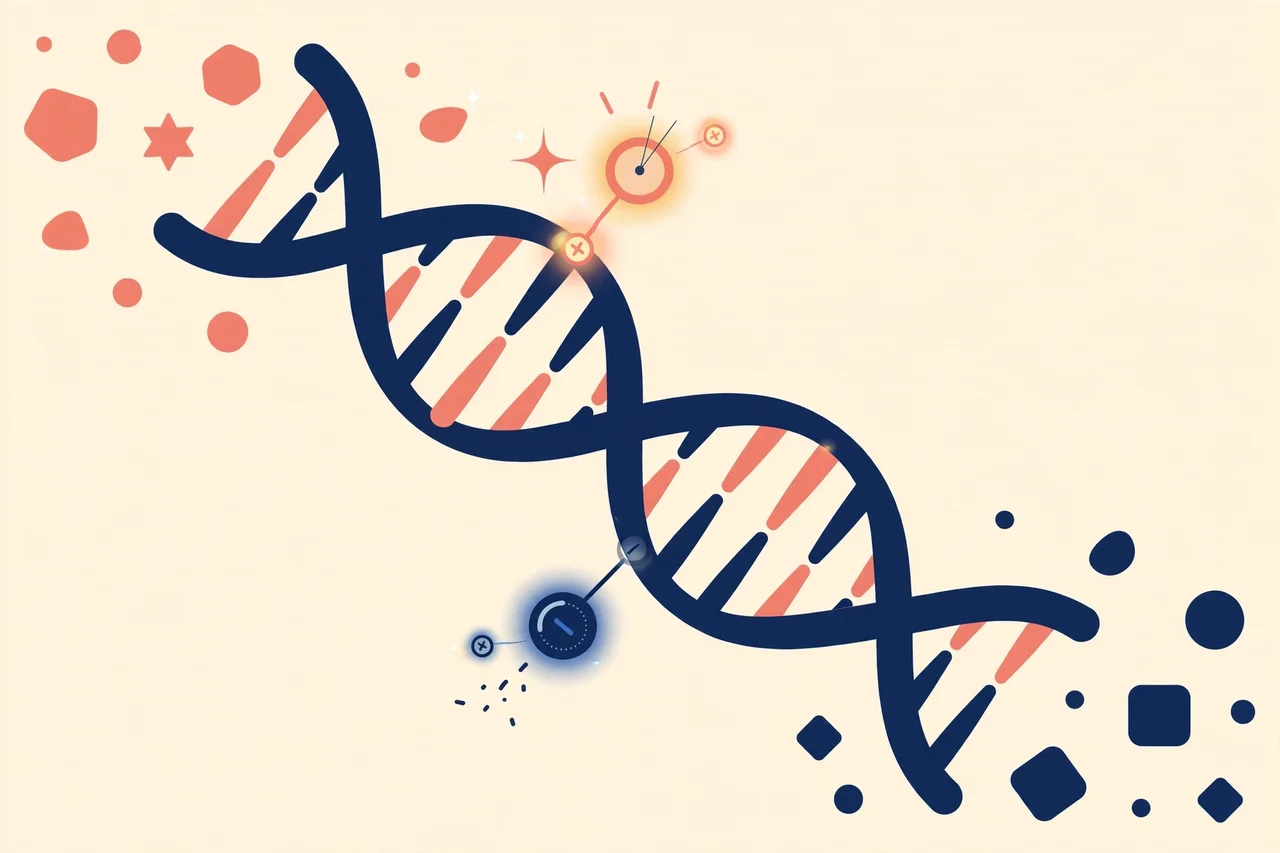
Epigenetic clocks read the pattern of methylation tags on DNA to estimate biological age. Image generated by AI.
Why do big dogs age faster? The jumping-gene clue
Here is the study’s headline result. Aging in these dogs was accompanied by widespread loss of DNA methylation, and the loss was not evenly spread. It was concentrated at transposable elements — the “jumping genes” that can copy themselves and reinsert elsewhere in the genome. The most affected class, LINE1 retrotransposons, showed the strongest age-related methylation loss: more than 40% of LINE1-associated regions lost methylation with age.
And the size gradient showed up exactly where the paradox predicts. In giant breeds, the age-related decline in methylation at LINE1s was about 35% greater than in small breeds. Across all transposable-element classes, the strength of the age effect was roughly 31% greater in larger dogs. To be precise about what that means: these figures describe how much more strongly aging erodes methylation in big dogs relative to small ones — the relative strength of the age effect — not the absolute percentage of methylation lost per year.
Why would this matter? LINE1s are DNA sequences that copy themselves through an RNA intermediate and paste the copy elsewhere, damaging the genome in the process. In young cells, methylation keeps them silenced — locked down. When that silencing fades with age, jumping genes can reactivate, and in other biological systems that derepression is linked to genomic instability, cancer, and age-related disease. The study shows the silencing fades fastest in the genomes of the biggest dogs.
Big, male, and faster
The size finding was not the only signal. Male dogs showed faster epigenetic aging than females — and strikingly, this held even for males that had been neutered while young. The researchers also found a distinct signature on the X chromosome: in males, LINE1s on the X chromosome were more methylated. As outside commentators noted, that is a separate signal from the size effect, not the same mechanism in disguise, and it needs follow-up work of its own.
On the central result, independent experts were receptive. Borbála Turcsán of Eötvös Loránd University, commenting on the study for Nature, welcomed the transposon angle as a plausible piece of the puzzle — while the authors themselves stress that more research is needed to determine whether LINE1 activity is a cause of faster aging or a consequence of it.
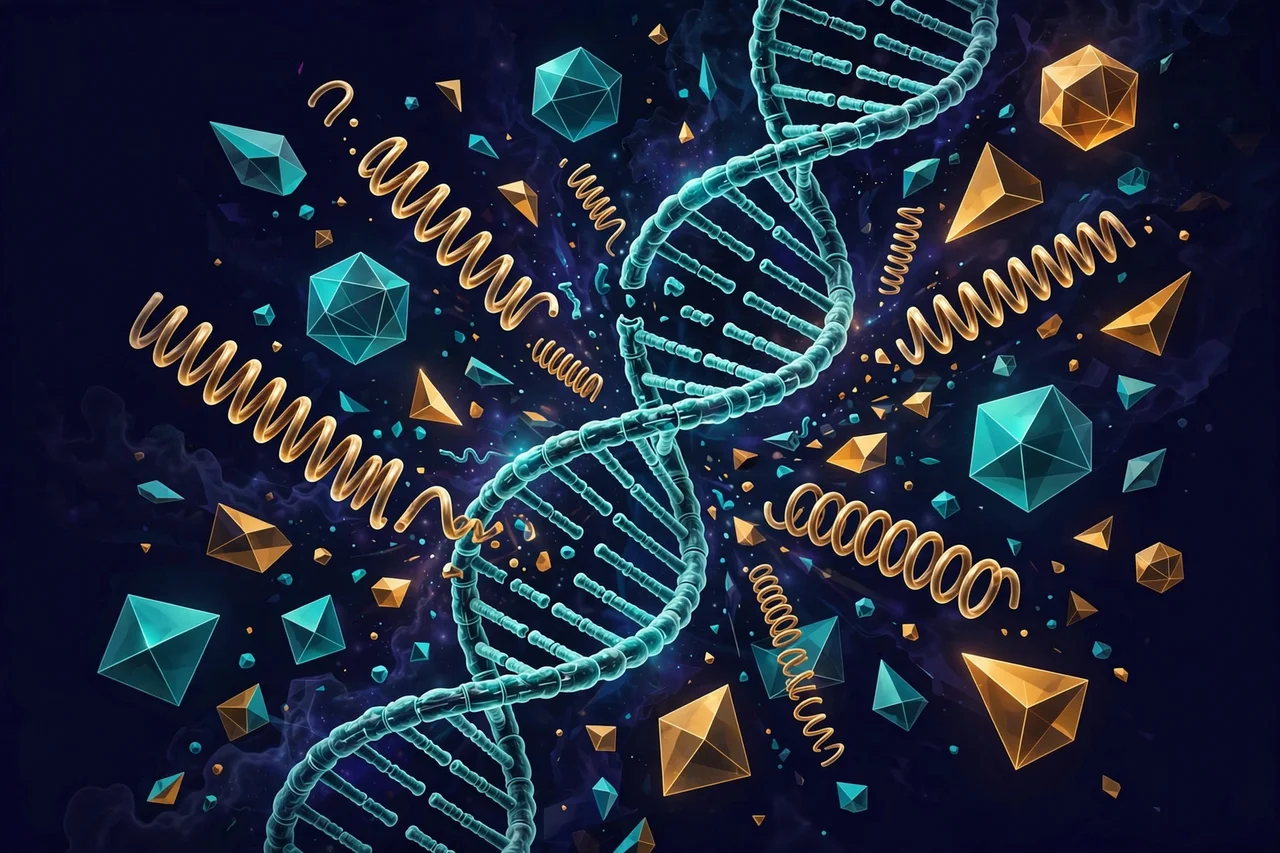
LINE1 jumping genes copy themselves through an RNA intermediate and paste the copy elsewhere; methylation normally keeps them silenced. Image generated by AI.
What it means — and what it doesn’t
This is an observational study. It shows that big dogs’ genomes lose methylation at jumping genes more quickly, and that epigenetic age predicts mortality — but it does not prove that LINE1 derepression is what shortens big dogs’ lives. Proving causation would require experiments: interventions that restore methylation control at transposons, and lifespan measurements to see whether the decline slows. The authors say those experiments are the natural next step.
Nor should anyone read this as advice about their dog. There are no interventions here, no supplements, no diet changes supported by the findings. The human implications are speculative at best: the authors frame the LINE1 pathway as a promising avenue for future research into extending health span, but they emphasize that much more work is needed. The dog-aging paradox remains a dog finding — fascinating, concrete, and molecular, but not a prescription.
Why it matters
Explaining lifespan differences within a species has long been one of aging biology’s stubborn puzzles. This study gives that puzzle its first genome-wide, mechanism-level lead: not growth rate or metabolism in the abstract, but a specific class of genomic parasites losing its restraints fastest in the largest animals. Whether that lead turns into a therapeutic target or stays a marker of aging, the result sharpens the question enormously — and gives the next generation of aging experiments a precise place to look.
Related reading: Vitamin B12: The Vitamin Only Microbes Can Make — another molecular story, this time about the one vitamin animals cannot make for themselves.
Frequently asked questions
Do big dogs really die younger?
Yes, and the gradient is steep. A Great Dane typically lives 7 to 10 years, while small breeds like Chihuahuas commonly reach 15 to 20. Size is one of the strongest predictors of a dog’s lifespan.
Is the “multiply by 7” rule wrong?
Essentially, yes. The 2020 dog epigenetic clock found that a one-year-old dog is physiologically closer to a 30-year-old human than to a 7-year-old child. Aging in dogs is fastest early in life and slows later, so any fixed multiplier misleads.
Can anything slow a big dog’s aging?
Not from this study. It identifies a molecular pattern, not an intervention. Good weight management, exercise, and veterinary care remain the best evidence-based ways to help any dog live longer — but nothing in these findings supports a specific treatment yet.
Does this apply to people?
Indirectly at most. Transposon derepression with age has been observed in human tissues, and the Dog Aging Project deliberately models aging shared across mammals. But the size-aging finding is specifically about dogs, and the authors offer no human conclusions.
Sources
- Nature news, October 8, 2026: “Big dogs age faster than little ones — rogue ‘jumping genes’ might be to blame”. Full story
- Arizona State University / phys.org, October 8, 2026: “Fading control over ‘jumping genes’ may explain why big dogs age faster”. Full release
- BioQuick News, October 2026: “Why Big Dogs Age Faster — Second Summary”. Full story
- particle.news, October 2026: “Large and Male Dogs Show Faster Molecular Aging Linked to Loss of DNA Methylation”. Full story
- thebrighterside.news, October 2026: “Why big dogs die younger: DNA study points to changes around jumping genes”. Full story
- Mariner BL et al., “Epigenetic aging and transposon dysregulation reflect size-related lifespan compression in dogs”, Science (2026), DOI 10.1126/science.aeb2986. Paper page
- Wang T et al., “Quantitative Translation of Dog-to-Human Aging by Conserved Remodeling of the DNA Methylome”, Cell Systems (2020). Full text (open access)










0 Comments