

Key takeaways
- For the first time, astronomers have directly watched water clouds thicken and thin over time on a world beyond our solar system.
- The world is WISE 0855, the coldest known brown dwarf: about 7.5 light-years away, roughly twice the mass of Jupiter, and colder at its surface than a winter day on Earth.
- The James Webb Space Telescope recorded its spectrum every 15 minutes for 11 hours, letting scientists separate cloud changes from deep chemical churning for the first time.
- The same physics of convection, clouds, and chemistry that governs Jupiter appears to govern this cold, free-floating world, a promising sign for studying weather on true exoplanets next.
Exoplanet weather has always been a guess. Astronomers could detect the chemicals in a distant world’s air, but they could not watch its sky change. That has just changed. Using the James Webb Space Telescope, a team led by Brittany Miles of the University of Arizona has caught water clouds thickening and thinning in real time on WISE 0855, the coldest known brown dwarf, a Jupiter-sized world drifting alone just 7.5 light-years from Earth.
It is the most detailed time-series portrait ever taken of such a cold, dim world, and the first direct confirmation that water clouds on another body behave like weather, growing and fading as the world turns beneath them. The research is published as a preprint and has been accepted for publication in a peer-reviewed astronomy journal.
A failed star colder than Earth
Brown dwarfs sit in the strange middle ground between planets and stars. They begin life like stars but never gather enough mass to ignite steady nuclear fusion at their cores, so they glow only dimly with leftover heat from their formation, cooling slowly over billions of years.
WISE 0855, formally WISE J085510.83-071442.5, sits at the very bottom of that category. Discovered in 2014 by NASA’s WISE infrared survey, it is the fourth-closest known system to the Sun. It packs about twice the mass of Jupiter into nearly the same size, yet its surface simmers at only about 265 Kelvin, roughly minus 8 degrees Celsius, colder than the ground on a crisp winter day on Earth.
That frigidity is exactly what makes it interesting. At such low temperatures, water can condense into clouds high in the atmosphere, just as it does on Earth and on the giant planets of our solar system. In many ways, WISE 0855 behaves like a free-floating giant planet, a natural laboratory for the physics of alien skies.
Eleven hours, one spectrum every 15 minutes
The breakthrough came from patience. Miles and her colleagues pointed Webb’s NIRSpec instrument at WISE 0855 for 11 straight hours, recording a full medium-resolution spectrum of its infrared light every 15 minutes, across wavelengths from 2.87 to 5.27 micrometres.
The cadence mattered. As the brown dwarf rotates, different patches of its surface swing into view, each with slightly different cloud cover and temperature. By sampling the spectrum repeatedly, the team could watch those patches come and go, effectively turning the telescope into a weather-monitoring station for a world colder than Earth’s own surface.
Before Webb, astronomers had only simple brightness measurements, photometry, which mixed the effects of clouds, chemistry, and temperature into one unreadable blur. Spectra separate the light into its component colours, revealing which molecules are responsible for the changes. “Now we can actually distinguish them,” Miles said, where before the signals were hopelessly tangled.
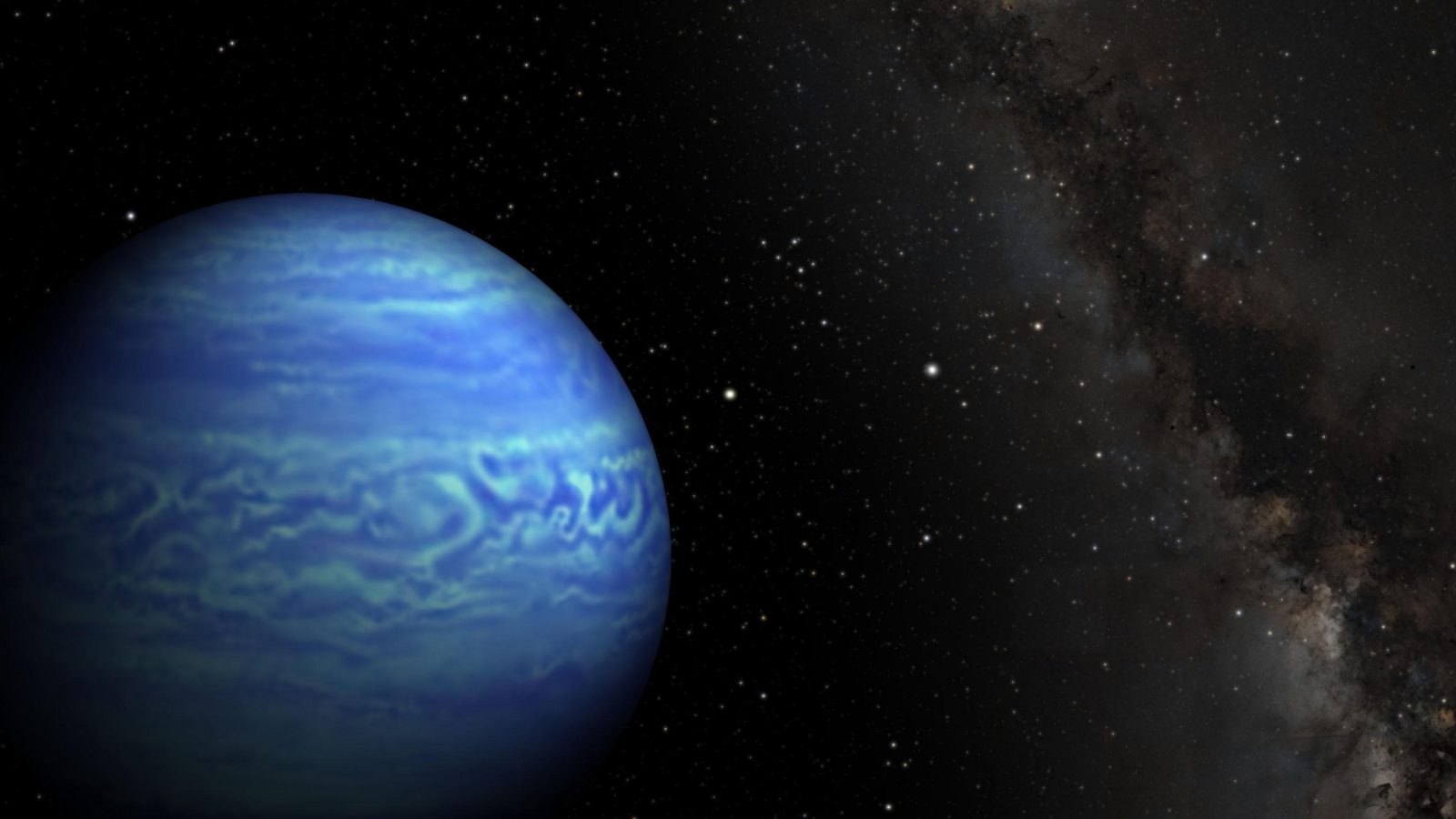
Artist’s concept of WISE 0855, the coldest known brown dwarf, drifting through space. Photo: NASA/JPL-Caltech/Penn State University (public domain).
Exoplanet weather: clouds that thicken and thin
Comparing the data with atmospheric models, the team found that water clouds are needed to match the overall shape of WISE 0855’s spectrum, and that the best-fitting picture is a world where patchy water clouds grow thicker and thinner as the object rotates.
This is the first time that changing water-cloud thickness has been directly confirmed on a body outside our solar system. It is weather in the most literal sense: the same kind of thickening and thinning that drives a cloudy afternoon on Earth, happening on a world no human will ever visit.
Two processes, unfolding at once
Clouds are only half the story. The strongest flickering in the data came not from water but from carbon monoxide gas, whose absorption features swung by up to 10 percent. Using principal component analysis, the team showed that the carbon monoxide variations rise and fall together with phosphine, another deep-atmosphere gas.
The models say these two signals come from different depths. The carbon monoxide and phosphine changes originate deep down, where convection dredges gases upward from hotter layers, a process called quenching that freezes the chemistry in place. The water-cloud changes happen much higher up, at lower pressures, where the clouds themselves thicken and thin.
Untangling those two layers, previously impossible with older telescopes, is what makes the Webb data so powerful. One of the astronomers likened it to looking at the world through a screen door: the screen filters some of the light, and to understand the world beyond, you first have to understand the screen itself.
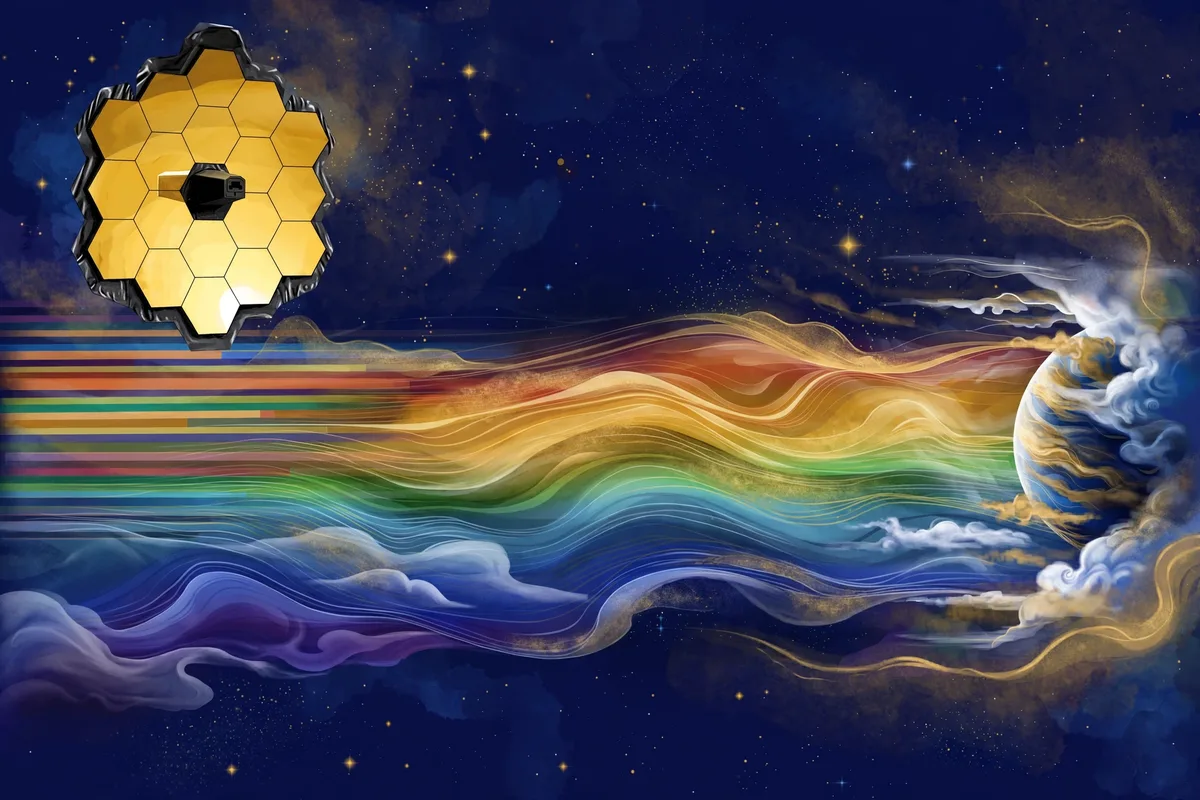
Webb’s gold mirror (top left) recorded WISE 0855’s spectrum every 15 minutes for 11 hours, revealing ripples from clouds and chemistry like a weather report. Image generated by AI.
Why it matters
The real value of the discovery is not WISE 0855 itself but what it implies. The basic physics of convection, clouds, and chemistry that governs Jupiter also governs this cold, free-floating world more than 7 light-years away. Jupiter and WISE 0855 look distinctly different, yet they share similar weather patterns.
If that physics is universal, it applies to the gas-giant exoplanets that astronomers are now beginning to study in earnest with Webb. Brown dwarfs are not true planets, but there is a spectrum of behaviour rather than a hard line between the two. Techniques proven on WISE 0855, the nearest and coldest test case, can now be aimed at genuine exoplanets, where the same methods might one day read weather on worlds with the potential for habitability.
The team plans longer observations and better models to map how the clouds and deep chemistry interact. For now, one small, frigid world has given astronomy its first real weather report from beyond the solar system: cloudy, with a chance of clearing.
Related reading
For another Webb-powered first, read Fast Radio Bursts, Explained: The Farthest Signal Ever Caught.
Frequently asked questions
Is WISE 0855 a planet?
Not quite. It is a brown dwarf: too massive to be a planet, too small to ignite as a star. But at about twice Jupiter’s mass and a similar size, it behaves in many ways like a free-floating giant planet, which is why it is such a useful stand-in for studying exoplanet atmospheres.
Does it rain there?
Unknown, and probably not in any Earth-like sense. The observations show water clouds changing thickness, which is weather, but there is no solid surface below and no evidence of liquid oceans. The value is in the atmospheric physics, not habitability.
How can astronomers see clouds they cannot photograph?
They do not photograph the clouds directly. Instead, they record the spectrum of infrared light escaping the atmosphere. Different molecules absorb different colours, so as cloud patches rotate in and out of view, the spectrum changes in ways that models can match only with patchy, varying water clouds.
What comes next?
The team wants longer observing runs and sharper atmospheric models to map how the clouds and deep chemistry interact over time. The same time-series spectroscopy technique can then be applied to genuine gas-giant exoplanets orbiting other stars.
Sources
- Miles, B. E., et al., “Water Cloud and Chemical Modulations in the Coldest Brown Dwarf,” arXiv:2609.20664 (submitted September 17, 2026). arxiv.org/abs/2609.20664v1
- University of Arizona press release: “Discovery marks the first detection of variable water clouds outside of the solar system” (October 9, 2026), via phys.org.
- “Webb Finds Signs of Patchy Water Clouds on Coldest Known Brown Dwarf,” Sci.News (October 9, 2026).
- “Webb Telescope Catches Water Clouds Changing Weather on a Nearby Brown Dwarf,” Scienmag (October 9, 2026).
- “First Detection of Variable Water Clouds Outside of Our Solar System,” Astrobiology (October 9, 2026).
- NASA/JPL-Caltech/Penn State University, artist’s concept of WISE J085510.83-071442.5 (image PIA18001, April 25, 2014, public domain), via NASA Images.










0 Comments