

Originally published by Gauri Gupta in Diff, the Wikimedia community blog on August 24, 2026, under a Creative Commons licence (CC BY-SA 4.0) (Diff’s footer reads “Content licensed under Creative Commons Attribution-ShareAlike 4.0 (CC-BY-SA) unless otherwise noted”; the group photo is credited CC BY-SA 3.0). Republished here under that licence. This adaptation is shared under the same licence (CC BY-SA 4.0). Diff, the Wikimedia Foundation and the people named are not contributors to TeaLamp and do not endorse it or its use of their work. This interview about the WikiWomen+ Summit 2026 was conducted on behalf of the Summit’s organizing team. Changes: formatting, the “Share this”, translation-request and related-post boxes removed, two AI-generated illustrations and a short “Key takeaways” section added by TeaLamp. The interview text is unchanged, and all quotes are Sana Sabir’s own words as published by Diff. Prepared for TeaLamp by the TeaLamp Editorial Team with the help of AI.
This blog post is an interview with Sana Sabir (User:CosmicCodex) reflecting on how WikiWomen+ Summit 2026 influenced her perspective on community, technology, AI, and women’s participation in Wikimedia. She highlights the importance of women supporting one another, the value of human-curated knowledge in the age of AI, and the many ways women can contribute to technical spaces without being programmers. Most importantly, Sana shares concrete plans to take her learnings back to her community through workshops, translation, documentation, and efforts to address knowledge gaps.
For young Wikimedians, in-person events offer something that online collaboration often cannot – the chance to build genuine relationships, find mentors and peers, exchange ideas across communities, and return home with the confidence to turn inspiration into action. Over the years, the WikiWomen+ Summit has been one such space where women and allies from across the Wikimedia movement come together to share experiences, learn from one another, and explore how they can shape a more inclusive and sustainable future for free knowledge.
As part of the WikiWomen+ Summit Core Organizing Team, I spoke with Sana about her experience at the Summit, the sessions that influenced her thinking, and the actions she plans to take after returning to her community.
Finding strength in community
When asked about the most valuable part of the Summit, Sana’s answer was not about a particular session or speaker. It was about the women she met.
“The women themselves. Being surrounded by resilient, welcoming leaders who uplifted and encouraged each other without judgment was transformative.”
For Sana, one of the most powerful aspects of the Summit was the openness between participants. Whether someone was an experienced Wikimedian or relatively new to the movement, people were willing to share, discuss, care and support one another.
That experience gave her a stronger sense of belonging within the global Wikimedia community.
Rethinking Wikimedia’s role in t he age of AI
One session that particularly changed Sana’s perspective was Christophe’s talk on the next 25 years of Wikimedia.
The discussion about artificial intelligence made her reconsider how she viewed the relationship between AI and Wikimedia. Rather than seeing AI only as a challenge, she came away thinking about the unique value of human-curated and contextual knowledge.
As AI becomes increasingly widespread, Sana believes that Wikimedians have an increasingly important role to play in safeguarding & preserving knowledge that is grounded in human experience and context.
The idea of Wikimedians as “spearheads of knowledge” particularly stayed with her.
It shifted her perspective from asking how Wikimedia might simply respond to AI to thinking about what human contributors can uniquely provide in an increasingly automated information environment.
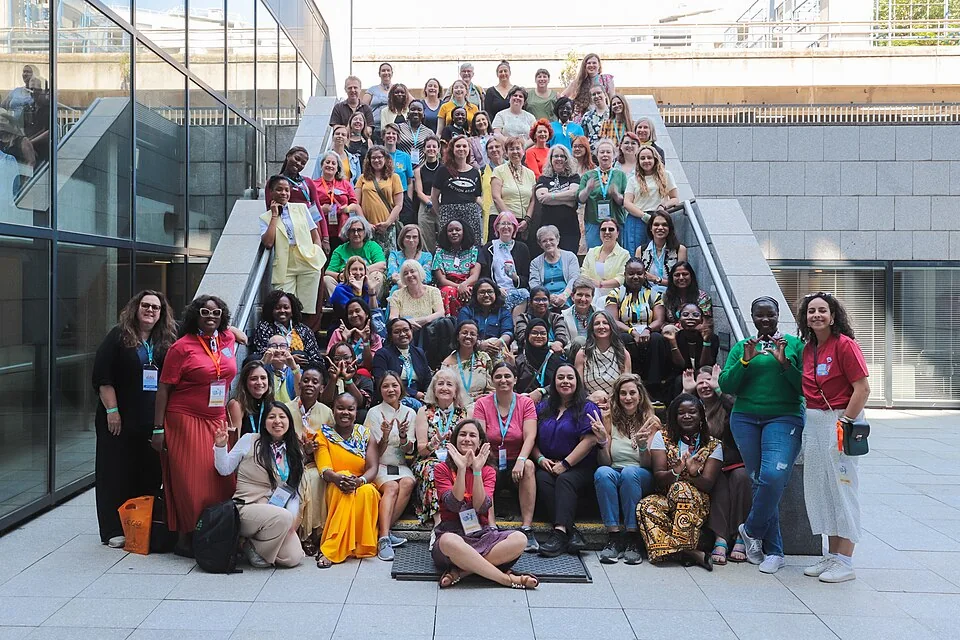
Group photo of the WikiWomen+ Summit at Wikimania 2026. Photo: Pierre-Selim Huard, CC BY-SA 3.0, via Wikimedia Commons.
Looking for what is missing
Another important takeaway for Sana was the need to focus not only on what exists in Wikimedia projects, but also on what is still missing.
Inspired by the discussion around Women in Red, she wants to bring this approach into her own community by organising workshops that help contributors identify gaps in local knowledge.
For Sana, this means looking for overlooked subjects, stories, and perspectives that may not yet be adequately represented.
This idea connects the work of individual contributors with a much larger question: whose knowledge gets documented, and whose stories remain invisible?
Making technology more accessible
Experience and insights from this year’s Summit also prompted Sana to think about the challenges women continue to face in Wikimedia’s technical ecosystem.
She highlighted issues including translation gaps, AI-related bias, copyright transparency, declining readership, and the need for more women to participate in technical contribution.
But one of her strongest takeaways was that technical contribution does not have to mean becoming an expert programmer.
Bee Piovesan’s session particularly influenced this perspective.
Sana realised that women can contribute to Wikimedia’s technical ecosystem in many ways: by usage of translating tools, documenting them, improving accessibility, and helping communities build or use technology that responds to their actual needs.
Community is at the heart of shared knowledge. Image generated by AI.
“I don’t need to be an expert coder; I can contribute by translating tools, documenting them, and making them accessible to other communities.”
For someone who wants to see more women participate in the Wikimedia technical ecosystem, this can be an important shift in thinking. Technical spaces can become more inclusive when contribution is understood beyond writing codes.
An unexpected lesson about editing
Not every takeaway from the Summit was technical.
One moment that surprised Sana was hearing contributors describe editing Wikipedia as something that could be personally meaningful and even therapeutic.
Some contributors shared how focusing on one edit at a time could provide attention, purpose, and a sense of visible progress.For Sana, this offered a different perspective on editing. Contributions are not only about adding knowledge to Wikimedia projects; they can also be personally fulfilling.
It was an unexpected reminder that community participation can affect contributors in ways that go beyond the measurable output of edits or uploads- Satisfaction is a success too 🙂
What should come next?
When asked what she would like to see at a future WikiWomen+ Summit, Sana had a practical suggestion: more hands-on workshops for non-technical participants.
She would like women to have more opportunities to learn how to translate, document, and work with Wikimedia tools, rather than feeling that technical contribution is reserved for experienced developers.She also suggested exploring ways to make Wikipedia more reader-friendly for women, particularly in conversations around gender gaps in readership.
For Sana, inclusion is not only about bringing more women into existing spaces. It is also about making those spaces easier to understand, participate in, and shape.
There are many ways to contribute, and you don’t need to code. Image generated by AI.
“You don’t need to code”
Sana’s message to women who are interested in Wikimedia but have not started contributing is simple:
There are many ways to begin: editing an article, translating a tool, documenting technical resources, or helping others use Wikimedia projects.
She encourages women to start small and find a form of contribution that feels meaningful to them.
It is a message that reflects one of the central themes of her Summit experience: there is no single correct way to become a Wikimedia contributor.
Turning a Summit into action
Perhaps the clearest indication of what the Summit meant to Sana is what she plans to do next.
Her first step is to share her learnings with the women of Wiki Club AMU and discuss what their community could address together.
She also plans to document and translate a Wikimedia tool for her community, simplify complex articles to make them more accessible, and continue exploring editing as a personally meaningful practice.
These are concrete actions that connect the Summit to community work beyond the event itself.
When asked to describe her WikiWomen+ Summit 2026 experience in one sentence, Sana called it:
“An empowering revelation that women can code, translate, document, heal, and lead in shaping the future of knowledge, addressing AI bias, simplifying language, and building tools we actually need.”
Her answer brings together the different ways she now sees participation in Wikimedia: through technology, documentation, translation, community building, and leadership.
The Summit gave her new perspectives, but the next step is turning those perspectives into action.
And perhaps that is one of the most valuable outcomes of a community event—not simply leaving with new ideas, but returning home with the confidence and motivation to do something with them.
About the interview
This interview was conducted by Gauri Gupta on behalf of the WikiWomen+ Summit Core Organizing Team.
Sana Sabir (CosmicCodex) is a Wikimedia contributor and member of the Wiki Club AMU community.
The responses have been lightly edited for clarity and flow while retaining the substance of Sana’s reflections.
Key takeaways on WikiWomen+ Summit 2026
- Sana Sabir says the most valuable part of the WikiWomen+ Summit 2026 was “the women themselves”, who encouraged each other without judgment.
- A talk on the next 25 years of Wikimedia changed how she thinks about AI: human contributors can safeguard knowledge that is grounded and reliable.
- She learned that women can contribute technically by translating tools, documenting them and making them accessible, without being expert coders.
- Her plans include sharing what she learned with Wiki Club AMU, documenting and translating a Wikimedia tool, and simplifying complex articles.





0 Comments