


Key takeaways on the spotted bat
- The spotted bat is one of North America’s most mysterious mammals: black fur with three white spots, large pink ears, and an echolocation call humans can actually hear.
- A new study in PLOS One analyzed DNA from 121 spotted bats across three time periods: ancient bones up to 2,100 years old, museum specimens from 1904 to 1991, and bats caught between 1994 and 2025.
- Bats in the U.S. Southwest carry the greatest genetic diversity, while northern populations are less diverse and may be more vulnerable to environmental change.
- The findings point conservationists toward three priorities: diverse core populations, vulnerable leading-edge populations, and isolated relict lineages.
It has polka dots, pink ears and a voice you can hear without any equipment. The spotted bat (Euderma maculatum) is among the most charismatic and most elusive mammals in North America. Before the mid-1960s, only 35 individuals were known to science, and in 1899 the naturalist C. Hart Merriam called it “among the rarest mammals in the world.” Now, a study published on October 7, 2026, has used ancient DNA to trace this bat’s history across more than two thousand years, and the results read like a conservation playbook.
A bat like no other
Spotted bats are unmistakable once you see one. Three white spots stand out against black fur, the ears are huge and pink, and unlike almost every other bat, its echolocation calls fall within the range of human hearing. You can stand in the desert at dusk and hear it hunting.
Yet they are rarely encountered. They roost alone in crevices of cliff faces, usually within 10 kilometres of a permanent water source, and range from central Mexico to southern British Columbia. They forage across an astonishing range of elevations, from 53 metres below sea level to alpine meadows above 3,200 metres. Only about 95 specimens exist in museum collections, and the total population is guessed to be somewhere between 2,500 and 100,000. Nobody knows for sure.
That data deficiency is exactly why the research team, led by Faith M. Walker of Northern Arizona University, turned to genetics. For rare and cryptic wildlife, DNA can reveal patterns of movement, isolation and long-term survival that field observation never could.

The spotted bat: three white spots on black fur, huge pink ears, and echolocation calls audible to human ears. Image generated by AI.
Three time periods, one species
The team assembled genetic material from 121 individual spotted bats, drawn from three very different eras. The ancient samples came from a large cave in northern Arizona near Grand Canyon National Park: subfossil bones and mummified specimens radiocarbon dated between 120 and 2,100 years old. The historical samples were skin clips, muscle and organs from 65 bats in 15 museum collections, collected between 1904 and 1991. The contemporary samples came from bats captured in mist nets over stock ponds and at cave entrances between 1994 and 2025, taken as tiny wing punches or cheek swabs.
From these, the researchers analyzed 17 nuclear microsatellite markers and sequences from the mitochondrial control region, a stretch of DNA that changes fast enough to track recent history. Ancient DNA work was carried out in two dedicated laboratories built to prevent contamination, one at Northern Arizona University and one at the Smithsonian.
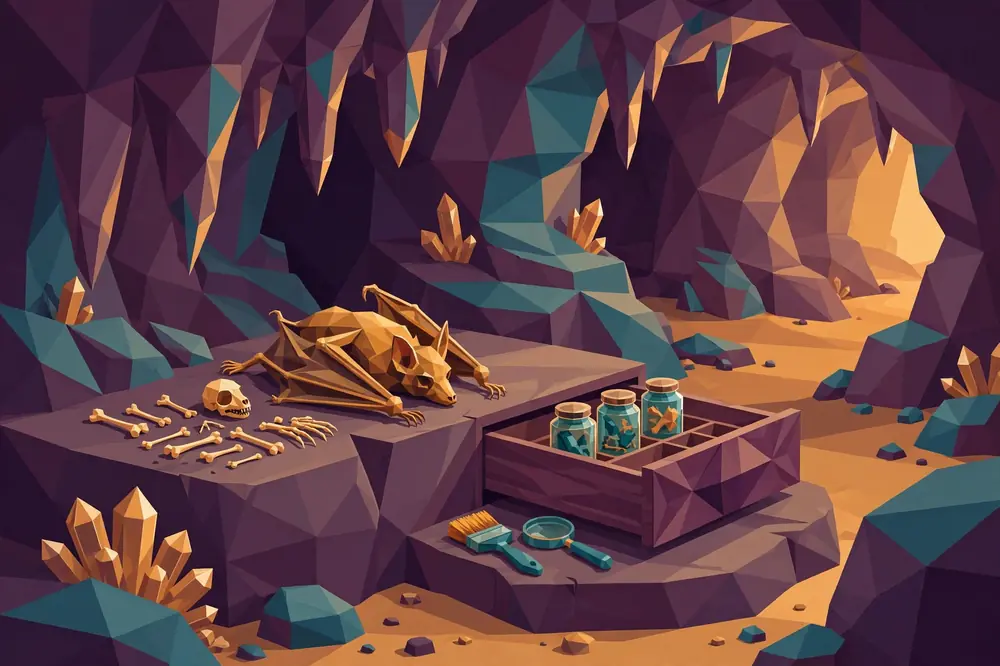
Ancient cave remains, museum specimens and modern swabs: three time periods of spotted bat DNA. Image generated by AI.
What the DNA revealed
The first surprise was continuity. Ancient bats from the Arizona cave shared mitochondrial haplotypes, versions of the same DNA stretch, with modern bats from the same locality. The population has been there for a very long time.
The broader pattern was a gradient. The nuclear DNA showed a weak genetic cline running from the genetically diverse core population in the U.S. Southwest, the spotted bat’s Arizona, Utah and New Mexico heartland, toward the less diverse northern range in British Columbia, Washington and Oregon. The pattern fits a post-Ice Age expansion northward, with males doing most of the dispersing.
The mitochondrial DNA told a more structured story, with distinct haplogroups in the northern, central and southern populations. Mitochondria are inherited from mothers, so this suggests females stay closer to home while males roam, a pattern seen in many bat species.
At the rare cave aggregation in Arizona, where spotted bats gather in unusual numbers, the team found father-son pairs and a male-biased sex ratio in the genetic data. That is the signature of swarming behaviour, when bats congregate, likely to mate, at a shared site.

From Mexico to Canada: the spotted bat’s range, with the genetically diverse U.S. Southwest core. Image generated by AI.
Why it matters
Bats make up one-fifth of all mammal species, roughly 1,500 species worldwide, and they are among the most data-deficient animals on the planet. In North America, more than half of the 153 bat species are predicted to face a moderate to very high risk of extinction by 2039, and 90 percent are thought to have declined in the past 15 years. Threats include climate change, white-nose syndrome, wind energy, persecution and habitat loss.
Against that backdrop, the study’s conclusions are practical. The southwestern United States holds the greatest genetic diversity in the species, making it a critical reservoir of evolutionary potential. Northern populations carry less diversity and may be more vulnerable to future change. And isolated lineages, like the one in central Mexico that was left behind as the climate shifted, deserve protection as irreplaceable branches of the family tree.
“Our integrative approach across temporal scales highlights the conservation importance of preserving genetically diverse core populations, vulnerable leading-edge populations and isolated relict lineages,” the authors write. It is a to-do list written in DNA, spanning 2,000 years.
Related reading
Another story of animal voices and the science of listening: This Singing Lemur Uses an Opera Singer’s Trick, on the first direct evidence of formant tuning in a singing primate.
Frequently asked questions
Why is it called the spotted bat?
For the three large white spots on its black fur, one on each shoulder and one on the rump. Combined with its huge pink ears, it is one of the easiest bats in the world to identify, if you are lucky enough to see one.
Can you really hear a spotted bat?
Yes. Unlike most bats, whose echolocation calls are ultrasonic, the spotted bat calls at frequencies within human hearing range. It is the only Canadian bat species you can hear without special equipment.
How do scientists get DNA from a 2,000-year-old bone?
In dedicated ancient-DNA laboratories, researchers extract tiny amounts of surviving DNA from subfossil bones using chemical methods, working under strict contamination controls. Even degraded fragments can yield enough genetic information for comparison with modern samples.
Is the spotted bat endangered?
It is a Species of Concern in the United States, with varying designations by state. In Canada it is listed as Special Concern, with fewer than 1,000 adults thought to remain, mostly in the southern interior of British Columbia.
Source
Adapted from: Walker FM, Sanchez DE, Campana MG, Fleischer RC, Foster JT, Sobek CJ, et al. (2026), “Conservation genetics of the spotted bat: Insights from ancient, historical, and modern samples,” PLoS One 21(10): e0358330, published October 7, 2026, under a CC0 1.0 public domain dedication. Read the original paper.










0 Comments