

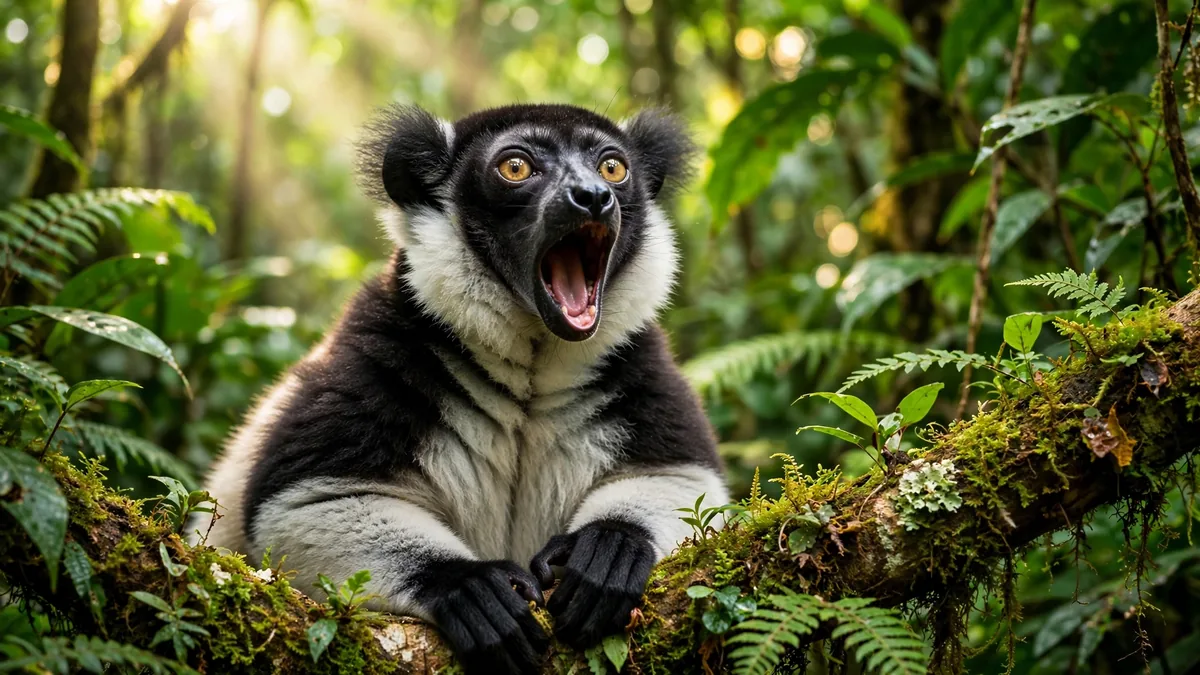
Originally published by Filippo Carugati and colleagues in PLOS Computational Biology on September 21, 2026, under a Creative Commons Attribution licence (CC BY 4.0). Adapted for TeaLamp by the TeaLamp Editorial Team with the help of AI. Changes: rewritten and restructured for a general audience; figures replaced with AI-generated illustrations; “Key takeaways” and FAQ sections added.
Key takeaways on the singing lemur
- The indri of Madagascar is the only lemur known to sing, and a new study shows it opens its mouth wider to hit higher notes, just like a trained opera singer.
- Researchers tracked the lip movements of 19 wild indris frame by frame and matched them to the pitch of their songs, finding the first direct evidence of this technique in a singing primate.
- A wider mouth tunes the vocal tract so the sound carries further through dense rainforest, which helps indris defend their territory.
- Humans and indris last shared an ancestor about 74 million years ago, so the two species almost certainly arrived at the same trick independently.
Deep in the rainforests of eastern Madagascar, the indri, the world’s only singing lemur, sits high in the canopy and sings. The indri is the only lemur that does this, and its haunting, wailing songs can travel up to two kilometres through the trees. Now scientists have discovered that these lemurs use the same vocal trick as a trained soprano: the higher the note, the wider they open their mouths.
The only lemur that sings
Singing is rare among primates. It has evolved separately in only a handful of unrelated groups, roughly 16 percent of primate species. Indris live in small family groups that occupy and defend patches of forest, and their songs are long-distance announcements: we are here, this territory is taken. Rival groups answer back, and the exchange can go on for an hour, a sort of singing contest that sometimes ends in a real confrontation. They also sing when group members reunite, like a game of Marco Polo played across the treetops.
Indris are difficult to study. They do not survive in captivity, so there is no zoo colony to film, and they live in remote, dense forest where a research team might hear a group sing only once every few hours of following it. Yet their songs may hold clues about the evolution of human music and language.

Indris live in small family groups in Madagascar’s eastern rainforests. Image generated by AI.
An opera singer’s trick
Frame by frame
A team led by Filippo Carugati of the University of Turin and Chiara De Gregorio of the University of Warwick analysed 83 video recordings of 19 wild indris, filmed in the Maromizaha forest and the Mitsinjo reserve in Madagascar. Using a markerless pose-estimation tool called DeepLabCut, the same kind of technology used to track human athletes, they marked the position of each animal’s upper and lower lip in every frame of video. Then they paired those mouth-opening measurements with the pitch of the song in the matching audio track.
The result was strikingly consistent: whenever the pitch of an indri’s song rose, its mouth opened wider, frame by frame. A statistical model confirmed a significant positive relationship between mouth opening and the fundamental frequency of the call. It is the first direct, quantitative evidence that a singing primate coordinates its mouth and its pitch this way.
Why open wide?
Trained singers do the same thing, and the physics is identical. Opening the mouth wider raises the resonant frequencies of the vocal tract until they line up with the harmonics of the voice. This alignment, known as formant tuning, makes the same breath produce a louder, clearer sound. In the indri’s case, a louder song means a song that carries further through thick vegetation, exactly what a lemur needs when its message is meant to reach a rival group a kilometre away.
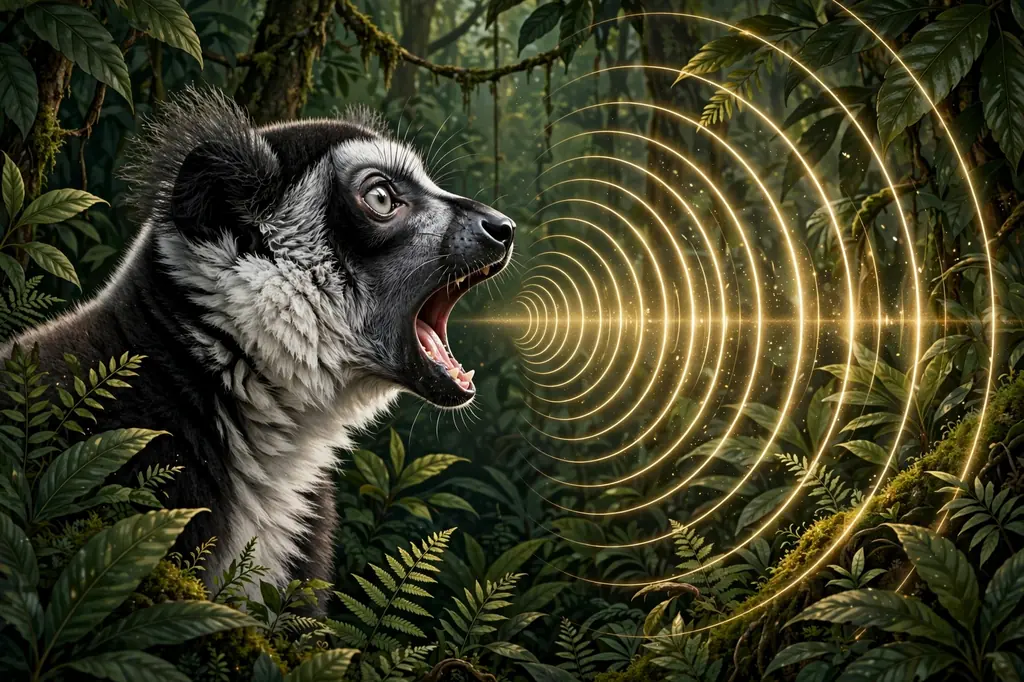
A wider mouth helps the indri’s song carry further through dense forest. Image generated by AI.
Seventy-four million years apart
Humans and indris last shared a common ancestor about 74 million years ago. That means the shared technique is almost certainly a case of convergent evolution: two lineages, separated by an enormous span of time, independently arriving at the same physical solution to the same problem. A soprano in a concert hall and a lemur in a rainforest canopy both discovered that to throw your voice further, you open your mouth wider.
The finding also matters for science beyond the curiosity factor. Most singing primates are endangered and live in hard-to-reach places, so studying how they produce sound has always been difficult. The new method, combining ordinary field video with AI motion tracking and audio analysis, gives researchers a way to study vocal mechanics in the wild without touching the animals.
Why it matters
The indri is listed as critically endangered on the IUCN Red List, with its forest home shrinking under pressure from slash-and-burn agriculture, logging and hunting. Understanding how these animals communicate is part of understanding what they need to survive. And there is something quietly wonderful in the discovery itself: a wild lemur, singing at dawn in Madagascar, turns out to be using the same physics as an opera star.

Indris sing to defend their territory in the dense rainforest. Image generated by AI.
Related reading
For more on how species adapt to protect their world, see Saving the Seas: What Works (and Why It Matters).
Frequently asked questions
What is an indri?
The indri (Indri indri) is the largest living lemur, found only in the rainforests of eastern Madagascar. It is known for its loud, haunting songs and its black-and-white fur.
Are indris the only singing lemurs?
Yes. They are the only known singing lemur species. Singing is rare among primates in general, found in only about 16 percent of species.
What is formant tuning?
Formant tuning is the alignment of the vocal tract’s resonant frequencies with the harmonics of the voice, usually by adjusting mouth opening. It amplifies the sound, which is why trained singers open their mouths wider for high notes.
Are indris endangered?
Yes. The indri is listed as critically endangered on the IUCN Red List. Its population is shrinking because of habitat destruction and hunting, and it cannot survive in captivity.










0 Comments