

Key takeaways on neutrinos
- Francis Halzen won the 2026 Nobel Prize in Physics for building the IceCube Neutrino Observatory and discovering high-energy neutrinos from deep space.
- Neutrinos are ghostly, nearly massless particles with no electric charge. Trillions of them stream through your body every second without leaving a trace.
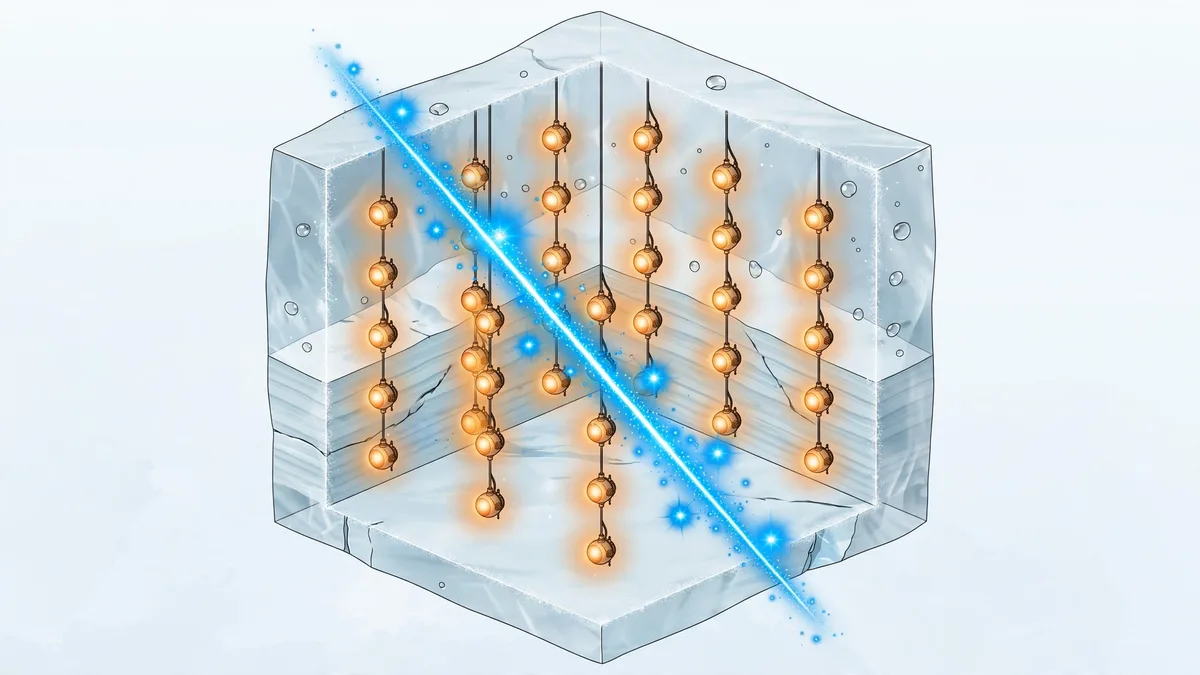
- IceCube turned a cubic kilometre of Antarctic ice into a telescope, catching the faint blue flashes produced when a neutrino very rarely collides with an atomic nucleus.
- In 2013 IceCube found the first cosmic neutrinos. In 2017 it traced one back to a blazar four billion light-years away, the first identified source of these particles.
This morning, the Royal Swedish Academy of Sciences awarded the 2026 Nobel Prize in Physics to Francis Halzen, a Belgian-American physicist at the University of Wisconsin–Madison. The citation honours his decisive contributions to the IceCube Neutrino Observatory and the discovery of high-energy neutrinos of astrophysical origin. It is a prize for catching the uncatchable: particles so shy that trillions pass through your body each second, and almost none of them stop to say hello.
What is a neutrino?
A neutrino is one of the most abundant particles in the universe, second only to photons of light. It has no electric charge and almost no mass, and it interacts with other matter so rarely that it can fly straight through the entire Earth as if it were not there. Physicists call them ghost particles for good reason.
They are produced in enormous numbers by nuclear reactions. The Sun pours them out, nuclear reactors make them, and the most violent events in the cosmos, exploding stars and black holes devouring matter, accelerate them to extreme energies. There are three known types, or flavours: the electron neutrino, the muon neutrino and the tau neutrino. They constantly change from one flavour to another as they travel, a quirk that proved they must have at least a tiny amount of mass.
The three known neutrino flavours: electron, muon and tau. Image generated by AI.
Why are they so hard to catch?
If a particle almost never interacts with anything, building a detector for it is a strange kind of engineering problem. You cannot build a trap. You can only build a very, very large net and wait.
When a neutrino does, on extraordinarily rare occasions, collide with an atomic nucleus, the collision creates fast-moving charged particles that emit a faint cone of blue light known as Cherenkov radiation. It is the same kind of glow seen around the cores of nuclear reactors. The trick is to watch an enormous volume of transparent material and catch those flashes. The bigger the volume, the more collisions you will see. Which is how physicists arrived at an audacious idea: use a cubic kilometre of Antarctic ice as the detector.
A cubic kilometre of ice
Francis Halzen first proposed the idea in 1988: sink strings of light sensors deep into the clear ice beneath the South Pole and wait for neutrinos to announce themselves. The ice there is some of the clearest solid material on Earth, and there is a lot of it. A smaller prototype called AMANDA proved the concept, and then the real thing was built.
IceCube is a marvel of stubborn engineering. Between 2005 and 2010, a hot-water drill melted 86 holes more than two kilometres deep into the ice sheet, and down each hole went a string of 60 glass spheres, each containing a light sensor. In total, 5,160 digital optical modules now hang in a cubic kilometre of ice at the Amundsen-Scott South Pole Station, watching and waiting around the clock.
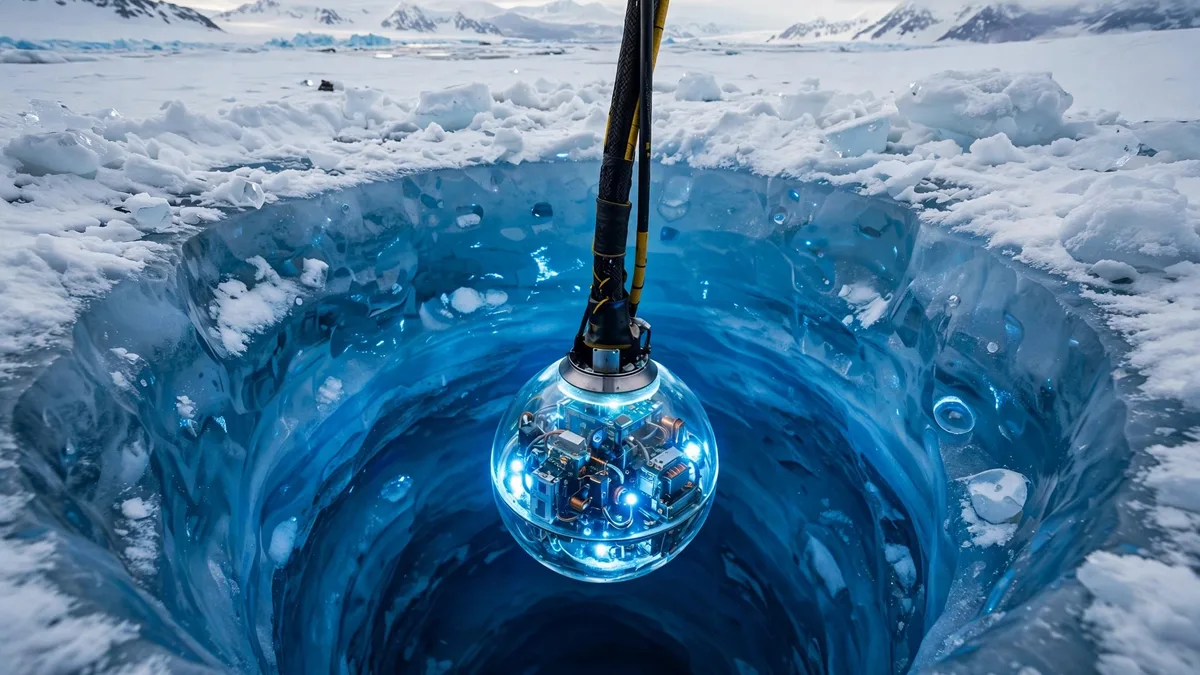
Strings of light sensors hang in the Antarctic ice, watching for faint blue flashes. Image generated by AI.
The first cosmic neutrinos
The wait paid off. In 2013, the IceCube Collaboration announced 28 high-energy neutrino events recorded between May 2010 and May 2012, with energies from tens of tera-electronvolts up to more than a peta-electronvolt, a million times the energy of the neutrinos seen from a 1987 supernova. Two of the biggest events were nicknamed Bert and Ernie, after the Sesame Street characters; a third, detected in December 2012, was called Big Bird. They were the first solid evidence of neutrinos arriving from cosmic accelerators beyond our solar system. The result was published in the journal Science and named the Physics World Breakthrough of the Year.
But there was a catch. These first events were diffuse. They told physicists that cosmic neutrinos exist, but not where they come from. The sources, the universe’s most violent particle accelerators, were still unidentified.
Tracing one back to a blazar
That changed on September 22, 2017. IceCube detected a single high-energy neutrino, dubbed IceCube-170922A, and within a minute its automatic alert system notified observatories around the world. About twenty telescopes on the ground and in space swung toward the patch of sky the neutrino had come from. NASA’s Fermi gamma-ray telescope found a blazar, TXS 0506+056, in a flaring state right at that spot, brighter in gamma rays than it had ever been.
A blazar is an active galaxy with a supermassive black hole at its centre, firing twin jets of particles outward, one of them aimed almost directly at Earth. The blazar sits about four billion light-years away, just off the shoulder of the constellation Orion. Follow-up observations across radio, optical, X-ray and gamma-ray wavelengths confirmed the picture: this was the first time a specific object had been identified as the probable source of a high-energy cosmic neutrino, and with it, a likely source of cosmic rays, a mystery more than a century old.
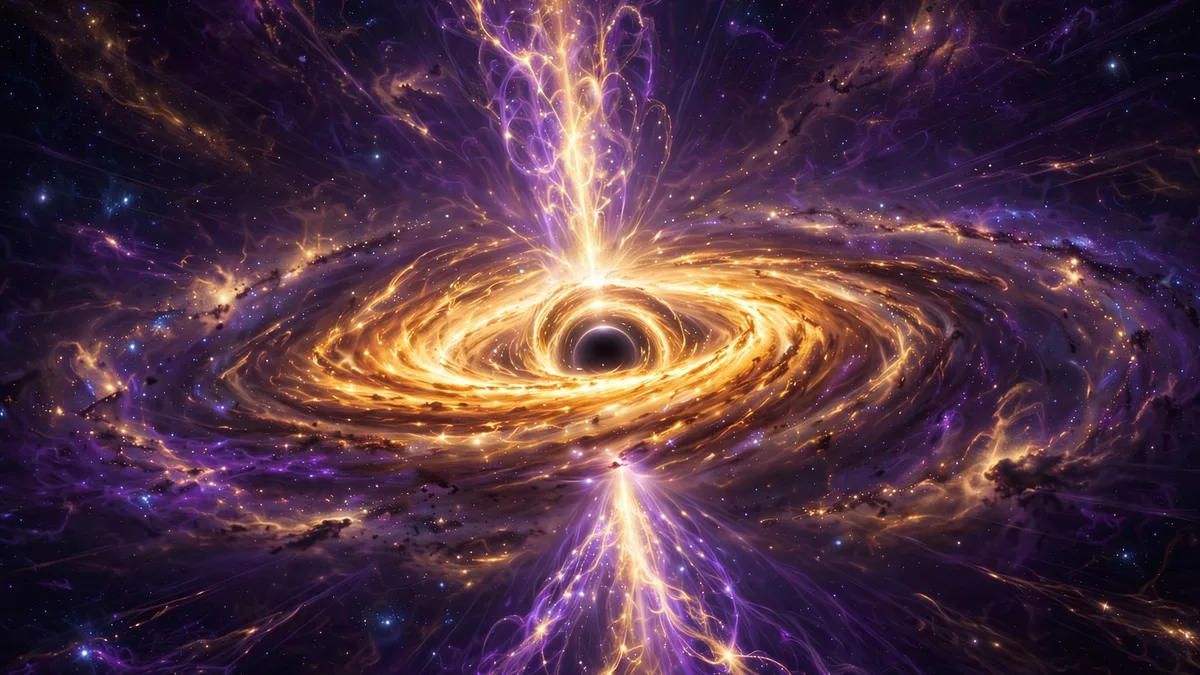
A blazar fires jets of particles from its central black hole, one aimed at Earth. Image generated by AI.
Why it matters
Neutrinos are messengers that nothing can stop. Light is blocked by dust, bent by gravity and absorbed by gas; charged particles are deflected by magnetic fields. Neutrinos travel in straight lines from the most extreme places in the universe, carrying information that no other signal can. With IceCube, astronomers gained a new sense, a way to see the universe not in light but in ghost particles. Mark Pearce, chair of the Nobel Committee for Physics, put it this way: Halzen’s tenacity and scientific vision paved the way for a new kind of astronomy.
Related reading
Yesterday’s Nobel Prize in Physiology or Medicine also honoured a technique for seeing the invisible: Optogenetics, Explained: Controlling Brain Cells with Light.
Frequently asked questions
How many neutrinos pass through me right now?
Trillions every second, most of them from the Sun. You do not feel a thing, because they almost never interact with the atoms in your body.
Can neutrinos harm me?
No. A neutrino could pass through a wall of lead a light-year thick and still probably not hit anything. They are the least dangerous particles in nature.
What is a blazar?
An active galaxy whose central supermassive black hole fires jets of high-energy particles outward. When one of those jets happens to point at Earth, astronomers call it a blazar, and it can outshine entire galaxies.
Why did Halzen win the prize alone?
The Academy credited his personal vision and scientific leadership: the original idea of using South Pole ice, decades of persistence through failed prototypes and harsh Antarctic fieldwork, and the discovery that followed. Thousands of scientists built and run IceCube, but the prize singled out the person who imagined it first.
Sources
- The Nobel Prize: press release, 2026 Nobel Prize in Physics — awarded to Francis Halzen “for decisive contributions to the IceCube Neutrino Observatory and the discovery of high-energy neutrinos of astrophysical origin” (October 6, 2026). See also the popular-information page.
- Associated Press / NPR: “Francis Halzen wins Nobel Prize in physics for work on high-energy neutrinos from space” (October 6, 2026).
- University of Wisconsin–Madison: “IceCube pushes neutrinos to the forefront of astronomy” (November 2013) — 28 events, Bert and Ernie, detector specifications.
- National Radio Astronomy Observatory: “Identifying the Source of a High-energy Neutrino” — IceCube-170922A and blazar TXS 0506+056.
- Johannes Gutenberg University Mainz: “IceCube provides proof of neutrinos from the cosmos” (November 2013) — detector specifications and the Science publication.









0 Comments