


Key takeaways from Nobel Prizes week
- All three science Nobel Prizes went to researchers who gave science new senses: optogenetics lets light steer brain cells, IceCube turned Antarctic ice into a neutrino telescope, and asymmetric catalysis explains how nature picks one molecular mirror image.
- Two space stories pushed instruments to their limits: the most distant fast radio burst ever seen, and the James Webb Space Telescope watching weather move across a brown dwarf.
- Closer to home, a draft map of the human blood proteome catalogued 179,000 protein variants, and a 16-week peanut trial linked daily peanuts to better brain insulin responsiveness in older adults.
- Read on for each story in two minutes, with links to our full coverage.
Some weeks in science are quiet. This one was not. Between October 5 and October 11, 2026, Stockholm handed out the Nobel Prizes in medicine, physics and chemistry, astronomers caught a signal from halfway across the visible universe, and Webb watched clouds roll over a failed star. Here is the week in science, item by item.
1. Medicine: light as a remote control for the brain
On October 5, the Nobel Assembly awarded the Physiology or Medicine prize to Karl Deisseroth, Peter Hegemann and Georg Nagel for discovering light-gated ion channels and turning them into optogenetics. By borrowing light-sensitive proteins from single-celled green algae, the trio gave researchers a way to switch individual neurons on and off with flashes of blue light. The technique has become the standard tool for mapping brain circuits, and early clinical trials are already testing whether it can restore vision. We broke the technique down earlier this week.
Go deeper: Optogenetics, Explained: Controlling Brain Cells with Light · nobelprize.org
2. Physics: the man who turned a continent of ice into a telescope
The next day, the physics prize went to Belgian-American particle physicist Francis Halzen for realising that a cubic kilometre of pristine South Pole ice could be wired into a detector for high-energy neutrinos from the distant cosmos. The IceCube Neutrino Observatory he championed has since traced ghost particles back to sources across the sky, including evidence of a neutrino glow from the active galaxy NGC 1068. Neutrinos are famously shy; catching them is one of the hardest measurements in physics, which is why we gave them their own explainer.
Go deeper: Neutrinos, Explained: Hunting the Universe’s Ghost Particles · nobelprize.org
3. Chemistry: why nature picks one mirror image
On October 7, the chemistry prize honoured Henri B. Kagan and Kenso Soai for nonlinear effects and autocatalysis in asymmetric organic synthesis. The problem sounds abstract and matters everywhere: many molecules exist as mirror images, and living things are relentlessly picky about which one they use. The two laureates showed how tiny imbalances can amplify into near-total selection of one handedness, a result with deep implications for drug manufacturing and for the origin of life’s homochirality. Our explainer has the full story.
Go deeper: Mirror Molecules, Explained: The 2026 Chemistry Nobel · nobelprize.org
4. The most distant fast radio burst ever caught
On October 8, astronomers announced FRB 20240304B, a millisecond flash of radio energy from a galaxy at redshift around 2, the farthest fast radio burst yet detected. MeerKAT in South Africa caught the burst; the James Webb Space Telescope then identified its host galaxy, whose light has travelled roughly 10 billion years to reach us. Because the burst’s radio waves were smeared by all the electrons they passed through, it also doubles as a census of ordinary matter between galaxies. The published result appears in Science (Caleb et al., DOI: 10.1126/science.adz2675).
Go deeper: Fast Radio Bursts, Explained: The Farthest Signal Ever Caught · phys.org
5. Webb watches weather on a failed star
Two days later came another Webb story. An international team pointed the telescope at WISE 0855, the fourth-closest system to the Sun and home to the coldest known brown dwarf, and watched its atmosphere change over eleven hours. The data show water clouds shifting at lower pressures than expected, with carbon monoxide and phosphine varying in lockstep, signs of weather driven by chemistry freezing out at depth. WISE 0855 sits at about 265 kelvin, barely above room temperature, and it remains the best nearby laboratory for the physics of cool atmospheres. The result is reported by Miles et al. (arXiv:2609.20664).
Go deeper: Exoplanet Weather: Webb Watches Clouds Shift on a Distant World · phys.org
6. A first draft of the human blood proteome, variant by variant
One of the week’s biggest datasets came not from a telescope but from blood. Markus Ralser’s team at Charité in Berlin posted a draft atlas of the human plasma proteome resolved at the proteoform level, meaning it distinguishes the many modified versions of each protein rather than counting proteins as single entities. Using timsTOF mass spectrometry, the study reports 5,077 protein groups across 179,049 distinct proteoforms, with a high-confidence map of 44,083 and a median of eleven proteoforms per protein. The headline implication is striking: canonical proteins may account for less than half of the molecular diversity in blood plasma. One caution: this is a preprint (bioRxiv, DOI: 10.64898/2026.09.26.754256), not yet peer-reviewed, so treat the numbers as a first draft rather than settled fact. If it holds up, it redraws the map for biomarker discovery and drug development.
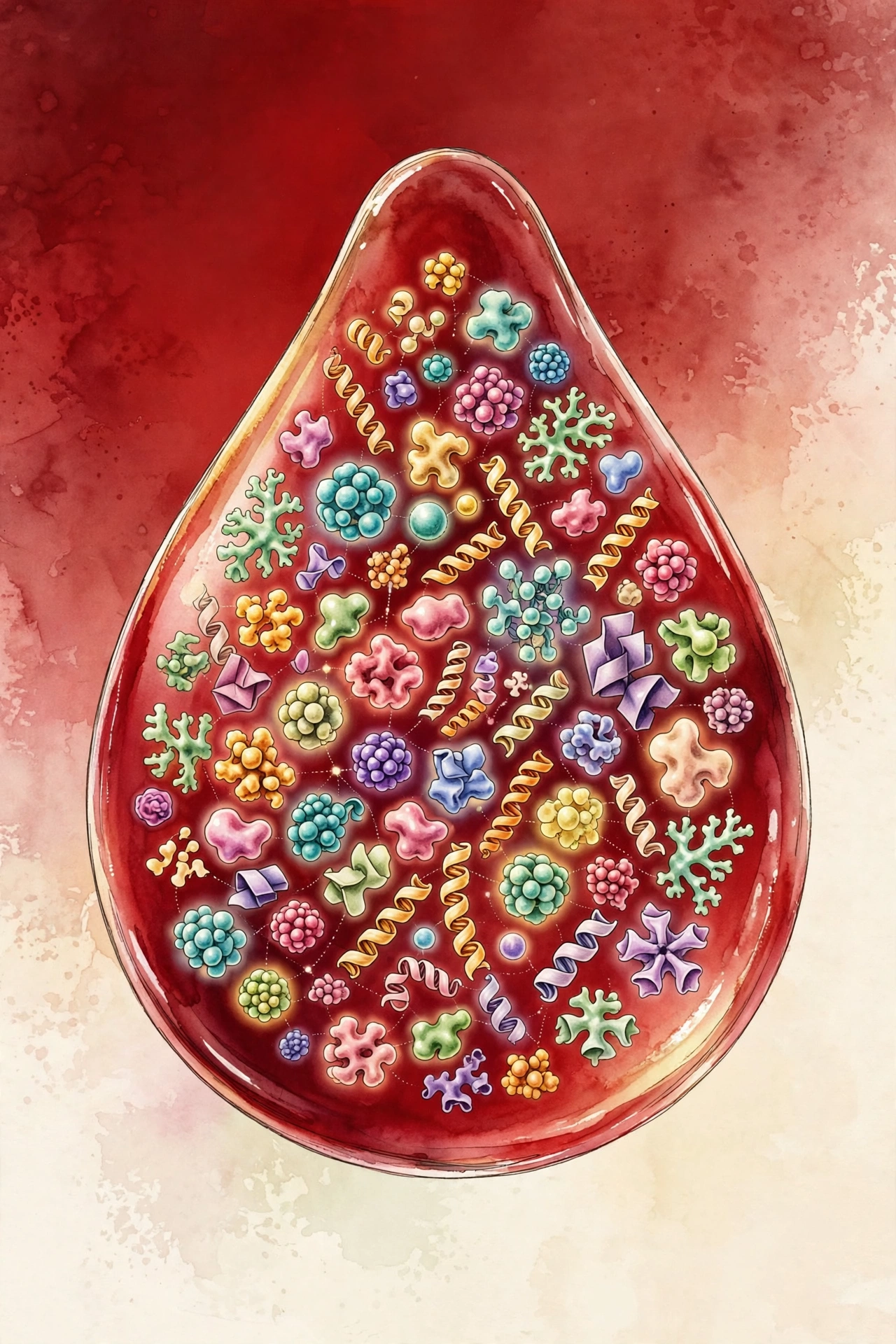
A single blood draw may hold 179,000 distinct protein variants, far more than the proteins themselves. Image generated by AI.
7. Peanuts and the ageing brain
The week’s most practical story was also the tastiest. Researchers at Maastricht University’s NUTRIM institute reported that 31 healthy adults aged 60 to 75 who ate 60 grams of unsalted, skin-roasted peanuts daily for 16 weeks showed improved brain insulin responsiveness in memory-related regions, including parts of the hippocampus and posterior cingulate gyrus, measured with arterial spin labelling MRI. The trial was a randomised, controlled crossover design, and the paper appears in Food & Function (Kerkhof et al., DOI: 10.1039/d6fo03208g). Two caveats worth knowing: the study was funded by The Peanut Institute Foundation (the authors state the funder had no role in the science), and insulin responsiveness is a mechanism, not a clinical outcome. Nobody should treat peanuts as a prescription, but as a piece of the brain-health puzzle it is an appetising one.
Sixteen weeks of daily peanuts was linked to better brain insulin responsiveness in adults aged 60 to 75. Image generated by AI.
Why it matters
Taken together, the week reads like a progress report on scientific senses. Optogenetics and IceCube extend what we can probe, from single neurons to cosmic neutrinos. The proteome atlas extends what we can count, down to protein variants in a blood draw. And the FRB and Webb results extend what we can see, across ten billion years and onto a failed star next door. That is the pattern worth watching: the instruments keep getting better, and the universe keeps obliging.
Sources
- Nobel Prize official announcements: Physiology or Medicine, Physics, Chemistry
- Caleb et al., Science (2026), DOI: 10.1126/science.adz2675 (via phys.org)
- Miles et al., arXiv:2609.20664 (2026), arxiv.org/abs/2609.20664v1 (via phys.org)
- Ralser et al., bioRxiv preprint (2026), DOI: 10.64898/2026.09.26.754256 (preprint, not peer-reviewed)
- Kerkhof et al., Food & Function (2026), DOI: 10.1039/d6fo03208g (via medicalxpress)










0 Comments