


Originally published by D. Graham Burnett in The Public Domain Review on January 21, 2026, under a Creative Commons licence (CC BY-SA 4.0) (“The text of this essay is published under a CC BY-SA license”). Republished here under that licence. This adaptation is shared under the same licence (CC BY-SA 4.0). The Public Domain Review and the authors are not contributors to TeaLamp and do not endorse it or its use of their work. The essay asks what we mean by cybernetic attention and where the idea came from. Changes: formatting, image captions rewritten, some images left out, an AI-generated illustration and a short “Key takeaways” section added by TeaLamp. Prepared for TeaLamp by the TeaLamp Editorial Team with the help of AI.
We worry about our attention these days — nearly all of us. There is something. . . wrong. We cannot manage to do what we want to do with our eyes and minds — not for long, anyway. We keep coming back to the machines, to the screens, to the notifications, to the blinking cursor and the frictionless swipe that renews the feed.
An ethnographer from Mars, moving among us (would we even notice?), might have trouble understanding our complaint: “Trouble with their attention? They stare at small slabs of versicolor glass all day! Their attentive powers are. . . sublime!”
And that misunderstanding rather sharpens the point: we don’t have any problem at all with the forms of attention that involve remaining engaged with, and responsive to, machines. We are amazing at the click and tap of durational vigilance to this or that stimulus, presented at the business end of a complex device. Our uncanny and immersive cybernetic attention is a defining characteristic of the age. Our human attention — our ability to be with ourselves and with others, our ability to receive the world with our minds and senses, our ability to daydream, read a book uninterrupted, or watch a sunset — well, many of us are finding it increasingly difficult to remember what that might even mean.
This isn’t really an accident. Over the last century or so, a series of elaborate programs of laboratory research have worked to slice and dice the attentional powers of human beings. Their aim? To understand the operational capacities of those who would be asked to shoot down airplanes, monitor radar screens, and otherwise sit at the controls of large and expensive machines. Seated in front of countless instruments, experimental subjects were asked to listen and look, to track and trigger. Psychologists stood by with stopwatches, quantifying our cybernetic capacities, and seeking ways to extend them. For those of us who have come of age in the fluorescence of the “attention economy”, it is interesting to look back and try to catch glimpses of the way that the movement of human eyeballs came under precise scrutiny, the way that machine vigilance became a field of study. We know now that the mechanomorphic attention dissected in those laboratories is the machine attention that is relentlessly priced in our online lives — to deleterious effects.
You could say that this process began with the fascinating and now mostly forgotten tool known as the “pursuit test”. Part steampunk videogame, part laboratory snuff-flick, the pursuit test staged and restaged the integration of man and machine across the first decades of the twentieth century.
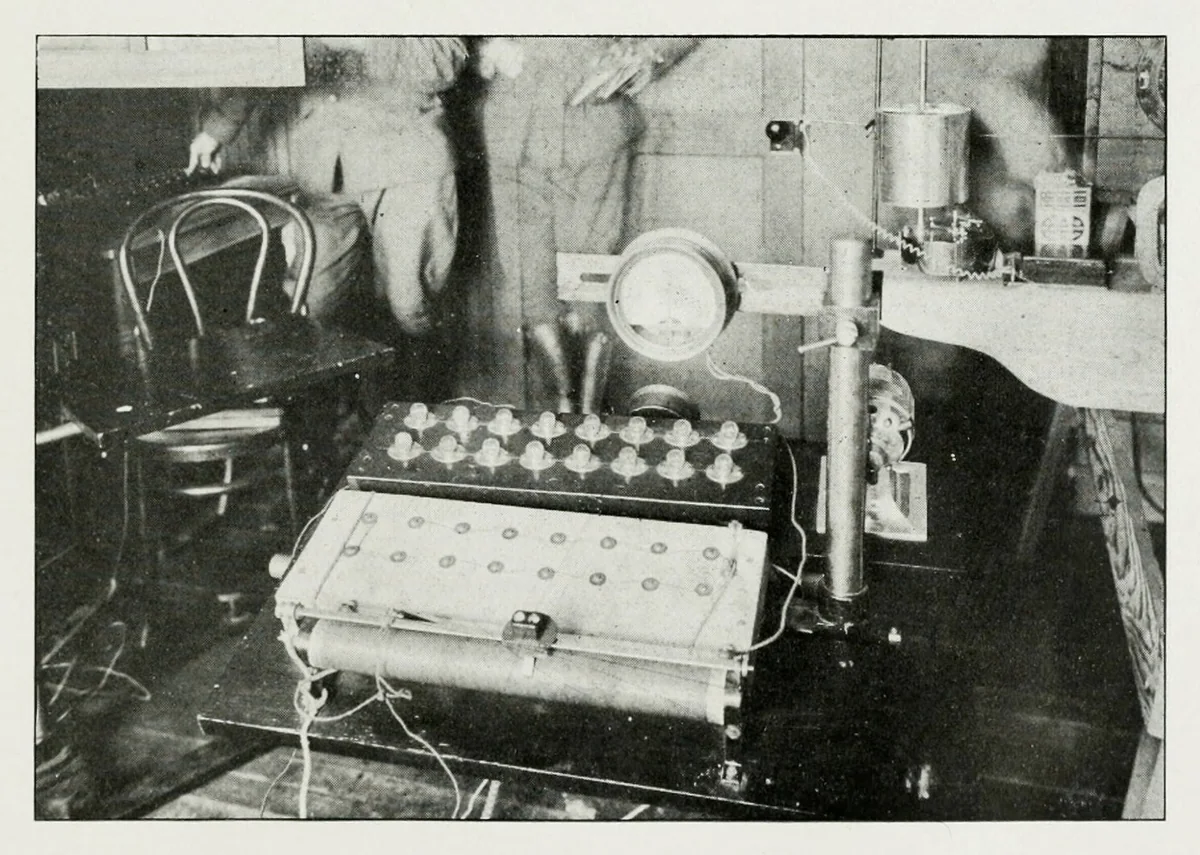
Early pursuit test developed by the psychologist Knight Dunlap for studying aviators’ attention, from the US War Department’s Air Service Medical (1919). Public domain, via The Public Domain Review.
This photograph depicts an early example of these devices, an elaborate apparatus developed by the mechanically minded American psychologist Knight Dunlap (1875–1949) during his work at the Medical Research Laboratory of the Air Service during World War I. We can think of it as a “beta build” of the pursuit test — an attention training system, used to assess aviators.
Dunlap was particularly and vocally concerned about the attentional capacities of airmen — especially under the extreme physiological conditions of combat-oriented powered flight. It is abundantly clear that he thought attention was of the utmost importance in the world of the military. Attention was also, as he saw it, one of the key domains in which the science of psychology could directly assist in the selection and training of combat aviators:
The system that Dunlap developed to test this general attentive “integration” was a kind of attentional stress-test. How did it work? A plate of fourteen stimulus lights was set up in front of the subject, along with fourteen small brass pins. Every time one of these lights turned on, the subject had to use a small metal stylus to touch the adjacent pin. Those pins, however, were each surrounded by a metal washer, and a sloppy gesture that nicked the washer amounted to a “fail” — and tallied an error. This part of the system worked a bit like a high-stakes version of the children’s game known as “Operation”. But that was not all. The full test panel also included a small amp-meter, which had been wired into a pair of rheostats: one controlled by the experimenter, the other controlled by the subject. These could be used to offset each other, so that as the experimenter pulled the needle of the amp-meter one way, the subject could, by manipulating his little dial, correct the needle back to center. And there was yet a third “problem” for the cadet to address (concurrently): a small motor sat on the table, and the experimenter could throw a switch that markedly reduced its running speed; the subject tried to restore its rate by depressing a pedal placed under the table.
Across twenty-five minutes, the cadet worked to monitor the lighted panel, keep the motor running at full speed, and hold the amp-meter needle at equilibrium while slowly. . . being deprived of oxygen — which definitely made it harder! (The subject wore a “rebreather” — a closed-loop respiration system that amounts to a gradual asphyxiation machine.)
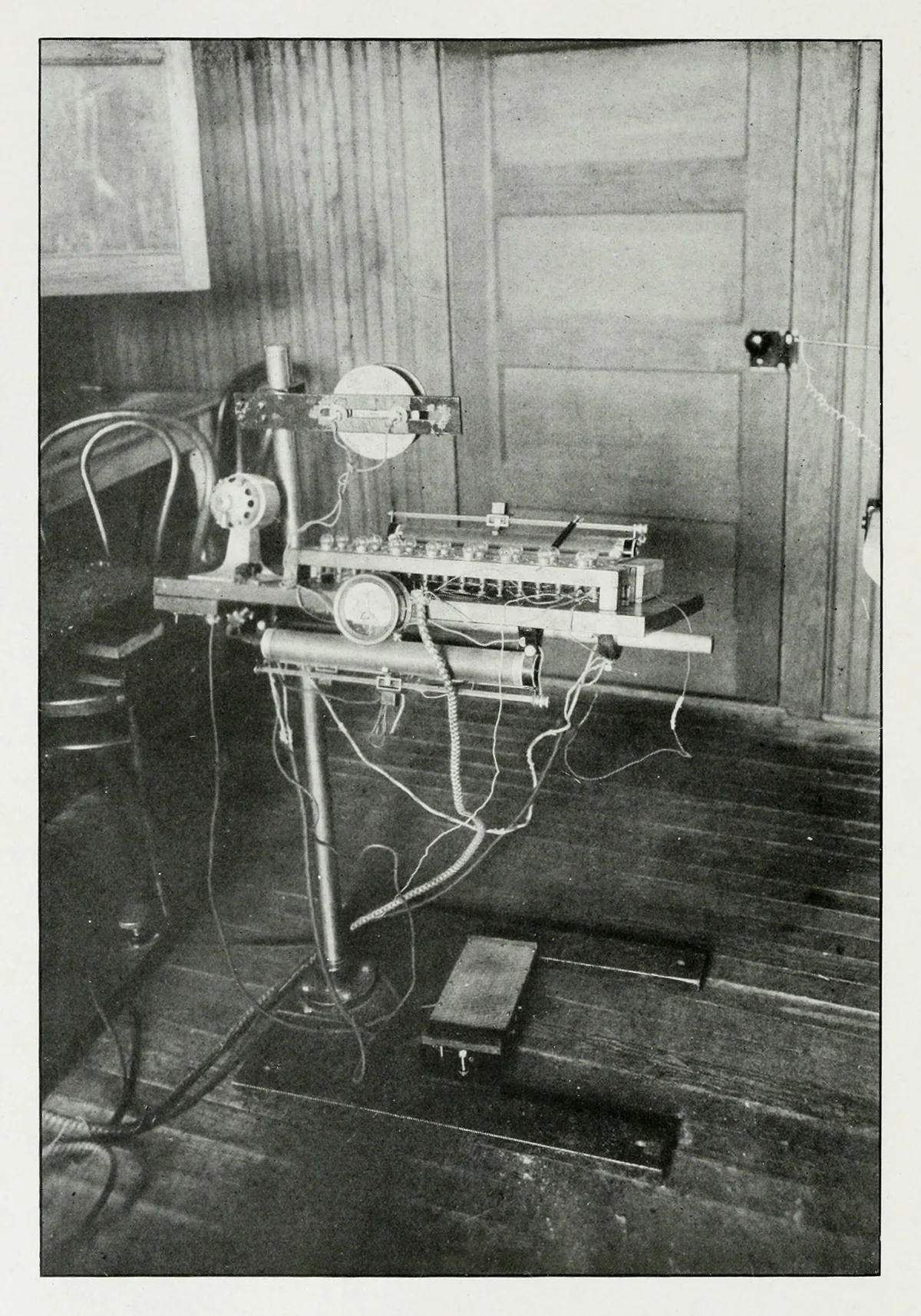
Knight Dunlap’s early pursuit test, with electrically sensitive pins, a rheostat for the amp-meter and a foot pedal, from Air Service Medical (1919). Public domain, via The Public Domain Review.
Experimental psychologists like Dunlap, working with early aviators, began to refigure their laboratory systems of attention-scrutiny as dynamic, scalar, and ultimately programmable instruments capable of monitoring and assessing long sequences of focused control. The pursuit tests were a direct result of this new attention problem.
Dunlap’s early device pitted the subject “against” the actual experimenter (who controlled the amp-meter to which the subject had to respond). But the next generation of pursuit tests automated the stimulus, and thus set the human subject against purely machinic trials. The most prominent of these was the Miles “Pursuitmeter”, invented by the American psychologist Walter R. Miles (1885–1978) in the early 1920s.
A first-class tinkerer in the laboratory, Miles would be remembered by his eulogists as a “gadgeteer supreme” of psychology across the first half of the twentieth century. With his irrepressible penchant for design, Miles invented a remarkable device that can be understood as the progenitor of a long line of increasingly sophisticated analogue feedback systems that would be used to train and assess the human capacity to enter into an intimate relationship with a dynamic mechanical apparatus. At the heart of the Pursuitmeter was a simple slit-sight, on which the subject focused all his attention.
The vertical white line is painted on the face of the slit-window. But the white dot bisecting that white line is motile, and drifts right and left, seemingly at random, over the course of an experimental run (it is driven by an internal clockwork program). The test subject, looking on, can “correct” these drifts by sliding the rheostat handle (“F”) to the right or left in such a way as to compensate for the dot’s departures. A recording device (not seen here) maintains a paper record of the location of the “cursor” in relation to the “crosshair” — a distance that was understood to correlate negatively with the focus and dexterity of the subject, who endeavors to keep the system “on target” as much as possible for the duration of the test.
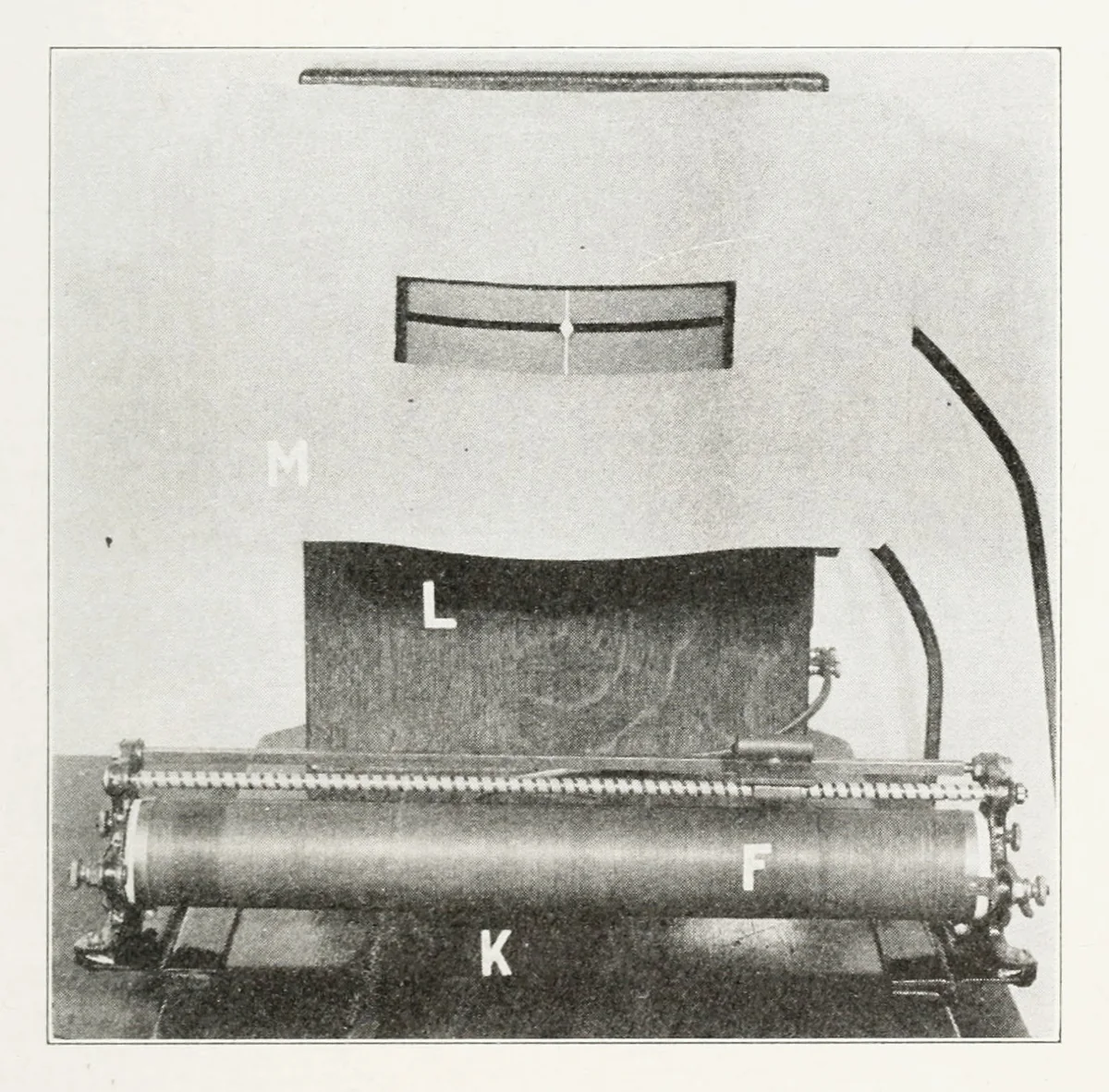
Walter R. Miles’s Pursuitmeter, from the Journal of Experimental Psychology (1921). Public domain, via The Public Domain Review.
In the photograph above, the subject is again undergoing one of a series of “asphyxiation” experiments designed to assess his capacities for sustained attention and motor response under conditions of reduced oxygenation (a standard problem for aviators flying without the assistance of supplemental oxygen, which only came into meaningful use after World War II).
Such a system created an uncanny (and novel) test-station for cybernetic integration. The Pursuitmeter manifestly staged a drawn-out dance of eye, hand, mind, and machine. Indeed, one can think of it as a remarkable inversion of the ordinary situation of a true “helmsman” (the Ancient Greek kybernētēs, from which “cybernetics” is derived). Whereas the pilot of an airplane provides regulating inputs that steer a system that is responding to real-time perturbations in the world, the Pursuitmeter flips the script; the machine “steers” its human through a set of reactions encoded in its program, assessing the human capacity to follow mechanical instructions. It is, in some sense, a “simulation” of the general problem of spatiotemporal homeostasis — keeping things on their keel. In another sense, however, it is robotic Simon Says.
The Miles Pursuitmeter, then, with its intricately programmed “disturber” circuitry of mechanically manipulated induction coils, and its continuous monitoring/recording of performance, represented a fully automated testing system. It charged those before it to give durational, focused attention to a percept, and the device kept track of each subject’s ability to follow and respond to a series of cues.
Looking at that subject, eyes fixed on the cursor, fingers tracking its movement — as his vision blurs and his consciousness gradually clouds into a hazy trance — we catch a glimpse of the future, of ourselves, eyes glazed, slipping ever deeper into the machine zone. This is not an accident. It is the result of a long history of placing humans in front of machines — and asking them to keep up.
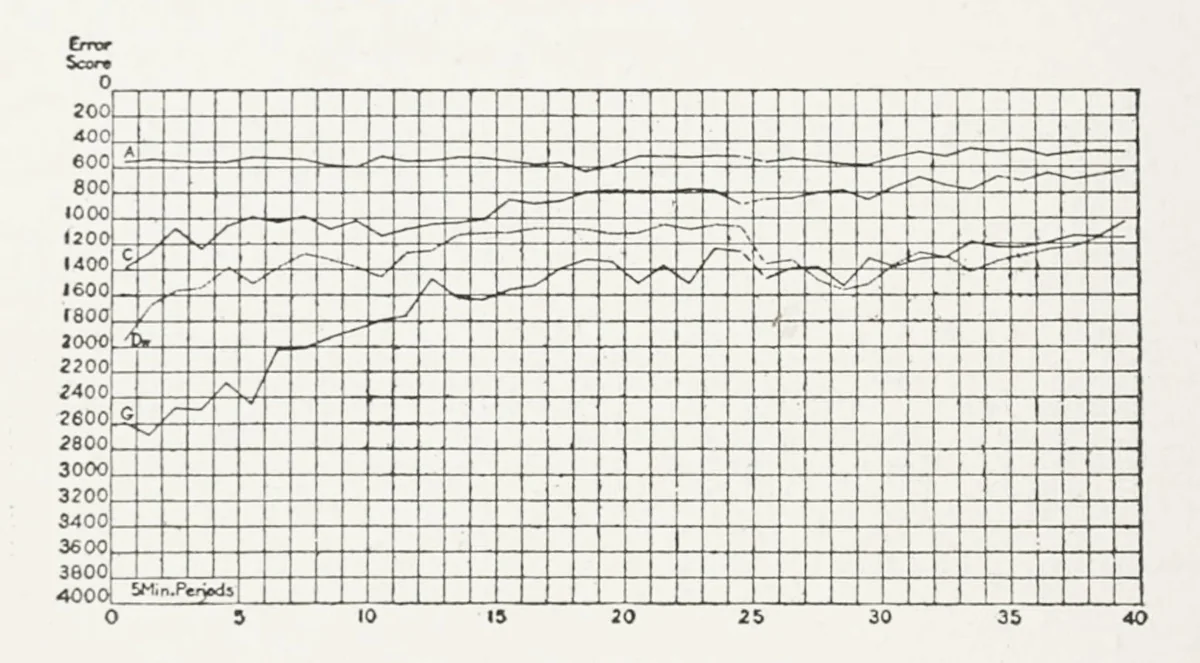
Practice curves showing the acquisition of skill in the Pursuitmeter test, from the Journal of Experimental Psychology (1921). Public domain, via The Public Domain Review.
We worry about our attention these days. But what we mostly worry about is cybernetic attention, the attention of the pursuit tests — our eyes on the stimulus, our fingers moving responsively. And there is, in fact, a direct line that links those pilot-testing contraptions to the click and tap of our modern attention economy. Pursuit tests were part of the history of experimental psychology — part of the laboratory efforts to quantify and measure the sensory and psychic features of the human person. Attention rose to prominence in this enterprise early, and the kind of attention that came under scrutiny in those laboratories was an instrumental, operational attention — the kind that could be elicited and assessed by instruments. For all the significance of these forms of attention in the machine ecologies of the military industrial complex, it was in the emerging big-money world of advertising that these tools found their most consequential application: from the Neilsen “audiometer” that monitored the radio dials of Americans, to the increasingly powerful eye-tracking systems that quantified the “attention value” of each glance, the metrical mechanisms of attention monitoring became the engines of the attention economy.
Is all that quick-twitch scrutiny, all that durational commitment to machine interfaces, actually “attention”? Yes and no. You can certainly call those behavior capacities of the human animal “attention”, and you can generate a lot of peer reviewed scientific literature about that kind of attention — precisely because it is easy to measure, and therefore lends itself to the forms of quantitative analysis prized in science and medicine. However, reading, too, is an attentional act, but it is harder to assess in quantitative terms. Not impossible. But difficult. And love. Love, too, is an act of attention. And it quantifies very badly indeed.
How do we address the “attention crisis” of our moment? The intense “human fracking” of the AI-driven attention economy? One way to move forward is to take a moment to remember that cybernetic attention is. . . just that. And human attention is something else. Step away from the pervasive pursuit tests of late modernity, and see what happens.
Key takeaways on cybernetic attention
- Early twentieth-century psychologists such as Knight Dunlap and Walter R. Miles built “pursuit tests” that asked people to track and respond to a moving signal while operating a machine.
- The author argues that today’s worries about attention are really about cybernetic attention: eyes on a stimulus and fingers responding to it.
- Reading, and even love, are also acts of attention, but they are much harder to measure.
- His suggestion is to step away from the “pursuit tests” of modern life and see what happens.










0 Comments