

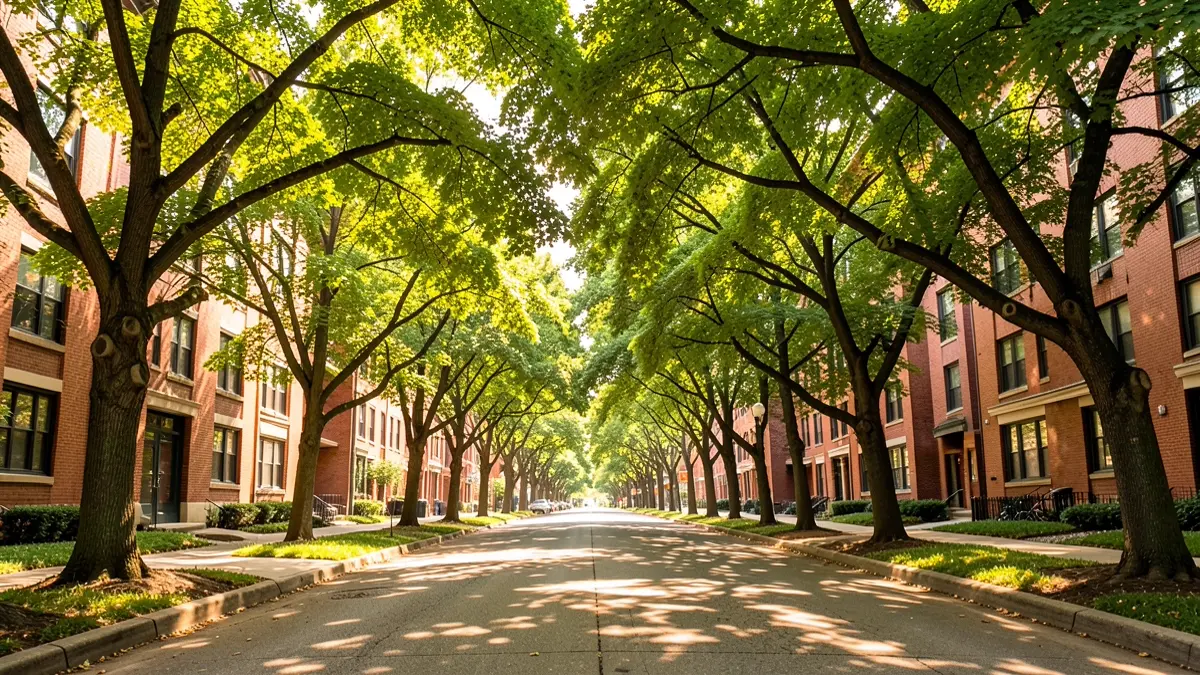
An original TeaLamp explainer based on the sources listed below. Prepared by the TeaLamp Editorial Team with the help of AI.
Step off a tree-lined street onto a bare one on a hot afternoon and you feel the difference at once: heavier air, shimmering pavement, nowhere to hide from the sun. The trees were doing quiet work all along. City trees are not decoration. They are part of how a city keeps itself liveable when the summer heat arrives.
Key takeaways on city trees
- Cities run hotter than the countryside around them, by about 1 to 7 degrees Fahrenheit in the daytime.
- City trees cool a street in two ways: shade that stops surfaces heating up, and transpiration, which releases water vapour and cools the air.
- Cooling grows much stronger once tree cover passes about 40 percent of a city block.
- Raising tree cover to 30 percent in 93 European cities could have prevented 2,644 premature deaths in a single summer.
- The shade is not shared fairly: poorer neighbourhoods and communities of colour have far fewer trees and run much hotter.
Why cities run hot
A city is a heat trap by design. Buildings, roads and pavements are made of concrete, asphalt and brick, materials that soak up the sun all day and give the heat back slowly, long after sunset. There is little greenery to break the pattern. The United States Environmental Protection Agency puts the gap plainly: urban areas run about 1 to 7 degrees Fahrenheit warmer than the land around them in the daytime, and about 2 to 5 degrees warmer at night.
The gap is not just a matter of comfort. A 2023 study in The Lancet looked at 93 European cities during the summer of 2015 and found that the extra city heat raised temperatures by a population-weighted average of 1.5 degrees Celsius, with the gap reaching 4.1 degrees in Cluj-Napoca, Romania. About 6,700 premature deaths that summer could be traced to the hotter urban temperatures, around 4.3 percent of all deaths in those cities over the summer months.
How a tree cools a street
A tree cools in two ways, and both matter. The first is the obvious one: shade. A tree’s canopy, the leafy roof it spreads overhead, stops sunlight from reaching the pavement, the walls and the parked cars below. Surfaces out of direct sun store less heat, so the whole street stays cooler into the evening.
The second way is quieter and easy to miss. Trees release water vapour through tiny pores in their leaves, a process called transpiration. As the water changes from liquid to vapour it takes energy with it, and the air around the tree cools down. It works a little like a small air conditioner, running hardest on the hottest days. Shade and transpiration together are what make a tree-lined street feel like a different place from a bare one a block away.
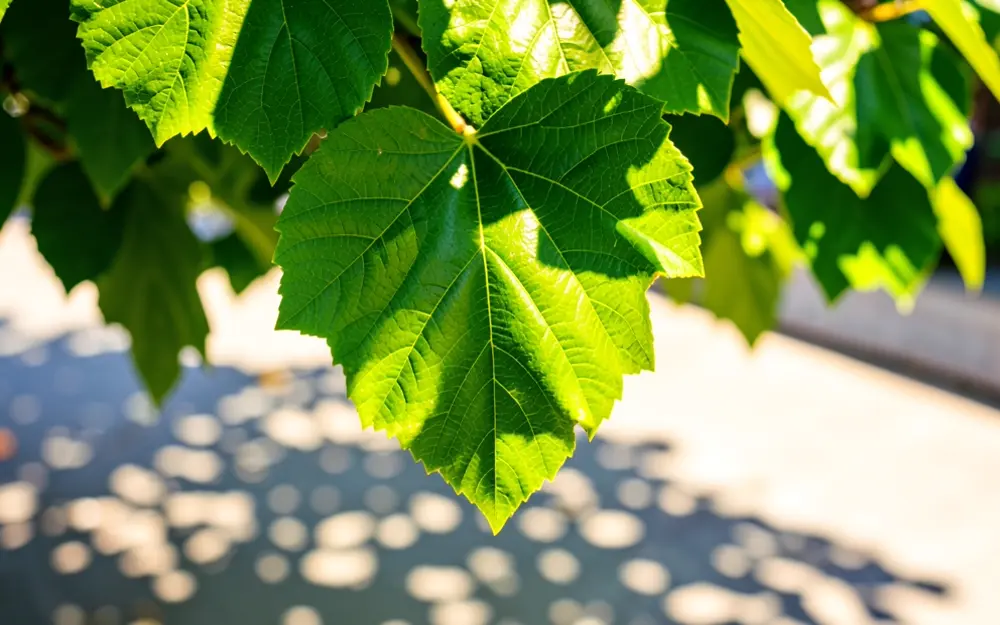
Sunlight through fresh leaves, with dappled shade on the pavement below. Image generated by AI.
The 40 percent tipping point
How much tree cover does a street actually need before the cooling becomes serious? A 2019 study in the Proceedings of the National Academy of Sciences went looking for the answer on bicycles. Researchers in Madison, Wisconsin, fitted small weather stations to bikes and rode about 7 kilometres of streets, measuring the air temperature every 5 metres on summer days.
What they found was a city of small climates. Daytime air temperature varied by an average of 3.5 degrees Celsius across Madison, and the gap between heavily treed spots and treeless ones could reach 4 to 5 degrees. The cooling did not rise in a straight line: it grew much stronger once the canopy, the share of ground covered by leaves, passed about 40 percent at the scale of a typical city block, about 60 to 90 metres across. Below that level, trees helped; above it, they changed the street.
The same study found a limit worth knowing. Trees did little for the heat at night, when the sun is gone and the stored warmth comes out of the pavement itself. For night heat, cutting back paved surfaces matters more than planting alone.
What 30 percent cover could save
The Lancet researchers did not stop at counting the cost of hot cities. They modelled what would happen if each of the 93 cities raised its tree cover to 30 percent, a target many cities already aim for. The answer was a mean cooling of 0.4 degrees Celsius across the cities, a small number with a large human meaning: about 2,644 premature deaths could have been prevented in that one summer, roughly one in three of all the deaths linked to city heat.
The starting point shows how far most cities have to go. Average tree cover across the cities studied was just 14.9 percent. Lisbon stood at 3.6 percent, Barcelona at 8.4 percent and Cluj-Napoca at 7 percent, while London managed 15.5 percent and Oslo, the greenest of the group, reached 34 percent. The study was a model, not a measurement of real plantings, using 2015 data because population figures for a more recent year were not available.
The 3-30-300 test
How should a city judge whether it has enough trees? In 2023, the researcher Cecil Konijnendijk published a simple rule of thumb, the 3-30-300 rule: every home, school and workplace should have a view of at least 3 trees, every neighbourhood should have 30 percent tree canopy cover, and every resident should live within a 300-metre walk of a park or green space.
A 2024 study in Nature Communications put the rule to the test against more than 2.5 million buildings in eight cities: Amsterdam, Buenos Aires, Seattle, Denver, New York, Singapore, Melbourne and Sydney. Most buildings failed, mainly for lack of canopy. Fewer than one building in five passed the 30 percent test in every city except Singapore and Seattle, and in half the cities, between a quarter and two fifths of buildings sat in neighbourhoods with only 0 to 10 percent canopy.
The study also found that the trees cities already have are often too small to give proper cover. Its authors argue cities should do more than plant: give young trees room and good soil to grow into, protect mature trees from early removal, and stop pruning them back so hard that the canopy never forms.
A park bench in the shade of mature trees, with the city behind them. Image generated by AI.
Who gets the shade
The shade is not shared fairly. In the United States, the conservation group American Forests scores neighbourhoods for tree equity, weighing canopy against heat, income, health and race. Its figures are stark: lower-income neighbourhoods have about 26 percent less tree cover than wealthier ones and run about 6 degrees Fahrenheit hotter, while communities of colour have about 38 percent less cover and run about 13 degrees hotter.
Closing the gap would take about 500 million more trees across American cities. There is money moving in that direction: the 2023 Inflation Reduction Act set aside 1.5 billion dollars for urban and community forestry. Where the trees go matters as much as how many are planted: the hottest streets usually have the fewest trees and the people least able to escape the heat.
What cities can do
Planting is only the start. A young tree takes years to grow a cooling canopy, and in its first years it needs regular watering, especially in dry summers. The wrong species in the wrong place can struggle, crack pavements with its roots, or die in a drought. That is why the cities doing this well protect the mature trees they already have first: a big old tree cools more today than a sapling will for decades.
The rest is patient work: space and decent soil for new trees, species that suit the local climate, watering while they establish, and less pavement where night heat lingers. Trees repay the effort with cleaner air, stored carbon, slower storm water and homes for birds. None of it is quick, and none of it works if the trees are planted and then forgotten.
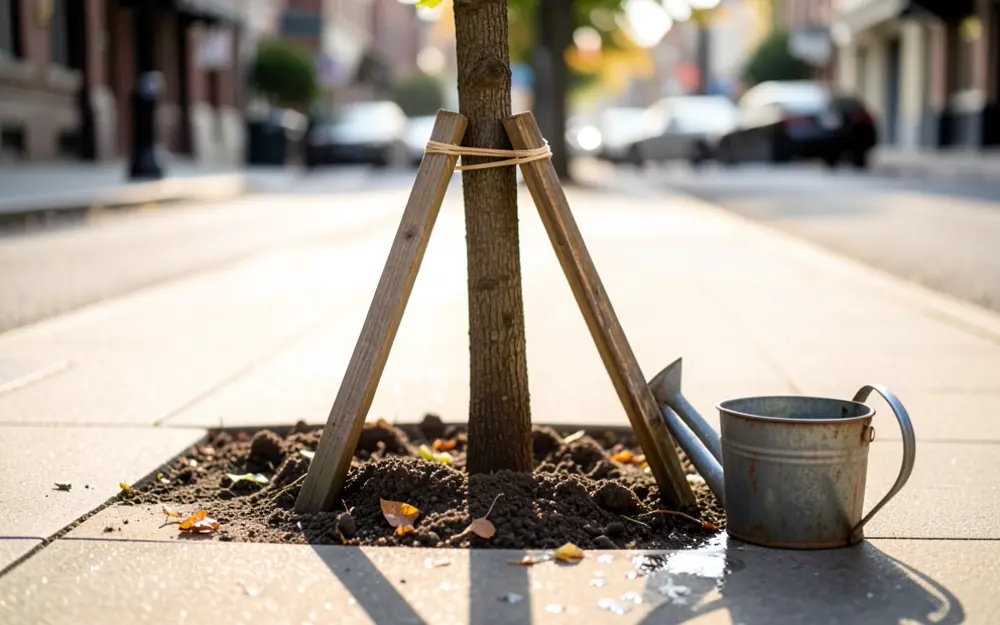
A newly planted street tree, staked and watered in. Image generated by AI.
Why it matters
City heat is not a future problem. It is already here, it already takes lives, and it falls hardest on people with the least shade. City trees are one of the few answers that is cheap, beautiful and proven: shade and water vapour, working street by street, block by block. A city that plants trees, protects the ones it has, and puts them where the heat is worst looks after everyone who lives in it.
Frequently asked questions
Do trees really cool a street, or just shade it?
Both. Shade stops the sun heating pavements and walls, and transpiration cools the air itself as water vapour leaves the leaves. Together they made a treed spot in Madison 4 to 5 degrees Celsius cooler than a treeless one nearby.
How long does a planted tree take to cool anything?
A young tree starts helping right away, but it takes years to grow a canopy large enough for serious cooling, and the effect grows much stronger once cover passes about 40 percent of a block. Planting for cool streets is long-term work, which is why protecting mature trees matters so much.
Can a city just plant its way out of heat?
Not on planting alone. Cities also need the right species, watering for young trees, protection for mature ones, and less pavement, which matters most for night heat. Planting is the most visible part of the answer, not the whole of it.
Related reading
For another story about how trees look after each other, read Mycorrhizal Networks: The Wood Wide Web, our explainer on the hidden fungal networks that connect trees underground.
Sources
- US Environmental Protection Agency. Learn About Heat Island Effects. Urban areas about 1–7°F warmer by day and 2–5°F warmer by night than outlying areas.
- Iungman, T., et al. (2023). Cooling cities through urban green infrastructure: a health impact assessment of European cities. The Lancet, 401(10376), 577–589. 93 European cities, summer 2015; 30% tree cover would cool cities by a mean of 0.4°C and could have prevented 2,644 premature deaths.
- Ziter, C. D., et al. (2019). Scale-dependent interactions between tree canopy cover and impervious surfaces reduce daytime urban heat during summer. Proceedings of the National Academy of Sciences, 116(15), 7575–7580. Bicycle-mounted sensors in Madison, Wisconsin; cooling strongest above about 40% canopy at city-block scale.
- Konijnendijk, C. C. (2023). Evidence-based guidelines for greener, healthier, more resilient neighbourhoods: Introducing the 3–30–300 rule. Journal of Forest Research, 34, 821–830.
- Croeser, T., et al. (2024). Acute canopy deficits in global cities exposed by the 3-30-300 benchmark for urban nature. Nature Communications, 15. More than 2.5 million buildings in eight cities; most fail the rule, mainly for lack of canopy.
- American Forests. Tree Equity. Lower-income neighbourhoods have about 26% less tree cover and run about 6°F hotter; communities of colour have about 38% less cover and run about 13°F hotter; about 500 million more trees needed.










0 Comments