

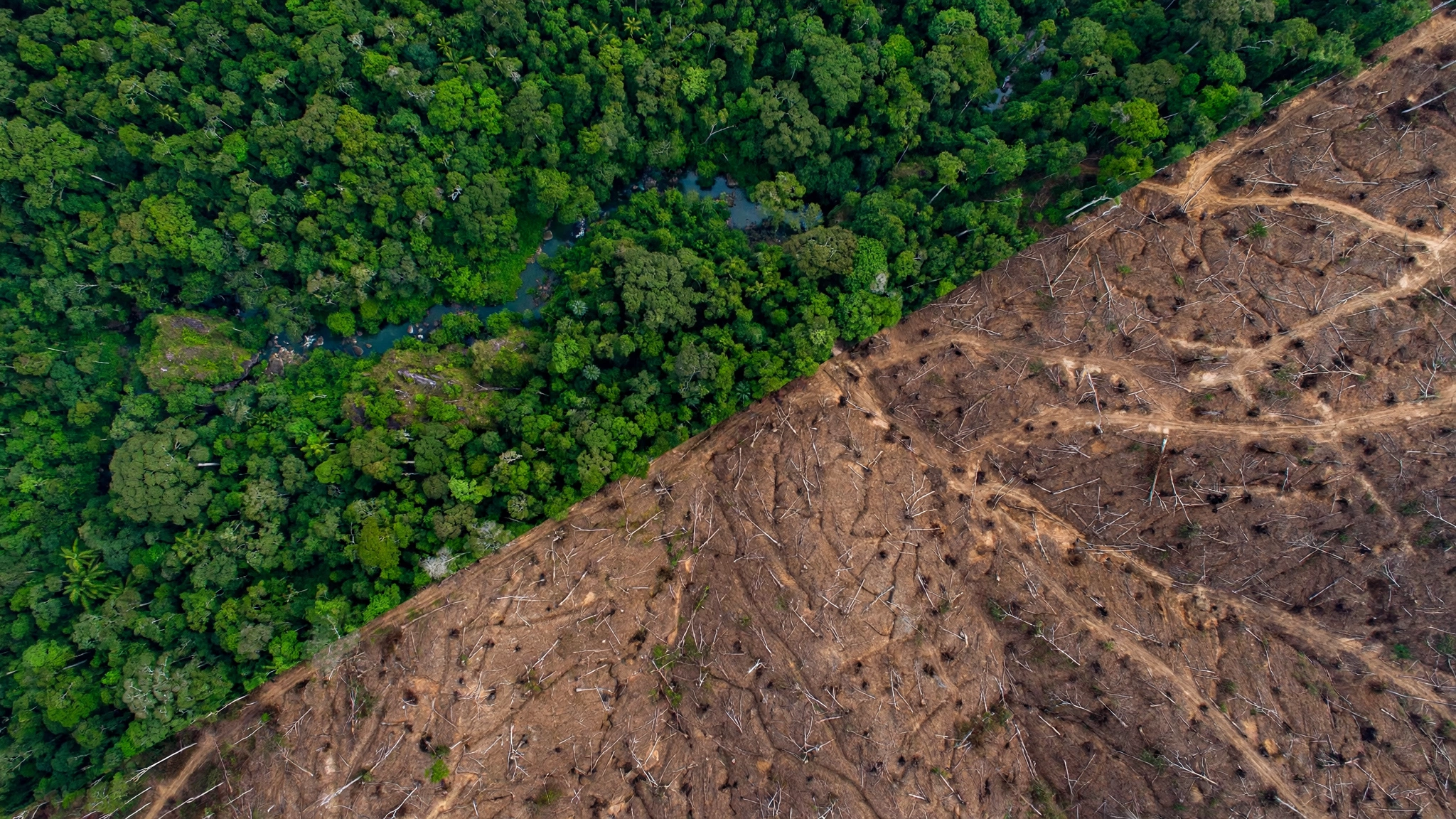
Originally published by Hannah Ritchie at Our World in Data on August 31, 2026, under a Creative Commons BY licence (CC BY 4.0). Republished here under that licence. Our World in Data and the author are not contributors to TeaLamp and do not endorse it. What follows is the original article, prepared for TeaLamp by the TeaLamp Editorial Team with the help of AI, with these changes: formatting, static images of the two charts in place of the interactive charts, an AI-generated illustration, and a short “Key takeaways” section added by TeaLamp. The article looks at the drivers of global deforestation and why beef production in Brazil stands out.
Since the turn of the century, an area of forest five times the size of my home country, the United Kingdom, has been cut down to free up land for farming.1
If we want to reduce — and ultimately end — deforestation, we need to know what’s causing it, and where.
When we look at the largest drivers of this deforestation, beef production is the standout. The clearing of forests to make space for grazing pastures has driven 41% of global deforestation in recent decades.2
Where has this happened? Mostly in Brazil. Almost two-thirds of it has taken place there, as you can see in the chart below. That means one-quarter of global deforestation is caused by beef production in Brazil.
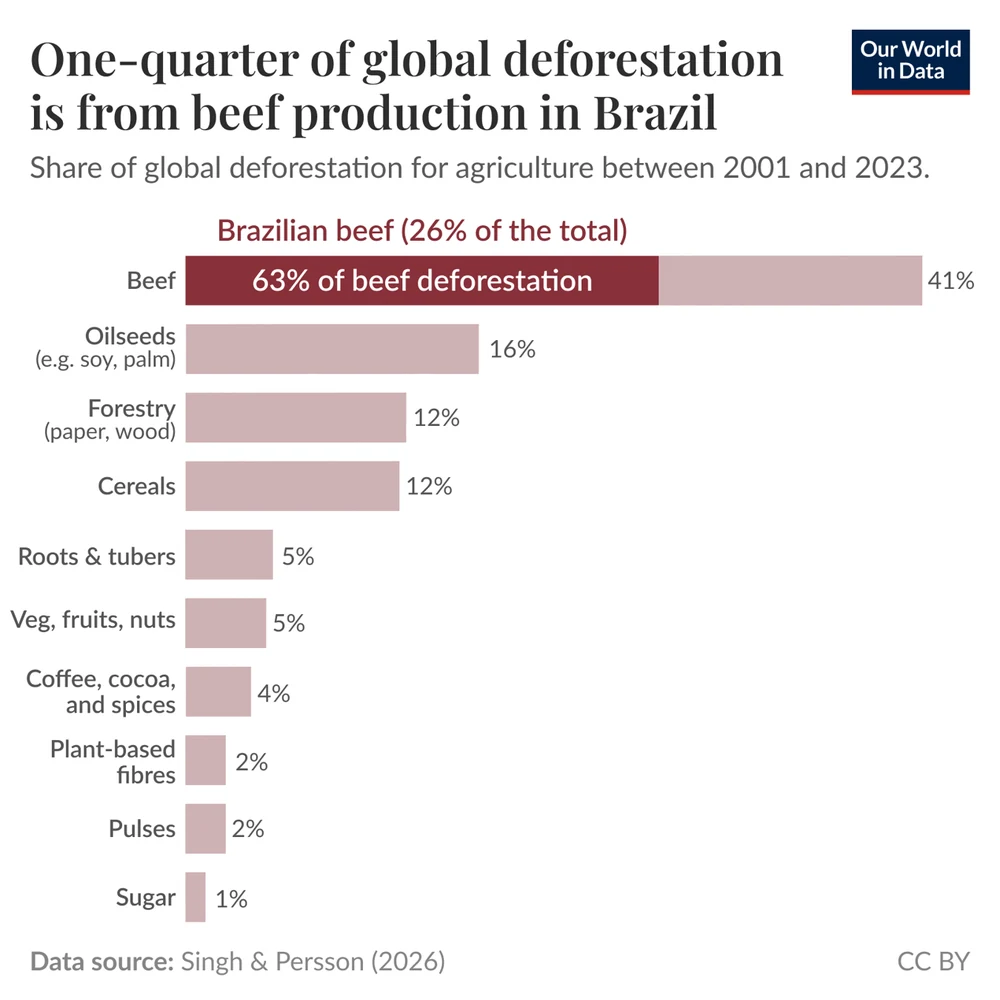
Chart: Our World in Data (author: Hannah Ritchie), licensed CC BY. Data: Singh & Persson (2026), via the interactive chart.
The expansion of cattle pastures has not just come at the expense of natural forests, but particularly of biodiverse regions in the Amazon rainforest and Cerrado savanna.
Aside: Since deforestation rates and drivers can vary a lot from year to year, here I’m looking at deforestation that happened in the two decades from 2001 to 2023. But if we look at data from only the last few years, we find a very similar result.
Forest giving way to pasture: an illustration, not a map. Image generated by AI
Since demand for beef is growing globally, one might think that a lot of this beef goes overseas. But this isn’t really true: most of the beef Brazil produces is consumed domestically.3
Beef consumption has grown a lot in Brazil, with per-person demand doubling over the past 50 years. Average consumption is now three times the European average.4
Estimates of “traded deforestation” confirm how much of this story is a domestic one.5 The chart below shows where the products that drive deforestation in Brazil end up. This data is for the period 2005 to 2023 (the only timeframe this trade-adjusted data is available), but you get similar results when looking only at the last few years.
Aside: You can explore these modeled trade estimates for other countries from DeforestationFootprint.earth.
An area of forest five times the size of the United Kingdom has been cut down to free up land for farming.
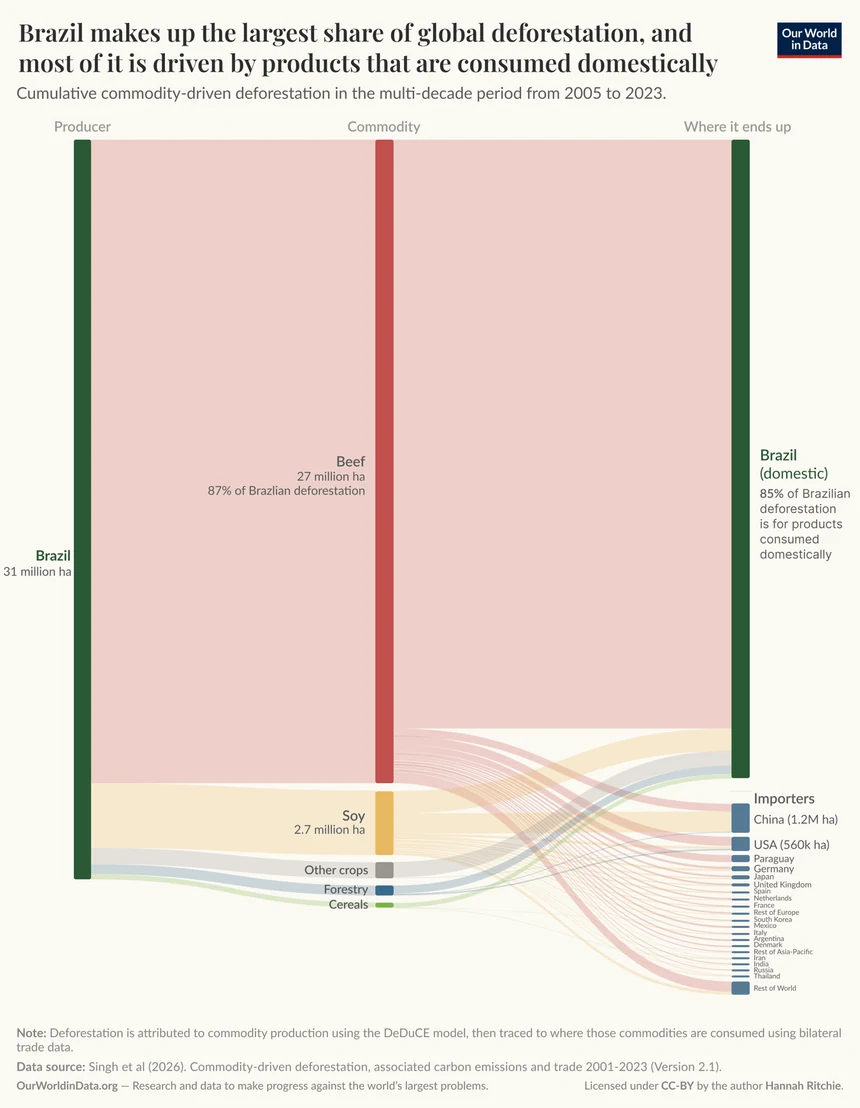
Chart: Our World in Data (author: Hannah Ritchie), licensed CC BY. Data: Singh et al. (2026), Commodity-driven deforestation, associated carbon emissions and trade 2001–2023 (Version 2.1, CC BY 4.0).
Again, you can see that beef production dominates.
Around 85% of deforestation in the country was driven by domestic demand. The other 15% was exported and spread across many countries — China and the United States are the largest importers, but none are particularly dominant.
International demand for beef (and soy) has driven some deforestation in Brazil, but most of it has been to meet demand at home.
Acknowledgments
Many thanks to Max Roser and Edouard Mathieu for their comments and suggestions on this article.
Why it matters
Deforestation is one of the largest sources of carbon dioxide from land use, and the Amazon and the Cerrado are among the most biodiverse places on Earth. The striking finding of this research is how concentrated the problem is: a single commodity, in a single country, drives about one-quarter of all commodity-driven deforestation worldwide — and most of that beef never leaves Brazil. That concentration also means targeted policies, from supply-chain monitoring to protecting the Cerrado, can have an outsized effect.
Frequently asked questions
What is commodity-driven deforestation?
It is forest cleared to produce traded agricultural commodities — beef, soy, palm oil, timber plantations — as opposed to forest lost to small-scale farming, fires, or natural causes.
What is the Cerrado?
The Cerrado is a vast tropical savanna in Brazil, covering about one-fifth of the country. It is less famous than the Amazon but holds extraordinary biodiversity, and much of Brazil’s agricultural expansion has happened there.
Does imported beef drive deforestation?
According to the trade-adjusted data in this article, around 85% of Brazil’s commodity-driven deforestation is linked to demand inside the country; the exported share goes mostly to China and the United States. The footprint of beef depends strongly on where and how it was produced.
Key takeaways on global deforestation
- Grazing pastures for beef have driven about 41% of global deforestation in recent decades, and almost two-thirds of that happened in Brazil.
- That makes Brazilian beef responsible for about one-quarter of global deforestation, particularly in the Amazon rainforest and the Cerrado savanna.
- Around 85% of Brazil’s commodity-driven deforestation was linked to demand inside the country; the other 15% was exported, mainly to China and the United States.
Endnotes
- Commodity-driven deforestation between 2001 and 2023 was estimated at 128 million hectares globally. This includes agricultural production and forest plantations. The United Kingdom has a land area of around 24 million hectares. [128 million / 24 million = 5.3 times the size].
- Singh, C., & Persson, U. M. (2026). Global patterns of commodity-driven deforestation and associated carbon emissions. Nature Food.
- The country produces around 9–10 million tonnes of beef each year, of which around 3 million tonnes are exported.
- In 2023, it was third in the global rankings, behind Argentina and Zimbabwe, which consume slightly more.
- Singh, C., Persson, U. M., Croft, S., Kastner, T., & West, C. D. (2026). Commodity-driven deforestation, associated carbon emissions and trade 2001–2023 (Version 2.1) [Dataset]. Zenodo.










0 Comments