

An original TeaLamp explainer based on the sources listed below. Prepared by the TeaLamp Editorial Team with the help of AI.
The Mona Lisa theft of 1911 is one of the strangest turning points in art history. Today Leonardo da Vinci’s small portrait is probably the most famous painting in the world, the reason millions of people queue in the Louvre every year. Yet before a handyman walked out of the museum with it under his smock, it was admired mostly by artists, critics and well-read travellers. Here is how the theft happened, why the empty wall caused such a sensation, and how two years of mystery helped turn a celebrated Renaissance portrait into a global icon.
Key takeaways on the Mona Lisa theft
- On Monday 21 August 1911, while the Louvre was closed, a former museum worker named Vincenzo Peruggia lifted the Mona Lisa off its wall and walked out with it.
- The painting was missing for more than two years, and suspicion briefly fell on the poet Guillaume Apollinaire and the painter Pablo Picasso, who were both cleared.
- Peruggia was caught in Florence in December 1913 when he tried to sell the painting, and it returned to the Louvre on 4 January 1914.
- Worldwide press coverage of the theft and recovery made the painting a household name far beyond the art world.
- Its later fame grew through reproductions, parodies, a celebrated 1963 visit to the United States and, today, mass tourism.
A famous painting, but not yet a superstar
Leonardo began the portrait in the early 1500s; a note written in October 1503 by Agostino Vespucci, a contemporary of the artist, confirms he was working on it then. It is traditionally thought to show Lisa del Giocondo, a member of the Gherardini family of Florence and the wife of a wealthy silk merchant, Francesco del Giocondo. Leonardo kept working on the picture for years and took it with him when he moved to France. It later entered the collection of King Francis I and, after the French Revolution, became one of the first works shown in the Louvre as a public museum.
By the nineteenth century the painting was well known among the educated public. French writers praised its mysterious smile, and an 1878 Baedeker travel guide called it the most celebrated work of Leonardo in the Louvre. But it was one masterpiece among many. Visitors to the Salon Carré, where it hung, could see it alongside works by Titian, Correggio and other great names, and few would have called it the single most important painting on Earth.
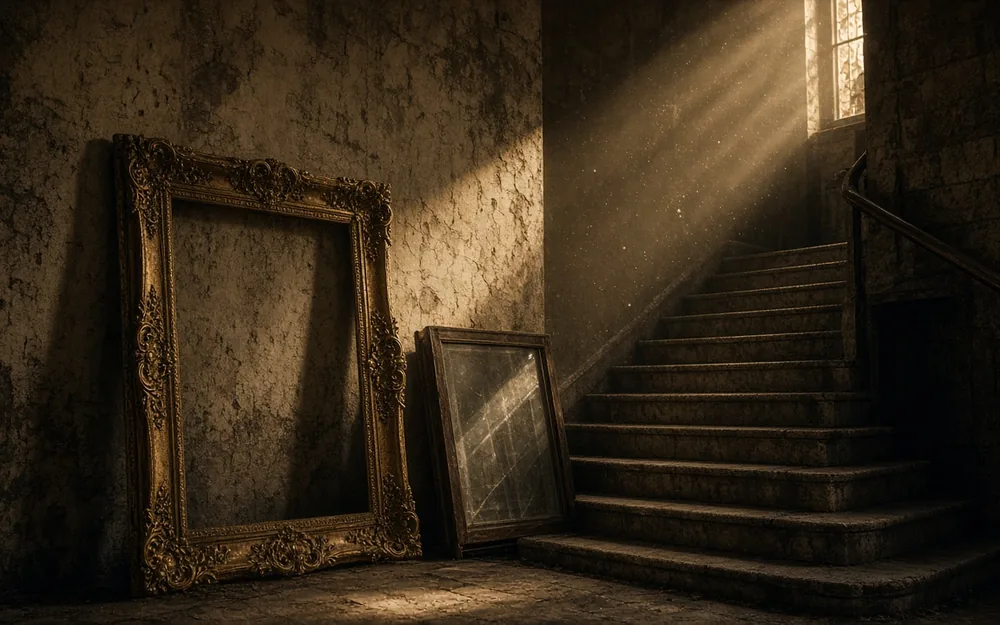
An empty frame left on a service staircase, as in the 1911 theft. Image generated by AI.
How the theft happened
Vincenzo Peruggia was an Italian decorator who had moved to Paris and briefly worked at the Louvre as a glazier. He had even helped fit the protective glass cases that some paintings, including the Mona Lisa, had recently been given. According to his later statements to police in Florence, he entered the museum early on the morning of Monday 21 August 1911, a day the Louvre was closed to the public. He came in through the workers’ door wearing one of the white smocks that museum staff wore, so he looked like any other employee.
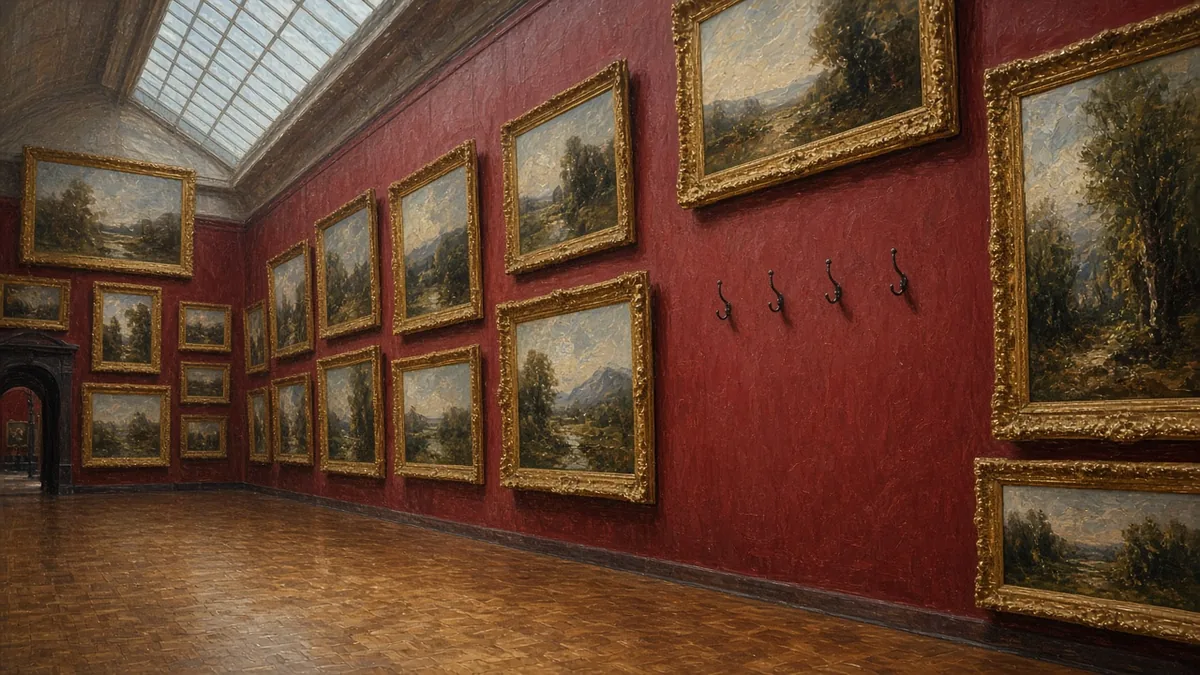
When the Salon Carré was empty, he lifted the painting from the four iron pegs that held it on the wall and carried it to a nearby service staircase. There he removed the glass case and the frame and left them behind. The painting itself is on a wooden panel of poplar, small enough to hide under a smock. He then walked out of the building.
Remarkably, nobody noticed for more than a day. On Tuesday the painter Louis Béroud arrived to work on a picture of the gallery and found only the bare wall. At first staff assumed the portrait had been taken away to be photographed. When it became clear that it was gone, the museum closed for a week while police searched the building.
Suspects, headlines and an empty wall
The investigation soon became a public drama. The poet Guillaume Apollinaire came under suspicion, partly because of an earlier scandal involving small statues stolen from the Louvre years earlier by his former secretary, and he was arrested and briefly jailed. He in turn implicated his friend Pablo Picasso, who was brought in for questioning. Both men were cleared, but the idea that two famous figures of the Paris avant-garde had been linked to the case only added to the excitement.
Newspapers in France and abroad followed every rumour. Police even visited Peruggia’s apartment and questioned him twice, but he was not treated as a main suspect. Meanwhile, the painting’s absence became a story in itself. A photograph of the bare wall in the Salon Carré survives as a reminder of how strange that gap looked. The art historian Bernard Berenson, who had never loved the picture, admitted that it had “simply become an incubus” and that he was glad to be rid of her. For most people, though, the loss turned a painting they had barely thought about into one they suddenly wanted to see.
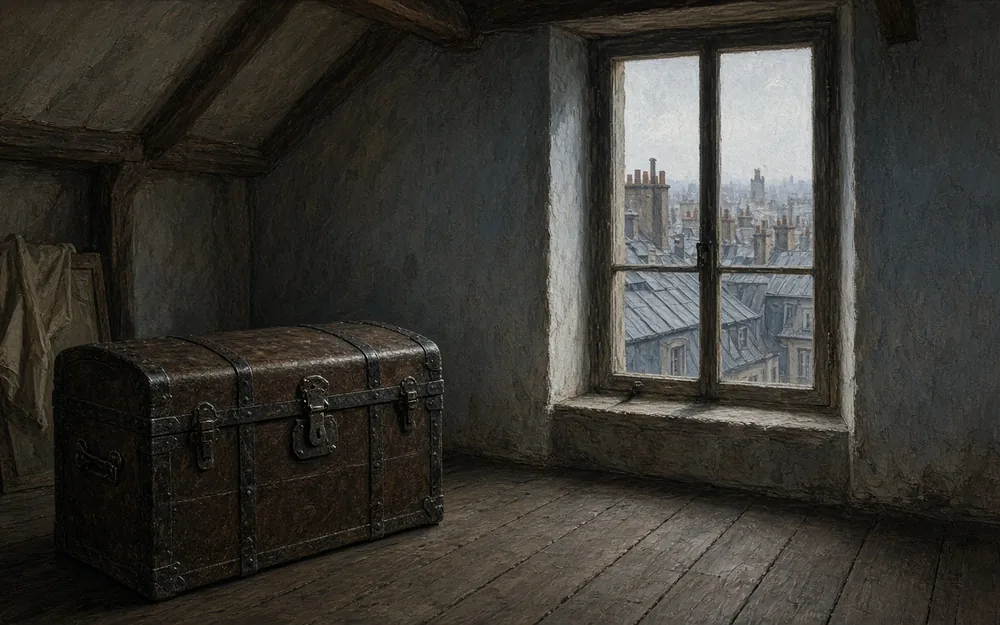
For two years the painting lay hidden in a trunk. Image generated by AI.
Two years in a trunk
For more than two years the Mona Lisa lay hidden in a trunk in Peruggia’s room in Paris. Eventually he took it by train to Italy. In late 1913 he contacted Alfredo Geri, an art dealer in Florence, signing himself “Leonardo V.” Geri brought in Giovanni Poggi, the director of the Uffizi Gallery, to examine the painting. Once they were sure it was genuine, the police were called, and Peruggia was arrested on 12 December 1913.
The recovery was front-page news. The painting was shown at the Uffizi in Florence for a little over two weeks, drawing large crowds, before it was returned to Paris. It was back in the Louvre on 4 January 1914, to great celebration.
Peruggia said he had acted out of patriotism, believing the painting had been taken from Italy by Napoleon and should go home. In fact, the record points the other way: Leonardo himself brought the work to France, and it had belonged to the French crown since the sixteenth century. Even so, many Italians saw him as a misguided patriot. The court gave him a lenient sentence of one year and fifteen days, and on appeal he served only about seven months. A later magazine story claimed the theft had been masterminded by a con man who sold forged copies, but that tale has never been proven.
Why the theft made the painting famous
Historians, including Donald Sassoon in his book Becoming Mona Lisa, argue that the painting’s modern fame rests on many layers: Leonardo’s reputation as a universal genius, nineteenth-century romantic writing about the mysterious smile, and the rise of cheap printed images. The theft arrived at exactly the moment when all of these could come together.
The early twentieth century was the age of mass-circulation newspapers and illustrated magazines. For the first time, a single story could be printed with photographs and read by millions of people in many countries within days. The Mona Lisa case had everything editors wanted: a priceless treasure, an embarrassing security failure, famous suspects, a two-year mystery and a dramatic, patriotic ending. Each new twist reprinted the same calm face, until people who had never been to Paris knew it by heart.
That familiarity became self-reinforcing. Once the image was everywhere, artists began to play with it. In 1919 Marcel Duchamp drew a moustache and beard on a cheap postcard reproduction, a joke that only works if everyone already knows the original. Advertisers, cartoonists and souvenir makers followed. A picture that had once been a connoisseur’s favourite became a symbol of art itself.
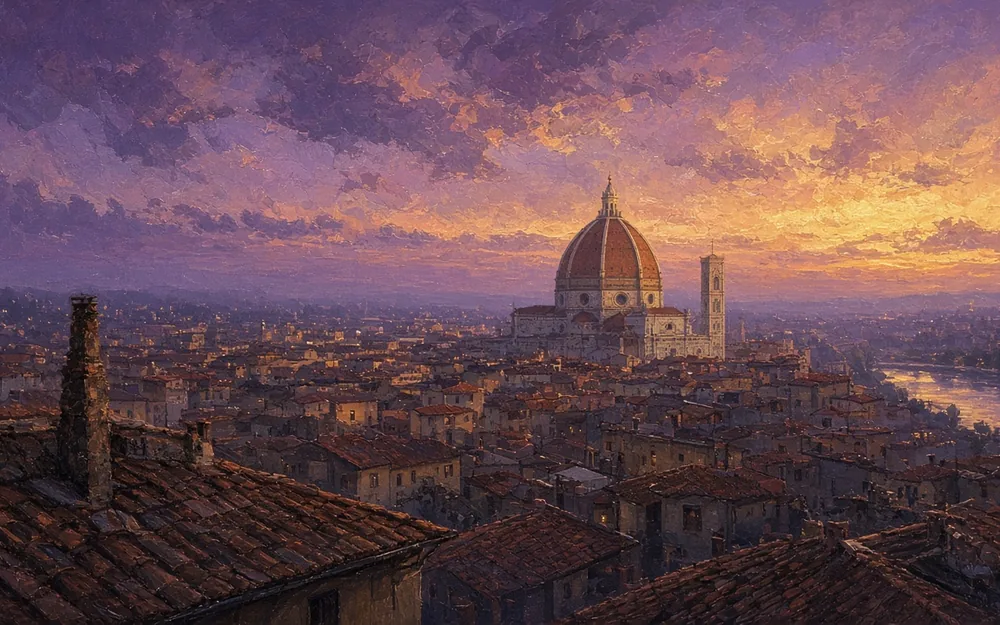
Florence, where the painting was finally recovered in 1913. Image generated by AI.
Protected, travelling and endlessly visited
The painting’s new status changed how it was treated. In 1939, shortly before the Second World War, it was moved out of Paris and kept in a series of châteaux and museums in the French countryside, safely away from looting. After a man threw a rock at it in 1956, damaging a speck of paint near the elbow, it was placed behind bulletproof glass, which has protected it from several later attacks.
In the winter of 1962 to 1963 France lent the painting to the United States. It crossed the Atlantic on the ocean liner SS France and was shown in Washington, D.C., and at the Metropolitan Museum of Art in New York, where an estimated 1.7 million people queued for a brief look. Before the trip it was assessed for insurance at 100 million dollars, though the insurance was never bought; the money went on security instead. In 1974 it travelled to Tokyo and Moscow. Since 2005 it has hung in the Louvre’s Salle des États in a climate-controlled case, and a former Louvre director estimated that about 80 percent of visitors mainly want to see it. In 2024 plans were announced to give it a room of its own, to ease the famous crowds.
Why it matters
The story of the Mona Lisa theft is a reminder that fame in art is not only about quality. Leonardo’s portrait is a remarkable painting, admired for its soft modelling, its dreamy landscape and that elusive smile. But its place as the world’s best-known picture also owes a great deal to timing, technology and a lucky crime. A missing painting gave newspapers a story, and the story gave the painting an audience of millions. The next time you see that small face behind its glass, or on a mug or a tote bag, it is worth remembering the morning it walked out of the Louvre under a workman’s smock.
If you enjoy the stories behind famous paintings, read about what science found under the paint of Girl with a Pearl Earring, or explore the myths and real history of the golden ratio in art.
Frequently asked questions
Who stole the Mona Lisa?
Vincenzo Peruggia, an Italian decorator who had briefly worked at the Louvre as a glazier, stole it on 21 August 1911. He was caught in Florence in December 1913.
How long was the Mona Lisa missing?
A little over two years. It was taken in August 1911, recovered in Florence in December 1913 and returned to the Louvre on 4 January 1914.
Was Picasso involved in the Mona Lisa theft?
No. Picasso was questioned after his friend Guillaume Apollinaire was arrested, but both men were cleared. The thief acted on his own account.
Sources
- Mona Lisa (Wikipedia, history, theft, travels and conservation, with references)
- Vincenzo Peruggia (Wikipedia, the thief’s life, the 1911 theft and his trial, with references)
- Guillaume Apollinaire (Wikipedia, on his 1911 arrest and the earlier statue theft, with references)
- Portrait of Lisa Gherardini, known as the Mona Lisa (Louvre collections database)
- The Mona Lisa (Metropolitan Museum of Art Bulletin, on the 1963 visit to New York)
- Becoming Mona Lisa: The Making of a Global Icon, by Donald Sassoon (Harcourt, 2001)










0 Comments