

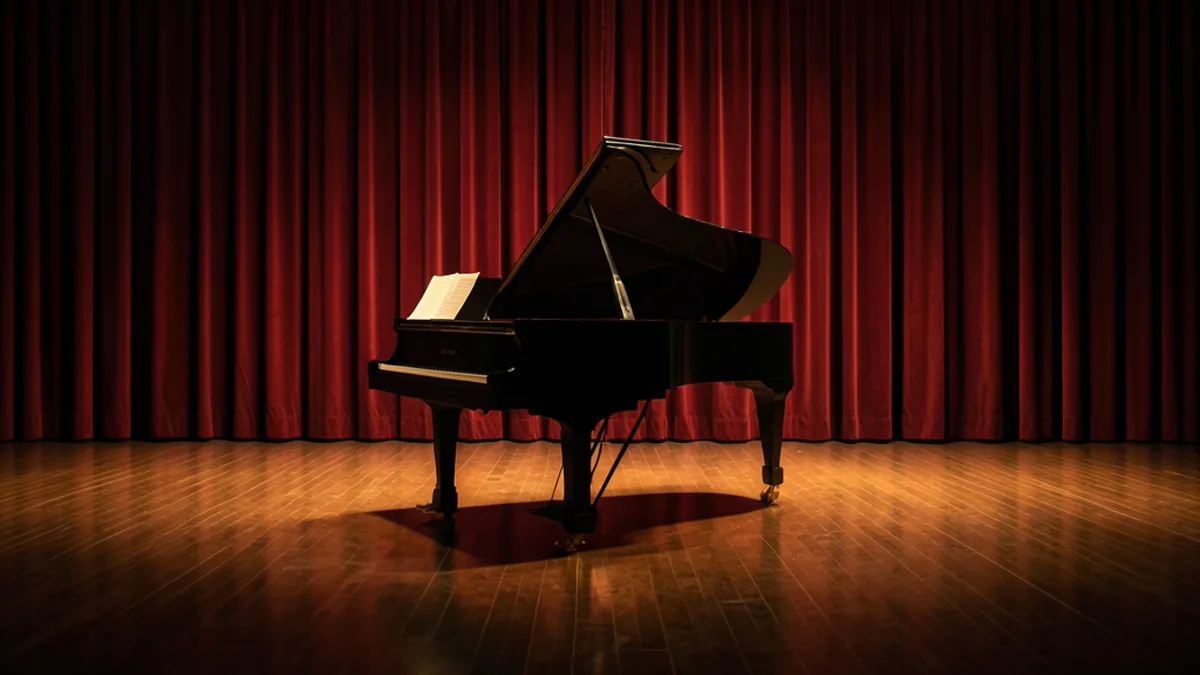
A TeaLamp reading list. Prepared by the TeaLamp Editorial Team with the help of AI.
These five books about music cover the subject from every side: what music does to the brain, how a whole century of classical music unfolded, what it feels like to love records too much, and what happens when a grown man walks into a small piano workshop in Paris and rediscovers a childhood passion. There is science here, history, a novel and a memoir, all written for ordinary readers, not specialists. Put the kettle on and pick the one that calls to you first.
Key takeaways on books about music
- Music reaches more of the brain than almost anything else we do, and two of these books explain why, through real people and plain science.
- Alex Ross tells the story of twentieth-century classical music as a human drama, from a scandalous opera premiere in 1905 to the minimalists of New York.
- Nick Hornby’s record-shop novel and Thad Carhart’s Paris memoir show music as a part of everyday life: lists, breakups, repairs and second chances.
- None of them asks you to read music or know theory. Curiosity is all you need to bring.
- Read them in any order. Start with the brain, the history or the stories, whichever sounds best with tea.
Musicophilia: Tales of Music and the Brain, by Oliver Sacks (2007)
Oliver Sacks was a neurologist who wrote about his patients the way a good storyteller writes about friends, and Musicophilia is his book about what music does inside the head. It is made of short case stories, each one about a real person whose brain and whose music collided in an unusual way. The opening story tells of a man who was struck by lightning and woke up with a sudden, urgent talent for composing music. Other stories follow people who cannot tell one tune from another, and people whose memory for songs survives long after other memories have faded.
The most moving passages are about music as medicine. Sacks describes people with Parkinson’s disease who can barely walk across a room until a steady beat helps their feet find a rhythm, and people with dementia who light up when an old song returns words they thought were gone. He never claims that music cures anything. He simply shows, case by case, how deeply music is wired into us. The book was published by Knopf in 2007 and was named one of the best books of that year by the Washington Post.
Read this one first if you like true stories about the mind, or if you have ever wondered why a song can bring back a whole summer in a single bar.
This Is Your Brain on Music: The Science of a Human Obsession, by Daniel J. Levitin (2006)
Where Sacks tells stories, Daniel Levitin explains the machinery. Levitin is a neuroscientist at McGill University in Montreal, and his book takes music apart into its working pieces: pitch, rhythm, timbre, harmony and the way a melody sets up an expectation and then satisfies it or surprises us. He explains why tunes get stuck in our heads, and why the music we loved as teenagers stays with us for life.
The science is real, but the book is written for readers with no background in it. Levitin uses songs everyone knows to make his points, and he is honest about what science does not yet know. He looks at how the brain predicts what comes next in a song, how emotion and memory share the same circuits, and how musical taste forms. The book was first published by Dutton in 2006, and it has been used as a course text at universities across North America.
Read this one if you like to know how things work. Pair it with Sacks, and you will never hear a favourite song in quite the same way again.
The Rest Is Noise: Listening to the Twentieth Century, by Alex Ross (2007)
Alex Ross is the classical music critic of the New Yorker, a job he has held since 1996, and The Rest Is Noise is his sweeping history of twentieth-century classical music. It opens with the premiere of Richard Strauss’s opera Salome in Dresden in 1905, a night that shocked its audience, and it travels from Vienna before the First World War through Paris in the twenties, Hitler’s Germany and Stalin’s Russia, to downtown New York in the sixties and the minimalists who followed.
The book works because Ross writes about composers as people living through history, not as names on a concert programme. Schoenberg, Stravinsky, Shostakovich, Sibelius, Britten, Copland and Bernstein appear as characters in a century that kept interrupting their work with war, exile and politics. He describes the music in plain language, so a reader who has never heard a Schoenberg piece can still follow the story. The book was first published by Farrar, Straus and Giroux in 2007, won the National Book Critics Circle Award for criticism, and was a finalist for the Pulitzer Prize.
Read this one if you like history told through art. It is the longest book on this list, but it reads like a good story, and you can dip in and out by chapter.
High Fidelity, by Nick Hornby (1995)
This list needs a novel, and High Fidelity is the funniest book about loving music ever written. Rob Fleming is thirty-five, owns a failing record shop called Championship Vinyl in London, and has just been left by his girlfriend Laura, who has moved in with the man upstairs. Rob copes the only way he knows how: by making top-five lists. Top five breakups, top five songs, top five films. He revisits his old girlfriends one by one, and slowly realises that the problem was never his record collection.
The joke of the book is that Rob understands music perfectly and people hardly at all, and Hornby lets him learn that difference without ever making him cruel or stupid. The record shop regulars, the arguments about song lists, and the London setting all feel true to anyone who has ever loved a band a little too much. The novel was first published by Victor Gollancz in 1995, Hornby’s first novel, and it has sold more than a million copies. It became a film in 2000, a stage musical in 2006 and a television series in 2020.
Read this one if you want to laugh, or if you have ever argued about the order of your favourite songs. It is the lightest book on this list, and the best one for a rainy afternoon with the kettle going.
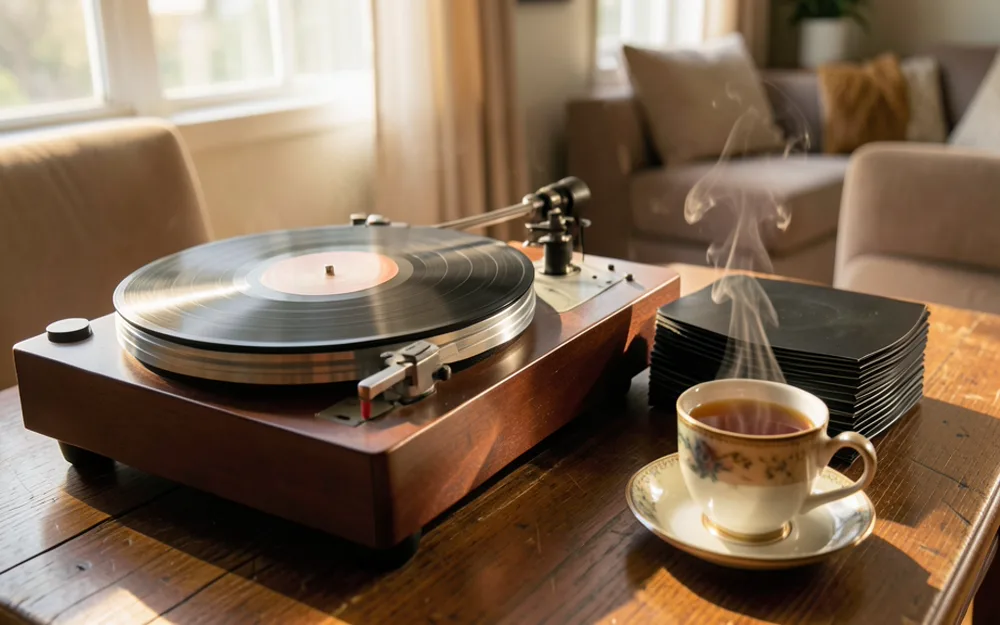
A record playing and tea steaming. Image generated by AI.
The Piano Shop on the Left Bank, by Thad Carhart (2000)
The last book on this list is the quietest, and perhaps the loveliest. Thad Carhart was an American living in Paris with his wife and two small children when he started noticing a little shopfront on his morning walk to school, signed simply Desforges Pianos. One day he went in, and found a workshop full of dismantled pianos and a master restorer named Luc.
The book follows Carhart’s return to the piano he had learned as a child and abandoned, and it weaves in the history of the instrument itself: how pianos are built, why old ones sound the way they do, and why a good restorer treats each piano as an individual. On Friday evenings the workshop filled with local people who came to talk about music and life over a glass of wine, and those evenings give the book its warmth. Carhart’s first book was published by Random House in 2000, became a bestseller, and was longlisted for the Guardian First Book Award.
Read this one if you love Paris, or pianos, or stories about starting again later in life.
Why it matters
Music is one of the few things almost everyone shares, and these five books show how many doors it opens. Two of them explain the brain, one tells a century of history, one makes us laugh at ourselves, and one reminds us that it is never too late to pick up an old passion. Together they show that music is not a luxury or background noise, but a basic part of how we think, feel and remember.
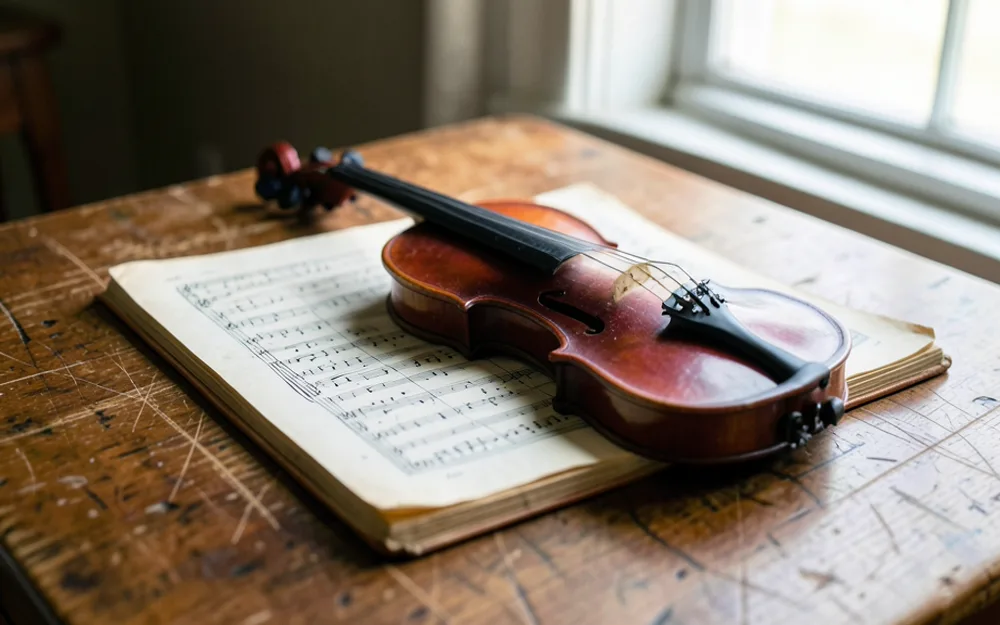
A violin waiting on its music. Image generated by AI.
If you enjoy reading about how songs bring people together, you may also like our article Why Singing Together Feels So Good, which looks at what happens when people make music side by side.
Frequently asked questions
Which book on this list should I start with?
Start with the one that matches your mood. If you love true stories, begin with Sacks. If you want to understand how music works, begin with Levitin. If you want a good story and a laugh, begin with Hornby. There is no wrong order.
Do I need to read music to enjoy these books?
No. None of them asks you to read a score or know music theory. The two science books explain every idea in plain words, and the novel and the memoir are stories first. Curiosity is enough.
Are these books only for classical music fans?
Not at all. Only one book on the list, Ross’s history, is mainly about classical music, and even that one reaches into jazz, film music and rock. Hornby writes about pop and rock, Carhart writes about the piano, and the two science books cover every kind of music.
Sources
- Musicophilia, Wikipedia (Oliver Sacks, Knopf, 16 October 2007; 29 essays on music and the brain)
- This Is Your Brain on Music, Wikipedia (Daniel J. Levitin, Dutton, 2006; McGill University neuroscientist)
- The Rest Is Noise, Wikipedia (Alex Ross, Farrar, Straus and Giroux, October 2007; National Book Critics Circle Award 2007)
- High Fidelity (novel), Wikipedia (Nick Hornby, Victor Gollancz, 16 September 1995; over a million copies sold)
- The Piano Shop on the Left Bank, Thad Carhart (author’s website; first book, 2000, Random House; New York Times bestseller)










0 Comments